
Navigating the intricacies of labor laws can be as complex as planning a luxurious getaway to Disneyland or a serene retreat in a Napa Valley resort. For businesses operating in the Golden State, and for employees seeking fair compensation, understanding when “double time” is mandated is crucial. This premium pay, representing twice an employee’s regular rate of pay, is a cornerstone of California’s commitment to protecting its workforce. It’s not just about logging hours; it’s about ensuring that certain demanding work conditions are appropriately recognized and compensated.
In the realm of travel and tourism, where the industry often operates outside traditional business hours, understanding double time is paramount. Whether you’re managing a bustling hotel in Los Angeles or a charming bed and breakfast near the Golden Gate Bridge, compliance with these wage and hour laws is non-negotiable. This guide will delve into the specific scenarios that trigger double-time pay in California, offering clarity for both employers and employees, and ensuring that your experiences, whether as a traveler or a worker in the hospitality sector, are built on a foundation of fairness and legal compliance.
Understanding the Basics of Overtime in California
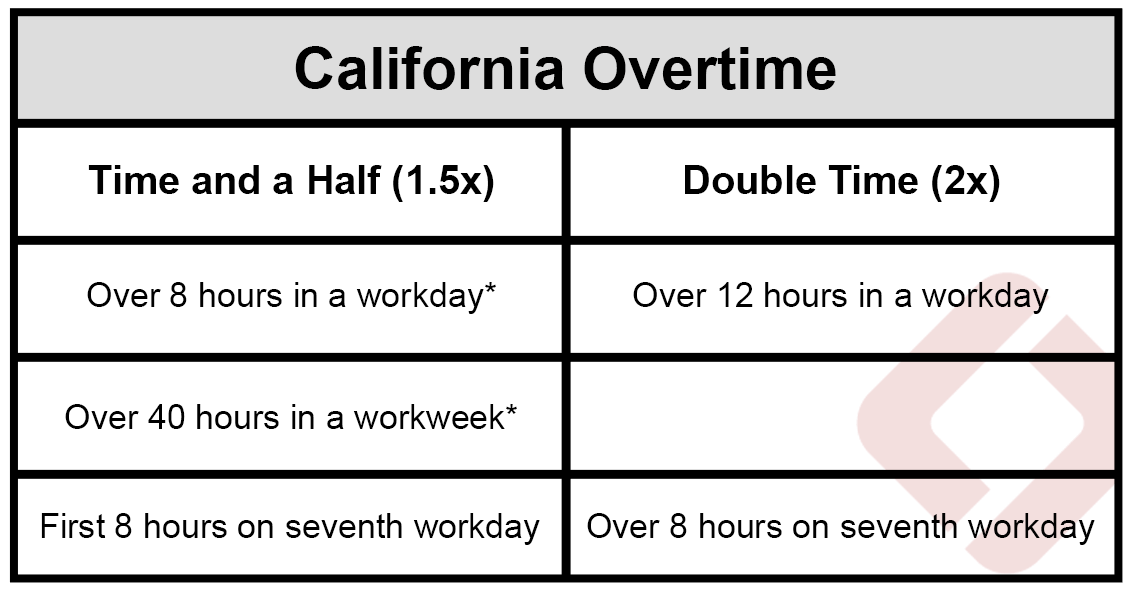
Before we dive into the specifics of double time, it’s essential to grasp the broader framework of overtime in California. The state boasts some of the most progressive labor laws in the United States, and overtime pay is a significant aspect of this. Generally, overtime is triggered when an employee works more than a standard workday or workweek. However, California law distinguishes between two levels of overtime: “time and a half” (1.5 times the regular rate) and “double time” (2 times the regular rate).
Time and a Half Overtime
The most common form of overtime in California is time and a half. This rate applies when an employee works:
- More than eight hours in a workday: This applies to any single calendar day. If an employee works, for example, 9 hours on a Tuesday, the 9th hour would be paid at time and a half.
- More than 40 hours in a workweek: This applies to the total hours worked within a designated seven-day workweek. If an employee works 45 hours in a week, the 5 hours exceeding 40 would be paid at time and a half.
This distinction is vital for employers to track meticulously. For instance, a hotel manager overseeing operations at a resort in Palm Springs must ensure that all hours beyond eight in a day, or 40 in a week, are compensated at the elevated rate. Similarly, travel agents who might be on call to assist clients with unexpected issues while they are in destinations like Paris or Rome need to be mindful of how these extra hours are accounted for.
The Critical Thresholds for Double Time
While time and a half is the standard for exceeding daily or weekly hour limits, California law introduces a higher premium for particularly arduous work schedules. Double time is reserved for specific circumstances that are deemed to require greater compensation due to the extended nature of the work. Understanding these triggers is key to compliant payroll practices, particularly in industries with flexible or demanding operational hours.
Double Time in the Workday
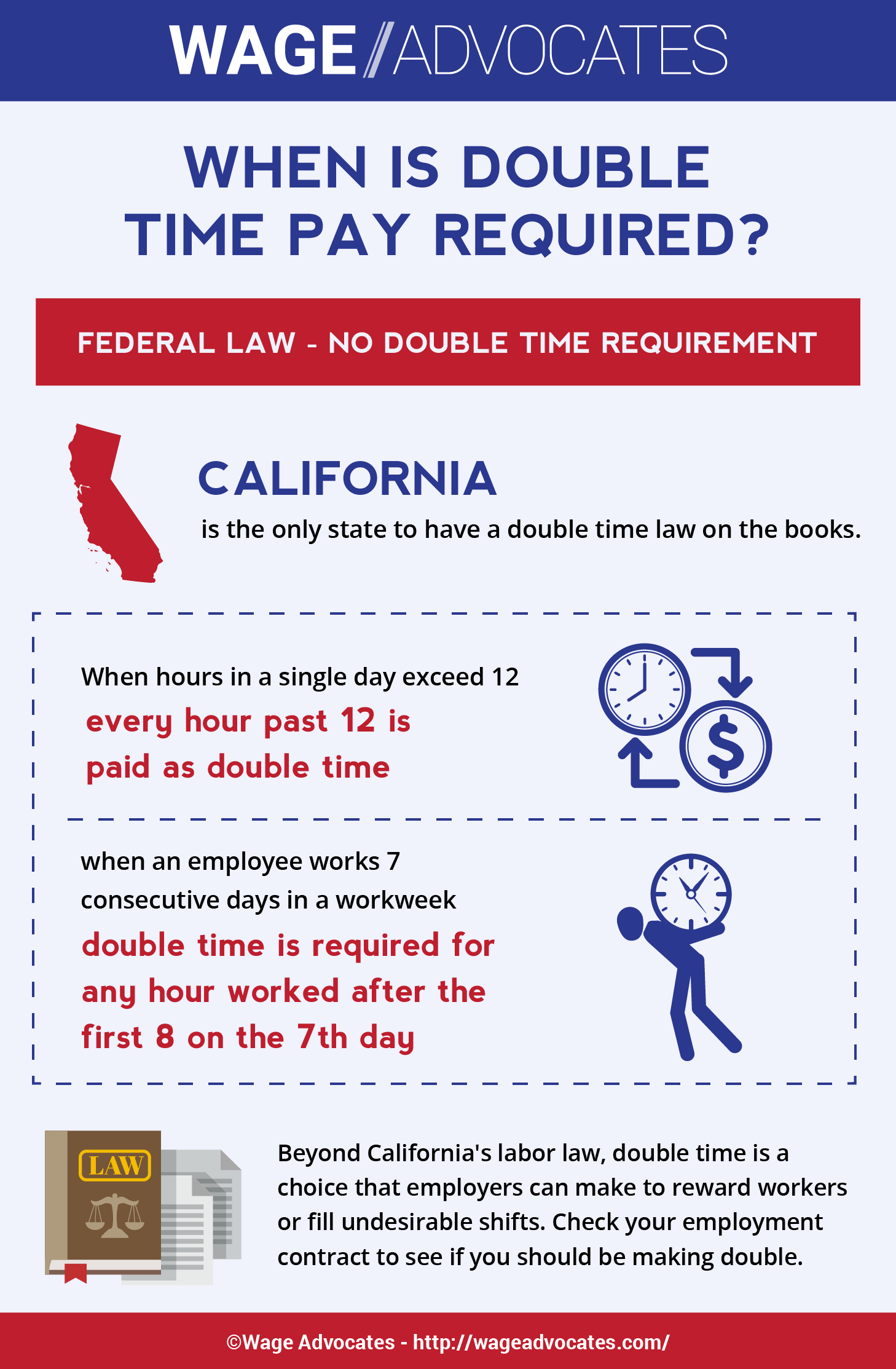
The primary scenario for earning double time within a workday is when an employee works:

- More than 12 hours in a workday: This means any hour worked beyond the 12th hour in a single calendar day must be paid at double the employee’s regular rate of pay. For example, if an employee works 13 hours on a given day, the first 8 hours are at the regular rate, hours 9 through 12 are at time and a half, and the 13th hour is at double time.
This provision is particularly relevant for workers in event planning, emergency response within the tourism sector, or those involved in critical infrastructure support for major travel hubs like Los Angeles International Airport. Imagine a scenario where a major event is happening at a convention center in San Diego, and staff are working extended shifts to ensure everything runs smoothly. Those hours exceeding 12 in a day would trigger double-time pay.
Double Time in the Workweek
In addition to the daily trigger, double time can also be earned based on the total hours worked within a workweek. This occurs when an employee works:
- More than eight consecutive days in a workweek: This is a less commonly understood but significant provision. If an employee works eight days in a row without a full day off (meaning they work on the 8th day of their workweek), the hours worked on that eighth consecutive day are paid at double time. This is often referred to as the “seventh consecutive day” rule, but it specifically applies to the eighth consecutive day worked. It is crucial to differentiate this from exceeding 40 hours in a week. Even if an employee hasn’t reached 40 hours in that week, if they’ve worked eight days consecutively, the hours on the eighth day are compensated at the double-time rate.
This rule has implications for industries that may require continuous operation, such as airlines with international flights that can span across days, or hotels offering long-term stays where staff might be scheduled for extended periods. For example, a tour guide leading an extended expedition through a national park like Yosemite for over a week without a day off would see their pay for the eighth consecutive day significantly increased.
Key Considerations and Nuances
It’s important to note that these overtime rules can interact and accumulate. For instance, if an employee works 14 hours in a day, they would receive 8 hours at their regular rate, 4 hours at time and a half, and 2 hours at double time for that day. Similarly, if an employee works 10 hours a day for 7 consecutive days, they would have earned time and a half for hours 9-10 each day (40 hours total for the week, so 7 days * 2 OT hours/day = 14 OT hours) and then double time for all hours worked on the 7th day, as it’s the 7th consecutive day worked. If they continue to work on the 8th consecutive day, all hours worked on that 8th day would be paid at double time, regardless of the total weekly hours.
The definition of a “workday” in California is a consecutive 24-hour period, and a “workweek” is a regularly recurring period of 168 hours, i.e., seven consecutive 24-hour periods. Employers must clearly define their workweek for payroll purposes. This might be a Sunday through Saturday cycle, or any other fixed and regularly recurring period.
Industry-Specific Exemptions and Rules
While the general rules for double time are clear, there are some industry-specific nuances and potential exemptions. For example, certain executive, administrative, and professional employees may be exempt from overtime requirements if they meet specific salary and duty tests. However, for most hourly employees in the hospitality, tourism, and travel sectors, these rules apply directly.
It’s also worth mentioning that the interpretation and enforcement of these laws are overseen by the California Labor Commissioner’s Office. Employers are expected to maintain accurate records of all hours worked and pay earned, and employees have the right to question their pay and seek clarification.
When planning your next luxurious vacation to a resort like the Ritz-Carlton Laguna Niguel or a family trip to Legoland California, the peace of mind that comes from knowing businesses are operating legally and ethically can enhance your experience. Understanding when double time is paid in California is not just a matter of compliance; it’s about upholding fair labor practices that contribute to a robust and equitable economy, supporting the very industries that provide us with memorable travel experiences.
In summary, double time in California is a critical protection for workers, primarily triggered by working more than 12 hours in a single workday or by working eight consecutive days without a full day off. For employers, meticulous record-keeping and adherence to these laws are essential to avoid penalties and foster a positive work environment. For employees, awareness of these rights ensures they receive fair compensation for their demanding work. This understanding is vital across all sectors, from the bustling streets of San Francisco to the quiet vineyards of Sonoma, ensuring that the labor behind our travel dreams is justly rewarded.