
The question of “who started” the Boston Massacre on March 5, 1770, is more than a simple historical inquiry; it’s an exploration into the complex tapestry of colonial grievances, military occupation, and the dramatic events that propelled American colonies toward revolution. This pivotal incident, often depicted as an unprovoked slaughter of innocent colonists by ruthless British soldiers, was in reality a chaotic street brawl, fuelled by years of simmering tension and miscommunication, where the lines between victim and aggressor were blurred by fear, anger, and political ambition. For travelers exploring the historical landmarks of Boston today, understanding the nuances of this event offers a profound insight into the very origins of the United States and the enduring power of historical narrative.
The Boston Massacre serves as a powerful reminder of how a single event, often embellished by propaganda and viewed through the lens of individual experience, can become a defining moment in a nation’s history. It’s a compelling piece of American history that continues to spark debate, inviting us to delve deeper into the circumstances, the characters, and the lasting impact of that cold March evening. By dissecting the political climate, the immediate events, and the subsequent fallout, we can better appreciate not just what happened, but why it happened, and how it shaped the destiny of a fledgling nation.
A City on the Brink: Boston in the Late 1760s
To comprehend the Boston Massacre, one must first understand the volatile environment of Boston in the late 1760s. The city, a bustling port and intellectual hub of New England, was a hotbed of revolutionary sentiment, where the seeds of independence were being sown long before the first shot was fired. Economic grievances, political disenfranchisement, and a palpable sense of injustice permeated daily life, setting the stage for an inevitable clash.
Seeds of Discontent: British Policies and Colonial Resistance
The period following the French and Indian War (1754-1763) saw Great Britain emerge as the dominant power in North America, but also saddled with immense debt. To alleviate this financial burden, the British Parliament began imposing a series of taxes and regulations on its American colonies, sparking outrage among colonists who believed they were being taxed without representation. Acts such as the Sugar Act (1764), the Stamp Act (1765), and the Townshend Acts (1767) were met with fervent resistance.
The Stamp Act, in particular, unified colonial opposition, leading to boycotts and protests orchestrated by groups like the Sons of Liberty. Though the Stamp Act was eventually repealed, the Townshend Acts, which levied duties on imported goods like glass, lead, paints, paper, and tea, continued to fuel colonial resentment. These acts were not merely about revenue; they were seen as an assertion of British Parliament’s right to legislate for the colonies in all cases whatsoever, a concept vehemently rejected by many Americans who championed the principle of “no taxation without representation.”
Boston, with its vibrant merchant class and strong Puritan tradition of self-governance, became a focal point of this resistance. Its citizens were particularly vocal in their opposition, organizing boycotts, publishing pamphlets, and staging public demonstrations. The Massachusetts Bay Colony felt disproportionately targeted, intensifying its anti-British sentiment and solidifying its reputation as a hotbed of radicalism. This environment of defiance and distrust created a fertile ground for conflict, making even minor incidents potentially explosive. For today’s traveler exploring Boston’s historic streets, these political struggles resonate through landmarks like the Old State House and Faneuil Hall, where revolutionary ideas were openly debated and solidified.

The Arrival of Redcoats: A City Under Occupation
The escalating unrest prompted the British government to take drastic measures. In October 1768, regiments of British troops—the feared “Redcoats”—arrived in Boston to enforce imperial laws and maintain order. The presence of these soldiers, numbering around 2,000 in a city of 16,000, was a constant source of friction. Soldiers were quartered in public buildings and, controversially, in private homes, straining resources and infringing upon what colonists considered their fundamental rights.
The daily interactions between soldiers and civilians were fraught with tension. Colonists viewed the soldiers as an occupying force, symbols of British tyranny, while the soldiers, often poorly paid and disciplined, resented the hostile reception they received. There were frequent skirmishes, brawls, and verbal insults exchanged in the streets, taverns, and marketplaces. Competition for jobs was another significant issue; off-duty soldiers often sought employment as laborers, undercutting wages for local workers and further exacerbating economic hardship and animosity.
The soldiers’ presence was particularly prominent around the Customs House and the Old State House on King Street (now State Street), where the very apparatus of British rule was concentrated. This highly visible military presence, combined with the underlying political and economic grievances, created a powder keg. The stage was meticulously set for an incident, small or large, to ignite the simmering tensions into an open conflagration. The question was not if something would happen, but when and how catastrophic it would be.

The Fateful Evening of March 5, 1770
The night of March 5, 1770, was cold and moonlit, an otherwise ordinary evening that would quickly spiral into an event of monumental historical significance. What began as a minor altercation quickly escalated into a deadly confrontation, leaving several colonists dead and forever altering the relationship between Britain and its American colonies.
Escalation on King Street: From Taunts to Tragedy
The incident began innocently enough near the Customs House on King Street. A young British sentry, Private Hugh White, was standing guard when a group of rowdy colonists, some of them laborers and sailors returning from various establishments, began to taunt him. The exact spark is debated, but it likely involved a dispute over an unpaid wigmaker’s bill, a common grievance among off-duty soldiers. The taunts quickly turned to insults, then to snowball and ice throwing, and eventually to more dangerous projectiles like oyster shells and chunks of ice.
As the crowd grew larger and more aggressive, Private White found himself surrounded and vulnerable. He called for reinforcements, and in response, Captain Thomas Preston arrived with a detachment of seven more soldiers from the 29th Regiment. They formed a defensive semicircle in front of the Customs House, bayonets fixed, facing an increasingly agitated mob that numbered several hundred. The air was thick with shouts of “Fire!”, “Kill them!”, and “Lobsters!”, a derogatory term for the British soldiers due to their red coats. Bells began to ring, a customary signal for fire, further drawing more citizens into the chaotic scene from Dock Square and beyond.
Amidst the cacophony and confusion, a soldier was struck by a projectile and fell. Whether this was an accidental discharge or a panicked reaction, shots rang out. Within moments, the soldiers fired into the crowd. The smoke cleared to reveal chaos and horror. Eleven colonists were hit, five of whom died either on the spot or shortly thereafter. The first to fall was Crispus Attucks, a mariner of African and Native American descent, who would later be immortalized as the first casualty of the American Revolution. The firing ceased, but the street was strewn with bodies, and the question of who fired first, and under what orders, immediately became the focus of intense scrutiny and political maneuvering. The tragedy on King Street marked a point of no return.
The Victims: A Catalyst for Revolution
The five men who lost their lives that night instantly became martyrs for the colonial cause.
- Crispus Attucks: A sailor, often identified as a runaway slave, of African and Wampanoag descent. His death made him a symbol of both colonial oppression and racial injustice, inspiring future generations.
- Patrick Carr: An Irish immigrant and leather breeches maker, who died nine days after the incident. His dying testimony, given to a doctor, indicated that the soldiers fired in self-defense, a crucial detail later used in the trial.
- James Caldwell: A young sailor.
- Samuel Gray: A rope maker, believed to have been involved in previous skirmishes with soldiers.
- Samuel Maverick: A 17-year-old apprentice ivory turner, who died the following morning.
The immediate reaction was one of shock and outrage. The bodies were paraded through the streets of Boston in a powerful display of grievance, culminating in a mass funeral that drew thousands. Samuel Adams, a master propagandist and leader of the Sons of Liberty, quickly seized upon the event, labeling it a “massacre” and portraying the soldiers as bloodthirsty murderers. The incident became a rallying cry, illustrating the stark brutality of British military presence and galvanizing opposition across the colonies. The deaths transformed the abstract concept of “taxation without representation” into a tangible, bloody sacrifice, imbuing the struggle for liberty with a powerful emotional charge. Today, visitors can reflect on their sacrifice at the Granary Burying Ground, where many of these figures are interred.
The Aftermath and Enduring Legacy
The immediate fallout of the Boston Massacre was profound, forcing the removal of British troops from Boston and setting in motion a series of events that would irrevocably alter the course of American history. Its legacy, however, extends far beyond the streets of 1770 Boston, shaping national identity and providing a cornerstone for understanding the American Revolution.
The Trials and Their Impact: Justice and Propaganda
In the immediate aftermath of the shooting, Captain Thomas Preston and eight of his soldiers were arrested and charged with murder. The trial, held in Boston in the fall of 1770, was a highly anticipated and politically charged event. Remarkably, two prominent colonial lawyers, John Adams and Josiah Quincy II, agreed to defend the soldiers. Adams, a staunch patriot, believed strongly in the rule of law and the right to a fair trial, even for his political adversaries. He famously argued that “Facts are stubborn things; and whatever may be our wishes, our inclinations, or the dictates of our passions, they cannot alter the state of facts and evidence.”
The trials lasted several weeks. Captain Preston was tried separately and acquitted, as the prosecution could not prove he gave an explicit order to fire. Six of the soldiers were also acquitted, while two, Hugh Montgomery and Matthew Kilroy, were found guilty of manslaughter. They successfully pleaded “benefit of clergy,” a legal maneuver that reduced their punishment from hanging to being branded on the thumb with an “M” for murder.
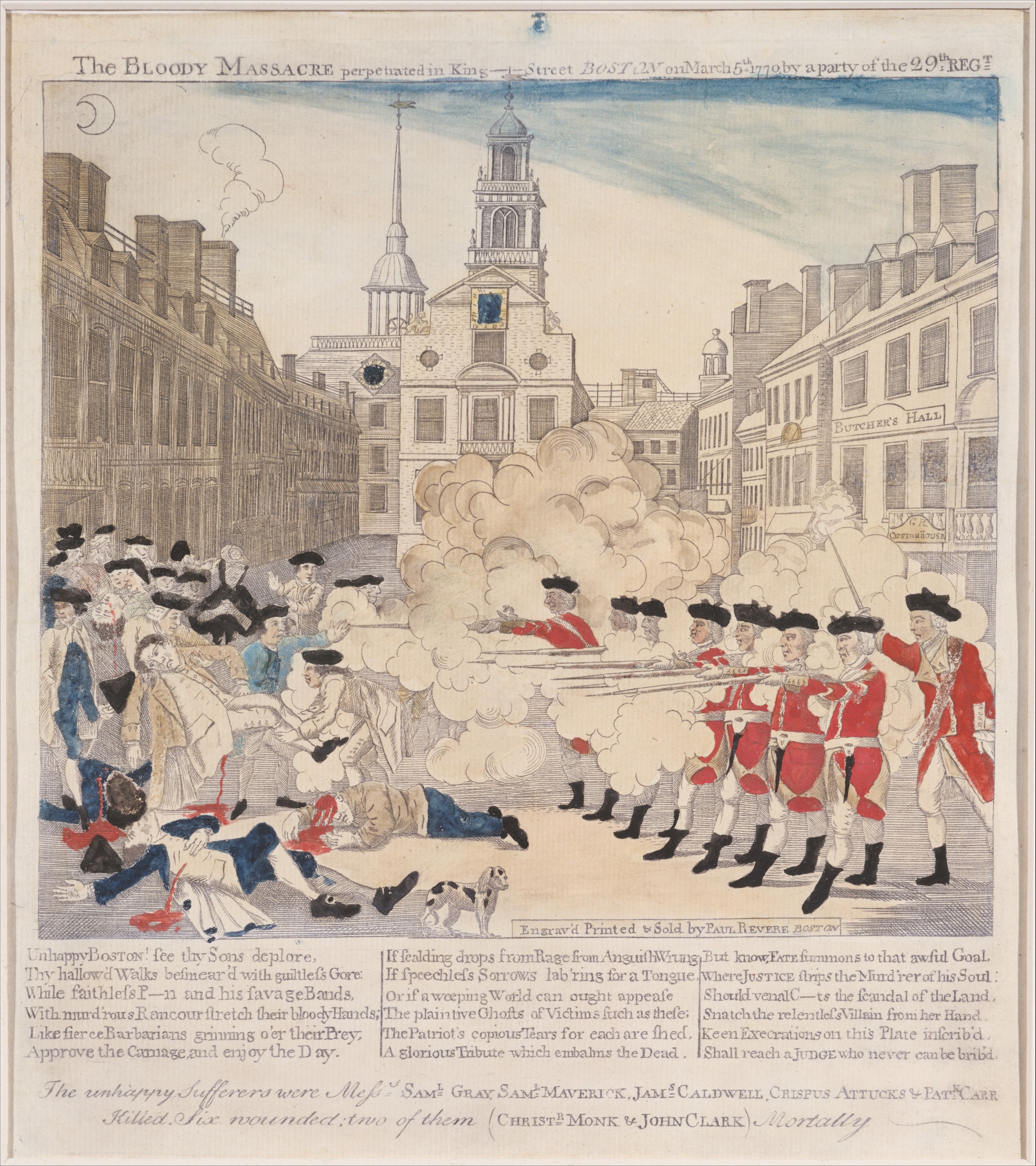
While the legal outcome demonstrated a surprising degree of fairness under immense public pressure, the narrative of the “massacre” had already taken root. Paul Revere’s famous engraving, “The Bloody Massacre in King-Street Boston on March 5th 1770 by a party of the 29th Regt.”, published just weeks after the event, was a powerful piece of propaganda. It depicted the British soldiers as cold-blooded murderers, firing on an innocent and unarmed crowd, with a smiling Captain Preston giving the command. This image, widely circulated throughout the colonies, fanned the flames of anti-British sentiment and became an iconic symbol of colonial oppression. The trials, while upholding legal principles, could not counteract the powerful emotional and political impact of this visual narrative.
The Boston Massacre’s Place in American History
The Boston Massacre stands as a critical turning point on the road to the American Revolution. It transformed abstract political disagreements into a visceral struggle for life and liberty. While tensions momentarily eased after the removal of troops and the repeal of most of the Townshend Acts (save for the tax on tea), the memory of the “massacre” lingered, a constant reminder of the potential for British brutality. It solidified the resolve of patriots like Samuel Adams and John Hancock and rallied public opinion against British rule.
The event is enshrined in American history as a symbol of colonial resistance and the injustice perpetrated by the British Empire. It served as a potent piece of rhetoric in the years leading up to the Continental Congress and the eventual Declaration of Independence. The very site of the massacre, marked by a cobblestone circle in front of the Old State House, is now a powerful landmark on Boston’s renowned Freedom Trail, drawing countless visitors eager to connect with this pivotal moment.
For those undertaking travel to Boston, tracing the steps of history offers an immersive experience that transcends textbooks. The historical accuracy of the Boston Massacre has been rigorously debated by historians, revealing the complexities of eyewitness accounts, judicial proceedings, and political spin. Yet, its enduring power lies not just in the factual recounting, but in its role as a narrative touchstone—a story that speaks to the struggle for freedom, the dangers of military occupation, and the power of individuals to shape destiny.
In conclusion, the question of “who started” the Boston Massacre doesn’t have a simple answer. It was a tragic confluence of circumstances, built upon years of escalating tensions between an imperial power and its restive colonies. While the immediate catalyst was a mob confronting a small group of soldiers, the deeper instigators were the policies that led to military occupation, the fierce colonial resistance, and the atmosphere of mutual fear and hostility. What began as a street brawl transformed into a symbol of colonial martyrdom, a critical step on the path to the American Revolution.
Visiting Boston today provides an unparalleled opportunity for tourism and cultural immersion, allowing one to walk through these historical landmarks and reflect on the intricate layers of history. The Freedom Trail guides you past the Old State House, where the Boston Massacre site is marked, inviting a moment of contemplation. From the Bunker Hill Monument to the USS Constitution, and through the vibrant neighborhoods of the Commonwealth of Massachusetts, Boston offers a rich tapestry of history, providing a tangible connection to the events that forged a nation. Understanding the Boston Massacre is not just about historical facts; it’s about appreciating the power of narrative, the pursuit of justice, and the enduring human quest for liberty, making it an essential part of any travel itinerary focused on American history and local culture.
LifeOutOfTheBox is a participant in the Amazon Services LLC Associates Program, an affiliate advertising program designed to provide a means for sites to earn advertising fees by advertising and linking to Amazon.com. Amazon, the Amazon logo, AmazonSupply, and the AmazonSupply logo are trademarks of Amazon.com, Inc. or its affiliates. As an Amazon Associate we earn affiliate commissions from qualifying purchases.