
The annexation of Hawaii by the United States in 1898 remains a pivotal and often debated moment in American history and the narrative of the Hawaiian Islands. This act, which transformed a sovereign kingdom into a U.S. territory, was not a sudden or spontaneous event but rather the culmination of decades of evolving geopolitical interests, economic pressures, and internal political shifts. Understanding the motivations behind this annexation requires delving into the complex interplay of American expansionism, the strategic importance of the islands, and the significant influence of American businessmen and missionaries who had established a strong presence in Hawaii.
The Erosion of Hawaiian Sovereignty and the Rise of American Influence
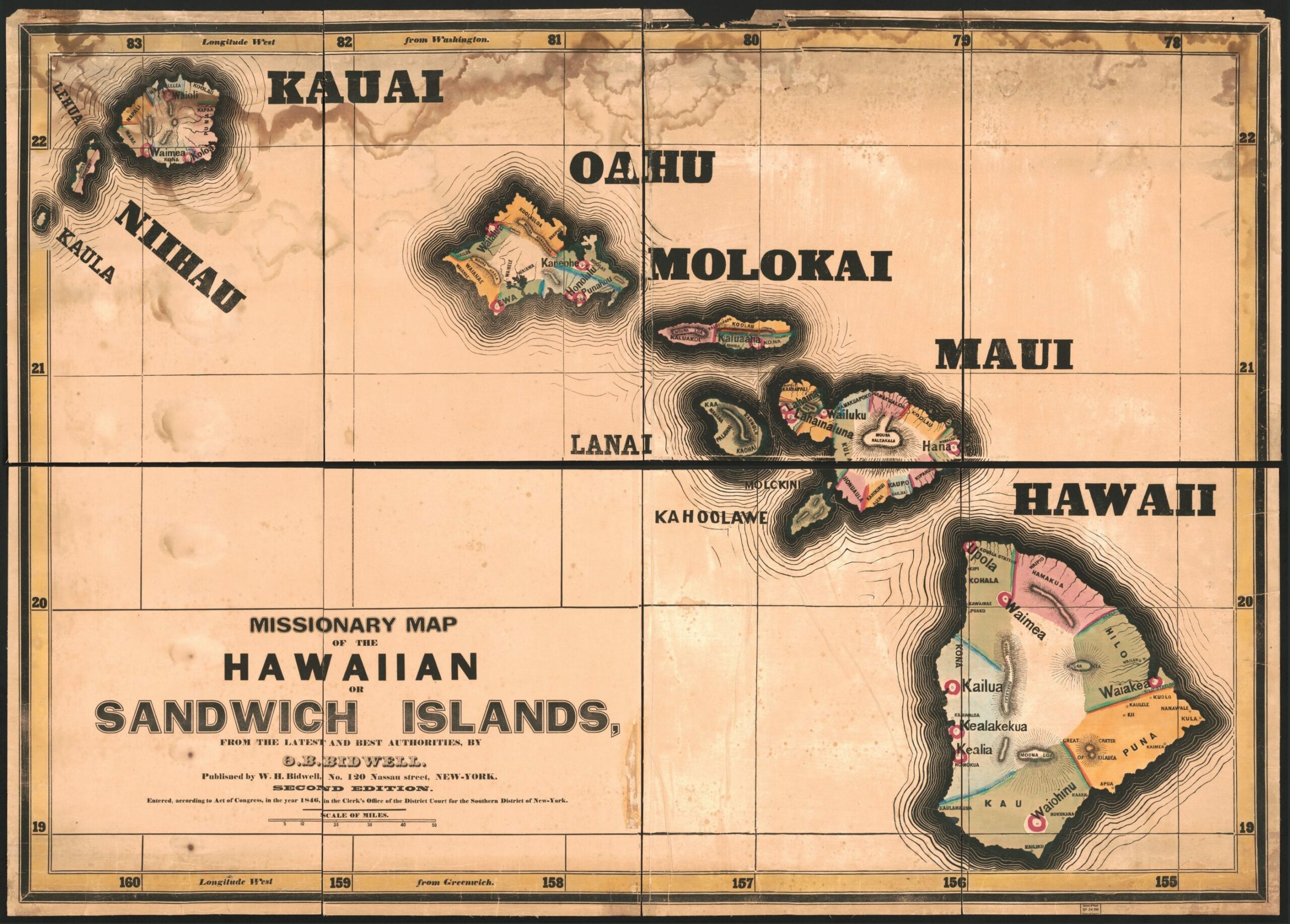
From the early 19th century, American missionaries began arriving in Hawaii, ostensibly to spread Christianity. However, their presence gradually extended to economic and political spheres. They introduced Western concepts of land ownership, which dramatically altered traditional Hawaiian communal practices and led to the redistribution of vast tracts of land. This land ownership became concentrated in the hands of a few, many of whom were of foreign descent.
The Sugar Industry and Economic Leverage
The burgeoning sugar industry became the primary economic driver in Hawaii by the mid-1800s. American businessmen, many of whom were descendants of the missionaries, heavily invested in sugar plantations. The Reciprocity Treaty of 1875 between the United States and the Kingdom of Hawaii was a crucial development. This treaty allowed Hawaiian sugar to enter the United States duty-free, providing a significant boost to the Hawaiian economy and further entrenching American economic interests. In return, Hawaii granted the United States exclusive rights to use Pearl Harbor as a coaling station and naval base. This provision, initially a concession, would later prove instrumental in the strategic arguments for annexation.
The economic dependence on the U.S. market made the Hawaiian economy vulnerable to American policy decisions. When the McKinley Tariff of 1890 removed the duty-free status of Hawaiian sugar, it dealt a severe blow to the industry, intensifying calls among American businessmen for annexation to secure their investments permanently within the U.S. tariff system. This economic imperative formed a powerful lobby pushing for political union.
The Bayonet Constitution and Political Disenfranchisement
The growing influence of American businessmen was further solidified by the 1887 constitution, often referred to as the “Bayonet Constitution.” Imposed on King Kalākaua under duress, it significantly curtailed the monarch’s powers and disenfranchised a large portion of the native Hawaiian population. Voting rights were restricted to wealthy property owners, effectively consolidating political power in the hands of the primarily American and European elite who controlled the economy. This constitutional shift marked a critical step in undermining Hawaiian self-governance and paving the way for foreign control.
The Overthrow of Queen Liliʻuokalani and the Establishment of the Republic
The culmination of these pressures led to the pivotal event of 1893: the overthrow of Queen Liliʻuokalani, the last reigning monarch of the Kingdom of Hawaii. The Queen had sought to restore power to the monarchy and re-establish a constitution that would grant voting rights back to native Hawaiians, thereby challenging the dominance of the American-backed oligarchy.
The Role of American Business Interests and the U.S. Military

A committee of public safety, largely composed of American businessmen and residents, with the support of the U.S. Minister to Hawaii, John L. Stevens, and a contingent of U.S. Marines from the USS Boston, orchestrated the coup. The presence of U.S. troops was justified as a measure to protect American lives and property, but their involvement was crucial in neutralizing any potential resistance to the overthrow. The Queen, to avoid bloodshed, yielded her authority under protest, appealing to the justice of the United States for a fair resolution.
The Provisional Government and the Republic of Hawaii
Following the overthrow, a Provisional Government was established, led by Sanford B. Dole, a prominent American lawyer and businessman. The Provisional Government immediately sought annexation by the United States. President Grover Cleveland, however, investigated the matter and concluded that the overthrow was an illegal act of force. He withdrew the annexation treaty from the Senate and attempted to restore the Queen, but his efforts were ultimately unsuccessful. The Provisional Government, with the continued backing of American interests, then declared itself the Republic of Hawaii in 1894, with Dole as its president. This move consolidated the control of the republic’s leaders, who were predominantly American, and kept the dream of annexation alive.
Strategic Imperatives and the Justification for Annexation
Beyond economic interests, the annexation of Hawaii was also driven by significant strategic considerations, particularly in the context of burgeoning American imperialism and the looming geopolitical landscape of the Pacific.
The Importance of Hawaii as a Naval Base
The control of Pearl Harbor as a naval station was a long-standing objective for the U.S. Navy. Its strategic location in the mid-Pacific made it an indispensable coaling station and repair facility for American ships traversing the vast ocean. As the United States expanded its influence westward and began to look towards Asia, particularly with growing interests in China, a strong naval presence in the Pacific became increasingly vital for projecting power and protecting trade routes. Annexation would ensure permanent, unfettered access to this crucial military asset.
The Spanish-American War and Manifest Destiny
The outbreak of the Spanish-American War in 1898 provided the immediate impetus for annexation. The war highlighted Hawaii’s strategic value as a way station for American forces heading to the Philippines. Many proponents of annexation framed it as a natural extension of America’s “Manifest Destiny” – the 19th-century doctrine that the United States was destined to expand its dominion and spread democracy across the North American continent, and by extension, into the Pacific. The war created a sense of urgency and provided a patriotic rationale for acquiring the islands, overshadowing the earlier ethical and legal objections. The acquisition of Hawaii was seen by many as crucial for America’s emergence as a global power.
The Annexation Process and its Aftermath
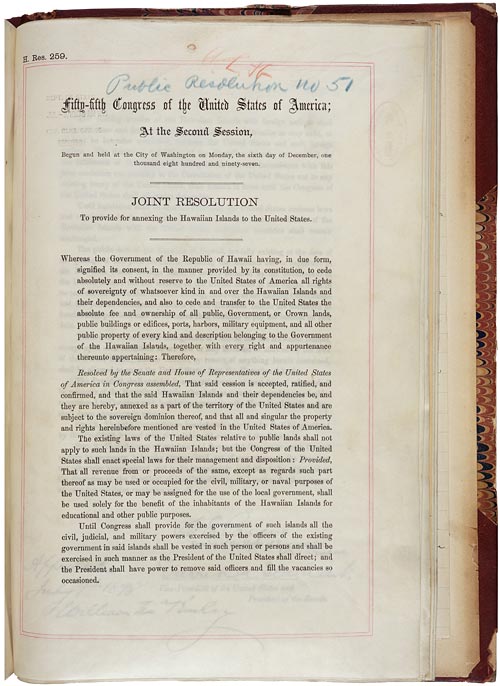
The annexation was ultimately achieved through a joint resolution of Congress, the Newlands Resolution, rather than a treaty. This method was chosen because a treaty required a two-thirds majority in the Senate, which was difficult to secure given the opposition and the lingering controversy over the overthrow. The resolution, however, only required a simple majority in both houses.
The Newlands Resolution and the End of the Republic
The Newlands Resolution was passed on July 7, 1898, formally annexing Hawaii to the United States. The Republic of Hawaii ceased to exist, and the islands became a U.S. territory. While the annexation was celebrated by many Americans and the ruling elite in Hawaii, it was met with deep sorrow and protest from native Hawaiians, who viewed it as an illegal seizure of their homeland. The act marked the beginning of a long and often painful chapter of American rule over Hawaii, with the consequences continuing to be felt and debated to this day. The legacy of this annexation continues to shape discussions about sovereignty, indigenous rights, and the historical injustices committed against the Hawaiian people.
LifeOutOfTheBox is a participant in the Amazon Services LLC Associates Program, an affiliate advertising program designed to provide a means for sites to earn advertising fees by advertising and linking to Amazon.com. Amazon, the Amazon logo, AmazonSupply, and the AmazonSupply logo are trademarks of Amazon.com, Inc. or its affiliates. As an Amazon Associate we earn affiliate commissions from qualifying purchases.