
The Hawaiian Islands, an idyllic paradise renowned for its pristine beaches, volcanic landscapes, and vibrant culture, consistently rank as a top global travel destination. Millions journey here annually, drawn by promises of unforgettable travel experiences, luxurious resort stays, and unique cultural immersion. Yet, beneath the allure of modern tourism lies a complex and often poignant history, marked by the transformative event of its annexation by the United States. Understanding “Why did the U.S. annex Hawaii?” is crucial for appreciating the islands’ unique heritage and the enduring spirit of its people. This historical narrative, spanning from a unified Polynesian kingdom to a strategic American territory, illuminates a pivotal moment in both Hawaiian and American history, enriching any visit to its iconic landmarks and diverse cultural offerings.
A Kingdom’s Vulnerability: Early Encounters and Economic Shift
For centuries, the Hawaiian Islands flourished as an independent nation, guided by a rich indigenous culture. However, the arrival of foreign powers in the late 18th century set in motion a series of events that would ultimately lead to the kingdom’s demise and annexation.
From Polynesian Sovereignty to Western Influence
The ancient history of Hawaii is one of remarkable Polynesian exploration and sophisticated societal development. Long before European contact, intrepid navigators established a thriving civilization, characterized by a deep connection to the ‘āina (land) and a complex system of governance. This period of relative isolation ended dramatically with the arrival of Captain James Cook in 1778. While his initial encounters brought new goods and ideas, they also introduced diseases that devastated the native population.
Despite these challenges, a powerful leader, Kamehameha I, emerged, successfully uniting the warring island chiefdoms to establish the Kingdom of Hawaii by 1810. Under his and subsequent monarchs’ rule, Hawaii developed diplomatic relations with major world powers, adopted a written language, and crafted its own constitution, becoming a recognized sovereign nation. The grandeur of the Hawaiian monarchy is perhaps best symbolized by Iolani Palace in Honolulu, the only official state residence of royalty in the United States, standing as a poignant reminder of this independent era.
The Sugar Industry and Growing American Power
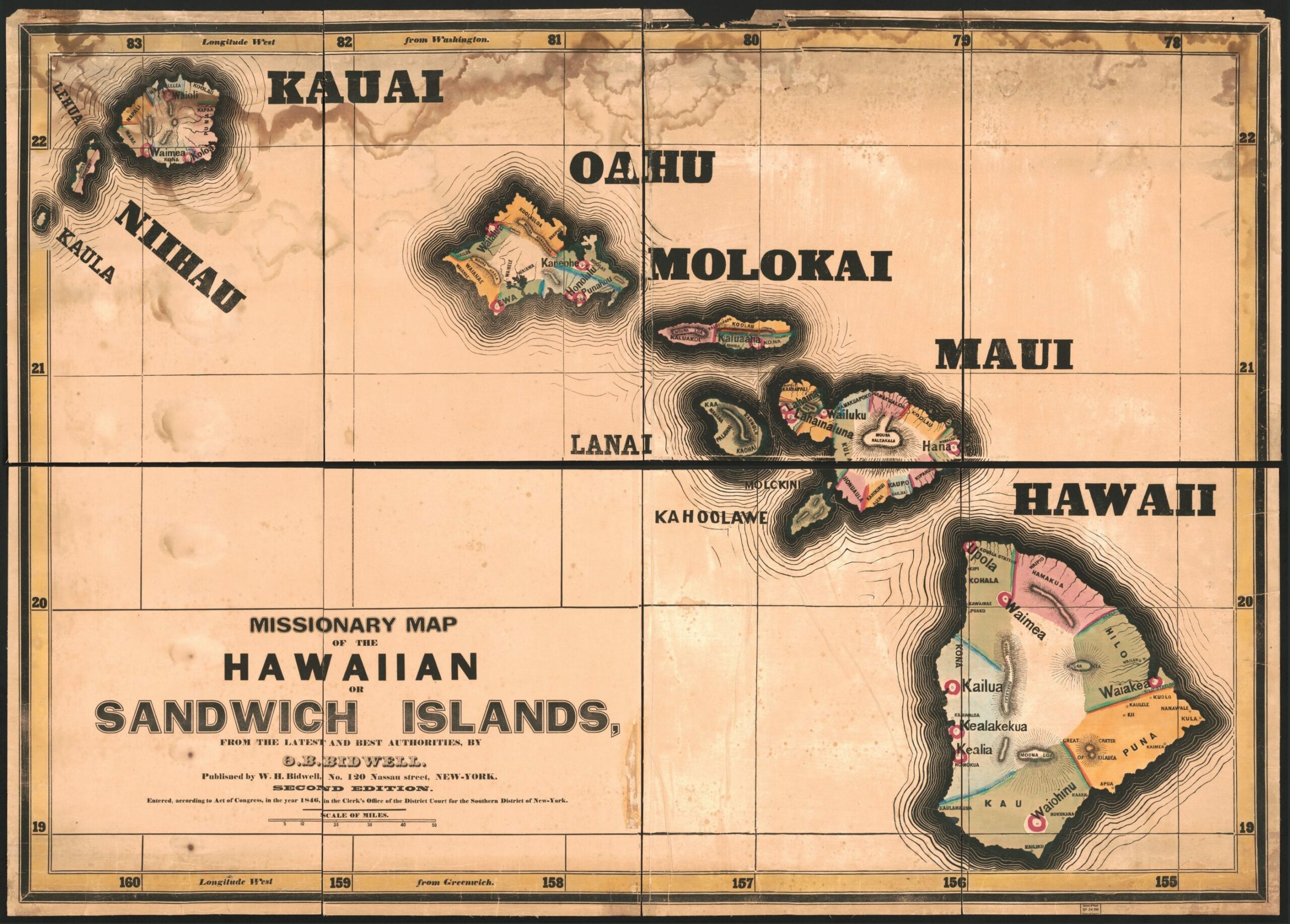
As the 19th century progressed, Hawaii’s strategic location in the Pacific Ocean attracted an influx of American missionaries, traders, and whalers. While missionaries introduced Western education and religious practices, American entrepreneurs soon discovered the islands’ immense agricultural potential. The fertile volcanic soil and tropical climate proved ideal for cultivating sugarcane, leading to the rapid growth of the sugar industry.
American businessmen, many descended from early missionaries, acquired vast tracts of land and established large-scale plantations, transforming sugar into Hawaii’s primary export. The reciprocity treaty of 1875 further bolstered this industry by allowing Hawaiian sugar to enter the United States duty-free, creating immense profits for American planters and fostering economic dependency on the U.S. This economic leverage soon translated into significant political influence, as these powerful foreign residents increasingly sought to protect and expand their commercial interests, often at the expense of native Hawaiian land rights and political autonomy. The stage was thus set for a power struggle between the indigenous monarchy and a growing, influential foreign elite.
The Path to Overthrow: Undermining Royal Authority
The escalating tension between the Hawaiian monarchy and the foreign business elite reached a critical point in the late 1880s and early 1890s, leading to the dramatic overthrow of the kingdom.
The Bayonet Constitution of 1887
The turning point in the erosion of Hawaiian sovereignty was the infamous “Bayonet Constitution” of 1887. By this time, a powerful group of American and European businessmen, known as the Hawaiian League, had solidified their political and economic dominance. Displeased with King Kalākaua’s efforts to assert royal authority and perceived resistance to their agenda, they orchestrated a coup. Backed by armed militias, they forced the King, under duress, to sign a new constitution.
This document drastically curtailed the monarch’s executive power, effectively transferring authority to the legislature, which was controlled by the foreign-born elite. Crucially, it disenfranchised most Native Hawaiians and Asian immigrants by imposing strict property and income requirements for voting rights, while granting suffrage to non-citizen Caucasians. The Bayonet Constitution stripped the Hawaiian people of their voice and fundamentally altered the nature of their government, consolidating power in the hands of those who actively sought closer ties, or even annexation, with the United States. It was a clear demonstration of how economic power could be wielded to dismantle a sovereign nation’s political structure.
Queen Liliʻuokalani and the 1893 Coup
Upon King Kalākaua’s death in 1891, his sister, Queen Liliʻuokalani, ascended to the throne. A devout patriot, she was committed to restoring the constitutional rights of her people and strengthening the monarchy. Her primary goal was to promulgate a new constitution that would revoke the unjust Bayonet Constitution and reinstate native Hawaiian voting rights and royal authority.
However, her efforts were met with fierce opposition from the Committee of Safety, a group of powerful American and European residents, many of whom were sugar planters. Fearing the loss of their privileged status and economic interests, and openly advocating for annexation by the United States to secure duty-free sugar exports, they launched a coup d’état on January 17, 1893. With the active encouragement of John L. Stevens, the U.S. Minister to Hawaii, and the intimidating presence of U.S. Marines from the USS Boston, the monarchy was overthrown. To prevent bloodshed, Queen Liliʻuokalani peacefully surrendered her authority, appealing to the United States government for justice. This illegal act remains a deeply painful memory for Native Hawaiians, marking the end of their independent kingdom.
The Strategic Imperative: American Expansionism
While local economic interests initiated the overthrow, the broader American desire for expansion and strategic dominance ultimately secured Hawaii’s annexation.
Economic & Geopolitical Rationale
For the American sugar planters in Hawaii, annexation represented the ultimate economic boon: the permanent elimination of tariffs on sugar exports to the United States, particularly after the detrimental McKinley Tariff of 1890. This would ensure unparalleled profitability and integrate their operations directly into the American market. Beyond sugar, the annexation aligned perfectly with the United States’ burgeoning imperial ambitions and its desire to expand commercial influence across the Pacific Ocean. Hawaii, centrally located, was seen as an indispensable stepping stone for trade with lucrative Asian markets like China and Japan.
Even more compelling was Hawaii’s immense strategic military value. In an era of global competition for power and colonies, control over vital coaling stations and naval bases was paramount. The magnificent natural deep-water harbor of Pearl Harbor on the island of Oʻahu was coveted as an ideal naval base. It offered the U.S. fleet a critical outpost to protect its West Coast, safeguard trans-Pacific trade routes, and project power across the vast Pacific. This geopolitical imperative, fueled by a belief in Manifest Destiny, underscored that Hawaii was not just about economic gains but about securing a vital asset for America’s global reach and maritime dominance.
The Annexation Resolution of 1898
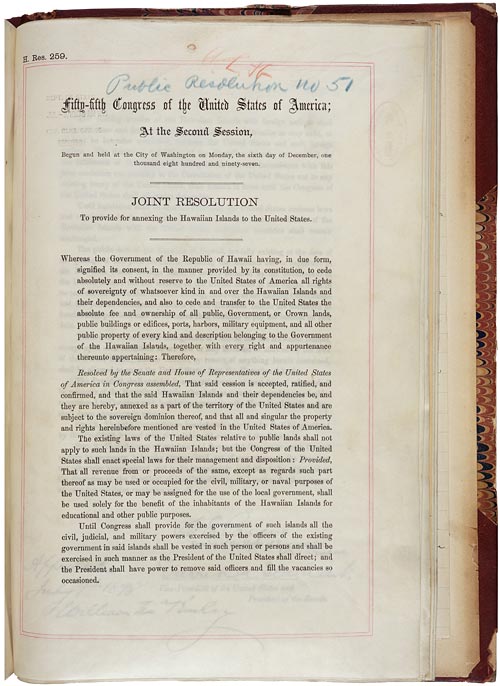
Despite President Grover Cleveland‘s strong opposition to the overthrow and his attempts to restore the monarchy, the push for annexation gained unstoppable momentum with the election of President William McKinley in 1896, a staunch expansionist. The final catalyst was the Spanish-American War in 1898. The war vividly demonstrated Hawaii’s critical military importance as a vital naval coaling and resupply station for U.S. ships en route to the Philippines and other Pacific territories.
This strategic necessity, combined with intense lobbying by annexationists and concerns that other world powers might claim the islands, prompted Congress to act decisively. Avoiding a formal treaty, which would have required a difficult two-thirds majority in the Senate and faced stiff opposition, annexation was achieved through a joint resolution. The Newlands Resolution was passed by Congress and signed into law by President William McKinley on July 7, 1898. This act formally annexed the Republic of Hawaii to the United States, making it a U.S. territory. The formal transfer of sovereignty, marked by the lowering of the Hawaiian flag and the raising of the American flag at Iolani Palace, took place on August 12, 1898, despite widespread petitions and protests from Native Hawaiians.
Hawaii’s Legacy: From Territory to Tourist Paradise
The annexation of Hawaii in 1898 was not an endpoint but the beginning of a profound transformation, shaping its destiny from a U.S. territory to the vibrant state and global travel destination it is today.
A New Era: Territorial Rule and Statehood
Following annexation, Hawaii was formally organized as a U.S. territory in 1900 through the Hawaiian Organic Act. This period, lasting nearly six decades, saw continued economic growth, primarily driven by the expanding sugar and pineapple industries. These plantations attracted waves of immigrant laborers from Japan, China, the Philippines, and Portugal, creating the rich, multicultural tapestry that defines modern Hawaii. This blend of cultures contributed to the unique customs, languages, and culinary scene that visitors experience today.
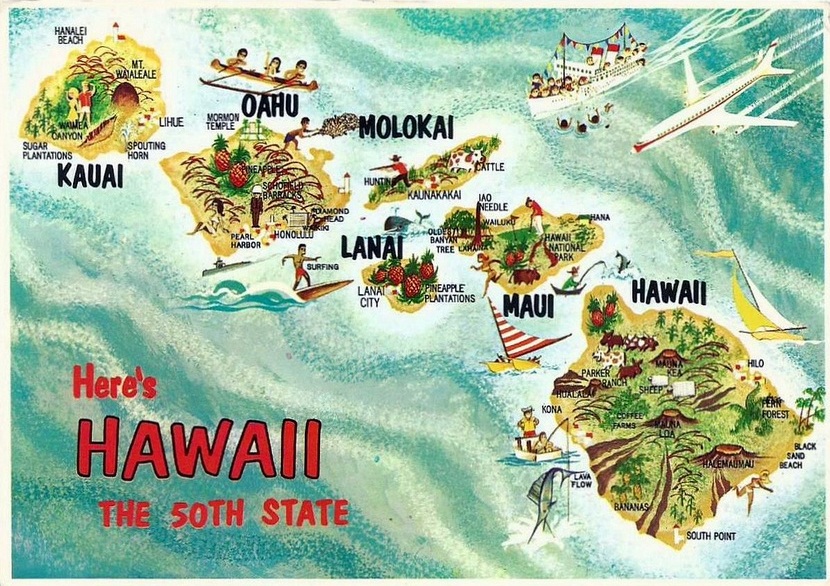
The strategic importance of Hawaii intensified during the territorial period, particularly with the escalating global tensions leading to World War II. The devastating attack on Pearl Harbor in December 1941 thrust Hawaii onto the global stage as a critical military stronghold, cementing its role in American defense. The push for statehood gained momentum after the war, driven by growing calls for civil rights and the demonstrated loyalty of Hawaiian residents. Finally, on August 21, 1959, Hawaii officially became the 50th state of the United States, a significant milestone that further integrated the islands into the American fabric.
Understanding Hawaii Today
The annexation of Hawaii was a complex historical event, fueled by a potent mix of economic ambition, geopolitical strategy, and the prevailing expansionist ideologies of the late 19th-century United States. It represents a narrative of lost sovereignty and the enduring resilience of a people. While the economic and military benefits for the United States were clear, the cost to the Kingdom of Hawaii and its people was immense, leading to profound cultural and political transformations.
Today, as travelers explore the vibrant cities and serene landscapes of Hawaii, they are encountering a living testament to this intricate past. From the solemn grounds of Iolani Palace to the historic sites of Pearl Harbor, the echoes of history resonate. Modern Hawaii is a beautiful paradox: a part of the United States yet uniquely distinct, gracefully carrying forward its Polynesian heritage while embracing its multicultural present. This rich tapestry of history, culture, and natural wonder makes Hawaii more than just a destination for leisure; it’s a place for discovery, learning, and reflection. For those seeking destinations that offer deep cultural experiences alongside stunning scenic beauty, Hawaii provides a compelling narrative of perseverance and identity, making every visit an experience interwoven with the threads of its captivating past.
LifeOutOfTheBox is a participant in the Amazon Services LLC Associates Program, an affiliate advertising program designed to provide a means for sites to earn advertising fees by advertising and linking to Amazon.com. Amazon, the Amazon logo, AmazonSupply, and the AmazonSupply logo are trademarks of Amazon.com, Inc. or its affiliates. As an Amazon Associate we earn affiliate commissions from qualifying purchases.