
Navigating the financial landscape of property ownership in California can feel like charting a complex course, especially when it comes to understanding recurring expenses like property taxes. These taxes are a fundamental part of funding local government services, from schools and libraries to public safety and infrastructure. For homeowners and investors alike, a clear grasp of when and how property taxes are levied is crucial for budgeting and financial planning. This article delves into the payment schedule and nuances of property tax obligations in the Golden State, aiming to demystify this essential aspect of California real estate.

Understanding the California Property Tax System
The foundation of California’s property tax system is established by Proposition 13, passed in 1978. This landmark legislation fundamentally altered how property taxes are assessed and collected. Prior to Proposition 13, property taxes were largely based on current market value, leading to significant year-to-year fluctuations and rising costs for long-time homeowners as property values appreciated. Proposition 13 rolled back assessed values to their 1975 levels and limited future increases in assessed value to no more than 2% per year, unless the property undergoes a change in ownership.
Base Year Value and Assessment
Under Proposition 13, each property has a “base year value.” This is the assessed value of the property as of March 1, 1975, or the date of the most recent change in ownership or new construction. Annually, this base year value is adjusted upward by no more than 2% to account for inflation. This means that for properties that have not experienced a change in ownership or significant new construction since 1975, the assessed value can be substantially lower than the current market value.
Change of Ownership and New Construction
A “change of ownership” is a key trigger that can lead to a reassessment of a property’s value to its current market value. This typically occurs when the property is sold, inherited, or transferred to a new owner. However, California law provides for numerous exclusions from reassessment, such as transfers between spouses, parents and children (subject to certain limitations), and certain transfers into a trust.
New construction also leads to a reassessment. When improvements are made to a property, such as adding a new room, a swimming pool, or significant renovations, the value of those new improvements is added to the existing assessed value, and this new value is then subject to the annual 2% inflation adjustment.
Property Tax Rate
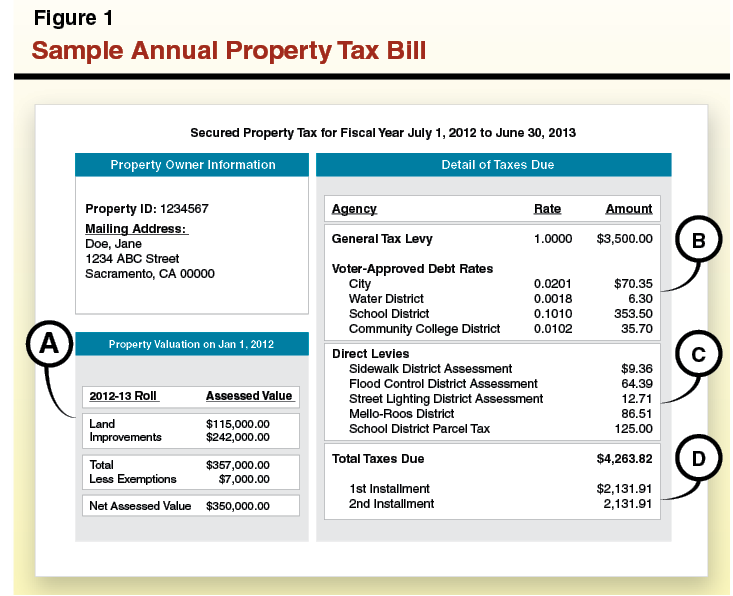
The property tax rate in California is generally capped at 1% of the property’s assessed value. This 1% covers local general-purpose revenues. However, property owners may also be subject to additional taxes, assessments, and fees levied by local special districts for specific services like flood control, fire protection, or school bonds. These can increase the total tax burden beyond the basic 1%. These additional levies are often referred to as “Measures” or “Special Assessments” and are voted on by the local electorate.
When Property Taxes Are Due in California
In California, property taxes are typically paid in two installments. This system is designed to provide a more predictable cash flow for local governments and a staggered payment schedule for property owners.
The First Installment Due Date
The first installment of your property tax bill is generally due on November 1st each year. This payment covers the period from July 1st of that year through December 31st of that year. The County Tax Collector will mail tax bills to property owners, usually in late September or early October. It is important to note that failure to pay the first installment by the due date incurs a penalty.
The Penalty for Late Payment (First Installment)
If the first installment is not paid by 5:00 p.m. on December 10th (the delinquency date), it becomes delinquent. A penalty of 10% of the unpaid installment amount is added. Furthermore, if the property tax remains unpaid for five years or more, the property can be subject to “tax-defaulted” status, eventually leading to a tax sale.
The Second Installment Due Date
The second installment of your property tax bill is generally due on February 1st of the following year. This payment covers the period from January 1st of that year through June 30th of that year. Similar to the first installment, the delinquency date for the second installment is April 10th.
The Penalty for Late Payment (Second Installment)
If the second installment is not paid by 5:00 p.m. on April 10th, it becomes delinquent. A penalty of 10% of the unpaid installment amount is added. As with the first installment, prolonged non-payment can lead to severe consequences, including the potential loss of your property.
Escape Assessments and Supplemental Taxes
There are instances where property owners may receive “escape assessments” or “supplemental tax bills.” An escape assessment is issued when the assessor discovers that property was not assessed correctly in a prior year, often due to an unrecorded change of ownership or unassessed new construction. A supplemental tax bill is issued when there is a change of ownership or new construction that occurs during the fiscal year. These bills reflect the difference in taxes due to the reassessment for the period between the event and the end of the fiscal year, and they are typically due in two installments, similar to the regular property tax bills.
Receiving Your Property Tax Bill
The County Tax Collector’s office is responsible for issuing property tax bills. These bills are typically mailed to the property owner’s address on record. It is the property owner’s responsibility to ensure they receive their tax bill, even if it is misplaced or not received. If you do not receive your tax bill by mid-October, you should contact your county’s Tax Collector’s office immediately. Relying solely on receiving a mailed bill is not a valid defense against penalties for late payment. Many counties now offer online access to tax bills and payment options, which can be a convenient and reliable way to stay informed and manage your tax obligations.
Online Access and Payment Options
Most California counties provide online portals where taxpayers can view their property tax bills, check payment status, and often make payments electronically. These services have become increasingly popular and user-friendly. You can typically search for your property by address, Assessor’s Parcel Number (APN), or owner’s name. Electronic payment options often include credit/debit card payments (though these may incur convenience fees) and electronic funds transfers (EFT) or direct debit from your bank account.
Autopay and Payment Plans
Some counties offer an “autopay” option, where you can authorize them to automatically deduct your tax payments from your bank account on the due dates. This is an excellent way to ensure timely payments and avoid penalties. For individuals facing financial hardship, some counties may offer limited payment plan options, but these are often subject to specific criteria and approval. It is essential to contact your County Tax Collector’s office directly to inquire about any available assistance programs or payment arrangements.
Factors Affecting Your Property Tax Bill
While the payment schedule is relatively fixed, the amount of property tax you owe can vary based on several factors beyond the base year value and the 1% rate. Understanding these can help you anticipate potential changes and appeal incorrect assessments.
Property Value and Assessment Changes
As discussed, changes in property value due to market fluctuations (though limited by Proposition 13 for existing owners), new construction, or reassessment after a change of ownership will directly impact your tax bill. If you believe your property has been over-assessed, you have the right to appeal the valuation through the county’s assessment appeals board.
Special Assessments and Bond Measures
Local jurisdictions frequently pass bond measures and special assessments to fund specific community projects. These can include school improvements, park developments, road repairs, or enhanced public safety services. When approved by voters, these measures are added to the property tax bill, increasing the total amount due. These are distinct from the base 1% property tax and are often levied based on factors like property frontage, acreage, or benefit derived from the service.
Exemptions and Reductions
Several exemptions can reduce your property tax liability. The most common is the Homeowners’ Exemption, which reduces the taxable value of a primary residence by a set amount. Other exemptions may be available for veterans, disabled individuals, seniors, or owners of properties used for charitable or religious purposes. It is crucial to research and apply for any exemptions for which you may be eligible, as they are not automatically applied.
The Homeowners’ Exemption
The Homeowners’ Exemption is a valuable benefit for California residents who own and occupy their homes as their principal residence. For the 2023-2024 fiscal year, the exemption reduced the taxable value of eligible homes by $7,000. This reduction translates into a direct saving on your property tax bill. To claim the exemption, you must file a claim form with your county’s assessor’s office by February 15th. If you miss this deadline, you can still file for the following fiscal year.
Other Exemptions
Beyond the Homeowners’ Exemption, California offers various other property tax exemptions. These may include:
- Disabled Veterans’ Exemption: Provides a significant exemption for disabled veterans.
- Senior Citizen Property Tax Assistance: While not a direct exemption from the tax bill itself, this program offers property tax relief to eligible low-income seniors.
- Disabled Persons’ Exemption: Similar to the veteran exemption, this offers relief to homeowners with permanent disabilities.
- Religious, Charitable, and Scientific Organizations: Properties owned and used by qualifying non-profit organizations are typically exempt from property taxes.
It is advisable to consult your county’s assessor’s office or the California State Board of Equalization (BOE) website for detailed information on eligibility requirements and application procedures for these exemptions.

Conclusion: Proactive Property Tax Management in California
Understanding when property taxes are due in California is more than just a matter of timing payments; it’s about strategic financial management. The system, while complex, is designed to provide stable funding for essential local services. By familiarizing yourself with the two-installment payment schedule, the potential for supplemental bills, and the various exemptions and assessments that can affect your bill, you can better manage your financial obligations as a property owner. Proactive engagement with your County Tax Collector and Assessor’s offices, along with utilizing online resources, will ensure you stay on track and avoid costly penalties, ultimately contributing to a smoother and more predictable property ownership experience in the vibrant state of California.
LifeOutOfTheBox is a participant in the Amazon Services LLC Associates Program, an affiliate advertising program designed to provide a means for sites to earn advertising fees by advertising and linking to Amazon.com. Amazon, the Amazon logo, AmazonSupply, and the AmazonSupply logo are trademarks of Amazon.com, Inc. or its affiliates. As an Amazon Associate we earn affiliate commissions from qualifying purchases.