
Navigating the legal complexities of divorce can be an emotionally taxing experience, and understanding the procedural steps is crucial for a smoother transition. This guide outlines the process of filing for divorce in Florida, offering a clear roadmap for individuals seeking to dissolve their marriage within the state’s legal framework. From initial requirements to finalization, we will explore the essential elements of a Florida divorce.
Understanding Florida Divorce Law
Florida is a “no-fault” divorce state, meaning that neither party needs to prove that the other spouse did something wrong to cause the divorce. The primary grounds for divorce are that the marriage is “irretrievably broken” or that one spouse has been mentally incapacitated for at least three years. This no-fault principle simplifies the initial filing process, as it removes the need for contentious accusations.

Residency Requirements
Before you can file for divorce in Florida, at least one of the spouses must meet the state’s residency requirements. This means that one spouse must have resided in Florida for a minimum of six months immediately preceding the filing of the petition for dissolution of marriage. Proof of residency can include a driver’s license, voter registration, or property ownership within the state.
Types of Divorce in Florida
Florida recognizes several types of divorce, each with its own set of requirements and procedures. The most common include:
Uncontested Divorce
An uncontested divorce occurs when both spouses agree on all the major issues, including property division, spousal support (alimony), child custody, and child support. In such cases, spouses can often work together to draft a Marital Settlement Agreement, which is then submitted to the court for approval. This is generally the fastest and least expensive type of divorce.
Contested Divorce
A contested divorce arises when spouses cannot agree on one or more of the critical issues. In these situations, the court will ultimately make decisions on behalf of the parties after a trial or through various forms of alternative dispute resolution. Contested divorces can be lengthy and significantly more expensive due to the legal battles involved.
Simplified Dissolution of Marriage
Florida offers a simplified dissolution of marriage process for couples who meet very specific criteria. To qualify for a simplified divorce, the following conditions must be met:
- Both spouses agree that the marriage is irretrievably broken.
- There are no minor or dependent children of the marriage, and the wife is not currently pregnant.
- Both spouses agree on the equitable distribution of all assets and liabilities.
- Neither spouse is seeking alimony.
- Both spouses agree to waive their right to a trial and to have the court determine any issues.
- Both spouses must attend a mandatory pre-trial education program if minor children are involved (though simplified divorce generally excludes this).
- Both spouses must file financial affidavits.
Dissolution of Marriage with Minor Children
When minor children are involved, the divorce process becomes more complex. Florida law requires parents to participate in a parenting plan and a child support calculation. The court will ensure that any agreement or decision regarding children is in their best interests.
The Divorce Filing Process
The procedural steps for filing for divorce in Florida are structured to ensure fairness and due process for both parties.
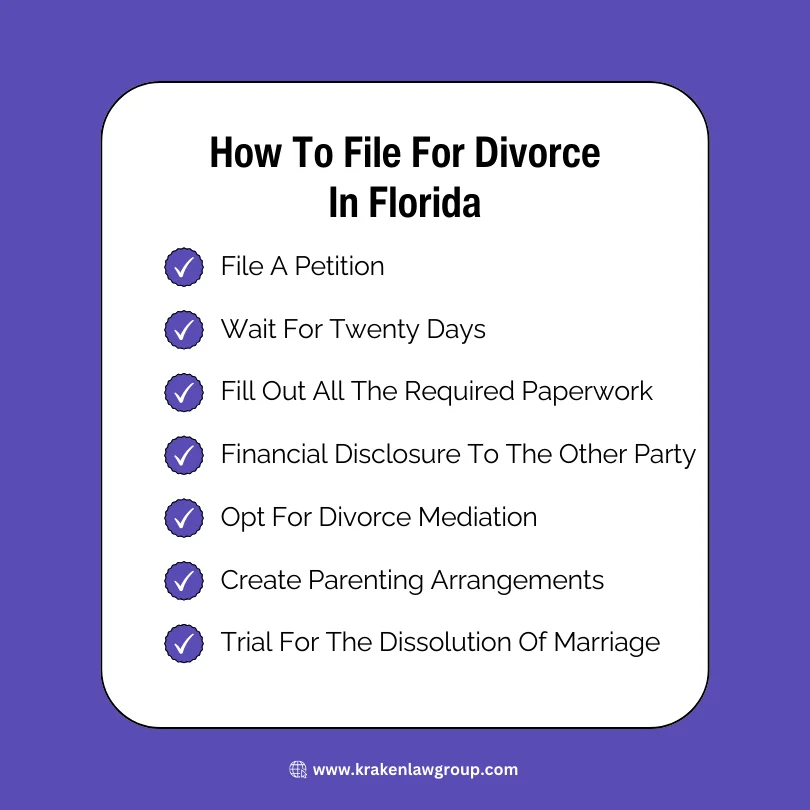
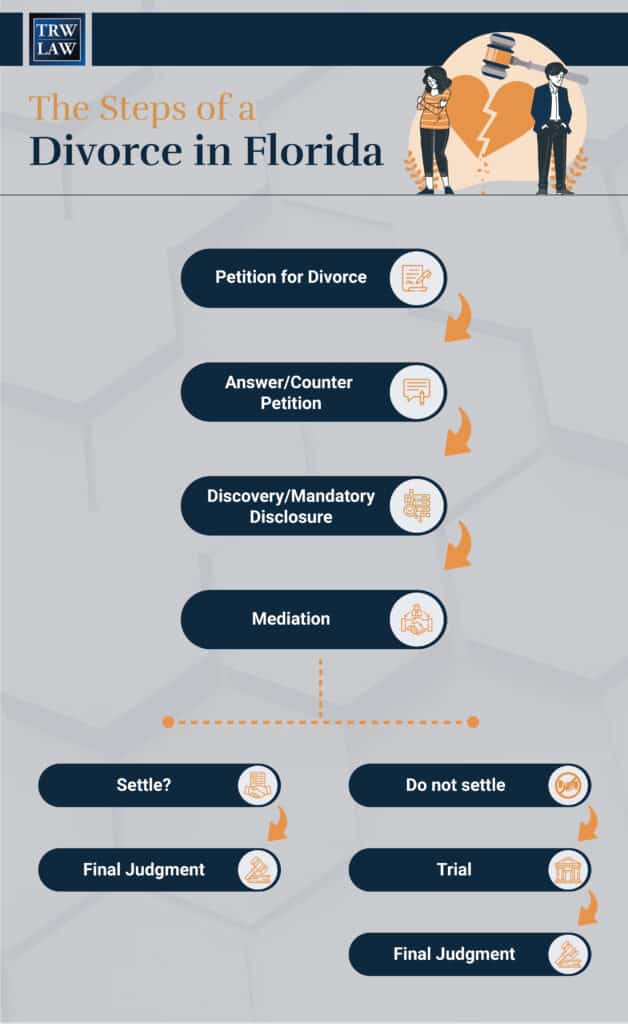
Step 1: Prepare and File the Petition for Dissolution of Marriage
The first formal step in initiating a divorce is to file a “Petition for Dissolution of Marriage” with the clerk of the circuit court in the county where either spouse resides. This document officially begins the divorce proceedings.
Content of the Petition
The petition must contain specific information, including:
- The names and addresses of both parties.
- The date and place of marriage.
- The grounds for divorce (e.g., irretrievably broken).
- The names and birthdates of any minor children.
- A statement regarding the residency of the parties in Florida.
- A request for relief, such as the dissolution of the marriage, equitable distribution of property, and any requested child support or alimony.
Filing Fees
There are filing fees associated with initiating a divorce case, which vary by county. If you cannot afford the fees, you may be eligible to file a “Motion to Proceed as an Indigent Person” to have the fees waived.
Step 2: Serve the Other Spouse
Once the petition is filed, the other spouse, referred to as the “Respondent,” must be formally notified of the lawsuit. This is called “service of process.” The Petitioner cannot personally serve the Respondent. Service is typically performed by a sheriff’s deputy or a certified process server.
Methods of Service
- Personal Service: The most common method, where the Respondent is personally handed a copy of the petition and a summons.
- Constructive Service: If the Respondent cannot be located, service can be made by publishing a notice in a local newspaper. This is generally used in cases where the Respondent’s whereabouts are unknown.
The Respondent’s Answer
After being served, the Respondent has a specific period (usually 20 days) to file a response, known as an “Answer” or a “Response,” with the court. This response indicates whether the Respondent agrees with the petition’s contents or disputes certain claims. If no response is filed, the Petitioner may be able to proceed with a default judgment.
Step 3: Financial Disclosures
Both parties in a divorce case are required to provide full and accurate financial disclosures to the court and to each other. This is a critical step, as it ensures transparency regarding all marital assets, debts, income, and expenses.
Mandatory Financial Affidavit
Each spouse must complete and file a “Financial Affidavit.” This document details income, expenses, assets (such as bank accounts, real estate, investments), and liabilities (such as mortgages, loans, credit card debt). There are two versions of the Financial Affidavit: one for cases with total household incomes over a certain threshold, and a simplified version for those below it.
Supporting Documents
In addition to the Financial Affidavit, parties may be required to provide supporting documents, such as tax returns, pay stubs, bank statements, and property deeds. Failure to provide complete and accurate financial disclosures can lead to severe penalties from the court.
Step 4: Reaching an Agreement or Going to Court
Depending on whether the divorce is contested or uncontested, the path forward will diverge.
Uncontested Divorce Resolution
If both parties agree on all issues, they will draft a comprehensive “Marital Settlement Agreement” (MSA). This legally binding document outlines all terms of the divorce, including property division, alimony, child custody arrangements, and child support obligations. Once signed by both parties and approved by the court, the MSA becomes part of the final judgment.
Contested Divorce Resolution
If spouses cannot agree, the case will proceed through the court system. This may involve:
- Mediation: A neutral third party helps the couple negotiate and attempt to reach an agreement. Mediation is often mandatory in Florida divorce cases, especially when children are involved.
- Discovery: This phase involves exchanging information and evidence through interrogatories, requests for production of documents, and depositions.
- Hearings and Motions: The court may hold hearings on specific issues, such as temporary alimony or custody.
- Trial: If no agreement is reached, the case will proceed to a trial where a judge will hear evidence and make a final ruling on all disputed matters.
Finalizing the Divorce
The final stage of the divorce process involves the court issuing a “Final Judgment of Dissolution of Marriage.”
The Final Judgment
This court order officially dissolves the marriage and incorporates the terms of the Marital Settlement Agreement (in uncontested cases) or the judge’s rulings (in contested cases). The Final Judgment is a legally binding document that dictates the rights and responsibilities of each former spouse.
Key Provisions in the Final Judgment
The Final Judgment will typically address:
- The dissolution of the marriage.
- Equitable distribution of marital assets and debts.
- Award of alimony, if applicable.
- Child custody and visitation schedules (time-sharing).
- Child support obligations.
- Any other related matters, such as name changes.
Waiting Period
Florida has a mandatory 20-day waiting period between the filing of the Petition for Dissolution of Marriage and the entry of the Final Judgment. This period allows parties time to reflect and potentially reconcile, or to ensure all necessary agreements are finalized.
Seeking Legal Assistance
While it is possible to represent yourself in a divorce case (pro se), navigating the legal intricacies of Florida divorce law can be challenging. Consulting with an experienced family law attorney is highly recommended, especially in complex cases involving significant assets, high conflict, or minor children. An attorney can ensure that your rights are protected, guide you through the procedural steps, and help you achieve a fair resolution. Even in seemingly straightforward uncontested divorces, legal advice can prevent costly mistakes and ensure all legal requirements are met.
LifeOutOfTheBox is a participant in the Amazon Services LLC Associates Program, an affiliate advertising program designed to provide a means for sites to earn advertising fees by advertising and linking to Amazon.com. Amazon, the Amazon logo, AmazonSupply, and the AmazonSupply logo are trademarks of Amazon.com, Inc. or its affiliates. As an Amazon Associate we earn affiliate commissions from qualifying purchases.