
The Hawaiian Islands represent one of the most geographically isolated and stunningly beautiful destinations on the planet. Floating in the vast expanse of the Pacific Ocean, this archipelago is a testament to the raw power of volcanic activity and the enduring spirit of Polynesia. For travelers planning a journey to this tropical paradise, understanding the spatial relationship between the islands is not just a matter of logistics; it is the key to unlocking a multi-faceted travel experience. While the islands may appear as a tight cluster on a map of the United States, the distances between them are significant enough to necessitate careful planning, yet close enough to make island-hopping an essential part of the Hawaii experience.

Mapping the Mid-Pacific: The Scale of the Hawaiian Chain
The Hawaiian Archipelago stretches over 1,500 miles across the central Pacific Ocean, but most visitors focus their attention on the eight main islands located at the southeastern end of the chain. These are Oahu, Maui, Kauai, the Island of Hawaii (commonly known as the Big Island), Lanai, Molokai, Niihau, and Kahoolawe. Because Niihau is privately owned and Kahoolawe is an uninhabited reserve, travel focuses on the primary six.
The Central Hub: Oahu as the Starting Point
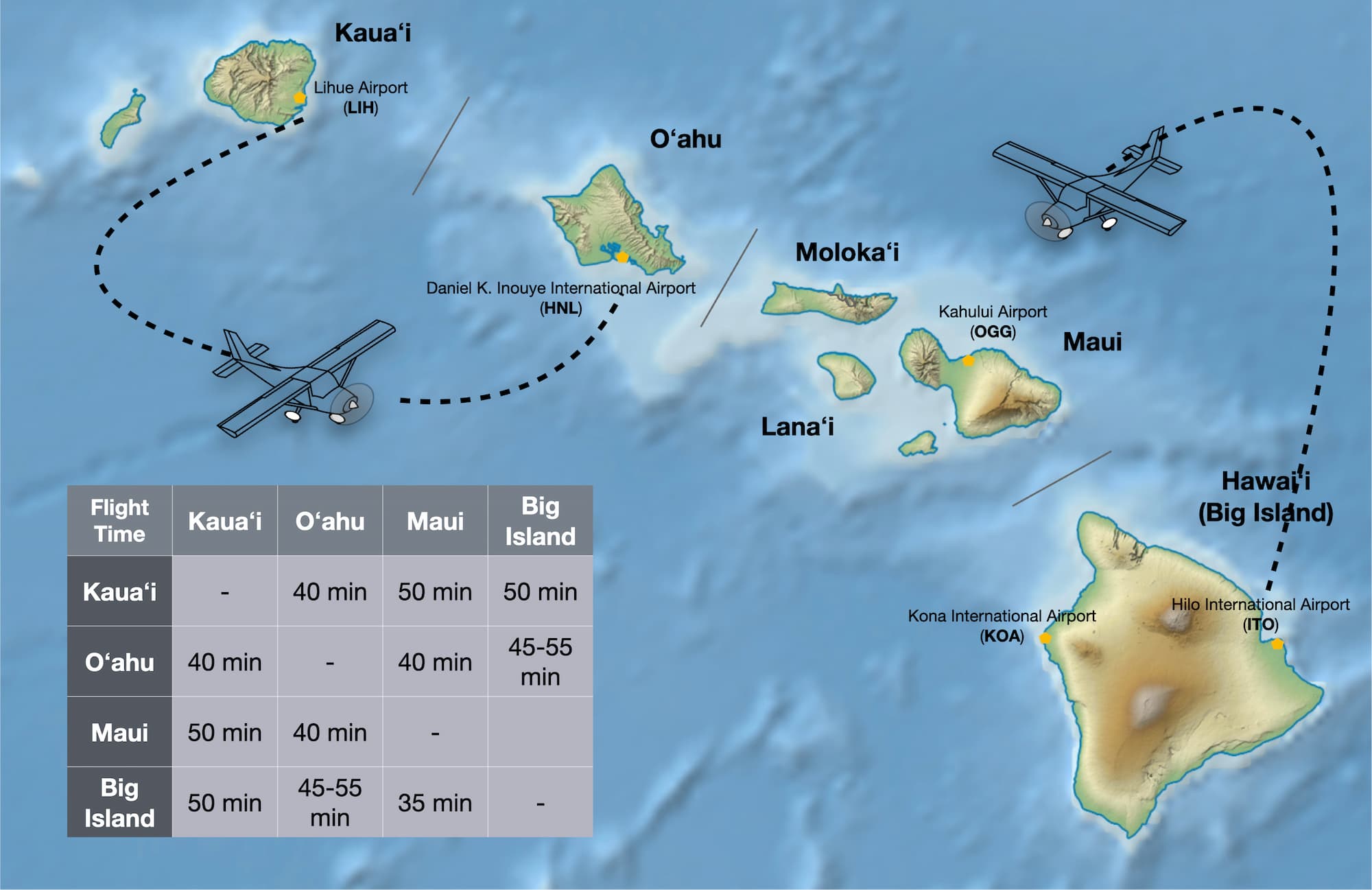
Oahu, home to the state capital of Honolulu, serves as the structural and logistical heart of the islands. Most international and domestic flights from North America or Asia land at Daniel K Inouye International Airport. From this central point, the other islands fan out in both directions. To the northwest lies Kauai, often referred to as the Garden Isle. The distance from Honolulu to Lihue Airport on Kauai is approximately 102 miles. This translates to a short 30-to-40-minute flight, crossing the Kauai Channel.
To the southeast of Oahu lies the Maui County island group and the Big Island. The flight from Honolulu to Kahului Airport on Maui covers about 101 miles. While the distances to Kauai and Maui are nearly identical from Oahu, the travel experiences on each are worlds apart, defined by their unique geological ages and cultural atmospheres.
The Proximity of the Maui County Cluster
One of the most interesting geographical features for travelers is the “tri-island” area of Maui, Lanai, and Molokai. These islands are significantly closer to one another than any other islands in the chain. In fact, during the last ice age, they were part of a single landmass known as Maui Nui.
Today, the distance between Maui and Lanai across the Auau Channel is only about 9 miles at its narrowest point. This proximity allows for a unique travel opportunity: the Maui Lanai Ferry. Departing from Lahaina Harbor (note: check current availability following local recovery efforts) and arriving at Manele Harbor, the ferry ride takes about 45 to 60 minutes. Similarly, Molokai sits roughly 9 miles from Maui across the Pailolo Channel, though travel between these two is more commonly conducted via small commuter aircraft.
Navigating the Distances: Logistics for Island Hopping
Because the islands are separated by deep-sea channels with unpredictable currents and significant distances, there are no bridges or tunnels connecting them. For the modern traveler, this means that moving between destinations requires either a flight or, in very specific cases, a boat.
The Role of Inter-Island Aviation
Air travel is the primary method for traversing the gaps between the islands. Hawaiian Airlines has long been the dominant carrier, offering frequent “shuttle” style flights that operate almost like a bus service. In recent years, Southwest Airlines has entered the market, increasing competition and making it more affordable for travelers to visit multiple islands in a single trip.
For those looking to reach the smaller airports, such as Molokai Airport or Lanai Airport, Mokulele Airlines provides essential commuter services. These flights often fly at lower altitudes, offering spectacular aerial views of landmarks like the Molokai Sea Cliffs—the highest in the world—and the shimmering turquoise waters of the Pacific Ocean.
The Longest Stretch: Reaching the Big Island
The Island of Hawaii is the furthest southeastern point of the main chain. Traveling from Honolulu to Kona International Airport involves a flight of approximately 170 miles. If your destination is Hilo International Airport on the lush eastern side of the island, the distance from Honolulu increases to about 216 miles.
The channel separating Maui and the Big Island, known as the Alenuihaha Channel, is roughly 30 miles wide. Despite this relatively short distance, the channel is known for being one of the most treacherous stretches of water in the world due to the wind-funneling effect between the high peaks of Haleakala on Maui and Mauna Kea on the Big Island. As a result, there are no commercial ferries between these two islands, and air travel remains the only practical option for tourists.

Destination Spotlights: Experiences Defined by Geography
The distances between the islands have allowed each to develop a distinct personality, ecosystem, and set of attractions. By understanding how far apart they are, travelers can better appreciate the diversity found within a single state.
Kauai: The Rugged Northwest
Located at the far northwestern end of the main chain, Kauai is the oldest of the major islands. Its distance from the more developed Oahu has helped it maintain a slower, more rural pace of life. Travelers heading here are rewarded with the breathtaking Na Pali Coast State Park, where emerald cliffs drop sharply into the sea. Because it is over 100 miles from Honolulu, a visit to Kauai feels like a true escape into nature. Don’t miss Waimea Canyon State Park, often called the Grand Canyon of the Pacific, which showcases the island’s ancient geological history.
Maui and Its Neighbors
The proximity of the islands in Maui County makes this the ideal region for those who want to experience multiple islands without long travel times. After exploring Haleakala National Park or driving the iconic Road to Hana on Maui, a quick ferry ride brings you to Lanai.
Lanai offers a stark contrast to Maui. It is a quiet island with fewer than 3,000 residents, home to the luxury Four Seasons Resort Lanai and the stunning Hulopoe Bay. To the north, Molokai remains the most traditional of the islands, where the Kalaupapa National Historical Park tells a moving story of Hawaiian History.
The Big Island: A World of Its Own
The Island of Hawaii is so large—twice the size of all the other islands combined—that its internal distances are often more significant than the distances between the other islands. It takes several hours to drive from the volcanic landscapes of Hawaii Volcanoes National Park on the southeastern side to the sunny beaches of the Kohala Coast in the northwest.
Because it is the furthest from Oahu, the Big Island often requires a dedicated portion of any itinerary. Here, you can witness the ongoing creation of new land at Kilauea Volcano or gaze at the stars from the world-class observatories atop Mauna Kea.
Planning Your Multi-Island Itinerary
When deciding which islands to visit and how to navigate the distances, it is helpful to group them logically based on your interests. If you seek urban excitement, Waikiki Beach and Pearl Harbor National Memorial on Oahu are essential. From there, choosing one other island based on distance and flight availability is a popular strategy for a one-week trip.
Time Management and Travel Tips
While a flight might only take 35 minutes, you must factor in the time spent at Daniel K Inouye International Airport or Kahului Airport. Generally, island-hopping requires at least half a day of travel when considering check-in, security, and car rental pickups.
For travelers who want to minimize time in the air, the Maui and Lanai combination is the most efficient. For those who don’t mind the 100-to-200-mile gaps, a combination of Oahu, Kauai, and the Big Island offers the most diverse look at the archipelago’s geography.
The Significance of the Channels
In Hawaiian Culture, the channels between the islands, such as the Kaiwi Channel (between Molokai and Oahu), are viewed not just as barriers but as connectors. They were the highways of the Ancient Hawaiians, who navigated these waters in outrigger canoes using the stars and ocean swells. Today, as you fly over these same blue expanses, the distance serves as a reminder of the incredible isolation and preservation of these islands.
Whether you are looking down at the Diamond Head State Monument from a plane window or watching the sun set over the Pacific Ocean from a ferry, the space between the islands is part of the magic. Understanding “how far apart” the islands are helps you appreciate the journey as much as the destination, ensuring that your Hawaii adventure is as seamless as it is memorable. From the lush rainforests of Hanapepe on Kauai to the black sand beaches of the Big Island, the distances are what make each island a world of its own, waiting to be explored.
LifeOutOfTheBox is a participant in the Amazon Services LLC Associates Program, an affiliate advertising program designed to provide a means for sites to earn advertising fees by advertising and linking to Amazon.com. Amazon, the Amazon logo, AmazonSupply, and the AmazonSupply logo are trademarks of Amazon.com, Inc. or its affiliates. As an Amazon Associate we earn affiliate commissions from qualifying purchases.