
When planning a trip to the Big Island of Hawaii, one of the first realizations travelers come to is the sheer scale of the landscape. While many visitors refer to the destination as “Kona Island,” it is important to clarify that Kona is actually a prominent district on the western side of Hawaii Island, the largest landmass in the Hawaiian archipelago. Understanding how long it takes to drive across this volcanic paradise is essential for creating a functional itinerary that balances relaxation with exploration. Because the Big Island is larger than all the other islands combined, driving times can be deceptively long, influenced by winding coastal roads, steep elevation changes, and the occasional volcanic crossing.

Understanding the Geography of the Big Island and the Kona Coast
The Big Island encompasses over 4,000 square miles, featuring nearly every climate zone on the planet. The Kona side, specifically the Kona Coast, stretches for about 60 miles along the western shore. This region is divided into North Kona and South Kona. Driving from the northernmost tip of the district to the southern boundary takes approximately 1.5 to 2 hours, depending on traffic in the primary hub of Kailua-Kona.
The terrain here is dominated by the slopes of Hualalai and Mauna Loa. Most travelers begin their journey at the Ellison Onizuka Kona International Airport. From the airport, it is a short 15-to-20-minute drive south to reach the heart of Kailua Village. However, if you are heading north toward the luxury resorts of the Kohala Coast, you should expect a 30-to-45-minute drive. The infrastructure is primarily centered around Highway 11 and Highway 19, which together form a belt around the island.
Driving Times Between Major Destinations on the West Side
To navigate the Kona side effectively, you must account for the distinct “Kona Crawl”—the local term for the afternoon traffic that often builds up along Kuakini Highway and Alii Drive. Despite the island’s laid-back atmosphere, the limited number of arterial roads means that a single bottleneck can add significant time to your journey.
From Kailua-Kona to the South Kona Gems
Heading south from Kailua-Kona toward Captain Cook takes about 25 to 35 minutes. This route takes you through the lush, elevated coffee country of Holualoa. If your destination is the historic Kealakekua Bay, famous for its snorkeling and the Captain Cook Monument, factor in the descent down the steep, winding Napoopoo Road. Continuing south to the Puuhonua o Honaunau National Historical Park will take an additional 15 minutes from Captain Cook.
Heading North to the Kohala Coast and Waimea
The drive north from Kailua-Kona is a stark contrast to the lush south. You will traverse vast, black lava fields created by previous eruptions from Mauna Loa. To reach the stunning white sands of Hapuna Beach State Recreation Area, plan for a 45-minute drive. If you are continuing to the paniolo (cowboy) town of Waimea, which sits at an elevation of 2,600 feet, the drive from Kona will take roughly 1 hour and 15 minutes. The air cools significantly as you climb, and the landscape shifts from volcanic rock to rolling green pastures.
Circling the Entire Island: The Full Big Island Loop
For many visitors, the ultimate road trip is the full circle of the Big Island. This journey covers approximately 240 to 300 miles, depending on the detours taken. If you were to drive the loop without stopping—which is not recommended—it would take between 6 and 8 hours. However, a realistic “Circle Island” tour typically requires a full 10-to-12-hour day to accommodate sightseeing.
The Southern Route: Kona to Hilo via Kau
Taking Highway 11 south from Kona leads you through the remote Kau district. This is one of the most sparsely populated areas in Hawaii. It takes about 1.5 to 2 hours to reach South Point, the southernmost tip of the United States. From there, it is another 20 minutes to the famous Punaluu Black Sand Beach.
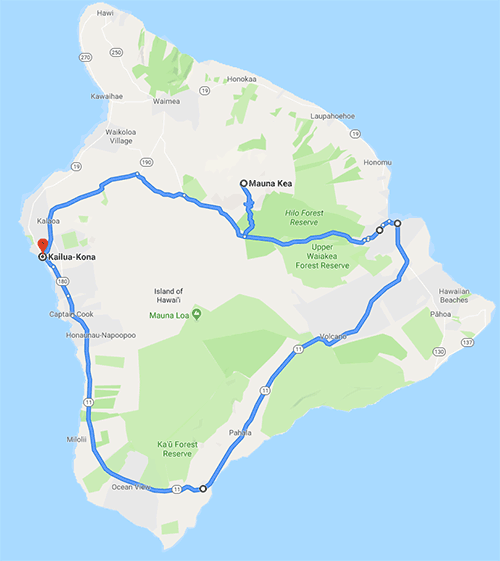
Continuing toward the east, you will enter Hawaii Volcanoes National Park. The drive from Kailua-Kona to the park entrance takes roughly 2 to 2.5 hours. Many travelers choose to stay overnight in the town of Volcano because there is so much to see, including the Halemaumau Crater. From the park, it is a further 45-minute drive down into Hilo, the island’s largest city on the windward side.
The Northern Route: Hilo to Kona via Hamakua
Returning to Kona from Hilo via the northern route on Highway 19 offers some of the most dramatic scenery in the Pacific Ocean region. The Hamakua Coast is characterized by deep gulches, tropical rainforests, and towering waterfalls like Akaka Falls State Park. The drive from Hilo to Honokaa takes about 1 hour. A detour to the Waipio Valley Lookout is a must, adding about 30 minutes to your total travel time. From Honokaa, you will pass through Waimea before descending back to the Kona Coast.
The Shortcut: Crossing the Island via Saddle Road
If you need to get from Kona to Hilo quickly, the most efficient path is the Saddle Road, now officially known as the Daniel K Inouye Highway. Historically, this road was avoided by rental car companies due to its rough condition, but it has been extensively renovated and is now a modern, high-speed highway.
Crossing the “saddle” between Mauna Loa and Mauna Kea takes about 1 hour and 30 minutes to 1 hour and 45 minutes from coast to coast. This route reaches an elevation of over 6,600 feet. Drivers should be aware that weather conditions here can change rapidly; it is common to drive through thick fog or heavy rain, even if both coasts are sunny. This road also provides the access point for the Mauna Kea Visitor Information Station. If you plan to visit the summit of Mauna Kea, you must have a 4-wheel drive vehicle, and the ascent from the visitor center adds significant time to your journey.
Essential Tips for Navigating Hawaii’s Unique Terrain
Driving on the Big Island requires a different mindset than driving on the mainland. The pace is slower, and the conditions are more variable. To make the most of your time behind the wheel in Kona, keep the following logistics in mind.
Fuel and Supplies
Gas stations are plentiful in Kailua-Kona, Hilo, and Waimea. However, once you leave these hubs, they become sparse. If you are driving the southern route through Kau, ensure your tank is full, as there are very few places to refuel between Ocean View and Hawaii Volcanoes National Park. Similarly, the Saddle Road has no gas stations for its entire length.
Daylight and Night Driving
In Hawaii, the sun sets relatively early year-round, usually between 6:00 PM and 7:00 PM. Many of the island’s roads, particularly in South Kona and along the Hamakua Coast, are unlit and have sharp curves with steep drop-offs. If you are unfamiliar with the area, it is highly recommended to complete your long-distance driving during daylight hours. Additionally, livestock and feral animals, such as goats and pigs, are frequent hazards on roads like Kohala Mountain Road and Highway 11 after dark.
Weather Variations
You might start your drive in Kailua-Kona with temperatures in the mid-80s and arrive in Waimea or the Saddle Road to find it is 55 degrees and raining. This “microclimate” phenomenon can affect driving visibility and road traction. Always check the weather forecast for the specific district you are visiting, rather than just a general “Hawaii” forecast.

Respecting the Speed Limits
The speed limits on the Big Island are generally lower than what many visitors are used to, often topping out at 55 mph on the main highways and dropping to 25 or 35 mph in residential and historic areas. Local law enforcement is active, particularly in Kailua-Kona and the Puna district. Moreover, driving slowly allows you to appreciate the remarkable vistas, from the emerald cliffs of Pololu Valley to the stark beauty of the Kaʻupulehu lava flows.
Ultimately, the answer to “how long to drive Kona” depends entirely on your curiosity. While you can zip from one side of the island to the other in under two hours via the Saddle Road, the true essence of the Big Island is found in the slow detours. Whether you are stopping for a fresh bag of Kona Coffee in Captain Cook or watching the sunset from the Kohala Coast, the journey is just as important as the destination. By planning for longer drive times and respecting the island’s unique geography, you ensure a safe and enriching travel experience through one of the most diverse landscapes in the United States.
LifeOutOfTheBox is a participant in the Amazon Services LLC Associates Program, an affiliate advertising program designed to provide a means for sites to earn advertising fees by advertising and linking to Amazon.com. Amazon, the Amazon logo, AmazonSupply, and the AmazonSupply logo are trademarks of Amazon.com, Inc. or its affiliates. As an Amazon Associate we earn affiliate commissions from qualifying purchases.