
The journey across the Atlantic Ocean, connecting London and New York, is one of the most significant and heavily traveled aviation corridors in the world. For travelers moving between the United Kingdom and the United States, understanding the duration and logistics of this flight is essential for effective trip planning. While the physical distance remains constant, the actual time spent in the air fluctuates based on a variety of meteorological and operational factors.
The Geography of the Transatlantic Flight Path
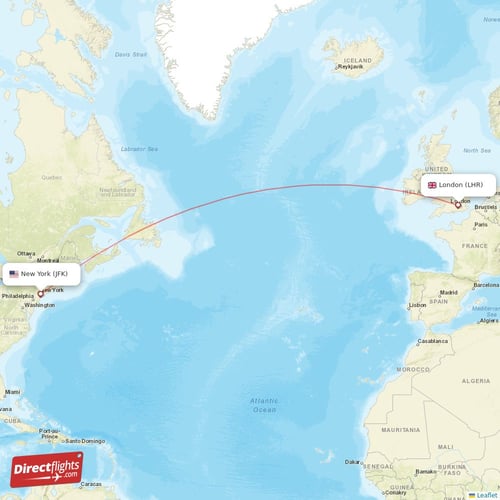
The distance between London and New York is approximately 3,450 miles (5,550 kilometers). When mapping this route, pilots do not typically fly in a perfectly straight line. Instead, they follow “Great Circle” routes, which are the shortest paths between two points on the surface of a sphere.
Why Routes Vary
Flight paths are constantly adjusted based on the North Atlantic Tracks (NATs). These are a series of organized tracks that span the Atlantic to ensure aircraft maintain safe separation while navigating the busiest oceanic airspace in the world. Because these tracks are updated twice daily by air traffic control to account for wind patterns and weather systems, a flight from London to New York might cross over different parts of Ireland, Canada, or the Atlantic Ocean depending on the specific flight plan assigned that day.
The Impact of Jet Streams
The most significant variable influencing travel time is the jet stream. This is a high-altitude, fast-moving wind current that typically flows from west to east. Because of this, flights traveling eastward from the United States to the United Kingdom often experience a “tailwinds” effect, significantly reducing flight time. Conversely, flights traveling westward from London to New York must fly against this wind, leading to longer durations.
Typical Flight Durations: Eastbound vs. Westbound
When passengers board a flight, they often notice a discrepancy in the estimated time of arrival between their outbound and return journeys.
Flying from New York to London
The journey from New York to London usually takes approximately 7 hours. With the benefit of the prevailing tailwinds, some flights may even complete the journey in under 6.5 hours if the jet stream is particularly strong. This allows many travelers to depart John F. Kennedy International Airport in the evening and arrive at London Heathrow Airport in time for breakfast the next morning.
Flying from London to New York
The return trip from London to New York is consistently longer due to the “headwinds” caused by the jet stream. Passengers should anticipate an average flight time of 8 to 8.5 hours. During winter months, when the jet stream is at its most powerful, it is not uncommon for flights to face significant delays or longer durations as pilots navigate around the strongest pockets of wind to maintain fuel efficiency and passenger comfort.

Operational Considerations for Transatlantic Travel
The time spent at 35,000 feet is only one part of the total travel experience. Modern aviation involves complex logistics that influence how quickly one can move between these two global hubs.
Aircraft Performance
The type of aircraft utilized for the route plays a role in speed and efficiency. Modern long-haul jets like the Boeing 787 Dreamliner or the Airbus A350 are designed to cruise at high subsonic speeds while optimizing fuel consumption. While the mechanical speed of these aircraft is relatively similar, their ability to cruise at higher altitudes can help them find smoother air and, in some cases, more favorable wind conditions.
The “Supersonic” Legacy
History buffs often reflect on the era of the Concorde, which famously connected the two cities in roughly 3.5 hours. By flying at twice the speed of sound, the Concorde effectively halved the travel time. Since the retirement of supersonic commercial travel in the early 2000s, flight times have returned to the standard 7-to-8-hour window. While there is ongoing interest in supersonic return, today’s focus is primarily on maximizing the comfort of the onboard experience, whether through British Airways business class or the various cabin offerings from Delta Air Lines.
Tips for Managing Long-Haul Flight Times
Regardless of whether the flight takes 7 or 8.5 hours, the journey from London to New York is categorized as a “red-eye” or a long-haul day flight. Managing your time and physical well-being is key to arriving ready to explore.
Cabin Comfort and Hydration
Since the air in an aircraft cabin is recycled and very dry, hydration is the most important factor in preventing fatigue. Drinking plenty of water and avoiding excessive caffeine can help mitigate the effects of the five-hour time difference between the Eastern Time Zone and Greenwich Mean Time.
Utilizing In-Flight Entertainment
Most modern carriers provide extensive content libraries. Whether you are flying into Newark Liberty International Airport or London Gatwick Airport, utilizing the time to rest or catch up on work can make the flight feel significantly shorter. For those aiming to adjust their body clocks, attempting to match the sleep schedule of your destination city while in the air is a highly recommended strategy.
The Arrival Process
Finally, remember that the “distance” also includes the time spent on the ground. Once the plane touches down at New York, travelers must navigate customs and immigration, which can add significant time to the overall trip. Utilizing programs like Global Entry can often shave an hour off the post-flight experience, ensuring that the total transit time from departure gate to Manhattan or Central London remains as efficient as possible.
The connection between these two iconic cities remains a marvel of modern travel, bridging the gap between Europe and North America with relative ease, provided one accounts for the predictable, yet variable, nature of transatlantic winds.
LifeOutOfTheBox is a participant in the Amazon Services LLC Associates Program, an affiliate advertising program designed to provide a means for sites to earn advertising fees by advertising and linking to Amazon.com. Amazon, the Amazon logo, AmazonSupply, and the AmazonSupply logo are trademarks of Amazon.com, Inc. or its affiliates. As an Amazon Associate we earn affiliate commissions from qualifying purchases.