
The sinking of the RMS Titanic remains one of the most haunting chapters in maritime history. While the tragic loss of life and the hubris surrounding the “unsinkable” vessel are well-documented, the geographical context of its final resting place relative to its intended destination provides a sobering look at the scale of the tragedy. To understand the magnitude of the disaster, one must look at the immense distance between the site of the collision and the bustling docks of New York.
The Planned Voyage and Final Coordinates
When the White Star Line commissioned the construction of the Titanic, the goal was to provide an unparalleled experience of luxury travel across the Atlantic Ocean. The vessel set sail from Southampton, England, with stops in Cherbourg, France, and Queenstown—now known as Cobh, Ireland—before venturing into the open sea.
Calculating the Distance
The ship struck an iceberg at approximately 11:40 PM on April 14, 1912. The final coordinates of the wreck site are roughly 41°43′57″N 49°56′49″W. At the time of the collision, the Titanic was approximately 370 miles southeast of Mistaken Point off the coast of Newfoundland, Canada. When measuring the distance to New York City, the ship was still approximately 1,000 to 1,200 miles away from its intended pier.
The Geography of the North Atlantic
The path chosen by Captain Edward John Smith took the vessel through the treacherous waters of the North Atlantic, a region notoriously difficult to navigate in April due to the presence of icefields. The distance remaining—over a thousand miles—meant that the vessel was effectively in the middle of nowhere, hundreds of miles from the nearest significant landmass and even further from the welcoming lights of Manhattan.
The Implications of the Distance for Rescue Efforts
The vast distance between the Titanic and any major port meant that survival depended entirely on the presence of nearby vessels and the efficacy of maritime communication. In 1912, the technology available for long-range communication was limited, and the isolation of the ship in the middle of the Atlantic Ocean proved fatal.
The Role of Nearby Ships
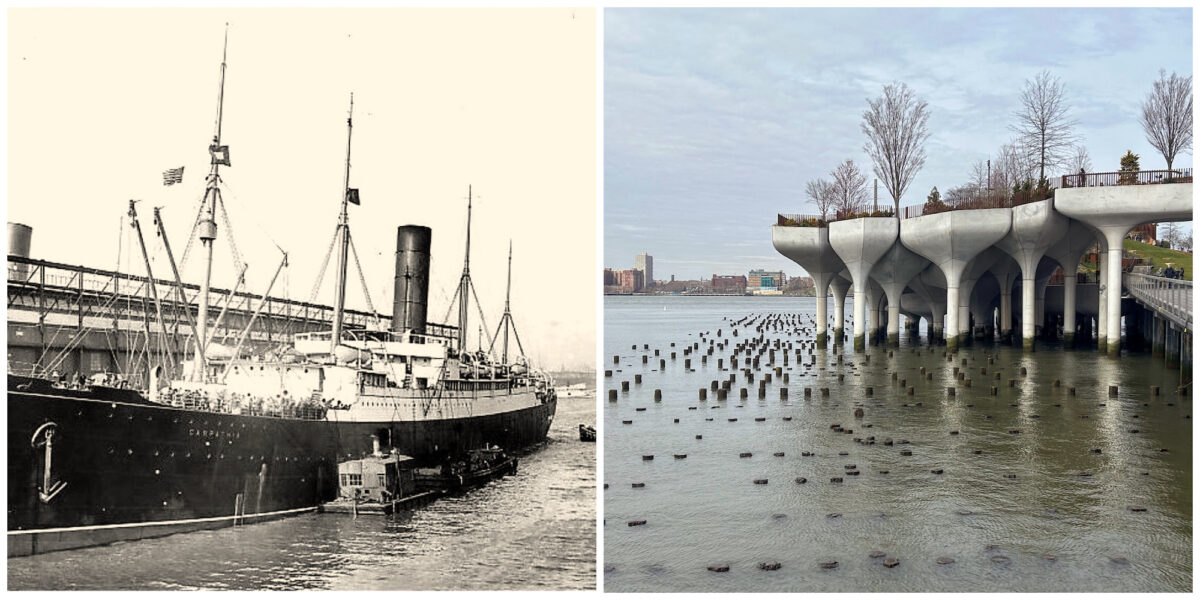
While New York was far beyond reach, the wireless distress signals sent out by the ship’s operators were received by several nearby vessels. The most famous of these was the RMS Carpathia, commanded by Captain Arthur Rostron. At the time of the distress call, the Carpathia was approximately 58 miles away. Despite pushing the ship to its maximum speed through treacherous ice, it took the Carpathia several hours to reach the scene. By the time they arrived, the Titanic had already disappeared beneath the surface.

The Communication Gap
The distance to New York also played a role in the dissemination of news. As the Carpathia began the long journey back toward North America, a confusing and incomplete picture of the disaster began to emerge. Telegraph operators in the United States and Europe struggled to piece together the events, as the ship was still hundreds of miles from the coast, making direct, clear communication nearly impossible in the era before widespread radio broadcasting.
The Legacy of the Site and Maritime History
Today, the wreck of the Titanic rests at a depth of nearly 12,500 feet. The location has become a site of immense historical and scientific interest, though it remains protected under various international agreements to ensure it is treated as a gravesite.
Exploring the Deep
In the decades since its discovery in 1985 by Robert Ballard, the wreck has been visited by numerous expeditions. These dives have provided a glimpse into the state of the vessel after more than a century on the seabed. The distance from New York that once seemed like a daunting barrier to rescue is now traversed by modern technology that allows researchers to map, photograph, and analyze the deteriorating structure of the ship.
A Lesson in Maritime Navigation
The tragedy prompted a massive overhaul of maritime safety regulations, including the establishment of the International Convention for the Safety of Life at Sea, or SOLAS. The realization that the Titanic was so far from safety—and that vessels like the SS Californian were potentially close enough to have intervened—forever changed how ships communicate and carry life-saving equipment.

Understanding the Tragedy Through Distance
When we look back at the map and see how far the Titanic was from New York, we are reminded of the fragility of human endeavor against the backdrop of the Earth. The voyage was intended to be a triumph of modern engineering and a symbol of progress, connecting the old world of Europe with the bustling promise of America.
Instead, the isolation of the ship in the deep ocean serves as a permanent historical marker. The distance of 1,000 miles to New York was not merely a measure of nautical miles; it was the distance between hope and catastrophe. Every ship that traverses these waters today owes a debt to the lessons learned from the Titanic. The vastness of the sea, once seen as an obstacle to be conquered, is now respected as a powerful force that requires constant vigilance, better technology, and a profound awareness of the dangers that still exist far from the safety of any harbor.
The story of the Titanic remains deeply embedded in the cultural consciousness of New York, with various memorials and exhibits honoring the lives lost. Visitors to the city can still find reminders of the tragedy, reflecting on how a journey intended to end in Manhattan became a timeless reminder of human fallibility. The distance remains the same, but our perspective on the fragility of travel has shifted, ensuring that the legacy of the voyage is never forgotten.
LifeOutOfTheBox is a participant in the Amazon Services LLC Associates Program, an affiliate advertising program designed to provide a means for sites to earn advertising fees by advertising and linking to Amazon.com. Amazon, the Amazon logo, AmazonSupply, and the AmazonSupply logo are trademarks of Amazon.com, Inc. or its affiliates. As an Amazon Associate we earn affiliate commissions from qualifying purchases.