
Acquiring a firearm in California is a process often described as one of the most stringent and complex in the United States. Known for its comprehensive gun control laws, the state of California has implemented a multi-layered regulatory framework designed to enhance public safety by meticulously controlling who can own firearms and what types of firearms can be purchased. For both long-term residents and newcomers alike, understanding these intricate regulations is not merely advisable but absolutely essential to ensure compliance with the law and avoid severe legal repercussions.
This comprehensive guide aims to demystify the firearm acquisition process in the Golden State. We will navigate through the critical eligibility requirements, detail the step-by-step procedures involved in purchasing a gun, illuminate the specific types of firearms permitted under state law, and discuss the ongoing responsibilities of firearm ownership. Whether you are considering your first firearm purchase, looking to understand the nuances of California’s gun laws, or simply seeking to ensure you remain on the right side of the law, this article provides the essential information needed to confidently and legally acquire a firearm in California. From the initial background checks to the final possession, every stage of the journey is governed by specific rules that demand careful attention and adherence.
Understanding California’s Unique Gun Laws
California’s approach to gun control is characterized by a philosophy that prioritizes public safety through extensive regulation. This has resulted in a legal landscape that stands apart from many other states, featuring a robust system of background checks, waiting periods, firearm safety requirements, and restrictions on certain types of weapons and accessories. These laws are continually evolving, shaped by legislative action and court decisions, making it imperative for prospective firearm owners to stay informed about the most current statutes. The state’s commitment to reducing gun violence has led to policies that are often seen as models for other jurisdictions, yet they also present unique challenges for individuals seeking to exercise their Second Amendment rights within California’s borders.
The Landscape of Firearm Regulations
The regulatory framework in California is extensive, covering everything from the manufacturing and sale of firearms to their storage and transportation. Key elements of this landscape include universal background checks for all firearm sales, including private party transfers, mandatory 10-day waiting periods for all purchases, and a comprehensive roster of handguns that are approved for sale. Furthermore, California has some of the strictest “assault weapon” bans in the nation, alongside limits on magazine capacity. These regulations collectively aim to prevent firearms from falling into the wrong hands, deter impulsive acts of violence, and restrict weapons deemed particularly dangerous. Understanding this intricate web of laws is the foundational step for any individual contemplating a firearm purchase in the state.
Eligibility Requirements: Who Can Buy a Gun?
Before embarking on the process of purchasing a firearm, it is critical to determine if you meet the fundamental eligibility criteria set forth by California law. These requirements are designed to filter out individuals who pose a risk to public safety, based on their age, residency, and criminal or mental health history.
- Age Requirements: In California, the minimum age to purchase a long gun (rifle or shotgun) is 18 years old. However, for handguns and “receiver” firearms (which can be built into handguns or long guns), the minimum age is 21. There are narrow exemptions to the 21-year-old rule for handguns, primarily for active-duty military personnel.
- California Residency: To purchase a firearm in California, you must be a bona fide resident of the state. Proof of residency is a critical part of the purchase process and often requires presenting documents such as a utility bill, vehicle registration, or a residential lease agreement that lists your current California address. This is a measure to prevent “straw purchases” by out-of-state individuals who might not meet California’s strict criteria.
- Passing a Background Check: This is arguably the most crucial hurdle. Every firearm purchase in California requires a thorough background check conducted through the California Department of Justice (DOJ) via the Dealer Record of Sale (DROS) system. This check screens for various disqualifying factors, including but not limited to:
- Felony Convictions: Individuals convicted of any felony are permanently prohibited from owning firearms.
- Certain Misdemeanor Convictions: Specific misdemeanors, particularly those involving domestic violence, assault, or illegal use of firearms, can lead to a 10-year or lifetime prohibition.
- Restraining Orders: Active domestic violence restraining orders, or other protective orders, can temporarily disqualify an individual.
- Mental Health Disqualifications: Individuals who have been adjudicated as mentally defective, committed to a mental institution, or are subject to certain mental health-related court orders are prohibited from firearm ownership.
- Narcotics Addiction: Unlawful users of or addicted to any controlled substance are also prohibited.
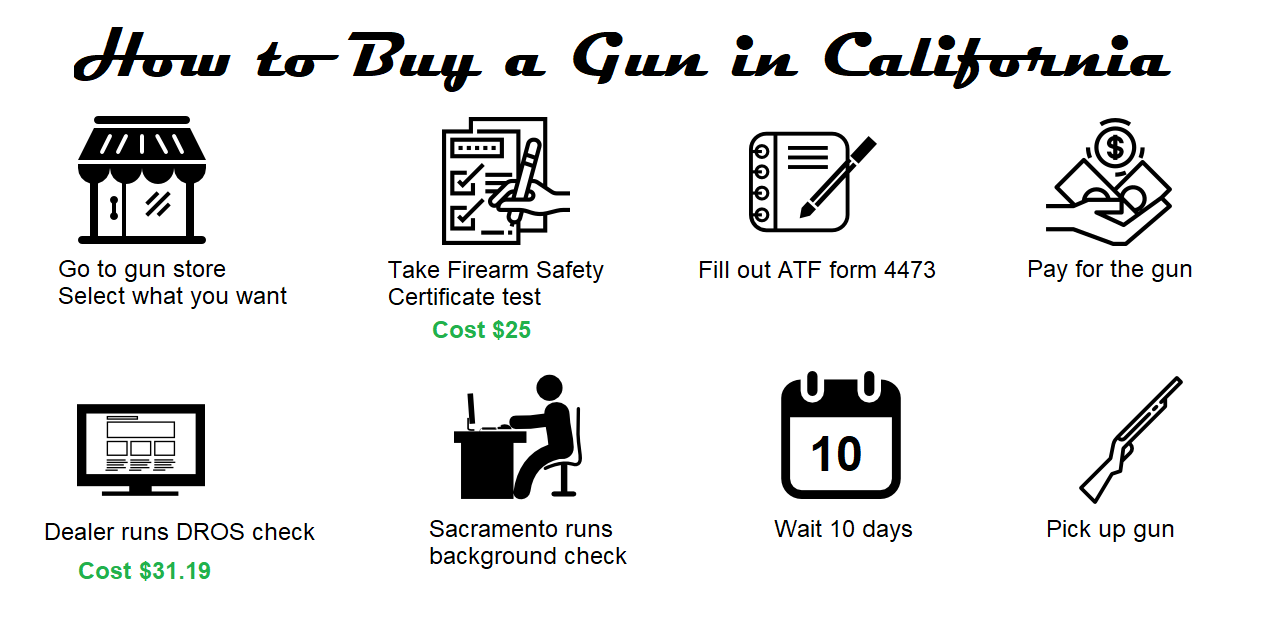
- Firearm Safety Certificate (FSC): With limited exceptions, anyone wishing to purchase a firearm in California must possess a valid Firearm Safety Certificate (FSC). This certificate is obtained by passing a written test, typically administered by a licensed firearm dealer, demonstrating knowledge of firearm safety laws and practices. The FSC is valid for five years and is a prerequisite for both handgun and long gun purchases.
- Proof of Identity: A valid California Driver’s License or Identification Card is required. The address on your ID must match your current residence, or you will need to provide additional proof of residency.
Meeting all these criteria is non-negotiable. Any discrepancy or failure to meet a single requirement will halt the purchase process.
The Step-by-Step Process of Firearm Acquisition
Once eligibility is confirmed, the actual purchase process involves several distinct steps, each with its own requirements and waiting periods. Navigating these steps meticulously is key to a successful and legal firearm acquisition in California.
Finding a Licensed Dealer
All firearm sales in California, including private party transfers, must go through a licensed firearm dealer, known as a Federal Firearms Licensee (FFL). These dealers are authorized by both federal and state governments to conduct firearm transactions.
- Locating an FFL: You can find FFLs in your area through online searches, firearm manufacturer websites, or local directories. Reputable FFLs will be knowledgeable about current California laws and can guide you through the process.
- Choosing a Firearm: Once at the FFL, you can select the firearm you wish to purchase. It is crucial at this stage to ensure the firearm is legal for sale in California. For handguns, this means checking if it is on the California Department of Justice’s Roster of Certified Handguns. For long guns, you must ensure it does not fall under the state’s “assault weapon” definitions.
The Background Check and Waiting Period
This stage involves the submission of paperwork and the mandatory delay before you can take possession of your firearm.
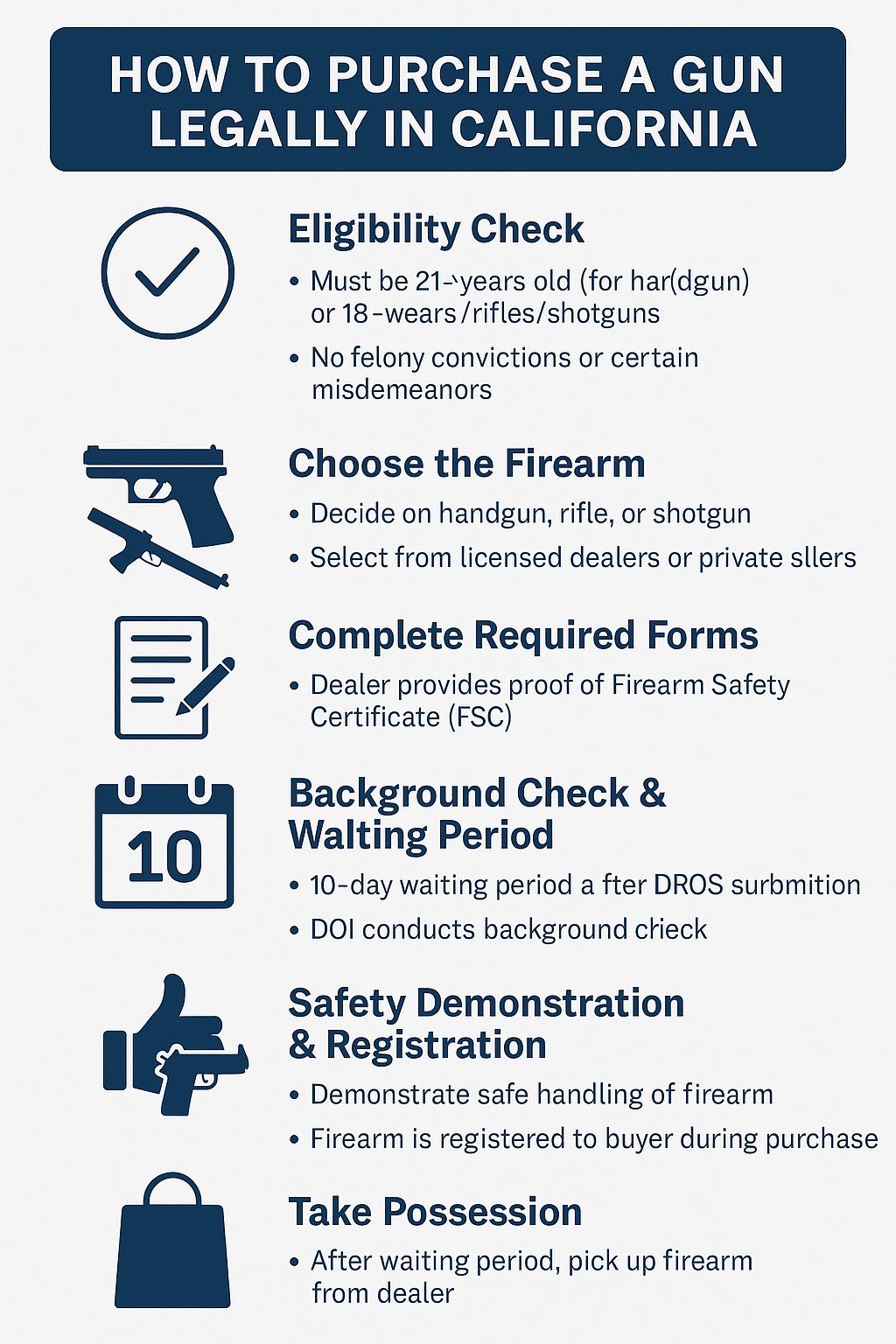
- Completing Federal and State Forms: You will be required to complete two primary forms:
- Federal Form 4473 (Firearms Transaction Record): This is a federal document issued by the Bureau of Alcohol, Tobacco, Firearms and Explosives (ATF). It requires you to provide personal information and answer a series of questions designed to determine your eligibility to own a firearm under federal law. Lying on this form carries severe federal penalties.
- State DROS (Dealer Record of Sale) Form: This form initiates the California background check through the California Department of Justice. It captures details about you and the firearm being purchased. The FFL will submit this electronically to the California Department of Justice.
- Firearm Safety Certificate (FSC) Check: If you do not already possess a valid FSC, you will need to take and pass the FSC test at the FFL. The test consists of 30 multiple-choice questions, and a score of 75% or higher is required to pass. The FFL will then issue your certificate.
- 10-Day Waiting Period: After all paperwork is submitted and approved by the FFL, a mandatory 10-day waiting period begins. This period is a cooling-off period, designed to prevent impulsive acts of violence and allow time for the background check to be thoroughly processed by the California Department of Justice. This waiting period applies to all firearm purchases in California, without exception, regardless of whether you already own other firearms.
- Passing the DROS Background Check: During the 10-day waiting period, the California Department of Justice conducts a comprehensive background investigation. If you pass, the FFL will receive notification. If you are denied, you will be informed of the reason, and there are processes to appeal a denial.
- Taking Possession: Once the 10-day waiting period has elapsed and the California Department of Justice has cleared you, you can return to the FFL to pick up your firearm. At this point, the FFL will typically conduct a safe handling demonstration, ensuring you understand how to safely operate and store your new firearm. They will also verify your identity one final time.
This entire process, from selecting the firearm to taking possession, can take anywhere from 10 days to several weeks, depending on the individual circumstances and the efficiency of the background check system. Patience and careful adherence to each step are crucial.
Types of Firearms and Legal Restrictions
California’s strict gun laws are particularly focused on regulating the types of firearms available for purchase and the features they may possess. This is where many prospective buyers encounter significant restrictions that differ greatly from other states.
Handguns: Rosters and Safe Handling Demonstrations
Purchasing a new handgun in California is subject to the state’s “Roster of Certified Handguns.” This roster lists specific handgun models that have been tested and certified by the California Department of Justice as meeting various safety requirements.
- The Roster: For a handgun model to be added to the roster, it must incorporate specific safety features, including a loaded chamber indicator, a magazine disconnect mechanism, and, controversially, microstamping technology. The microstamping requirement, which mandates that firearms uniquely mark bullet casings upon firing, has significantly limited the number of new models that can be added to the roster, as very few manufacturers currently produce handguns with this feature. This effectively means that many popular handgun models available elsewhere in the United States are not available for direct purchase by civilians in California unless bought through specific exemptions (e.g., private party transfer, law enforcement sales).
- Safe Handling Demonstration: As part of the handgun purchase process, you must demonstrate to the FFL that you are capable of safely loading, unloading, and operating the specific handgun you are purchasing. This is often done using a dummy round.
Rifles and Shotguns: Specific Considerations
While long guns (rifles and shotguns) are not subject to the Roster of Certified Handguns, they are still heavily regulated, particularly concerning features that might classify them as “assault weapons.”
- “Assault Weapon” Ban: California has a comprehensive ban on “assault weapons,” which are defined not only by specific makes and models but also by certain cosmetic and functional features. For rifles and shotguns, this includes features such as pistol grips, adjustable stocks, flash suppressors, grenade launchers, and certain types of magazine releases if they are paired with a detachable magazine. Compliance often involves purchasing “featureless” rifles (without these banned features) or rifles with fixed magazines that require disassembly to reload.
- Registration: Certain firearms that were legally purchased or possessed before the “assault weapon” ban expanded might be “grandfathered” in, but they must be registered with the California Department of Justice. New purchases cannot fall under these categories.
Prohibited Firearms and Features
Beyond specific “assault weapons,” several other categories of firearms and features are outright prohibited in California.
- Magazine Capacity Limits: The possession, sale, or transfer of magazines capable of holding more than 10 rounds of ammunition is generally prohibited. If you own such magazines legally acquired prior to the ban (often referred to as “high-capacity magazines”), they are typically grandfathered in, but you cannot purchase new ones.
- Short-Barreled Rifles and Shotguns: These are generally illegal to possess without special federal permits, which are rarely granted to civilians in California.
- Silencers/Suppressors: These devices are also largely prohibited for civilian ownership in California.
- Armor-Piercing Ammunition: The sale or possession of armor-piercing handgun ammunition is prohibited.
These restrictions are paramount. Attempting to purchase or possess a prohibited firearm or accessory can lead to severe felony charges, including significant fines and lengthy prison sentences. Always consult with your FFL or a qualified legal expert if you have any doubts about a firearm’s legality in California.
Post-Purchase Responsibilities and Ownership
Acquiring a firearm in California is just the first step; responsible ownership entails a continuous commitment to safety, compliance with storage and transportation laws, and an understanding of when and how a firearm may legally be used. California places significant emphasis on these post-purchase responsibilities to ensure public safety and prevent accidents or misuse.
Safe Storage and Transportation
California has specific laws governing the safe storage and transportation of firearms, primarily aimed at preventing accidental shootings, theft, and unauthorized access, particularly by minors.
- Secure Storage: When not in your immediate control, all firearms must be stored in a locked container or rendered inoperable with a locking device (e.g., a trigger lock or cable lock). This applies within the home, even if no children reside there, and is especially critical when children or prohibited persons might have access to the premises. The purpose is to prevent unauthorized access and reduce the risk of tragic accidents or firearms being used in crimes. Failure to securely store a firearm can result in criminal penalties, especially if a minor or prohibited person gains access to it.
- Transportation: When transporting a handgun in a vehicle, it must be unloaded and stored in a locked container, separate from any ammunition, and not visible from outside the vehicle. This locked container can be the vehicle’s trunk, a locked glove compartment, or a specific firearm case. For long guns (rifles and shotguns), they must also be unloaded during transport, but the requirement for a locked container varies depending on whether you are transporting them in a vehicle or openly carrying them. Generally, it’s safest and recommended to transport all firearms unloaded and in a locked container to avoid any ambiguity. There are also specific rules about transporting firearms through “gun-free zones,” such as school grounds or government buildings, where even unloaded and locked firearms may be prohibited.
Understanding Use-of-Force Laws and Training
Owning a firearm carries immense responsibility, and understanding the legal parameters for its use is paramount. California has strict laws regarding self-defense and the justifiable use of deadly force.
- Self-Defense Laws: In California, individuals have the right to use reasonable force, including deadly force, to protect themselves or others from imminent death or great bodily injury. However, the use of deadly force must be objectively reasonable given the circumstances. This is a complex area of law, and a mistake in judgment can lead to severe criminal charges. The “Castle Doctrine” in California allows for a presumption of reasonable fear of death or great bodily injury if an intruder unlawfully and forcibly enters your home, but this doctrine has limits and nuances.
- Training and Proficiency: While not always legally mandated beyond the FSC, continuous training in firearm safety, handling, and marksmanship is highly recommended. Regular practice helps maintain proficiency and instills confidence in safe operation. Many FFLs and shooting ranges offer courses for new and experienced shooters, covering topics from basic firearm safety to advanced defensive shooting techniques. Participating in such training is a key aspect of responsible gun ownership.
- Concealed Carry Permits (CCW): Obtaining a permit to carry a concealed firearm in California is exceptionally difficult. California is generally a “may-issue” state, meaning that local law enforcement agencies (sheriffs or police chiefs) have significant discretion in issuing permits. Applicants typically need to demonstrate “good cause” beyond general self-defense, undergo extensive background checks, and complete a certified training course. The requirements and issuance rates vary significantly from county to county, with more rural counties often being more permissive than urban areas like Los Angeles or San Francisco. Open carry of loaded or unloaded firearms is also highly restricted or generally prohibited in most public places.
- Ammunition Purchases: Since January 1, 2018, all ammunition purchases in California must go through a licensed ammunition vendor and require an instant background check. This check verifies that the purchaser is not prohibited from owning firearms. This additional layer of regulation ensures that even the consumables for firearms are tracked and controlled.
In conclusion, purchasing a gun in California is a journey through a tightly regulated landscape. From ensuring you meet the stringent eligibility criteria and diligently completing the multi-step acquisition process to understanding the specific restrictions on firearm types and committing to ongoing safe ownership practices, every detail matters. The state’s commitment to public safety means that prospective gun owners must be well-informed, patient, and unwavering in their adherence to the law. While the process may seem daunting, a thorough understanding of these regulations ensures that you can legally and responsibly exercise your right to firearm ownership within the unique legal framework of the Golden State.
LifeOutOfTheBox is a participant in the Amazon Services LLC Associates Program, an affiliate advertising program designed to provide a means for sites to earn advertising fees by advertising and linking to Amazon.com. Amazon, the Amazon logo, AmazonSupply, and the AmazonSupply logo are trademarks of Amazon.com, Inc. or its affiliates. As an Amazon Associate we earn affiliate commissions from qualifying purchases.