
The New York City Subway isn’t just a mode of transportation; it’s a living, breathing artery of one of the world’s most dynamic urban centers. For anyone planning a visit to the United States‘ most iconic city, understanding the subway’s history is key to appreciating its enduring legacy and its vital role in modern New York City life. This colossal subterranean network, a marvel of engineering and a testament to urban ambition, officially opened its doors to the public on October 27, 1904. Yet, the story of its construction is far more complex, a tale woven with decades of visionary planning, intense competition, and groundbreaking innovation that truly began much earlier.

As a landmark, an attraction, and an essential travel guide component, the New York City Subway offers a unique experience. Its history reveals much about the city’s relentless growth, its architectural ambition, and its diverse population. From its humble beginnings to its expansive current state, the subway system has continuously shaped how residents and tourists alike navigate the five boroughs. Embarking on a subway journey is not merely about getting from point A to point B; it’s an immersion into local culture, a glimpse into the city’s past, and a direct encounter with the pulse of millions. Whether you’re a luxury traveler exploring upscale districts or a budget traveler seeking efficient ways to see countless attractions, the subway is an indispensable part of the New York City experience.
The Vision Beneath the City Streets: Early Challenges and Innovators
Before the grand opening in 1904, New York City was grappling with an escalating transportation crisis. The city, particularly Manhattan, was experiencing unprecedented population growth and commercial expansion in the late 19th century. Horse-drawn omnibuses and elevated trains, while revolutionary in their time, simply couldn’t keep pace with the sheer volume of people needing to move across the island. The streets were perpetually congested, and the “El” lines, as the elevated trains were known, cast dark shadows and generated immense noise, leading to calls for a more efficient, less obtrusive solution: an underground railway.
Precursors to the Modern Subway
The idea of a subterranean transit system was not entirely new. Inspired by pioneering efforts in London, various proposals for underground railways circulated in New York City throughout the mid-1800s. One of the most fascinating, albeit short-lived, experiments was the Beach Pneumatic Transit. In 1870, inventor Alfred Ely Beach secretly constructed a single-track, 312-foot pneumatic subway line under Broadway, running from Warren Street to Murray Street. Passengers sat in a luxurious circular car that was propelled by a giant fan, demonstrating the feasibility of underground travel. While an engineering marvel of its time, Beach’s project faced political opposition and a lack of funding, preventing its expansion into a full-fledged system. Nevertheless, it proved that the technology and public interest were there, laying conceptual groundwork for what was to come.
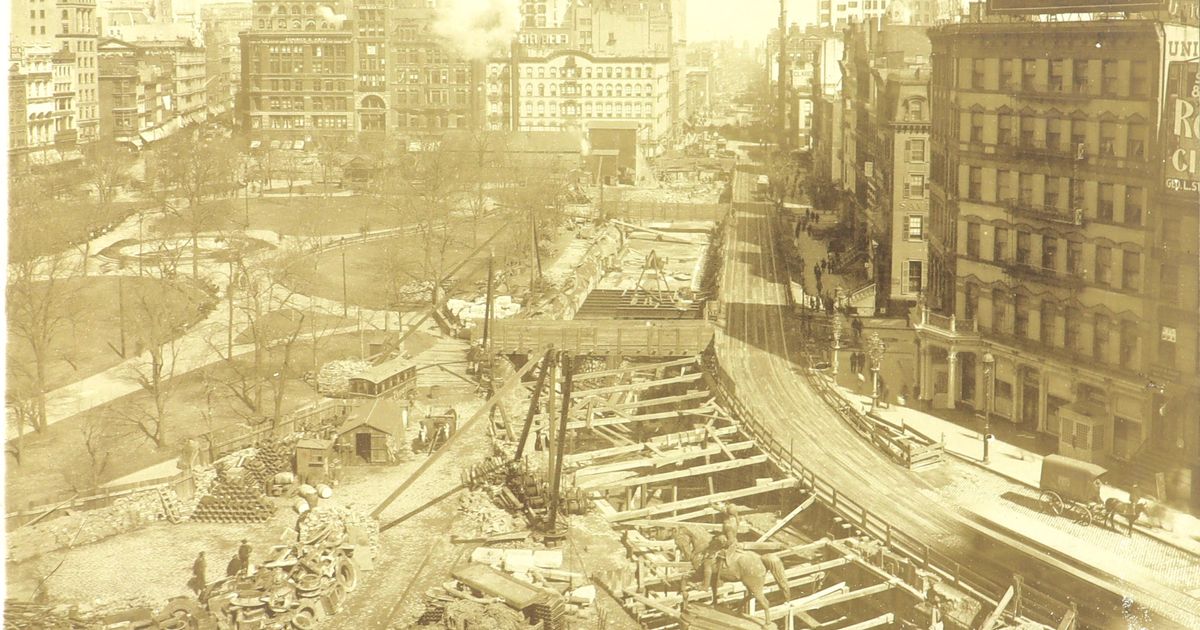
The challenges were immense. Digging beneath a densely populated island, crisscrossed by utility lines and unstable geology, required unprecedented engineering solutions. The “cut-and-cover” method, where streets were trenched open, track laid, and then covered over, dominated much of the early construction. This process was disruptive but effective, allowing the creation of a vast underground network without requiring deep tunneling across the entire length. The ambition was audacious, a testament to New York City’s spirit of innovation, which continues to drive its appeal for business stays and general tourism.
The Birth of a Public System
After decades of debate, political wrangling, and various failed private ventures, the city finally took control of the subway’s development. In 1894, the Rapid Transit Act was passed, paving the way for public funding and oversight. The contract to build and operate the first subway line was awarded to the Interborough Rapid Transit Company (IRT), led by financier August Belmont Jr.. Construction began on March 24, 1900, with groundbreaking ceremonies held at City Hall Park.
The momentous day finally arrived on October 27, 1904. Amidst widespread public excitement, the New York City Subway officially opened. Mayor George B. McClellan himself piloted the first train from the exquisite City Hall Station northward. The initial line stretched 9.1 miles, boasting 28 stations, running from City Hall in Lower Manhattan all the way up to 145th Street in Harlem. This route followed what would become the IRT Broadway-Seventh Avenue Line and the IRT Lexington Avenue Line (though these specific designations came later with expansion). The opening was met with overwhelming enthusiasm; over 100,000 people rode the subway on its inaugural day, eager to experience the future of urban travel. The nickel fare was a symbol of accessibility, making the city more navigable for everyone, from daily commuters to visitors exploring new attractions.
Expanding the Labyrinth: Growth, Competition, and Unification
The immediate success of the New York City Subway spurred rapid expansion, but also intense competition. The city quickly realized the single IRT system was insufficient to serve its burgeoning population. Different companies, driven by their own interests and visions, began to carve out their own transit empires, leading to a complex and often fragmented network.
Rival Networks Emerge
The IRT continued to expand its lines, reaching further into Harlem, the Bronx, and under the East River to Brooklyn. However, it wasn’t long before new players entered the field. The Brooklyn-Manhattan Transit Corporation (BMT) emerged from the consolidation of various elevated and surface lines in Brooklyn. The BMT focused on connecting Brooklyn to Manhattan and Queens, building iconic lines like the BMT Broadway Line that served major commercial arteries. These new lines provided crucial links to growing residential areas and future attractions like Coney Island.
Later, in the 1920s and 30s, the City of New York itself decided to build and operate its own subway system, independent of the existing private companies. This led to the creation of the Independent Subway System (IND). The IND lines were generally larger, with wider cars and more spacious stations, reflecting a more modern design philosophy. They were strategically built to serve areas not adequately covered by the IRT or BMT, such as parts of Queens and western Manhattan, alleviating congestion on the private lines and bringing mass transit to underserved communities. This period of competitive expansion laid the intricate groundwork for the subway map we know today, with each company leaving its distinct mark on the city’s underground architecture and operational practices. Exploring these different lines offers a fascinating journey through the city’s historical development and diverse neighborhoods, a key part of any comprehensive guide to New York City travel.
The Era of Unification
While competition spurred growth, it also led to inefficiencies and frustrations for riders. The three separate systems (IRT, BMT, and IND) often had different fares, incompatible train sizes, and limited transfers between lines, making seamless travel across the city a challenge. The city recognized that a unified system was essential for truly effective mass transit.

This vision came to fruition on June 1, 1940, when the City of New York officially acquired the IRT and BMT companies, consolidating them with the existing IND under the single administrative body of the Board of Transportation. This historic unification allowed for integrated planning, standardized fares, and eventually, improved inter-system transfers, greatly enhancing the efficiency and convenience of urban travel. In 1953, the New York City Transit Authority (NYCTA) was established to operate the unified system, later becoming part of the larger Metropolitan Transportation Authority (MTA) in 1968. This marked the end of the competitive era and the beginning of a unified public transit system that would become the backbone of New York City‘s infrastructure and a crucial element for all tourism and travel experiences.
The Subway as a Landmark and Cultural Icon
Beyond its functional role, the New York City Subway has evolved into a landmark in its own right, a sprawling subterranean museum reflecting distinct eras of architectural design and artistic expression. It’s a place where history intertwines with daily life, and where millions of stories unfold every day.
Architectural Wonders Underground
The early subway stations, especially those built by the IRT, are often hailed as architectural masterpieces. The original City Hall Station, while no longer in active service, is a stunning example with its vaulted Guastavino tile arches, brass chandeliers, and elaborate skylights. Many other stations from the early 1900s, such as those at Grand Central Terminal or along the IRT Lexington Avenue Line, feature intricate mosaic work, often depicting the station’s name or a local landmark. These designs were not merely decorative; they also served as functional wayfinding elements in a time before widespread literacy and standardized signage. Each mosaic and tile pattern tells a story, offering a fascinating glimpse into the city’s past and showcasing the craftsmanship of the era.
As the system expanded, later stations adopted different styles, from the more utilitarian aesthetics of the IND lines to modern renovations incorporating contemporary art. The subway itself, therefore, becomes an underground gallery, a unique attraction that provides a backdrop to the diverse local culture. For visitors interested in architecture, history, and unique experiences, a self-guided tour of the most beautiful subway stations is a recommended item on any travel guide. It’s an immersion into New York City’s identity, a blend of functionality and artistry that few other cities can boast.
A Lifeline for Millions: Tourism and Daily Life
The New York City Subway is unequivocally the lifeblood of the city. It carries millions of passengers every day – residents commuting to work, students heading to classes, and, crucially, tourists exploring the vast array of attractions. For visitors, the subway is an indispensable tool, connecting iconic destinations with remarkable efficiency and affordability. Want to see a show on Broadway? The subway will take you directly to Times Square. Planning a serene afternoon in Central Park or a cultural immersion at the Metropolitan Museum of Art? The subway has multiple stops convenient to both. Exploring the financial hub of Wall Street or catching a ferry to the Statue of Liberty from Battery Park? The subway is your fastest route.
Its extensive reach across Manhattan, Brooklyn, Queens, and the Bronx makes it an essential part of any budget travel plan, allowing visitors to save on expensive taxis or ride-shares while experiencing the city like a local. For families, navigating the subway can be an adventure in itself, providing quick access to family-friendly attractions like the Empire State Building, Rockefeller Center, or even the beaches of Coney Island. The subway isn’t just a means of transport; it’s an experience that defines New York City’s vibrant, fast-paced lifestyle, offering a continuous parade of diverse people and unexpected moments. It’s truly a microcosm of the city itself, making it a crucial element for anyone seeking an authentic New York experience.
Modern Challenges and Future Horizons
Even after more than a century of operation, the New York City Subway continues to evolve, facing new challenges and embracing future possibilities. Maintaining such an aged and expansive system is a monumental task, but the commitment to modernization ensures its enduring legacy for generations to come.
Maintaining a Century-Old System
Operating a system built primarily in the early 20th century presents unique challenges. Decades of continuous use, combined with the harsh underground environment, necessitate constant maintenance, repairs, and technological upgrades. The Metropolitan Transportation Authority (MTA), which oversees the subway, invests billions of dollars annually in infrastructure improvements, signal modernizations, track repairs, and station renovations. Projects like replacing old signal systems with modern Communication-Based Train Control (CBTC) are crucial for increasing capacity and reliability. Efforts are also continuously made to improve accessibility, with more stations being retrofitted with elevators and ramps, enhancing the experience for all travelers, including those with mobility challenges.
The balancing act between preserving the subway’s rich historical character and adapting to modern demands is ongoing. While some older stations are being restored to their original grandeur, others are receiving contemporary upgrades to improve passenger flow, safety, and amenities. This constant state of renewal ensures that the subway remains a functional and iconic part of New York City, a testament to its enduring importance. For those interested in urban planning and engineering, observing the subway’s ongoing transformation offers a compelling insight into the complexities of managing a global metropolis.
The Subway’s Enduring Legacy
From its pioneering pneumatic experiments to its status as one of the world’s most extensive rapid transit networks, the New York City Subway is a monument to human ingenuity and resilience. It transformed New York City from a collection of fragmented communities into a unified metropolis, facilitating commerce, culture, and social interaction on an unprecedented scale. It’s not just a collection of tracks and tunnels; it’s a dynamic ecosystem that reflects the city’s constant evolution.
For any visitor, riding the subway is more than just transportation; it’s an immersive cultural experience. It offers a raw, unfiltered look at the diversity and energy that define New York City. Whether you’re heading to the vibrant lights of Times Square, the historic significance of the World Trade Center and One World Observatory, or a quiet neighborhood for a local culinary experience, the subway is your reliable guide. Its history is deeply intertwined with the city’s identity, making it one of the most significant landmarks and a continuous source of fascination for tourists and residents alike. The subway stands as a living testament to the belief that even the most ambitious visions can be brought to life, forging connections that last more than a century.
In conclusion, the New York City Subway officially opened on October 27, 1904, marking the beginning of a transformative era for urban transit. However, its story encompasses decades of bold ideas, competitive expansion, and eventual unification, culminating in the intricate, indispensable network we see today. More than a century later, this underground marvel continues to be a vital artery, an architectural showcase, and an indelible cultural symbol of one of the world’s greatest cities. For any traveler, experiencing the subway is not just about convenience; it’s about connecting with the very heart and soul of New York City.
LifeOutOfTheBox is a participant in the Amazon Services LLC Associates Program, an affiliate advertising program designed to provide a means for sites to earn advertising fees by advertising and linking to Amazon.com. Amazon, the Amazon logo, AmazonSupply, and the AmazonSupply logo are trademarks of Amazon.com, Inc. or its affiliates. As an Amazon Associate we earn affiliate commissions from qualifying purchases.