
The story of how America acquired Texas is a compelling saga woven with threads of ambition, migration, revolution, and war. It’s a journey that transformed the geopolitical landscape of North America and continues to shape the identity of one of the United States’ most distinctive states. For travelers and history enthusiasts alike, understanding this rich past offers an unparalleled perspective on the vibrant culture, enduring landmarks, and unique lifestyle found across the Lone Star State today. From the ancient mission trails to the battlefields where independence was forged, the echoes of this history invite exploration and deeper appreciation.
The Lure of the Lone Star Land: Early Encounters and American Migration
Long before it became a battleground for independence and annexation, the vast territory known as Texas was a frontier region claimed by various empires and home to indigenous peoples for millennia. Its strategic location, fertile lands, and promise of new beginnings made it an irresistible magnet for different cultures seeking to expand their influence and fortunes.
Spanish and Mexican Texas: A Contested Frontier
In the early 16th century, Spanish explorers, including Álvar Núñez Cabeza de Vaca, became some of the first Europeans to set foot in what would become Texas. For centuries, Spain asserted control over this sprawling territory, establishing missions, presidios (forts), and small settlements like San Antonio de Valero (later famously known as the Alamo) and Nacogdoches. These efforts, however, were often met with resistance from various native groups and struggled to attract a large Spanish civilian population. The region, then known as Tejas, remained sparsely populated and largely untamed, serving primarily as a buffer zone against incursions from the French to the east and American expansion from the north.
When Mexico achieved its independence from Spain in 1821, Tejas became part of the new Mexican nation, specifically as a province within the larger state of Coahuila y Tejas. The young Mexican government, facing challenges in securing its vast northern frontier and eager to develop the region, adopted a policy that would inadvertently sow the seeds of future conflict: encouraging foreign settlement.
The Empresario System and the Anglo-American Influx
To populate Tejas and solidify its claims, the Mexican government implemented the “empresario” system. This innovative approach granted land agents, known as empresarios, large tracts of land in exchange for recruiting and settling hundreds of families. The most prominent and successful of these empresarios was Stephen F. Austin, a Missouri native who took over his father’s grant. In 1821, Austin led his first group of 300 Anglo-American families, famously known as the “Old Three Hundred,” to settle along the Brazos River.
The terms of settlement were clear: newcomers had to become Mexican citizens, abide by Mexican laws, and convert to Roman Catholicism. Despite these requirements, the allure of cheap, fertile land—significantly cheaper than in the United States—drew thousands of Americans into Texas. By the mid-1830s, the Anglo-American population in Texas swelled to an estimated 30,000, outnumbering the native Tejano (Mexican-Texan) population by more than six to one. This demographic shift was critical, as the cultural and political differences between the predominantly Protestant American settlers and the Catholic Mexican government began to create deep fissures, setting the stage for an inevitable confrontation.
A Revolution Ignites: The Birth of a New Nation
The growing tensions between the Mexican government and the Anglo-American colonists ultimately erupted into open rebellion. This period, often romanticized in American history, was a brutal and transformative chapter that birthed an independent republic.
Seeds of Conflict: Cultural Clashes and Political Grievances
Several factors fueled the growing discontent among the Texan colonists. Cultural differences were paramount; the American settlers, accustomed to self-governance and individual freedoms under a common law system, chafed under Mexican civil law and the centralized authority of the Mexican government. The official religion of Catholicism was often ignored by the largely Protestant settlers, leading to friction.
Economic issues also played a significant role. The colonists relied heavily on trade with the United States and were increasingly frustrated by Mexican tariffs and trade regulations. Perhaps most contentiously, many American settlers brought enslaved Africans with them, despite Mexico’s gradual abolition of slavery. The Mexican government’s attempts to enforce anti-slavery laws were met with defiance, highlighting a fundamental clash of values.
Politically, the colonists were deeply alarmed by Mexico’s shift from a federalist republic to a more centralized, autocratic government under General Antonio López de Santa Anna. In 1830, Mexico passed the Law of April 6, 1830, which aimed to curb further American immigration, cancel existing empresario contracts, and impose customs duties. This law, combined with increased military presence and the suspension of the 1824 Mexican Constitution, was seen by Texans as a direct threat to their liberties and economic prosperity. Petitions and calls for greater autonomy escalated into cries for outright independence.
From Gonzales to San Jacinto: Key Battles for Independence
The Texas Revolution officially began in October 1835 with the “Come and Take It” battle in Gonzales, where Texan settlers famously resisted Mexican attempts to reclaim a cannon. This skirmish ignited a full-blown rebellion. Early Texan victories, such as the capture of Goliad and San Antonio in late 1835, emboldened the revolutionaries.
However, the tide soon turned. In early 1836, General Santa Anna personally led a massive Mexican army into Texas to crush the rebellion. The most iconic and tragic event was the Siege of the Alamo in San Antonio. For 13 days, a small force of around 200 Texan defenders, including legendary figures like Davy Crockett, Jim Bowie, and William B. Travis, held out against thousands of Mexican troops. On March 6, 1836, the Alamo fell, and all defenders were killed. A few weeks later, another group of Texan forces, approximately 340 men, were massacred at Goliad after surrendering. These brutal losses galvanized the remaining Texans and fueled their determination for independence.
Meanwhile, on March 2, 1836, while the Alamo was under siege, a convention of delegates at Washington-on-the-Brazos formally declared Texas’ independence from Mexico and adopted a constitution for the new Republic of Texas. Sam Houston was appointed commander-in-chief of the Texan Army. The decisive battle came on April 21, 1836, at the Battle of San Jacinto. Houston’s forces, numbering around 900 men, launched a surprise attack on Santa Anna’s larger Mexican army, reportedly shouting “Remember the Alamo!” and “Remember Goliad!” The battle lasted only 18 minutes, resulting in a stunning Texan victory and the capture of Santa Anna himself. This victory secured Texas’ independence.
The Republic Years and the Road to Annexation
With independence secured, Texas embarked on a tumultuous decade as a sovereign nation, navigating international relations and grappling with its eventual destiny: joining the United States.

The Republic of Texas: A Decade of Independence
From 1836 to 1845, Texas existed as an independent nation, the Republic of Texas. Sam Houston was elected its first president, and the capital was eventually established in the city named after him, Houston, before moving to Austin. The new republic faced immense challenges: an empty treasury, continued threats from Mexico (which refused to recognize its independence), border disputes, and conflicts with Native American tribes.
Despite these difficulties, the Republic of Texas developed its own unique character and institutions. It sought recognition from major world powers, successfully gaining it from the United States, France, and Great Britain. For travelers visiting Texas today, the spirit of this independent era is still palpable in historical sites like Washington-on-the-Brazos State Historic Site, where the declaration of independence was signed, offering a tangible connection to this formative period.
The Great Annexation Debate: US Ambition Meets Texan Desire
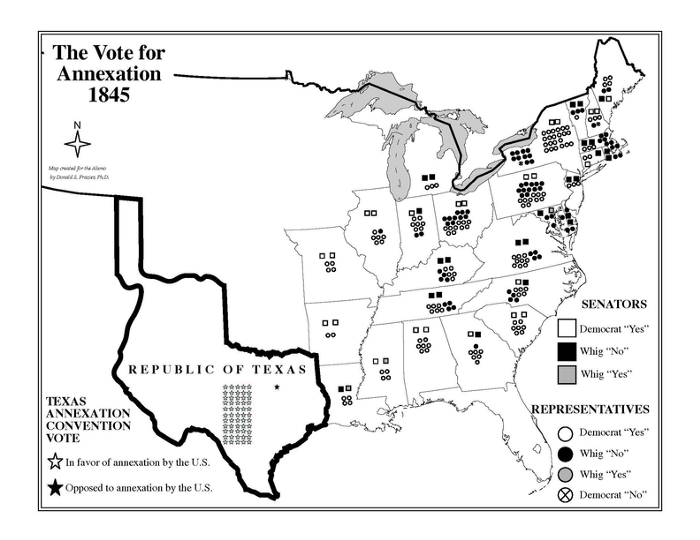
From the moment of its independence, the question of Texas’ annexation by the United States was a dominant political issue. Many Texans, having originally emigrated from the US, strongly desired to join the Union. This sentiment was also popular in the Southern United States, where the addition of Texas as a slave state would bolster their political power.
However, annexation was a contentious issue within the United States Congress. Northern abolitionists vehemently opposed it, fearing it would expand slavery and upset the delicate balance of free and slave states. Furthermore, the US government was wary of provoking a war with Mexico, which still considered Texas a rebellious province. For nearly a decade, the issue remained a political football.
The turning point came with the election of James K. Polk to the US presidency in 1844. Polk, a strong proponent of manifest destiny—the belief that the United States was destined to expand across the North American continent—made the annexation of Texas a central promise of his campaign. Following his election, the outgoing President John Tyler, acting on the mandate of Polk’s victory, pushed through a joint resolution in Congress offering Texas annexation. On December 29, 1845, Texas officially became the 28th state of the United States, fulfilling the aspirations of many of its citizens and significantly expanding the nation’s territory.
The Mexican-American War and the Definitive Border
The annexation of Texas did not come without consequences. It immediately ignited a long-simmering border dispute with Mexico, ultimately leading to a full-scale war that profoundly reshaped the map of North America.
A Conflict of Claims: The Nueces vs. Rio Grande Dispute
Upon annexation, the United States inherited Texas’ disputed southern border. While the Republic of Texas claimed its border extended to the Rio Grande (as defined in the Treaty of Velasco signed by Santa Anna under duress), Mexico maintained that the historical boundary of Tejas was the Nueces River, about 150 miles to the north. This left a vast strip of land between the two rivers, fertile and strategically important, in contention.
President Polk, committed to territorial expansion, ordered General Zachary Taylor to move US troops into the disputed territory between the Nueces and the Rio Grande. When Mexican forces attacked a US cavalry patrol in this area in April 1846, Polk declared that Mexico had “shed American blood upon American soil,” providing a casus belli for the Mexican-American War.
The Treaty of Guadalupe Hidalgo and the Mexican Cession
The Mexican-American War (1846-1848) was a swift and decisive victory for the United States. American forces, including those led by future presidents Zachary Taylor and Winfield Scott, successfully invaded Mexico, capturing Mexico City. The war concluded with the signing of the Treaty of Guadalupe Hidalgo on February 2, 1848.
Under the terms of this treaty, Mexico formally recognized the annexation of Texas and definitively accepted the Rio Grande as the border. More significantly, Mexico ceded vast territories—what became known as the Mexican Cession—to the United States in exchange for $15 million. This colossal land transfer included all or parts of present-day California, Nevada, Utah, Arizona, New Mexico, Colorado, and Wyoming. The acquisition of Texas and the subsequent Mexican Cession dramatically expanded the territory of the United States, stretching its borders from the Atlantic to the Pacific Ocean and fulfilling the vision of manifest destiny.
Texas Today: A Legacy Forged in History
The intricate process by which America acquired Texas is more than just a historical footnote; it is the foundational narrative that continues to define the state’s identity, culture, and very landscape. This layered history offers countless opportunities for travelers to connect with the past and experience the vibrant present.
Exploring the Historical Footprints
For those drawn to history, Texas is a living museum. A visit to San Antonio is incomplete without exploring the iconic Alamo or strolling along the historic River Walk, which winds past Spanish colonial missions that predate the revolution. These missions, now part of the San Antonio Missions National Historical Park and a UNESCO World Heritage Site, offer a glimpse into the earlier Spanish era. Further east, the San Jacinto Battleground State Historic Site, with its towering monument, allows visitors to stand on the very ground where Texan independence was won.
The cities of Austin, the state capital, and Houston, a bustling metropolis, bear the names of key figures in the annexation story. Even smaller towns across Texas often boast historical markers, museums, and restored buildings that tell tales of the empresario grants, pioneer life, and the struggles for a new beginning. Whether you’re interested in booking a heritage tour, finding charming boutique hotels near historic downtowns, or experiencing local cuisine with Mexican and American influences, Texas offers a diverse range of travel experiences.
The Enduring Spirit of the Lone Star State
The legacy of how America got Texas is deeply embedded in the state’s identity. It explains the fierce independence, the blend of Anglo-American and Hispanic cultures, and the “larger than life” reputation often associated with Texans. This complex history provides a rich backdrop for exploring the state’s vibrant tourism scene, from its dramatic natural landscapes to its bustling urban centers.
Understanding this journey—from a sparsely settled Spanish frontier to a Mexican province, an independent republic, and finally a cornerstone of the United States—is essential for truly appreciating the unique character of Texas today. It’s a testament to the enduring human quest for land, freedom, and a place to call home, a story that continues to resonate with visitors from around the world. Whether you seek adventure, relaxation, or cultural immersion, Texas provides a rich tapestry of experiences, all set against the dramatic backdrop of its storied past.
LifeOutOfTheBox is a participant in the Amazon Services LLC Associates Program, an affiliate advertising program designed to provide a means for sites to earn advertising fees by advertising and linking to Amazon.com. Amazon, the Amazon logo, AmazonSupply, and the AmazonSupply logo are trademarks of Amazon.com, Inc. or its affiliates. As an Amazon Associate we earn affiliate commissions from qualifying purchases.