
Yes, California is definitively a community property state. For anyone considering marriage, relocating, or investing in the Golden State, understanding this fundamental legal distinction is paramount. Unlike many other states that follow equitable distribution laws, California adheres to a principle of equal ownership and division of assets and debts acquired during a marriage. This legal framework has profound implications for finances, property ownership, and even long-term lifestyle planning for couples, whether they’re settling down, purchasing a vacation home, or exploring business opportunities across the state’s diverse regions from the bustling streets of Los Angeles to the serene vineyards of Napa Valley.
The concept of community property isn’t just a legal formality; it’s a cornerstone of how assets are viewed and managed within a marriage in California. It dictates what belongs to “us” versus what belongs to “me” or “you” individually, a distinction that becomes critically important in situations like divorce, estate planning, or even when seeking credit. For travelers considering extended stays or digital nomads looking to establish residency, this legal landscape can significantly impact how their global assets might be treated under California law.
Understanding Community Property in California
At its core, community property in California dictates that most property acquired by either spouse during the marriage, while living in California, is equally owned by both spouses. This includes everything from income earned to real estate purchased, bank accounts, investments, and even debts incurred. The guiding principle is that marriage is an equal partnership, and contributions to that partnership, financial or otherwise, are equally valued. This stands in stark contrast to the majority of U.S. states that operate under an “equitable distribution” model, where marital assets are divided fairly, but not necessarily equally, based on a judge’s discretion.
What is Community Property?
Community property encompasses a broad range of assets and liabilities. The most common examples include:
- Income and Earnings: Wages, salaries, bonuses, commissions, and any other income earned by either spouse from the date of marriage until the date of separation. This also extends to income generated from community property assets themselves.
- Real Estate: Homes, vacation properties, or investment properties purchased during the marriage using community funds. This could be a primary residence in San Francisco, a luxury apartment in Beverly Hills, or a charming cottage near Lake Tahoe. Even if only one spouse’s name is on the deed, if it was acquired during the marriage with community funds, it’s generally considered community property.
- Personal Property: Vehicles, furniture, art collections, jewelry, and other tangible items acquired during the marriage.
- Investments: Stocks, bonds, mutual funds, retirement accounts (like 401(k)s and IRAs), and business interests established or enhanced during the marriage.
- Debts: Mortgages, car loans, credit card debts, and other obligations incurred by either spouse during the marriage are typically also considered community debts.
The key takeaway is “during the marriage.” The moment two individuals exchange vows, a new legal entity for property acquisition is essentially formed under California law.
What is Separate Property?
While community property dictates shared ownership, California law also recognizes separate property. These are assets that belong exclusively to one spouse and are not subject to equal division in the event of divorce. Separate property typically includes:
- Assets Owned Before Marriage: Any property, real or personal, that a spouse owned prior to the marriage remains their separate property. For instance, if one partner owned a condo in Santa Monica before getting married, that condo (and its accumulated equity up to the marriage date) is generally separate property.
- Gifts and Inheritances: Any gifts received by one spouse individually (not jointly to the couple) or inheritances received by one spouse, before or during the marriage, are considered separate property.
- Proceeds from Separate Property: Income generated solely from separate property (e.g., rental income from a pre-marital investment property) can also remain separate property, provided it is kept separate and not commingled with community funds.
- Personal Injury Awards: Funds received as compensation for personal injuries can sometimes be classified as separate property, depending on the nature of the award.
Understanding the distinction between community and separate property is crucial, especially for individuals entering marriage with significant pre-existing assets or expecting inheritances. Maintaining clear records and keeping these assets segregated can prevent disputes down the line.
The “Date of Marriage” and Its Significance
The “date of marriage” is the foundational timestamp for California’s community property laws. It marks the precise moment when the legal framework shifts from individual ownership to joint community ownership for most acquired assets. Conversely, the “date of separation” is equally significant. This is generally defined as the point when one spouse expresses the intent to end the marriage and acts upon that intent, signaling the end of the accumulation of community property.
For many couples, especially those who may have lived together for years before marrying, the legal “start” of their community property journey might not align with their emotional perception of when they became a unit. This is why official records, like marriage certificates, are so important in California. Any assets or debts acquired between these two dates are generally presumed to be community property, subject to specific exceptions and legal nuances like transmutation agreements or proper tracing of separate funds.
Community Property vs. Equitable Distribution: A National Overview
The U.S. is largely divided into two main categories when it comes to marital property laws: community property states and equitable distribution states. Understanding this difference is not just an academic exercise; it’s vital for couples who might move between states, own property in different jurisdictions, or are simply curious about how their state stacks up.
Most states, encompassing the vast majority of the U.S. population, adhere to the principle of equitable distribution. In these states, when a marriage ends, marital property (which is generally defined as property acquired during the marriage) is divided fairly, but not necessarily equally. A judge will consider various factors to determine a fair division, which could include each spouse’s income, earning capacity, contributions to the marriage (both financial and non-financial, such as childcare or homemaking), duration of the marriage, age and health of each spouse, and more. This discretionary approach allows for flexibility but can also lead to less predictable outcomes. Examples of equitable distribution states include Florida, New York, and Idaho.
In contrast, community property states like California operate under the premise that spouses are equal partners, and thus, all community property should be divided equally (50/50) upon divorce. This simplifies the division process in some ways by removing judicial discretion over the percentage of division, but it often necessitates complex accounting and tracing to correctly identify what constitutes community versus separate property.
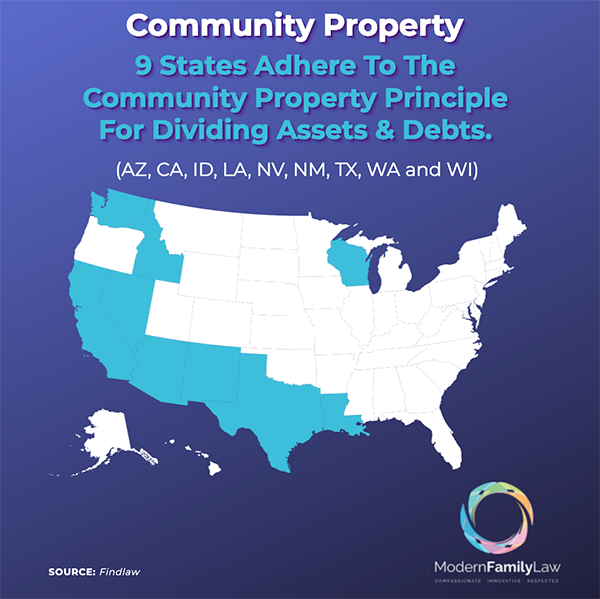
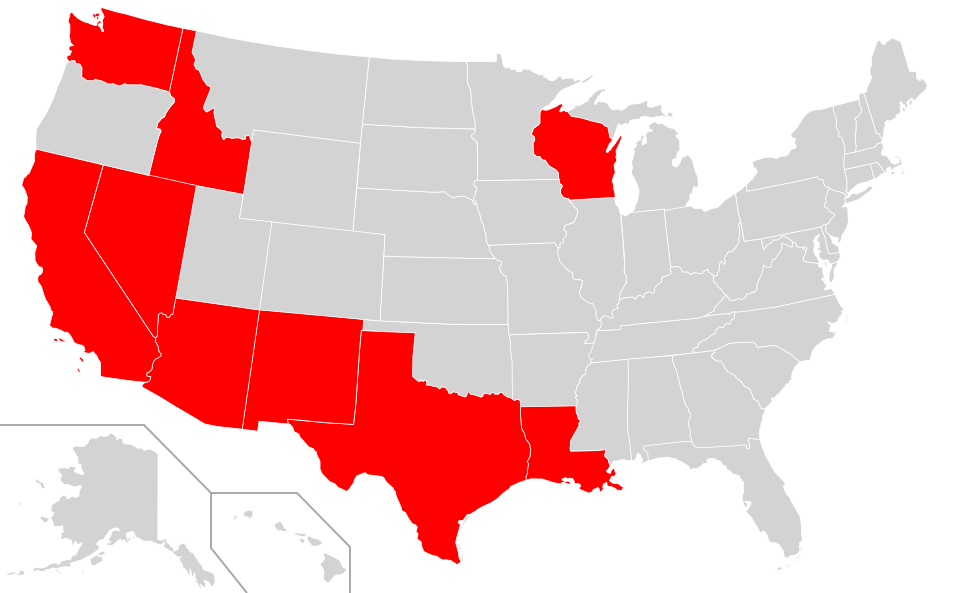
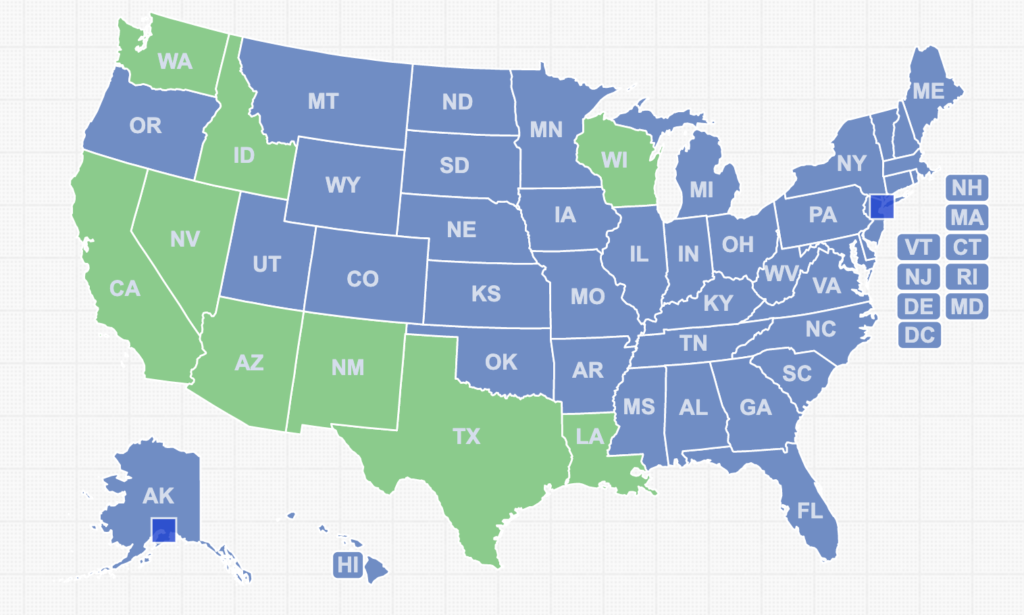
There are currently nine community property states in the U.S.: Arizona, California, Idaho, Louisiana, Nevada, New Mexico, Texas, Washington, and Wisconsin. Additionally, Alaska allows couples to opt into a community property system. For couples moving from an equitable distribution state to California, or vice-versa, understanding how their assets might be reclassified under the new jurisdiction’s laws is a critical consideration that warrants legal counsel.
Navigating Property Division in California
When a marriage in California comes to an end, the community property framework dictates the division process, which can be both straightforward in principle and complex in execution.
Division Upon Divorce
The core principle in California divorce is a 50/50 division of all community assets and debts. This means that after identifying all community property, each spouse is entitled to precisely half of its value. While conceptually simple, achieving this equal division in practice can be intricate. For example, if a couple owns a home in San Diego and one spouse wants to keep it, that spouse would typically need to buy out the other’s 50% interest, or other assets of equal value would be allocated to the other spouse to balance the division. This often involves appraisals, valuations of businesses (especially prevalent in areas like Silicon Valley), and careful accounting of all financial holdings.
Debts are also divided equally. If a couple has a mortgage on their home and credit card debt, these liabilities are split down the middle. This can sometimes mean that one spouse might be responsible for debts incurred primarily by the other, highlighting the interconnected financial lives created by community property laws.
Commingling and Tracing
One of the most challenging aspects of community property law arises when separate property and community property become mixed, a process known as commingling. For instance, if one spouse uses an inheritance (separate property) to make a down payment on a home purchased during the marriage (community property), or if income from a pre-marital investment account (separate property) is deposited into a joint checking account used for household expenses (community property), the separate property has been commingled.
When commingling occurs, the separate property often loses its distinct character and can be presumed to have become community property. However, California law allows for a process called tracing, where a spouse can provide evidence to demonstrate that certain funds or assets originated from their separate property. This typically requires meticulous record-keeping, such as bank statements, receipts, and property deeds, to track the flow of funds and prove their separate origin. Tracing can be a complex and costly endeavor, often requiring forensic accountants, but it’s essential for protecting separate assets that have been inadvertently mixed.
Reimbursement Claims
Another important nuance in California community property law involves reimbursement claims. These arise when one type of property (either separate or community) is used to benefit the other type of property. Common scenarios include:
- Separate Property Used for Community Assets: If one spouse uses their separate funds (e.g., from a pre-marital savings account) to pay for a down payment or make improvements on a community home, they may be entitled to reimbursement for that separate contribution without interest or appreciation.
- Community Property Used for Separate Assets: Conversely, if community funds are used to improve or pay down the mortgage on a separate property owned by one spouse (e.g., a rental property owned before marriage), the community estate may have a right of reimbursement from the separate property.
- Education or Training Expenses: If community funds were used to pay for a spouse’s education or training that substantially enhances their earning capacity, the community may be entitled to reimbursement for those expenses.
These reimbursement claims are designed to ensure fairness and prevent unjust enrichment, allowing spouses to recover contributions made from one estate to the other.
Protecting Your Assets: Prenuptial and Postnuptial Agreements
Given the strict 50/50 division under California’s community property laws, many couples, especially those with significant assets, existing businesses, or children from previous relationships, choose to enter into prenuptial or postnuptial agreements. These legal documents offer a way to customize how assets and debts will be handled, deviating from the standard community property rules.
The Role of Prenuptial Agreements
A prenuptial agreement, often referred to as a “prenup,” is a contract entered into by prospective spouses before marriage. In California, a well-drafted prenup can:
- Reclassify Property: Define what will be considered separate property and what will be community property, overriding the statutory definitions. For example, future earnings could be designated as separate property, rather than community property.
- Protect Pre-Marital Assets: Safeguard assets brought into the marriage by one spouse, such as a family business, an inheritance, or real estate in Palm Springs.
- Address Debts: Determine how pre-marital and future debts will be allocated.
- Outline Spousal Support: Set limits or waive spousal support (alimony) under certain conditions, though courts scrutinize waivers of spousal support heavily to ensure they are not unconscionable.
- Simplify Divorce: Streamline the property division process in the event of a divorce, potentially reducing legal fees and emotional distress.
For a prenuptial agreement to be enforceable in California, specific requirements must be met. Both parties must have independent legal counsel (or waive it in writing), there must be full and fair disclosure of all assets and debts, and the agreement must be signed voluntarily without duress, fraud, or undue influence. The agreement cannot promote divorce or be unconscionable.
Postnuptial Agreements
A postnuptial agreement serves a similar purpose to a prenup but is entered into by spouses during their marriage. Couples might consider a postnup if their financial circumstances change significantly after marriage (e.g., one spouse inherits a large sum, or a business takes off), if they didn’t have a prenup and now wish to formalize their financial arrangements, or if they are attempting to reconcile after a period of marital difficulty.
The enforceability requirements for postnuptial agreements in California are even stricter than for prenups, as spouses owe each other a fiduciary duty during marriage. This means an even higher standard of fair dealing, full disclosure, and independent legal representation is expected to prevent one spouse from taking unfair advantage of the other.
Estate Planning Implications
California’s community property laws also have significant implications for estate planning. When a spouse dies, their half of the community property typically passes according to their will or trust. However, if there is no will or trust, intestate succession laws dictate how community and separate property are distributed. Generally, the surviving spouse inherits the deceased spouse’s half of the community property, alongside a portion of the separate property. Understanding these rules is essential for couples creating wills, trusts, and other estate planning documents to ensure their assets are distributed according to their wishes and to minimize potential probate issues.
Lifestyle and Investment Implications in a Community Property State
For individuals and couples drawn to California’s vibrant culture, stunning landscapes, and dynamic economy, understanding its marital property laws extends beyond legal theory into practical daily living and long-term financial strategy. Whether you’re considering a move, investing in real estate, or simply planning your future, the community property framework touches many aspects of life.
For travelers and digital nomads considering a long-term stay or establishing residency in California, knowing how property acquired during their residency might be classified is crucial. If a couple decides to purchase a condo in San Diego or an Airbnb investment property in Palm Springs while married and residing in California, those assets will almost certainly be considered community property. This means that both spouses have an equal ownership interest, regardless of whose name is on the deed or who contributed more financially. This level of interconnectedness can be a source of security for many couples, but it also necessitates joint decision-making and awareness regarding property management and potential disposition.
Investment in the Golden State takes on a unique dimension for married couples. Imagine a couple deciding to invest in a burgeoning tech startup in Silicon Valley or a luxury resort development near Yosemite National Park. Any profits or equity gained from these ventures during the marriage would be community property. This encourages joint investment strategies and shared risk, as the rewards (and liabilities) are equally distributed. For those with significant separate property, careful structuring of investments or the use of prenuptial/postnuptial agreements can help maintain the separate character of those funds while still pursuing opportunities within the state.
Even aspects of lifestyle, such as acquiring luxury assets like a yacht for exploring Catalina Island or a private jet for business travel, are governed by these laws. If purchased during the marriage with community funds, these high-value items are joint assets. This impacts not only who technically owns them but also how they might be insured, maintained, and ultimately divided if the marriage were to end.
Furthermore, for couples relocating to California from other states, the concept of “quasi-community property” becomes relevant. This refers to property acquired by either spouse while residing in a non-community property state that would have been community property had they been living in California at the time of acquisition. Upon divorce or death in California, quasi-community property is treated largely like community property, ensuring that the 50/50 division principle applies even to assets brought into the state from elsewhere. This means a couple moving from, say, Florida to California might find assets they considered individually owned in Florida become subject to California’s equal division rules if they divorce there.
In conclusion, California’s status as a community property state is a defining legal characteristic with far-reaching implications. For residents, investors, and even long-term visitors, a clear understanding of these laws is essential for informed decision-making regarding finances, property, and personal relationships. Whether you’re planning a romantic getaway, investing in a dream home, or simply enjoying the unique California lifestyle, being well-versed in these distinctions can provide peace of mind and strategic advantage.
LifeOutOfTheBox is a participant in the Amazon Services LLC Associates Program, an affiliate advertising program designed to provide a means for sites to earn advertising fees by advertising and linking to Amazon.com. Amazon, the Amazon logo, AmazonSupply, and the AmazonSupply logo are trademarks of Amazon.com, Inc. or its affiliates. As an Amazon Associate we earn affiliate commissions from qualifying purchases.