
Navigating significant life events, particularly those involving loss, can be incredibly challenging. For individuals and families who live a dynamic “life out of the box,” constantly exploring new destinations, or managing affairs across different states and countries, understanding bureaucratic processes becomes even more crucial. Whether you’re a long-term resident of the Golden State, a recent transplant, or an out-of-state individual needing to settle an estate or manage property in California, knowing how to obtain a death certificate is an essential piece of information. This document is far more than just a record; it’s a vital tool required for everything from insurance claims and estate settlement to accessing benefits and making critical travel arrangements.

This comprehensive guide aims to demystify the process of ordering a death certificate in California. We’ll cover who can request one, the different types of certificates available, the necessary steps, where to apply, and crucial considerations for those managing affairs from afar or with international ties. For anyone whose lifestyle involves extensive travel, managing properties in diverse locations, or simply seeking clarity on administrative tasks in the face of bereavement, this information is invaluable.
Understanding the Importance and Who Can Order
A death certificate serves as the official legal record of an individual’s death. It confirms not only the passing but also the date, time, and location of death, along with the cause. This single document unlocks a myriad of necessary post-bereavement processes. From a lifestyle perspective, imagine needing to liquidate assets, close bank accounts, transfer property deeds, or apply for survivor benefits while residing in a different state or even a different country. Without an official death certificate, these tasks can become insurmountable hurdles, causing significant delays and additional stress, especially when travel plans or long-term accommodation bookings are on hold.
The California State Legislature has specific rules dictating who is authorized to receive an “authorized” copy of a death certificate. These restrictions are in place to protect the privacy of the deceased and their family. Understanding these distinctions is paramount before initiating your request, as it directly impacts what type of document you will receive and for what purposes it can be used.
Authorized vs. Informational Copies: Navigating Your Needs
In California, there are two main types of death certificates: “authorized” and “informational.” Knowing which one you need is crucial, as their uses and the eligibility requirements for obtaining them differ significantly.
Authorized Certified Copy:
An authorized certified copy is the official document that can be used for legal purposes. This includes, but is not limited to:
- Settling an estate or probate.
- Claiming life insurance benefits.
- Transferring property ownership.
- Accessing government benefits (e.g., Social Security, veteran benefits).
- Closing bank accounts and other financial instruments.
- Obtaining an Apostille for international use (more on this later).
Due to the sensitive nature of its use, only specific individuals are legally permitted to obtain an authorized certified copy. These include:
- A parent or legal guardian of the deceased.
- A child, grandchild, or sibling of the deceased.
- A current spouse or registered domestic partner of the deceased.
- A funeral director or authorized representative of the funeral establishment handling the disposition of the deceased’s remains.
- A legal representative (e.g., attorney, executor, administrator) of the deceased’s estate, as authorized by statute or court order.
- A party entitled to receive the record as a result of a court order.
- A law enforcement agency or a governmental agency that requires the death certificate to perform its official duties.
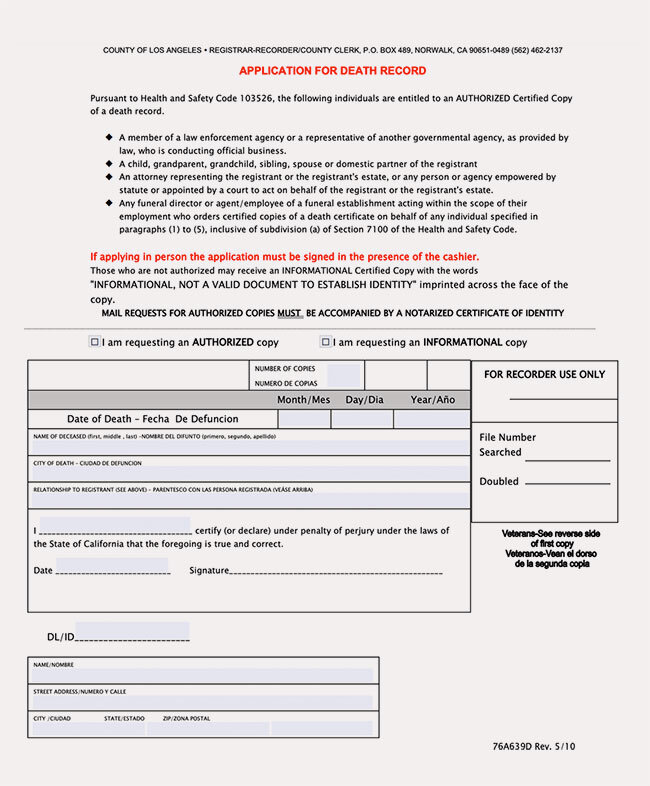
When applying for an authorized copy, eligible individuals must complete a sworn statement, often included as part of the application form, affirming their relationship to the deceased. This statement typically needs to be notarized, especially for mail-in requests. For those managing affairs from out-of-state, finding a notary public in your current location before mailing your application to California is a standard step.
Informational Certified Copy:
An informational certified copy, while still an official record, cannot be used for legal purposes to establish identity or rights. These copies bear an advisory legend across the face, stating: “INFORMATIONAL, NOT A VALID DOCUMENT TO ESTABLISH IDENTITY.”
Informational copies are typically requested for genealogical research, historical records, or personal archives. Anyone can obtain an informational copy without needing to prove a direct relationship or provide a notarized sworn statement. For individuals interested in family history while exploring California’s rich heritage, an informational copy can be a valuable memento or research tool, connecting personal stories to the broader narratives of a region.
The Step-by-Step Process: A Guide for Travelers and Residents Alike
Obtaining a death certificate in California follows a relatively structured process. While the exact steps might vary slightly depending on whether you apply through the state or a specific county, the core requirements remain consistent. For those with a transient lifestyle or managing responsibilities across different geographical locations, meticulous preparation is key to a smooth process.
Gathering Essential Information
Before you even begin filling out forms, gather all the necessary information about the deceased. This proactive step can save significant time and prevent delays, especially if you’re coordinating from a distance. You will generally need:
- Full legal name of the deceased: As it appears on official documents.
- Date of death: Month, day, and year.
- Place of death: City and county in California.
- Date of birth of the deceased.
- Names of the deceased’s parents: Including the mother’s maiden name.
- Name of the deceased’s spouse or registered domestic partner (if applicable).
- Your full name and mailing address.
- Your relationship to the deceased (if requesting an authorized copy).
Having this information readily available will streamline the application process, whether you’re submitting it online, via mail, or in person.
Choosing Your Application Method
California offers several ways to request a death certificate, catering to various needs and logistical situations. Your choice of method might depend on urgency, your location, and personal preference.
1. Mail-in Applications: This is often the most common method, especially for out-of-state applicants or those who cannot visit an office in person.
* California Department of Public Health (CDPH) – Vital Records Branch: You can download the application form directly from the California Department of Public Health website. Complete the form, including the notarized sworn statement if requesting an authorized copy. Attach a check or money order for the applicable fee. Mail everything to the CDPH.
* County Offices: Most county vital records offices also accept mail-in requests. For example, the Los Angeles County Registrar-Recorder/County Clerk provides a specific application form on their website for mail-in requests. This method can sometimes be faster than state-level processing, particularly for deaths that occurred more recently within that specific county.
2. Online Services: While the state of California does not directly process online orders for death certificates through the CDPH, many counties offer their own online portals, or you can use authorized third-party vendors.
* County Online Portals: Check the website of the specific county where the death occurred. Some, like Orange County or Santa Clara County, may have online ordering systems.
* Third-Party Vendors: Services like VitalChek are authorized by the state to process requests for a nominal additional fee. These services often offer expedited shipping options, which can be invaluable for those with urgent travel plans or deadlines. They act as intermediaries, streamlining the process and securely transmitting your request to the appropriate vital records office.
3. In-Person Applications: For residents or those who can travel to California, applying in person can be the quickest way to obtain a certificate, often allowing same-day issuance.
* County Vital Records Offices: This is typically the best option for in-person requests. You would visit the Registrar-Recorder/County Clerk’s office in the county where the death occurred. For instance, if the death happened in Los Angeles, you would visit the Los Angeles County Registrar-Recorder/County Clerk‘s office. Be prepared to present a valid government-issued photo ID. If requesting an authorized copy, you will sign the sworn statement in front of a clerk, acting as a notary.
* CDPH Sacramento Office: While possible, the California Department of Public Health office in Sacramento primarily handles mail-in requests, and in-person service may be limited or require an appointment. County offices are generally more efficient for walk-in requests. For those visiting California’s capital, exploring nearby landmarks could be part of your travel, but remember that the primary goal is often accomplished more swiftly at the county level for vital records.

Understanding Fees and Payment
There is a standard fee for each certified copy of a death certificate. This fee is subject to change, so always check the current amount on the official CDPH or relevant county vital records website before submitting your application.
- Standard Fee: As of the last update, the fee for a death certificate in California is typically around $24 per copy.
- Payment Methods: Acceptable payment methods usually include check or money order for mail-in applications. In-person applications may accept cash, credit/debit cards, and checks/money orders. Online services will accept credit/debit cards.
- Expedited Service Fees: If you opt for expedited processing or shipping through a third-party vendor, additional fees will apply. These extra costs can be justified by the urgency of your travel plans or financial obligations, making it a viable option for those living a fast-paced lifestyle.
Where to Apply: State vs. County Vital Records Offices
Deciding where to send your application is a key consideration. Both the state and county vital records offices process requests, but there are distinct differences in their functions and processing times.
California Department of Public Health (CDPH) – Vital Records Branch
The California Department of Public Health is the central repository for all vital records in California. They maintain records for all deaths that occurred statewide.
- Role: The CDPH handles requests for death certificates from any county in California, regardless of where the death took place.
- Processing Times: Generally, CDPH processing times can be longer than county offices, often ranging from several weeks to a few months for mail-in requests, especially during peak periods. This is a crucial factor if you have urgent deadlines related to travel or financial matters.
- Mailing Address:
California Department of Public Health
Vital Records – MS 5103
P.O. Box 997410
Sacramento, CA 95899-7410
County Registrar-Recorder/County Clerk Offices
Each of California’s 58 counties has its own vital records office, typically part of the Registrar-Recorder/County Clerk’s department.
- Role: County offices maintain records for deaths that occurred within their specific county. For example, the Los Angeles County Registrar-Recorder/County Clerk handles deaths that occurred in Los Angeles County.
- Advantages: For deaths that occurred relatively recently (typically within the last 12-18 months), applying through the county office where the death took place is often the fastest method, especially for in-person requests. They may be able to issue certificates on the same day or within a few days. Mail-in requests to county offices can also be processed quicker than state-level requests.
- Locating Offices: To find the appropriate county office, simply search for “[County Name] Registrar-Recorder/County Clerk” (e.g., “San Diego County Registrar-Recorder/County Clerk,” “Alameda County Clerk-Recorder,” “Riverside County Assessor-County Clerk-Recorder”). Their websites will provide specific application forms, fees, and instructions.
For travelers or individuals whose lives span multiple locations, opting for the county office when possible can significantly reduce waiting times, minimizing the disruption to your accommodation plans or onward journeys. If you’re staying in a hotel in San Francisco while handling affairs, visiting the local county clerk’s office might be more efficient than waiting for a state-level mail order.
Special Considerations for the Modern Explorer
For those who embrace a “life out of the box” – whether it’s through international travel, remote work, or maintaining residences in multiple countries – obtaining a death certificate in California can involve additional layers of complexity.
Out-of-State or International Applicants
If you reside outside of California, the primary method of application will likely be mail or through an authorized online vendor.
- Notarization Requirements: Remember that if you are requesting an authorized copy, the sworn statement must be notarized. This means finding a notary public in your current state or country of residence to witness your signature before mailing the application to California. This small but critical step ensures the legal validity of your request.
- Apostille for International Use: If the death certificate is needed for legal purposes in another country (e.g., settling an estate abroad, proving lineage for a visa application, or managing international property), you will likely need an “Apostille.” An Apostille is a certification issued by the California Secretary of State that authenticates the signature and seal on a public document (like a death certificate) for use in countries that are party to the 1961 Hague Apostille Convention.
- Process: First, you obtain an authorized certified copy of the death certificate from either the CDPH or a county vital records office.
- Next, you submit this authorized copy to the California Secretary of State’s office, along with a request for an Apostille and the applicable fee. This additional step is vital for international affairs and showcases the intersection of vital records with global travel and residency. For those with luxury travel arrangements or planning long-term stays overseas, factoring in this extra processing time is essential.
Expedited Services
Sometimes, waiting weeks or months for a death certificate simply isn’t an option. Urgent travel, immediate financial deadlines, or critical legal proceedings can necessitate faster processing.
- Online Third-Party Vendors: As mentioned, services like VitalChek offer expedited processing and shipping for an additional fee. This can cut down the delivery time significantly, often to a matter of days.
- In-Person at County Offices: For the absolute fastest turnaround, an in-person visit to the appropriate county Registrar-Recorder/County Clerk’s office is usually the best bet. Many counties offer same-day issuance for authorized copies, provided all requirements are met and you arrive during business hours. This option often requires traveling to California, perhaps booking short-term accommodation in cities like San Diego, San Jose (for Santa Clara County), or Riverside (for Riverside County), making careful planning crucial.
Recent Deaths
If the death occurred very recently (e.g., within the last few weeks), there might be a waiting period before the certificate is officially registered and available.
- Funeral Director’s Role: Funeral directors typically file the death certificate with the local registrar within eight days of the death and before final disposition of the remains.
- Availability: While the funeral director files the record, it still needs to be processed and officially registered by the county and then the state. For very recent deaths, it’s often best to contact the county vital records office directly to inquire about availability before submitting an application. This can prevent unnecessary delays or rejections if the record hasn’t yet been fully processed.
Conclusion
Obtaining a death certificate in California is a fundamental administrative task that underpins a wide array of legal, financial, and personal processes. For those living a dynamic “life out of the box” – balancing travel, international commitments, and diverse lifestyle choices – understanding this procedure is not just a matter of compliance, but of efficiency and peace of mind.
By familiarizing yourself with the difference between authorized and informational copies, gathering all necessary information beforehand, choosing the most appropriate application method (mail, online, or in-person at a county office), and being aware of fees and special considerations like Apostilles, you can navigate this process smoothly. Whether you are settling an estate in San Francisco, managing international assets from Los Angeles, or simply archiving family history, careful preparation ensures that you can focus on what truly matters, rather than being bogged down by bureaucracy. This knowledge empowers you to manage life’s inevitable challenges, even when your “home” is wherever your adventures take you.
LifeOutOfTheBox is a participant in the Amazon Services LLC Associates Program, an affiliate advertising program designed to provide a means for sites to earn advertising fees by advertising and linking to Amazon.com. Amazon, the Amazon logo, AmazonSupply, and the AmazonSupply logo are trademarks of Amazon.com, Inc. or its affiliates. As an Amazon Associate we earn affiliate commissions from qualifying purchases.