
For enthusiasts of gripping drama and interconnected narratives, the “One Chicago” franchise offers an immersive television experience unlike any other. Centered around the heroic first responders and dedicated law enforcement of the Windy City, Chicago Fire, Chicago P.D., and Chicago Med have captivated audiences worldwide. These shows not only bring to life the high-stakes professions of firefighters, police officers, and medical professionals but also celebrate the vibrant backdrop of Chicago itself. However, with multiple series frequently crossing over storylines and characters, knowing the correct viewing order can be as complex as planning a multi-city travel itinerary.

Much like meticulously planning a memorable trip – from selecting destinations and booking the ideal accommodation to discovering local culture and navigating attractions – watching the One Chicago series in chronological order ensures a seamless and fully rewarding journey. Skipping episodes or watching out of sequence can lead to confusion, missed character arcs, and a diluted emotional impact, akin to arriving at your dream landmark only to find you’ve missed a crucial part of its history. This comprehensive guide will serve as your ultimate travel planner for the One Chicago universe, ensuring you experience every thrilling moment and character development in its intended sequence, transforming your viewing into a lifestyle choice of structured entertainment. Beyond the screen, we’ll also explore how these compelling narratives can inspire your next real-world Chicago adventure, connecting your passion for the series with the city’s rich tourism and vibrant lifestyle offerings.
Understanding the One Chicago Universe
The enduring appeal of the One Chicago franchise lies in its commitment to realistic portrayal, compelling human drama, and the undeniable charisma of its ensemble casts. Each show delves into the personal and professional lives of those who protect and serve Chicago, showcasing their daily sacrifices and triumphs. The magic behind this interconnected universe is primarily attributed to legendary producer Dick Wolf, a maestro of the procedural genre renowned for his “Law & Order” empire. Wolf’s genius lies in creating universes where different branches of public service operate within the same fictionalized city, allowing for rich cross-pollination of narratives and characters.
This interconnectedness isn’t just a gimmick; it’s the beating heart of the franchise. Characters from Firehouse 51 might be rushed to Chicago Med after a dangerous call, or the Chicago P.D. Intelligence Unit might investigate a crime scene that originated from a medical emergency. These frequent interactions deepen character relationships and provide a more holistic view of the city’s challenges and the coordinated efforts required to overcome them. Watching the shows in order becomes paramount to fully appreciate these intricate narrative threads and the evolution of each character across the different series. It’s like embarking on a grand tour where each city visit builds upon the last, providing a richer understanding of the entire region.
The Pillars of One Chicago
The One Chicago universe is built upon three core series, each offering a distinct perspective on the city’s heroic everyday. A fourth series, Chicago Justice, briefly joined the fold, providing a look into the legal system, further solidifying the intricate web of public service.
-
Chicago Fire: The pioneering series that launched the franchise in 2012, Chicago Fire centers on the brave firefighters, rescue squad, and paramedics of Firehouse 51. From battling infernos to responding to harrowing accidents, the show emphasizes the camaraderie, dangers, and emotional toll of their profession. It’s the foundational piece, introducing many characters who would later become integral to the other series, making it the essential starting point for your viewing journey.
-
Chicago P.D.: Spun off from Chicago Fire in 2014, Chicago P.D. delves into the grittier side of Chicago law enforcement. It follows the uniformed patrol officers and the elite Intelligence Unit of the 21st District, tackling complex and often darker criminal cases. The show explores moral ambiguities, the psychological impact of police work, and the constant battle against the city’s criminal underbelly. Its direct connection to Chicago Fire is evident from its very inception, with characters frequently moving between the two narratives.
-
Chicago Med: The third core series, Chicago Med, premiered in 2015, completing the trio of essential services. This medical drama takes viewers into the bustling Emergency Department of Gaffney Chicago Medical Center (a fictionalized version of Rush University Medical Center). It explores the lives of doctors and nurses as they face life-or-death decisions, navigate complex medical ethics, and balance personal struggles with professional demands. Many patients treated here are victims of incidents that originated in Chicago Fire or Chicago P.D. storylines, making its integration crucial for a complete viewing experience.
-
Chicago Justice: While short-lived, running for only one season in 2017, Chicago Justice focused on the State’s Attorney’s team as they navigated the complexities of the legal system in Chicago. Its cancellation meant its crossovers were minimal, but for the most dedicated completists, it offered an additional layer to the city’s interconnected services. Its brief run reminds us that even with the best travel plans, sometimes an itinerary can change unexpectedly.
The Ultimate Chronological Viewing Guide
For anyone embarking on the extensive journey through the One Chicago universe, adhering to a chronological viewing order is not merely a recommendation but a necessity for optimal enjoyment. The primary reason stems from the frequent and often significant crossover events that weave the narratives of Chicago Fire, Chicago P.D., and Chicago Med together. These crossovers are more than just guest appearances; they are multi-part stories that begin in one series and conclude in another, often introducing new characters, resolving major plotlines, or creating pivotal moments for existing ones. Watching them out of order would be like flying to a spectacular destination only to miss the connecting flight that takes you to its most breathtaking attraction.
Beyond the major crossovers, subtle narrative threads and character developments often span across the shows. A character introduced in a Chicago Fire episode might reappear in Chicago P.D. a few episodes later, or a medical crisis in Chicago Med might be the direct result of an incident handled by Chicago Fire. To fully grasp the evolving relationships, internal struggles, and professional challenges faced by the One Chicago heroes, maintaining chronological integrity is key. Think of it as mapping out the perfect tourism route: each stop is enjoyable on its own, but the true experience comes from seeing how they all connect and contribute to the grander picture.
The general rule of thumb for watching the series concurrently is to alternate between them, especially during the television season. Major crossover events are usually heavily advertised and structured, often airing back-to-back on the same night. For casual viewing, watching a full season of one show before moving to the next might be acceptable for the initial seasons before deep crossovers began. However, as the universe expanded, especially with the introduction of Chicago Med, a more detailed episode-by-episode or block-by-block approach becomes essential. This ensures that you witness events unfold as the creators intended, preventing spoilers and ensuring maximum emotional resonance.
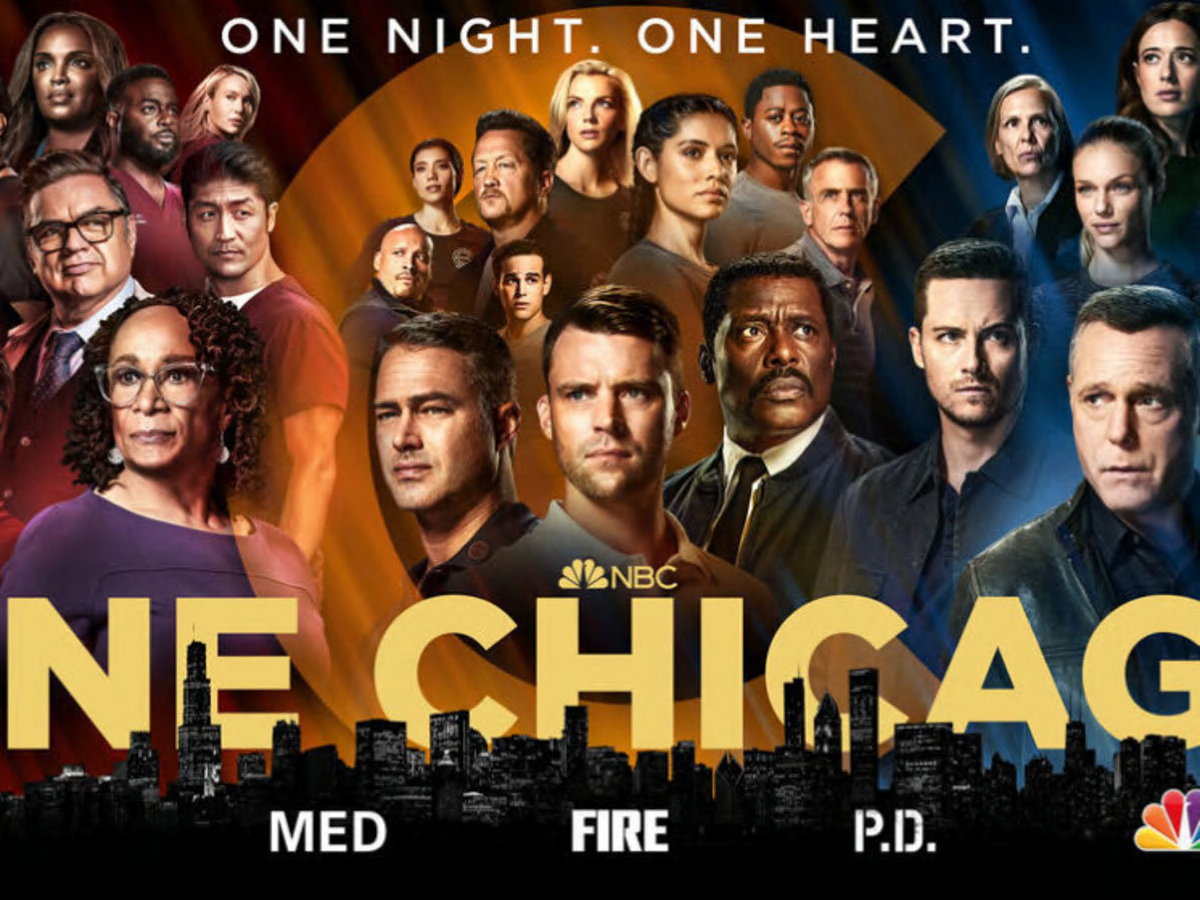
Navigating the Seasons: A Detailed Breakdown
Embarking on a complete One Chicago binge requires a structured approach, almost like a detailed travel guide to the series’ extensive landscape. Here’s a breakdown designed to help you navigate the interwoven narratives effectively:
-
Chicago Fire Season 1 (2012-2013): Start here. This season introduces the characters of Firehouse 51 and establishes the foundation of the universe. It’s entirely standalone.
-
Chicago Fire Season 2 (2013-2014) & Chicago P.D. Season 1 (2014): Chicago P.D. spun off midway through Chicago Fire Season 2. You should watch Chicago Fire Season 2, Episodes 1-20. The backdoor pilot for Chicago P.D. is Chicago Fire S2E20, “A Dark Day.” After this, you can watch Chicago P.D. Season 1 (all 15 episodes). While Chicago P.D. S1 largely stands on its own after its pilot, some minor characters introduced in Chicago Fire will transition.
-
Chicago Fire Season 3, Chicago P.D. Season 2 (2014-2015): The first major crossover event occurs here. Watch Chicago Fire S3E13, “Three Bells,” and then immediately follow with Chicago P.D. S2E13, “A Little Devil Complex.” For the rest of the seasons, the general advice is to alternate episodes, especially if you see a character from one show appearing in another.
-
Chicago Fire Season 4, Chicago P.D. Season 3, Chicago Med Season 1 (2015-2016): This is where Chicago Med enters the picture, making the viewing order more intricate. The backdoor pilot for Chicago Med is Chicago Fire S3E19, “I Am the Apocalypse.” It’s best to watch Chicago Fire S3 up to this point, then watch Chicago Med S1 in full after its pilot if you wish, or intersperse it with Chicago Fire S4 and Chicago P.D. S3. A key crossover for this period is Chicago Fire S4E10, “The Beast,” followed by Chicago P.D. S3E10, “Now I’m God.”
-
Subsequent Seasons (2016 – Present): From this point onward, with all three core shows running, you’ll need to pay close attention to the broadcast order or a dedicated fan-made guide for precise chronological viewing. NBC often airs crossover events on consecutive nights. For example:
- “Infection” Crossover (Fall 2019): Chicago Fire S8E4, “Infection: Part I,” followed by Chicago Med S5E4, “Infection: Part II,” and concluding with Chicago P.D. S7E4, “Infection: Part III.”
- “What Happened At Whiskey Point?” Crossover (Spring 2020): While not a traditional three-part event, a storyline begins in Chicago Fire S8E15, “Off the Grid,” continues into Chicago P.D. S7E15, “The Right Thing,” and has ramifications in Chicago Med S5E15, “I Will Do No Harm.”
The best practice for keeping up with the contemporary seasons is to alternate episodes roughly based on their original air dates. Usually, this means watching the current week’s episode of Chicago Fire, then Chicago Med, then Chicago P.D. Major crossovers will typically require you to pause your usual rotation and watch the event in its entirety. Websites like lifeoutofthebox.com or dedicated fan wikis often provide updated chronological lists, acting as your indispensable GPS for this multi-series adventure.
Beyond the Screen: Experiencing Chicago Inspired by the Series
The One Chicago series does more than just entertain; they serve as a powerful, albeit dramatic, tour guide to the city of Chicago. For many viewers, the city itself becomes a character – a vibrant, resilient, and at times gritty backdrop that is integral to the narratives. This virtual immersion can powerfully inspire real-world travel and exploration, transforming a casual viewing habit into a desire to experience the Windy City firsthand. Much like how a captivating documentary about an exotic destination can spark your wanderlust, the depiction of Chicago in these shows can ignite a passion to walk its streets and soak in its atmosphere.
From the iconic skyline dominated by structures like the Willis Tower to the artistic marvel of Cloud Gate (affectionately known as “The Bean”) in Millennium Park, the series frequently showcases Chicago’s renowned landmarks and vibrant neighborhoods. You see the bustling energy of the Magnificent Mile, the family-friendly fun of Navy Pier, and the historical charm of various districts. Beyond the postcard views, the shows offer glimpses into the everyday life and diverse culture of the city, from local eateries to unique activities.
For dedicated fans, visiting specific filming locations can be a highlight. The exterior of Firehouse 51 is actually a working fire station, Engine 18, located on S. Loomis Street in the Near West Side neighborhood. While interiors are mostly filmed at Cinespace Chicago Film Studios, seeing the real-life facade where your favorite characters “work” can be a surreal and exciting experience. Even Rush University Medical Center serves as inspiration for the fictional Gaffney Chicago Medical Center in Chicago Med, providing another tangible link between the screen and reality. Beyond the set locations, the shows often feature genuine Chicago institutions, from sports stadiums to famous restaurants, encouraging viewers to explore the city’s authentic flavors, such as its famous deep-dish pizza and Chicago-style hot dogs. This fusion of entertainment and potential tourism creates a unique lifestyle opportunity for fans.
Planning Your Chicago Getaway
If the allure of the One Chicago universe has inspired you to visit the real Chicago, planning your trip can be as rewarding as curating your perfect viewing order. To fully immerse yourself in the city’s magic, consider the best time to visit – typically late spring or early fall offers pleasant weather for exploring. Chicago boasts an excellent public transportation system, making it easy to navigate between attractions without the need for a car, much like effortlessly switching between episodes of your favorite show.
When it comes to accommodation, Chicago offers a spectrum of choices, from luxurious hotels like The Langham Chicago, Thompson Chicago, or the Waldorf Astoria Chicago to charming boutique apartments and budget-friendly options. Websites like lifeoutofthebox.com can assist with booking and finding detailed reviews to match your preferences and lifestyle. Consider staying in a neighborhood like River North or Magnificent Mile for easy access to major attractions, or venture into areas like Lincoln Park for a more local feel.
Beyond seeking out filming locations, delve into Chicago’s rich cultural offerings. Take an architectural boat tour to appreciate the city’s stunning skyline, visit world-class museums such as the Art Institute of Chicago, or catch a live jazz performance. The experience of seeing the city’s familiar landmarks and bustling streets in person, knowing they serve as the backdrop for the stories you love, creates a profound connection. It transforms your passive viewing into an active engagement with the world, enhancing both your appreciation for the series and your experience of the destination.
In conclusion, watching the One Chicago series in chronological order is a journey of discovery, offering deep character development and intricate storylines that resonate with viewers. Just as a well-planned trip enriches your travel experiences, a structured approach to this captivating universe ensures you don’t miss a single beat of the heroic narratives set in the heart of Chicago. So, prepare your viewing schedule, perhaps with a side of deep-dish pizza, and consider how this on-screen adventure might just be the inspiration for your next real-life Chicago getaway, seamlessly blending your entertainment lifestyle with the thrill of tourism and exploration.
LifeOutOfTheBox is a participant in the Amazon Services LLC Associates Program, an affiliate advertising program designed to provide a means for sites to earn advertising fees by advertising and linking to Amazon.com. Amazon, the Amazon logo, AmazonSupply, and the AmazonSupply logo are trademarks of Amazon.com, Inc. or its affiliates. As an Amazon Associate we earn affiliate commissions from qualifying purchases.