
The decision by Thomas Jefferson, the third president of the United States, to orchestrate the Louisiana Purchase in 1803 remains one of the most pivotal moments in American history. This audacious acquisition, doubling the size of the young nation overnight, was not a spontaneous whim but a calculated move driven by a complex interplay of strategic, economic, and political considerations. Far from being a simple real estate transaction, the purchase was a bold gamble that shaped the destiny of America and continues to influence its vast landscapes, from bustling cities to untamed natural wonders.
The Strategic Imperative: Securing the Frontier
At the dawn of the 19th century, the United States was a nascent republic, still finding its footing on the global stage. Its western border was precariously defined, and the burgeoning nation faced significant threats to its expansion and security. The primary strategic driver behind Jefferson’s pursuit of Louisiana was the urgent need to secure the vital port of New Orleans and control of the Mississippi River.
The Mississippi River: Lifeline of a Young Nation
The Mississippi River was the undisputed economic artery of the western United States. For farmers and merchants west of the Appalachian Mountains, it was the only practical route to transport their goods to market. Crops from the fertile lands of the Ohio Valley, timber from the forests, and furs from the burgeoning fur trade all flowed down the Mississippi to be shipped to the East Coast or to international destinations. The port of New Orleans, strategically located at the river’s mouth, was the critical bottleneck for this entire operation.
Under the terms of the Pinckney’s Treaty of 1795, the United States had secured the right of deposit in New Orleans, meaning American goods could be stored there temporarily before being loaded onto ocean-going vessels. This right was crucial for the economic survival of the western states. However, this treaty was negotiated with Spain, which had held Louisiana since the end of the Seven Years’ War. In 1800, Spain secretly ceded Louisiana back to France under the Treaty of San Ildefonso. This transfer of power sent ripples of alarm through Washington D.C.
The Shadow of Napoleon
The prospect of France, under the ambitious leadership of Napoleon Bonaparte, regaining control of Louisiana was deeply unsettling for Thomas Jefferson and his administration. Napoleon was a brilliant military strategist and a visionary empire builder. His previous experience in the Caribbean, particularly his unsuccessful attempt to regain control of Saint-Domingue (modern-day Haiti), had taught him the immense cost and difficulty of maintaining a vast colonial empire across the Atlantic. However, his renewed interest in North America was undeniable.
The potential for France to blockade the Mississippi River at New Orleans or to levy exorbitant taxes on American trade was a grave concern. Such actions could cripple the economy of the western United States, potentially leading to secessionist movements or even conflict. Jefferson, a staunch advocate for agrarian democracy and westward expansion, recognized that unfettered access to the Mississippi River was essential for the nation’s future prosperity and unity. He understood that a powerful European nation like France controlling the gateway to the west was an unacceptable strategic vulnerability.
Beyond the Port: The Vision of an Expanding Republic
While securing New Orleans and the Mississippi River was the immediate catalyst, Thomas Jefferson‘s vision extended far beyond this single objective. He saw the potential of Louisiana as a vast expanse for westward expansion, a critical element in his agrarian ideal for America.
The Agrarian Dream and Territorial Ambition
Jefferson envisioned an America characterized by independent yeoman farmers, each owning and cultivating their own land. This agrarian ideal was fundamentally tied to the availability of land. As the original thirteen colonies became more settled, the pressure for new land for agriculture and settlement intensified. Louisiana offered an unparalleled opportunity to fulfill this vision on a grand scale, providing an almost limitless supply of land for generations of Americans to come.
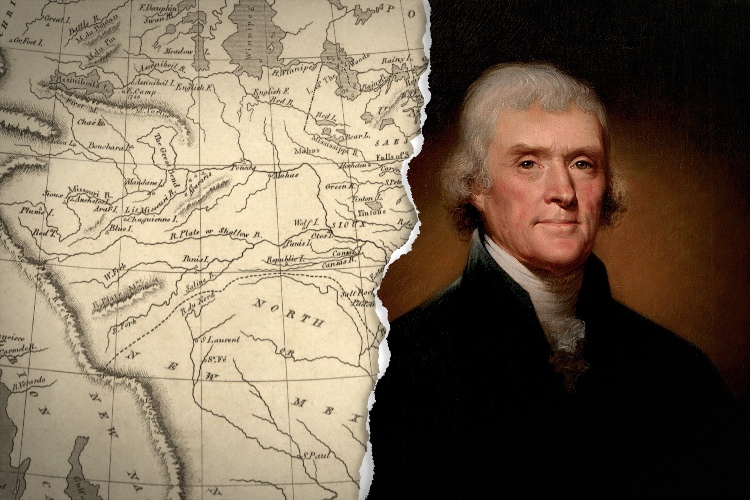
The territory acquired was immense, stretching from the Mississippi River to the Rocky Mountains and from the Gulf of Mexico to the Canadian border. This vast domain was sparsely populated by indigenous tribes and a small number of European settlers, primarily French and Spanish. It represented an “empty canvas” for American expansion, a chance to extend the principles of liberty and self-governance across a continent.
A Buffer Against Future Conflicts

Furthermore, possessing Louisiana would serve as a crucial buffer zone, pushing the United States‘ western frontier further away from potential conflicts with European powers. Instead of having France or Spain as immediate neighbors on its western flank, the United States would now have a vast, largely undeveloped territory. This would reduce the likelihood of border disputes and entanglements in European power struggles, allowing the young republic to focus on its internal development and growth.
The Diplomatic Maneuvers and Unexpected Opportunity
The path to the Louisiana Purchase was paved with skillful diplomacy and a timely, albeit unexpected, turn of events. Jefferson initially sought only to acquire New Orleans and a strip of land along the Gulf Coast to ensure American access to the Mississippi River. He dispatched James Monroe and Robert Livingston to Paris with instructions to negotiate the purchase of this strategically vital territory.
A Favorable Climate for Negotiation
However, circumstances in Europe and the Caribbean dramatically shifted the landscape. Napoleon, despite his imperial ambitions, faced mounting difficulties in his efforts to re-establish French authority in Saint-Domingue. A fierce slave revolt, led by Toussaint Louverture, had effectively ousted French rule and established an independent Haitian republic. The devastating loss of life and resources in Saint-Domingue made Napoleon reconsider the feasibility and desirability of maintaining a vast North American empire.
Furthermore, France was on the cusp of renewed conflict with Great Britain. Napoleon needed funds to finance his wars and recognized that Louisiana would be extremely difficult to defend against the powerful British navy. Selling the territory to the United States would not only generate much-needed revenue but also prevent it from falling into British hands.
The Deal of a Lifetime
Recognizing this opportune moment, Napoleon‘s representatives, including Charles Maurice de Talleyrand-Périgord, made a stunning counter-offer: they proposed selling the entire Louisiana territory to the United States for the sum of $15 million. This offer far exceeded Monroe and Livingston‘s wildest expectations. They quickly seized the opportunity, understanding the immense long-term value of the acquisition, even if it stretched the constitutional authority of the president.
The treaty was signed on April 30, 1803. The United States acquired approximately 828,000 square miles of territory, at a cost of about three cents per acre. This vast expanse encompassed all or parts of fifteen present-day states, from the Mississippi River west to the Rocky Mountains and from the Gulf of Mexico to the Canadian border.
The Legacy of the Louisiana Purchase: Shaping a Continent
The Louisiana Purchase was not without its critics. Some in the United States questioned its constitutionality, as the Constitution did not explicitly grant the president the power to acquire new territory. Others worried about the financial cost and the logistical challenges of governing such a vast and sparsely populated region. However, the overwhelming consensus was that the benefits far outweighed the drawbacks.
Exploration and Expansion
The acquisition of Louisiana immediately spurred further exploration and settlement. The Lewis and Clark Expedition, commissioned by Thomas Jefferson even before the purchase was finalized, embarked on its epic journey to explore the newly acquired lands, seeking a water route to the Pacific Ocean and documenting the region’s geography, flora, fauna, and indigenous peoples. This expedition, and others that followed, opened up the west to American pioneers, forever changing the demographic and geographic landscape of the United States.
The Louisiana Purchase laid the groundwork for the westward expansion that defined much of 19th-century American history, a process that would eventually lead to the United States stretching from coast to coast. It secured the nation’s borders, provided abundant land for agriculture and settlement, and firmly established the United States as a continental power.

Economic and Cultural Ramifications
Economically, the Louisiana Purchase unlocked immense natural resources and agricultural potential. The fertile lands of the Great Plains, once part of Louisiana, became the breadbasket of America. Control of the Mississippi River and the port of New Orleans remained crucial for trade and commerce. Culturally, the purchase brought diverse peoples and traditions into the American fold, contributing to the rich tapestry of American identity. While the acquisition and subsequent expansion also had profound and often devastating impacts on the indigenous populations of the Louisiana territory, the purchase irrevocably altered the trajectory of American development.
In conclusion, Thomas Jefferson‘s decision to buy the Louisiana Purchase was a prescient act of statesmanship. Driven by the strategic necessity of securing the Mississippi River and New Orleans, fueled by a grand vision of agrarian expansion, and facilitated by a unique diplomatic alignment, the purchase was a transformative event. It secured the future of the United States as a continental power, unleashed the potential of its vast interior, and fundamentally shaped the nation we know today. From the vibrant cities that have sprung up along the Mississippi to the vast national parks that preserve its natural wonders, the legacy of the Louisiana Purchase continues to resonate across the American landscape.
LifeOutOfTheBox is a participant in the Amazon Services LLC Associates Program, an affiliate advertising program designed to provide a means for sites to earn advertising fees by advertising and linking to Amazon.com. Amazon, the Amazon logo, AmazonSupply, and the AmazonSupply logo are trademarks of Amazon.com, Inc. or its affiliates. As an Amazon Associate we earn affiliate commissions from qualifying purchases.