
Dreaming of shaping young minds in the Sunshine State? Florida’s vibrant communities, from the bustling streets of Miami to the charming historic districts of St. Augustine, offer a rewarding career path for educators. However, to teach in Florida, you’ll need to navigate the process of obtaining a Florida teaching certificate. This guide will walk you through the essential steps, ensuring your transition into the Florida education system is as smooth as a gentle Gulf Coast breeze.
While the initial thought of certification might seem daunting, the Florida Department of Education has established a clear framework to guide aspiring teachers. This process is designed to ensure that all educators possess the necessary qualifications and expertise to provide high-quality instruction to Florida’s students. Whether you’re a recent graduate or a seasoned educator looking to relocate, understanding the requirements is paramount. This article will break down the journey into manageable steps, covering everything from educational prerequisites to the final issuance of your certificate.

Understanding the Florida Teacher Certification Process
The Florida teacher certification system is overseen by the Florida Department of Education. Their primary goal is to ensure that individuals entering the teaching profession meet specific academic, professional, and character standards. This comprehensive approach safeguards the quality of education provided in Florida public schools and provides a benchmark for professional excellence.
There are several pathways to obtaining a Florida teaching certificate, catering to individuals with diverse backgrounds and experiences. The most common route involves completing an approved teacher education program, followed by passing required examinations. For those with degrees in subjects for which there is a teacher shortage, or for experienced out-of-state educators, alternative pathways may be available. It’s crucial to identify the route that best aligns with your academic history and career aspirations.
Key Requirements for Florida Teacher Certification
Regardless of the specific pathway you pursue, several core requirements are generally applicable to all candidates seeking Florida teaching certification. These form the bedrock of the state’s commitment to a qualified teaching force.
Educational Background and Degree Requirements
A fundamental requirement for Florida teacher certification is a bachelor’s degree from an accredited institution. This degree should be in the subject area you intend to teach. For example, if you wish to teach high school mathematics, your bachelor’s degree should be in mathematics or a closely related field that has been approved by the Florida Department of Education.
In addition to a relevant bachelor’s degree, you will likely need to have completed a state-approved teacher preparation program. These programs are designed to equip you with pedagogical knowledge, classroom management skills, and an understanding of child development and learning theories. If you completed your teacher preparation program outside of Florida, you may need to have your program evaluated to ensure it meets Florida’s standards. This often involves submitting course descriptions and syllabi for review.
For individuals who already hold a bachelor’s degree but have not completed a formal teacher preparation program, Florida offers alternative routes. These programs, often referred to as “alternative certification programs,” allow individuals to gain the necessary pedagogical training while potentially working in a classroom setting. These programs are typically offered by universities or private organizations approved by the state.
Examinations: The Florida Teacher Certification Examinations (FTCE)
A critical component of obtaining Florida teaching certification is successfully passing the Florida Teacher Certification Examinations (FTCE). These exams are designed to assess your general knowledge, professional skills, and subject-specific content mastery. The FTCE is comprised of several sub-tests, and the specific exams you need to take will depend on the type of certificate you are pursuing.
The most common exams include:
- General Knowledge Test (GKT): This test assesses fundamental skills in reading, writing, and mathematics. It is designed to ensure that all teachers have a solid foundation of general academic knowledge.
- Professional Education Test (PET): This exam evaluates your understanding of pedagogical principles, instructional strategies, classroom management, assessment, and professional ethics. It focuses on the art and science of teaching.
- Subject Area Examinations: These exams are specific to the content area you wish to teach. For instance, if you want to teach biology, you will need to pass the Biology Subject Area Exam. Similarly, there are exams for subjects like English, Mathematics, Social Science, and various exceptional student education (ESE) specializations.
It is imperative to prepare thoroughly for each of these examinations. The Florida Department of Education website provides detailed information on the content of each test, as well as study guides and practice materials. Many candidates also find it beneficial to enroll in FTCE preparation courses or utilize online study resources to enhance their chances of success.
Background Checks and Fingerprinting
As a requirement for any position involving working with children, all prospective teachers in Florida must undergo a thorough background check. This process includes fingerprinting, which is submitted to the Florida Department of Law Enforcement (FDLE) and the Federal Bureau of Investigation (FBI). The purpose of these checks is to ensure the safety and well-being of students. Any past criminal history will be reviewed, and its relevance to a teaching position will be assessed. It is advisable to be transparent about any past legal issues and to address them proactively.
Application and Fees
Once you have met all the educational, examination, and background check requirements, you will need to formally apply for your Florida teaching certificate. The application is typically submitted online through the Florida Department of Education’s educator certification portal. Along with the application, there will be a fee associated with processing your application and issuing the certificate. It’s important to ensure all required documentation is submitted accurately and completely to avoid delays in the processing of your application.
Pathways to Certification
Florida recognizes that educators come from diverse backgrounds, and therefore offers several distinct pathways to obtain teaching certification. Understanding these pathways can help you identify the most efficient and appropriate route for your situation.
The Traditional Route: College/University Teacher Preparation Programs
For individuals who are currently pursuing or have recently completed a bachelor’s degree, the most common and often straightforward path is through a traditional teacher preparation program offered by a Florida college or university. These programs are accredited by the state and are designed to provide a comprehensive educational experience that meets all Florida’s certification requirements.
- Curriculum: These programs typically include a blend of general education courses, specialized content courses in your chosen subject area, and pedagogical coursework. A significant component of these programs is the student teaching experience, where candidates gain hands-on classroom experience under the supervision of experienced mentor teachers.
- Benefits: Graduating from an approved teacher preparation program in Florida often streamlines the certification process. The university or college will typically guide you through the necessary steps, including recommending you for certification upon successful completion of the program and required exams.
If you are currently enrolled in a bachelor’s degree program, consult with your academic advisor about their teacher education program options and how they align with Florida’s certification requirements.
Alternative Certification Routes for Career Changers and Out-of-State Educators
Florida is committed to attracting talented individuals to the teaching profession, and this includes welcoming those who may not have followed a traditional education degree path.
For Career Changers with Bachelor’s Degrees
If you hold a bachelor’s degree in a subject area where there is a demand for teachers (e.g., STEM fields, exceptional student education) and have no prior formal teacher training, Florida’s alternative certification programs are an excellent option. These programs are designed to provide you with the essential pedagogical knowledge and skills needed to teach effectively.
- Program Structure: Alternative certification programs often involve intensive coursework, workshops, and a mentored teaching experience. They are typically shorter in duration than traditional programs but are rigorous and focused on practical application.
- Subject Area Focus: Many of these programs are designed to certify individuals in high-need subject areas, addressing critical teacher shortages across the state.
For Out-of-State Certified Teachers
Educators who are already certified in another state can often transfer their credentials to Florida through a reciprocity agreement. The Florida Department of Education evaluates out-of-state certificates to determine if they are equivalent to Florida’s requirements.
- Evaluation Process: You will need to submit your out-of-state teaching certificate and transcripts for review. The department will assess your educational background, teaching experience, and the rigor of your prior certification.
- Potential Requirements: While reciprocity can simplify the process, you may still be required to pass certain FTCE exams, particularly the General Knowledge Test and any subject area exams that do not directly align with your previous certification. You might also need to complete specific coursework if there are gaps identified in your preparation compared to Florida’s standards.
For both career changers and out-of-state educators, thorough research into approved alternative programs and the specific requirements for out-of-state certification is essential. The Florida Department of Education website is the definitive resource for identifying approved programs and understanding the evaluation process.
Maintaining and Advancing Your Florida Teaching Certificate
Obtaining your initial Florida teaching certificate is a significant achievement, but it’s also the beginning of a professional journey. To remain in good standing and to advance your career, you’ll need to be aware of the requirements for renewing your certificate and opportunities for professional development.
Certificate Validity and Renewal
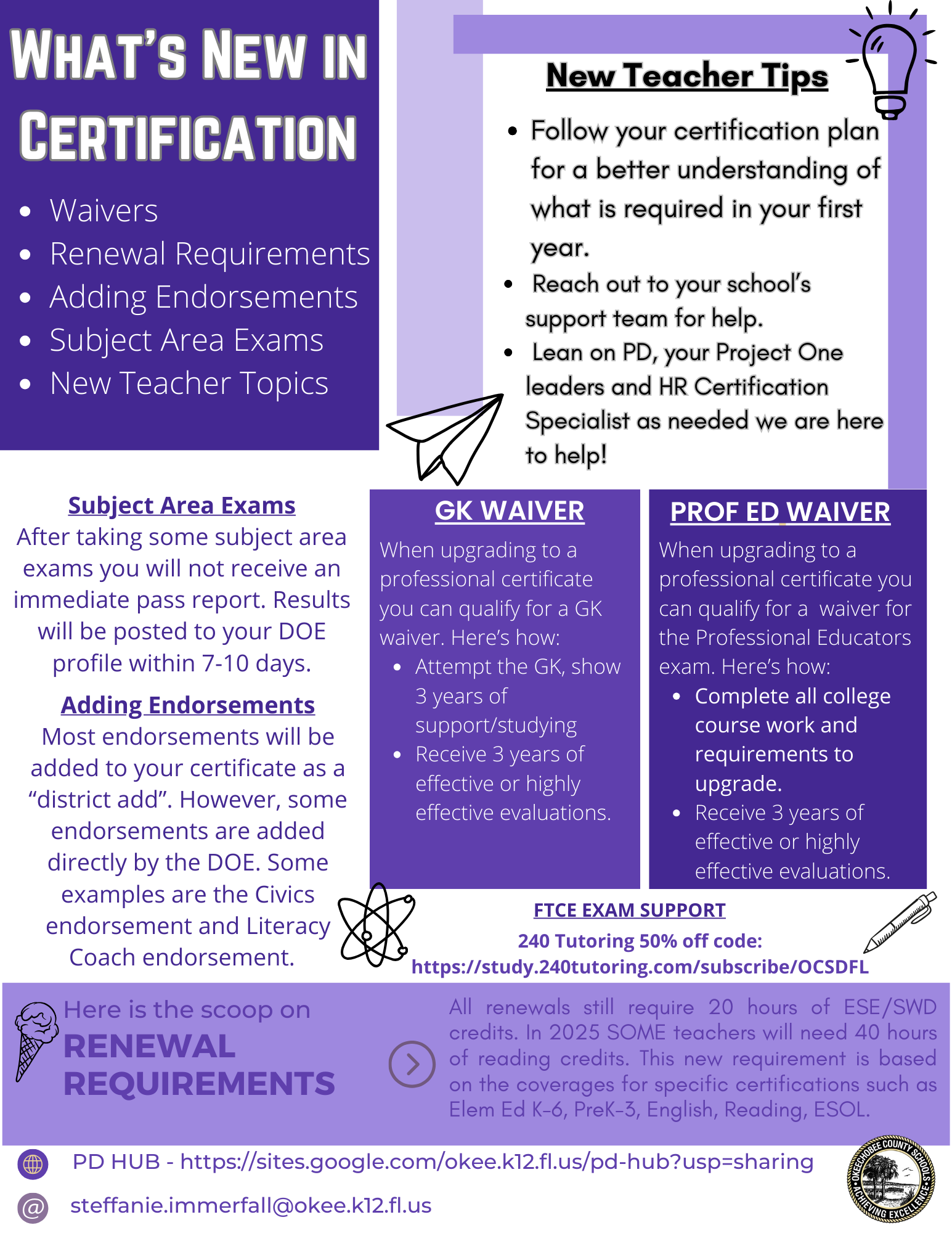
Florida teaching certificates are typically issued for a validity period of five years. During this period, you are expected to maintain your professional growth. To renew your certificate, you will need to:
- Complete In-service Training: You are generally required to complete a specified number of in-service training hours each renewal period. These hours focus on professional development topics relevant to teaching and your subject area. Many school districts offer approved in-service training opportunities throughout the year.
- Maintain Good Standing: You must continue to meet all background check requirements and maintain ethical professional conduct.
- Submit Renewal Application and Fee: As with the initial application, a renewal application and fee will be required.
It is crucial to track your renewal dates and ensure you are meeting all requirements well in advance of your certificate’s expiration. Failure to renew on time can result in the expiration of your certificate, requiring you to go through a more involved process to reinstate it.
Professional Development and Advanced Certification
The field of education is constantly evolving, and Florida encourages educators to engage in continuous learning and professional development. Beyond the renewal requirements, there are opportunities to advance your certification to a higher level or to add endorsements for additional subject areas or specializations.
- Professional Learning Communities (PLCs): Participating in PLCs within your school or district can be an effective way to collaborate with colleagues, share best practices, and enhance your teaching skills.
- Graduate Studies: Pursuing a master’s degree or other graduate-level coursework in education can not only deepen your expertise but also qualify you for advanced professional certifications or salary increases.
- Endorsements: Florida offers various endorsements that can be added to your teaching certificate, allowing you to teach additional subjects or work with specific student populations. For example, an endorsement in English as a Second Language (ESOL) can be highly valuable.
By actively engaging in professional development, you not only enhance your career prospects but also contribute to a more dynamic and effective educational environment for Florida’s students. The journey to becoming a certified teacher in Florida is a rewarding one, and with careful planning and attention to detail, you can successfully navigate the process and embark on a fulfilling career in education within the beautiful and diverse landscape of the Sunshine State. Whether you find yourself in the bustling energy of Orlando, exploring the natural wonders near Everglades National Park, or enjoying the coastal charm of Clearwater, Florida offers a welcoming environment for dedicated educators.
LifeOutOfTheBox is a participant in the Amazon Services LLC Associates Program, an affiliate advertising program designed to provide a means for sites to earn advertising fees by advertising and linking to Amazon.com. Amazon, the Amazon logo, AmazonSupply, and the AmazonSupply logo are trademarks of Amazon.com, Inc. or its affiliates. As an Amazon Associate we earn affiliate commissions from qualifying purchases.