
The question “How far away is Alaska from Russia?” often sparks curiosity, conjuring images of vast, icy expanses and the geopolitical intrigue of two world powers standing almost face-to-face. While maps might make them appear oceans apart, the reality on the ground – or rather, across the water – is astonishingly different. These two colossal landmasses are separated by a mere sliver of ocean, a geographical marvel that has shaped human history, influenced global politics, and continues to fascinate travelers and explorers alike. For anyone interested in the extremities of our planet, the intersection of history and geography, or simply planning an extraordinary journey, understanding this unique proximity is an essential starting point. This article delves into the captivating details of this separation, its historical implications, and what it means for travel and exploration in this remote corner of the world.

The Astonishing Proximity: A Narrow Channel
The geographical reality of Alaska and Russia’s proximity is often a surprising revelation. Far from being separated by thousands of miles, they are, in fact, incredibly close, creating a unique frontier that is both a physical boundary and a gateway to understanding deep historical and natural processes.
The Bering Strait: A Geographical Marvel
At the heart of this close encounter lies the Bering Strait, a narrow waterway that connects the Arctic Ocean to the Bering Sea and, subsequently, the wider Pacific Ocean. At its narrowest point, the distance between the mainland of Alaska’s Seward Peninsula and Russia’s Chukotka Peninsula is approximately 55 miles (88 kilometers). This is roughly the distance one might travel for a daily commute in many urban areas, highlighting just how close these two nations truly are.
However, the closest point between sovereign territories is even more remarkable. Within the Bering Strait lie a pair of islands known as the Diomede Islands. To the west, controlled by Russia, is Big Diomede (also known as Ratmanov Island). To the east, belonging to the United States (specifically Alaska), is Little Diomede (or Krusenstern Island). These two islands are separated by a mere 2.4 miles (3.8 kilometers) of water. On a clear day, inhabitants of Little Diomede can indeed see Russia with the naked eye, a testament to the incredible geographical intimacy of this region. This close proximity makes the Bering Strait one of the most strategically significant and geographically fascinating waterways on Earth.
The International Date Line’s Role
Adding another layer of intrigue to this narrow passage is the presence of the International Date Line. This imaginary line, which roughly follows the 180-degree longitude, serves as the boundary between one calendar day and the next. Uniquely, the International Date Line passes directly between Big Diomede and Little Diomede.
This means that while the islands are just a few miles apart geographically, they are almost a full day apart chronologically. When it’s Sunday on Little Diomede (USA), it’s Monday on Big Diomede (Russia). This temporal anomaly has earned the Diomede Islands the nickname “Tomorrow Island” and “Yesterday Island,” making them a fascinating point of interest for anyone captivated by the quirks of global geography and timekeeping. For travelers, it represents a unique opportunity to quite literally stand at the edge of two different days, even if physical travel between the islands is highly restricted.
Historical and Cultural Connections Across the Strait
The narrowness of the Bering Strait has meant that this region has never truly been a barrier, but rather a bridge, facilitating the movement of peoples, cultures, and even entire ecosystems over millennia. Understanding this deep historical connection is crucial to appreciating the unique fabric of the region.
Ancient Migrations and Indigenous Heritage
Perhaps the most profound historical significance of the Bering Strait lies in its role during the Ice Ages. During periods of glacial maximum, vast quantities of Earth’s water were locked up in ice sheets, causing sea levels to drop significantly. This exposed a vast landmass known as the Bering Land Bridge (or Beringia), connecting what is now Alaska with Siberia. This natural land bridge served as the primary migration route for early humans from Asia into the Americas, giving rise to the indigenous populations of both continents.
Today, the descendants of these ancient migrants, such as the Inupiat and Yupik peoples, still inhabit the coastal regions and islands on both sides of the strait. Despite the modern international border, these communities share deep linguistic, cultural, and familial ties that span the water. Traditional hunting practices, artistic expressions, and spiritual beliefs reflect a shared heritage that predates national boundaries. Travel to the remote villages along Alaska’s western coast, such as those near Nome, offers a glimpse into this vibrant indigenous culture, where the echoes of ancient migrations are still keenly felt.
The Alaskan Purchase and Geopolitical Significance
The historical connection between Alaska and Russia took a decisive turn with the Alaska Purchase in 1867. Prior to this, Alaska was a Russian colony, established through fur trading and exploration in the 18th century. However, facing financial difficulties and concerns about defending such a distant territory, Russia sold Alaska to the United States for $7.2 million. This transaction dramatically shifted the geopolitical landscape of the Arctic and transformed the Bering Strait from an internal Russian waterway into an international border.
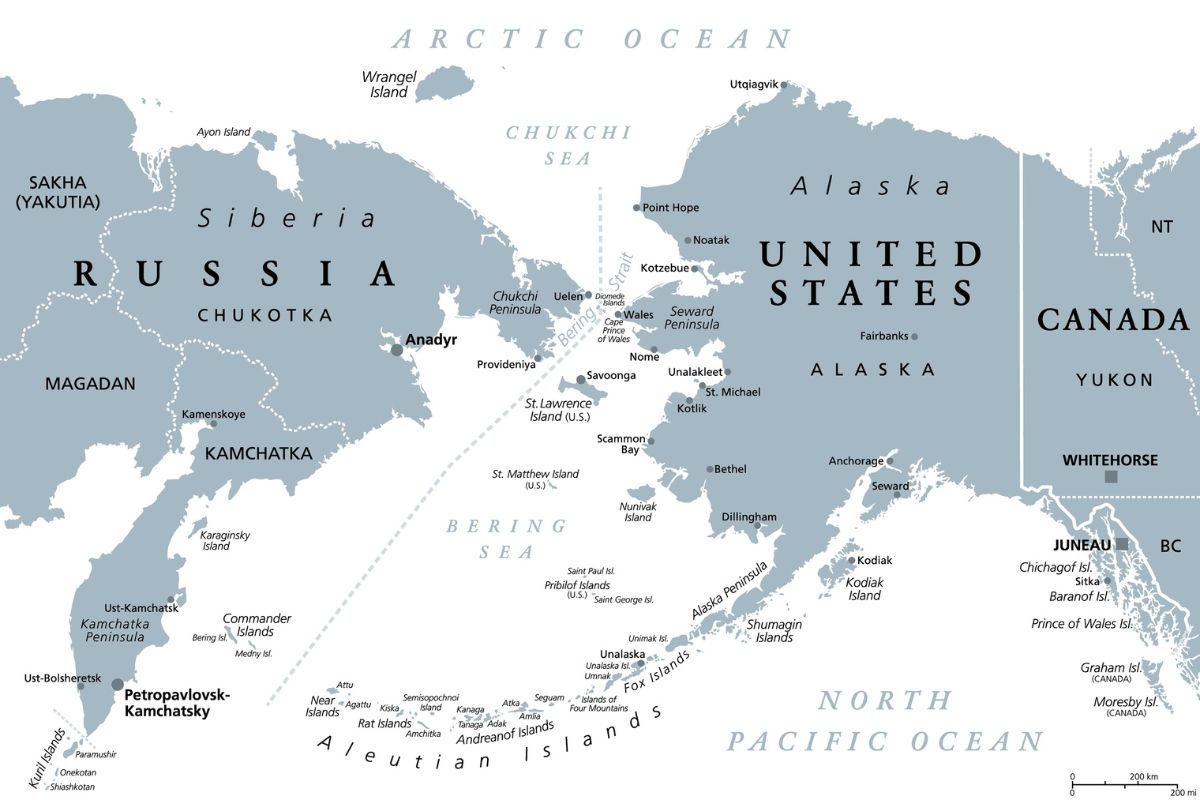
Throughout the Cold War and continuing into the present day, the Bering Strait has remained a zone of strategic importance. Its proximity to both nations makes it a sensitive area for military surveillance, scientific research, and resource management. The strait is also a critical choke point for shipping, particularly with the increasing melting of Arctic ice opening up potential new trade routes. For travelers, this historical context adds a layer of depth to any visit, offering a reminder of the complex interplay of history, geography, and international relations that defines this unique part of the world.
Travel Implications and Challenges
Given the astonishing proximity of Alaska and Russia, one might assume that travel between the two would be relatively straightforward. However, the reality is far more complex, constrained by geopolitical realities, logistical challenges, and the harsh environment.
Crossing the Strait: From Ice Bridges to Regulated Zones
Historically, and pre-dating modern borders, the Bering Strait has been crossed by indigenous peoples for millennia, often utilizing kayaks, umiaks, or during winter, venturing across treacherous ice bridges. There have even been documented individual feats, such as Lynne Cox’s swim across the strait in 1987, symbolizing a moment of cross-cultural connection.
However, for the modern tourist, a casual crossing of the Bering Strait is practically impossible and legally prohibited. The waters separating the Diomede Islands constitute an international border, guarded by both the United States Coast Guard and Russian border patrols. Any unauthorized crossing would lead to severe legal repercussions. Special permits are required for entry into certain sensitive areas on both sides, making organized tourist crossings extremely rare and highly regulated, typically limited to scientific expeditions or very specialized voyages. While the dream of walking from Alaska to Russia (or even seeing both from the same vantage point) is enticing, practical travel plans need to acknowledge these strictures.
Future Possibilities and Tourism Prospects
Despite current restrictions, the concept of bridging the Bering Strait with infrastructure has been a recurring dream. Proposals for a Bering Strait tunnel or bridge, connecting the North American and Eurasian rail networks, have been floated for over a century. Such a mega-project, if ever realized, would be an engineering marvel and could revolutionize global transportation and potentially open up unprecedented tourism opportunities, creating a continuous land route from Europe to North America.
For now, the tourism prospects around the Bering Strait primarily involve experiencing the Alaskan side’s unique natural beauty and indigenous culture. Travel to remote communities like Nome, the largest town on the Seward Peninsula, offers a window into life at the edge of the world. Specialized cruises sometimes navigate the Bering Sea and Arctic Ocean, offering glimpses of the Russian coast from international waters, but rarely allow for landing on either side of the actual strait. These expeditions cater to intrepid travelers seeking unique wildlife viewing opportunities, untouched wilderness, and an appreciation for the planet’s vast, remote expanses.
Exploring Alaska’s Western Frontier
For travelers keen to experience the proximity to Russia without the complexities of border crossings, Alaska’s western frontier offers an unparalleled opportunity to connect with this unique geographical and cultural landscape.
Destinations Near the Strait
The primary gateway to Western Alaska is typically Anchorage, the state’s largest city, from where travelers can take connecting flights to smaller, remote hubs. The town of Nome, located on the southern coast of the Seward Peninsula, is arguably the most accessible and prominent destination for those wishing to feel the closeness to Russia. Nome is famous as the finish line of the Iditarod Trail Sled Dog Race and offers insights into gold rush history and rich Inupiat culture. While Nome itself isn’t directly on the strait, it provides a base for understanding the broader region.
Further west, and requiring more specialized travel, are smaller Alaskan Native villages on the Seward Peninsula and the islands of the Bering Sea, including Little Diomede. Visiting Little Diomede is an exceptional experience, offering the unique chance to see Big Diomede (Russia) across the strait, but it requires careful planning, permits, and an understanding of the challenges of travel to such a remote and culturally sensitive community. Access is typically via helicopter from Nome or small plane, weather permitting.

Unique Travel Experiences in Western Alaska
Travel to Western Alaska is not for the faint of heart, but it promises some of the most authentic and memorable experiences available. It’s a journey into a land defined by its extremes: vast tundra, dramatic coastlines, abundant wildlife, and vibrant indigenous traditions.
Opportunities abound for wildlife viewing, with chances to see polar bears, walruses, various seal species, and migratory birds. The region is home to the Bering Land Bridge National Preserve, a vast, roadless expanse dedicated to preserving the remnants of the ancient land bridge and its associated geological and paleontological features. Here, travelers can explore volcanic landscapes, search for hot springs, and immerse themselves in a wilderness largely untouched by human development. Cultural experiences focus on interactions with Alaskan Native communities, learning about their subsistence lifestyle, traditional arts, and history. Dog sledding, snowmobiling (in winter), and fishing are also popular activities, offering active ways to engage with the environment. This region represents the ultimate adventure travel, where the journey itself is as significant as the destination, providing profound insights into humanity’s oldest migrations and the enduring power of nature.
The distance between Alaska and Russia is, geographically speaking, minimal, particularly across the Bering Strait and between the Diomede Islands. This extraordinary proximity holds immense significance, from the ancient migrations that populated the Americas to the modern geopolitical landscape. While direct tourist travel across this international border remains highly restricted, the Alaskan side offers a wealth of unique travel experiences. Exploring Western Alaska provides a tangible connection to this fascinating frontier, allowing travelers to witness a land shaped by deep history, resilient cultures, and the awe-inspiring power of nature, all while standing on the edge of two worlds.
LifeOutOfTheBox is a participant in the Amazon Services LLC Associates Program, an affiliate advertising program designed to provide a means for sites to earn advertising fees by advertising and linking to Amazon.com. Amazon, the Amazon logo, AmazonSupply, and the AmazonSupply logo are trademarks of Amazon.com, Inc. or its affiliates. As an Amazon Associate we earn affiliate commissions from qualifying purchases.