
California, a state renowned for its innovative spirit, diverse culture, and bustling economy, is also at the forefront of robust labor protections. For many individuals considering or currently engaged in part-time employment within the Golden State, a crucial question often arises: “Do part-time employees get sick pay in California?” The answer is a resounding yes, thanks to comprehensive state legislation. This intricate framework ensures that nearly all employees, regardless of their full-time or part-time status, have access to paid sick leave, offering a vital safety net that underpins the working lifestyle across various industries, from the dynamic tech sector to the vibrant tourism and hospitality services that define much of California’s appeal. Understanding these rights is not just a matter of legal compliance for employers but a fundamental aspect of employee well-being and financial stability.
This article delves into the specifics of California’s paid sick leave laws, demystifying the regulations for both employees and employers. We will explore the foundational legislation, eligibility criteria for part-time workers, the mechanics of sick leave accrual and usage, and the critical responsibilities employers bear to ensure compliance. For anyone navigating the complex landscape of employment in California, from recent graduates entering the workforce to seasoned professionals seeking flexible arrangements, this guide offers clarity and insight into a crucial aspect of their working lifestyle.
Understanding California’s Paid Sick Leave Law
California’s commitment to worker welfare is prominently showcased through its paid sick leave mandates. These laws are designed to protect public health and provide employees with the security of knowing they won’t lose pay or their job when illness strikes.
The Healthy Workplaces, Healthy Families Act of 2014
The cornerstone of paid sick leave in California is the Healthy Workplaces, Healthy Families Act of 2014, codified under Labor Code Sections 245-249. This landmark legislation, which came into effect on July 1, 2015, fundamentally changed the landscape of employee benefits across the state. It established a statewide minimum standard for paid sick leave, ensuring that virtually every employee, including part-time, temporary, and seasonal workers, is entitled to accrue and use paid time off for health-related reasons. The Act was a significant step forward, recognizing the crucial role sick leave plays in preventing the spread of illness in the workplace and allowing individuals to care for themselves or family members without facing undue financial hardship. Subsequent amendments and interpretations have further refined and strengthened these protections, reflecting California’s ongoing dedication to creating a supportive and healthy working environment for all.
Who is Covered? Defining “Part-Time” for Sick Leave
One of the most important aspects of the Healthy Workplaces, Healthy Families Act is its broad scope of coverage. The law applies to almost all employees who work for the same employer for 30 or more days within a year in [California](https://lifeoutofthebox.com/california], including part-time, temporary, and seasonal employees. There is no distinction made between full-time and part-time status when it comes to eligibility for sick leave accrual. This means that if an individual meets the 30-day employment threshold, they begin earning sick leave from their first day of employment. This inclusive definition ensures that part-time workers, who form a significant segment of California’s diverse workforce, particularly in sectors such as retail, food service, and tourism, are not left without crucial protections. The intent is clear: to provide a universal baseline of support that contributes to the overall stability and quality of life for all workers.
Accrual Rates and Caps: How Sick Leave is Earned
Under state law, employees accrue paid sick leave at a rate of no less than one hour for every 30 hours worked. This method ensures that part-time employees accrue sick leave proportional to their hours, albeit at a slower rate than their full-time counterparts, yet still providing meaningful benefits.
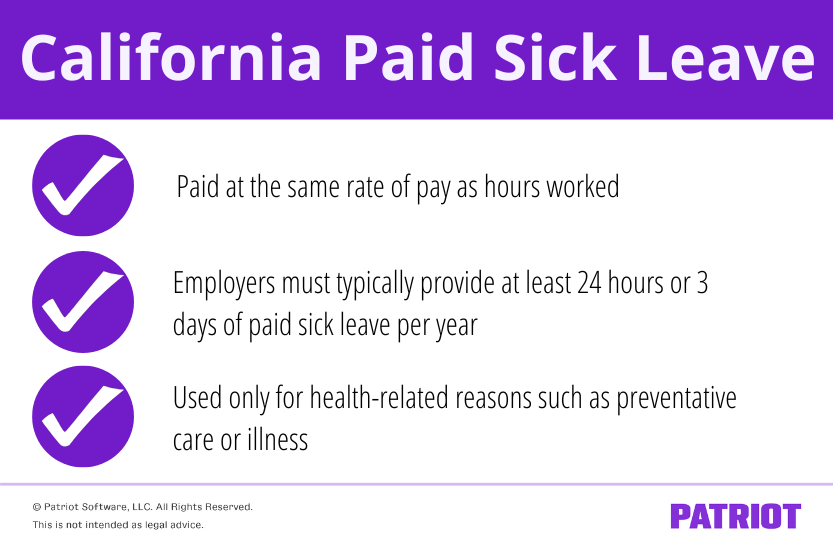
Employers can cap an employee’s total accrual of paid sick leave at 80 hours or 10 days, provided the employee has at least 24 hours (or 3 days) available for use per year. Alternatively, employers can choose to “front-load” sick leave, meaning they provide the full amount of sick leave (at least 24 hours or 3 days) at the beginning of each 12-month period of employment. If front-loaded, employers are not required to allow accrual beyond that initial grant, nor are they generally required to carry over unused leave to the next year, provided the employee receives the full 24 hours (or 3 days) at the start of each year. For accrual plans, however, unused sick leave must generally carry over from year to year, though the employer may still impose a cap on the total amount of sick leave that can be accrued. These rules balance the need for employee protection with practical considerations for businesses, ensuring that California’s vibrant economy remains dynamic and fair.
Eligibility and Usage of Paid Sick Leave
Understanding when and how to use accrued sick leave is as important as knowing your rights to accrue it. The law outlines clear provisions for its application, designed to be flexible and comprehensive.
When Can Part-Time Employees Use Sick Leave?
Paid sick leave can be used for a variety of health-related reasons affecting the employee or their family members. This broad scope reflects a recognition of the interconnectedness of family well-being and an individual’s capacity to work. Specifically, part-time employees can use their accrued sick leave for:
- Their own diagnosis, care, or treatment of an existing health condition, or for preventive care.
- The diagnosis, care, or treatment of an existing health condition, or for preventive care, for a family member. “Family member” is broadly defined to include a child (biological, adopted, foster, step, legal ward, or a child to whom the employee stands in loco parentis), a parent (biological, adoptive, foster, stepparent, or legal guardian of an employee or the employee’s spouse or registered domestic partner, or a person who stood in loco parentis to an employee when the employee was a minor), a spouse, a registered domestic partner, a grandparent, a grandchild, or a sibling.
- For victims of domestic violence, sexual assault, or stalking, to seek medical attention for injuries, obtain services from a domestic violence shelter or rape crisis center, obtain psychological counseling, or participate in safety planning.
Employers cannot require a doctor’s note or other documentation to verify the illness or purpose of the leave, especially for shorter absences, though reasonable verification might be requested for longer, non-routine absences.
The Waiting Period and Minimum Usage
While employees begin accruing sick leave from their first day of employment, there is a waiting period before they can actually use it. An employee can use accrued sick leave beginning on the 90th day of employment. This means that for the first 90 days, even if leave has been accrued, it cannot be utilized. Once this waiting period is satisfied, an employee can use their sick leave. Employers generally cannot restrict the use of sick leave to a minimum increment larger than two hours. For example, if an employee only needs to take one hour off for an appointment, the employer must allow them to use one hour of sick leave, rather than requiring them to take a full half-day or full-day. This flexibility is particularly beneficial for part-time employees who may have more fluctuating schedules or require shorter periods of absence.
Family Members and Broad Interpretations of Care
California’s law is notably progressive in its definition of “family member” for sick leave purposes. As mentioned, it extends beyond immediate nuclear family to include siblings, grandparents, and grandchildren. This expansive definition acknowledges the diverse family structures in modern society and the varied caregiving responsibilities employees often undertake. The law aims to reduce the burden on employees who might otherwise have to choose between their job and caring for a loved one. This broad interpretation promotes a more compassionate and understanding workplace culture, aligning with California’s overall emphasis on work-life balance and employee welfare.
Employer Responsibilities and Compliance
Employers in California have specific legal obligations to ensure compliance with paid sick leave laws, which are crucial for maintaining a fair and lawful working environment.

Providing Notice and Displaying Posters
Employers are required to inform their employees about their sick leave rights. This includes providing written notice to each employee at the time of hire (or when the law became applicable to them) containing specific information about sick leave accrual and usage. Additionally, employers must display a poster in a conspicuous place at the workplace that outlines the provisions of California’s paid sick leave law. These transparency requirements ensure that employees, especially part-time workers who may be less familiar with all their rights, are fully aware of their entitlements. Failure to provide proper notice or display the required poster can result in penalties for employers.
Record-Keeping Requirements
Accurate record-keeping is a fundamental responsibility for employers under California’s paid sick leave law. Employers must maintain records documenting the hours worked and paid sick leave accrued and used by each employee for at least three years. These records must be made available to the employee upon reasonable request. The information must also be provided on employees’ itemized wage statements (pay stubs) or in a separate written notice provided with the payment of wages. This documentation is crucial for verifying compliance, resolving disputes, and ensuring that employees are correctly compensated for their time, reinforcing the legal framework designed to protect workers.
Preventing Retaliation Against Employees
California’s law explicitly prohibits employers from discriminating or retaliating against an employee for requesting or using paid sick leave, for filing a complaint with the Labor Commissioner regarding sick leave, or for exercising any other right provided by the Healthy Workplaces, Healthy Families Act. Retaliation can take many forms, including termination, demotion, reduction in hours, or any other adverse employment action. Employees who believe they have been retaliated against have the right to file a complaint with the Division of Labor Standards Enforcement (DLSE) of the California Labor Commissioner’s Office. This protection is vital, ensuring that employees feel secure in exercising their legal rights without fear of negative repercussions, thereby fostering a more equitable and respectful workplace culture.
Navigating Common Scenarios and Employer Variations
While California’s state law sets a minimum standard, the actual experience of paid sick leave can vary based on local ordinances and specific employment situations.
Local Ordinances: Beyond State Law
It’s important to note that many cities and counties within California have enacted their own paid sick leave ordinances that provide greater benefits than the state law. For instance, major cities like San Francisco, Los Angeles, and San Diego have specific local laws that might dictate higher accrual rates, greater maximum accrual caps, or broader definitions of family members. Where local laws provide more generous benefits than the state law, employers are required to comply with the more beneficial local ordinance. This patchwork of regulations means that employers must be diligent in understanding both state and local requirements applicable to their specific location, and employees should be aware that their rights might be even more extensive depending on where they work within California.
Industry-Specific Considerations
While the law applies broadly, its practical application can look slightly different across industries. In sectors with high numbers of part-time or seasonal workers, such as hospitality, retail, and agriculture, employers must be particularly vigilant in tracking hours and accruals. For instance, a hotel in San Francisco or a vineyard in Napa Valley employing part-time staff would need to adhere not only to state law but also to any relevant local ordinances. The transient nature of some part-time work, such as gig economy jobs, also presents unique challenges for compliance and tracking, although the law generally aims to cover these workers if they meet the 30-day threshold. Understanding these nuances is key for both employers and employees to ensure that the spirit and letter of the law are upheld consistently across California’s diverse economic landscape.
Termination, Reinstatement, and Payouts
One common question pertains to what happens to accrued sick leave upon termination of employment. Unlike vacation time, employers are generally not required to pay out unused paid sick leave upon an employee’s termination, resignation, or retirement. However, if an employee is rehired by the same employer within 12 months, any previously accrued and unused paid sick leave must be reinstated. This reinstatement provision encourages stability in the workforce and ensures that employees who return to a former employer do not lose their earned benefits, further cementing the employee-protective nature of California’s labor laws.
Seeking Clarification and Enforcing Rights
Navigating labor laws can be complex, and both employees and employers may require assistance to understand or enforce their rights and obligations.
Resources for Employees and Employers
The California Department of Industrial Relations (DIR) and its Division of Labor Standards Enforcement (DLSE), also known as the Labor Commissioner’s Office, are primary resources for information regarding paid sick leave. Their websites provide detailed FAQs, fact sheets, and links to the relevant legal statutes. Employers can also consult with labor law attorneys or employer associations to ensure their policies are fully compliant. For employees, union representatives, legal aid organizations, and non-profit worker advocacy groups can offer guidance and support if they believe their sick leave rights have been violated. These resources are critical for fostering a knowledgeable workforce and a compliant business environment.

The Role of the California Labor Commissioner
The California Labor Commissioner plays a vital role in enforcing the state’s labor laws, including those related to paid sick leave. Employees who believe their employer has violated their sick leave rights can file a wage claim or a retaliation complaint with the Labor Commissioner’s Office. The office has the authority to investigate complaints, conduct hearings, and issue awards for unpaid sick leave wages, penalties, and interest. This enforcement mechanism ensures that the protections afforded by the Healthy Workplaces, Healthy Families Act are not merely theoretical but are actively upheld, providing a crucial avenue for redress for employees whose rights have been infringed upon.
In conclusion, part-time employees in California are indeed entitled to paid sick leave, a testament to the state’s progressive approach to worker protections. The Healthy Workplaces, Healthy Families Act of 2014, with its broad coverage and clear guidelines for accrual and usage, ensures that all eligible workers, irrespective of their employment status, have the security of paid time off for health-related needs. Both employers and employees must familiarize themselves with these provisions, along with any applicable local ordinances, to ensure compliance and to fully leverage the benefits designed to support a healthy and stable working lifestyle across California. Understanding these rights is fundamental to navigating the employment landscape in one of the nation’s most dynamic states.
LifeOutOfTheBox is a participant in the Amazon Services LLC Associates Program, an affiliate advertising program designed to provide a means for sites to earn advertising fees by advertising and linking to Amazon.com. Amazon, the Amazon logo, AmazonSupply, and the AmazonSupply logo are trademarks of Amazon.com, Inc. or its affiliates. As an Amazon Associate we earn affiliate commissions from qualifying purchases.