
The allure of online poker has captivated millions worldwide, offering the thrill of the game from the comfort of one’s home. For residents and visitors in California, a state renowned for its innovation and forward-thinking policies, the question of whether this popular pastime is legally accessible often leads to confusion. Despite being a hub for technological advancement and a significant market for entertainment, the Golden State’s stance on online poker remains complex and, for many, frustratingly restrictive. This article delves into the intricate legal landscape of online poker in California, exploring why the state has yet to embrace regulated online play and what options currently exist for enthusiasts.
The Evolving Landscape of Online Gambling in California
Understanding the current status of online poker in California requires a look back at the state’s rich, albeit often contentious, history with gambling and the interplay between federal and state legislation.
A Brief History of Gambling in the Golden State
California has a long and varied history with gambling. From its early days, gold rushes brought with them a proliferation of card games and informal betting. Over time, the state has developed a robust land-based gambling industry, primarily driven by two distinct entities: tribal casinos and licensed card rooms.
Tribal casinos, operated by federally recognized Native American tribes under the Indian Gaming Regulatory Act (IGRA) of 1988, represent the largest segment of California’s gambling market. These establishments, such as the Pechanga Resort Casino in Temecula or San Manuel Casino in Highland, offer a full spectrum of casino games, including slot machines, blackjack, roulette, and poker. The success of these tribal gaming operations has made tribes powerful stakeholders in any discussions about expanding gambling in the state. Groups like the California Nations Indian Gaming Association actively advocate for tribal interests.
Alongside tribal casinos, California is home to numerous licensed card rooms, which predate tribal gaming. These establishments, like the Commerce Casino or The Bicycle Hotel & Casino, are unique in that they are typically restricted to offering “player-banked” or “third-party-banked” card games, where players play against each other or a third-party proposition player rather than the house. Poker, by its nature, fits perfectly into this model, making card rooms popular destinations for poker enthusiasts. The revenue generated by these card rooms and tribal casinos is substantial, creating a powerful lobbying force against any perceived threats to their existing monopolies.
Federal Law vs. State Law
The legal framework for online gambling in the United States is a patchwork of federal and state regulations. Federally, the Wire Act of 1961 originally prohibited certain types of interstate betting, primarily targeting sports betting. However, a 2011 interpretation by the Department of Justice clarified that the Wire Act applies only to sports betting, effectively opening the door for states to regulate other forms of online gambling, including poker and casino games, within their own borders.
Further federal legislation, the Unlawful Internet Gambling Enforcement Act (UIGEA) of 2006, does not explicitly outlaw online gambling for individuals. Instead, it targets the financial transactions involved, making it illegal for gambling businesses to “knowingly accept payments in connection with the participation of another person in a bet or wager that involves the use of the Internet and that is unlawful under any federal or state law.” This means that if a state has not explicitly legalized and regulated online gambling, participating in it (especially through offshore, unregulated sites) can put financial institutions at risk of violating UIGEA.
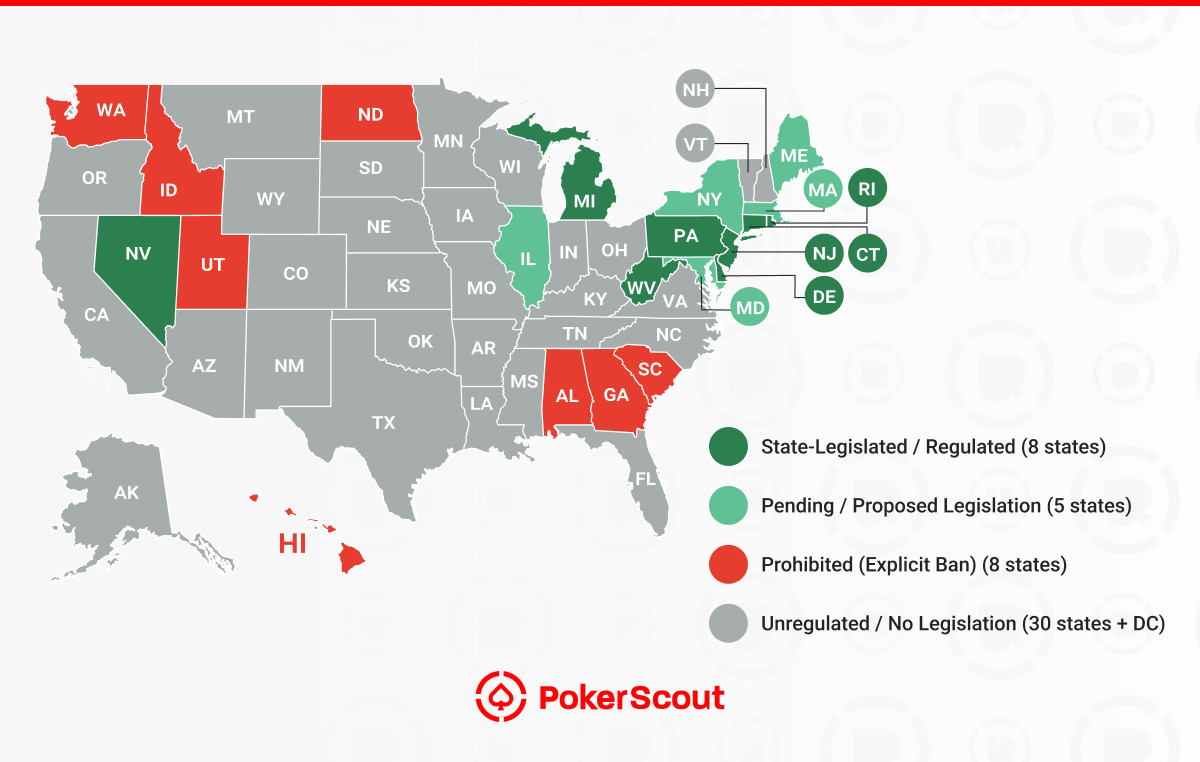
Crucially, the power to authorize and regulate intrastate online gambling largely rests with individual states. This is why states like New Jersey, Nevada, Michigan, Pennsylvania, and West Virginia have successfully launched regulated online poker markets, while others, including California, have not.
The Current Legal Status of Online Poker in California
Despite persistent efforts by proponents, the straightforward answer to the question “Is online poker legal in California?” is no, at least not in the sense of state-licensed and regulated real-money platforms.
The Lack of Regulated Online Poker
As of today, there is no legislation in California that authorizes or regulates real-money online poker. This means that residents cannot legally play poker on websites that are licensed and overseen by the State of California, ensuring player protection, fair play, and tax revenue for the state. Unlike states with regulated markets, there are no official platforms operating under a California gaming commission or similar body.
This absence of regulation leaves a vacuum that is often filled by offshore poker sites. These sites operate outside of United States jurisdiction, meaning they are not subject to California or federal consumer protection laws, responsible gambling mandates, or auditing requirements. While players in California might access these sites, doing so carries inherent risks, including the security of funds, the fairness of games, and the ability to withdraw winnings. There are no legal recourses if disputes arise with an offshore operator.
Distinguishing Between Legal and Illegal
It’s important to clarify the distinction between illegal online poker and other forms of poker play. The term “illegal” in this context primarily refers to the operation of an unlicensed, real-money online poker site within or targeting California residents. While the act of playing on an offshore site might not typically lead to individual prosecution for players in most states, it exists in a legal grey area where consumer protections are non-existent.
In contrast, land-based poker rooms throughout California are fully legal and regulated. These include the many tribal casinos and commercial card rooms mentioned earlier, offering a vibrant live poker scene.
Furthermore, “social poker” applications and “sweepstakes” poker sites offer alternative ways to play online without violating current California law. Social poker apps typically involve playing with virtual chips that have no real monetary value, purely for entertainment. Sweepstakes poker sites operate under sweepstakes laws, where players purchase virtual currency that can be used to play games, and also receive “sweeps coins” for free. These sweeps coins can then be used to play games, and any winnings from sweeps coins can be redeemed for real cash prizes. This model has been deemed legal in many states, including California, as it technically does not involve direct real-money gambling on poker games.
Why Has California Not Legalized Online Poker?
The reasons for California’s inaction on online poker legalization are multifaceted, stemming from powerful competing interests, complex political dynamics, and significant legislative hurdles.
Competing Interests and Lobbying
The primary obstacle to online poker legalization in California has been the inability to reconcile the divergent interests of key stakeholders within the state’s existing gambling ecosystem.
- Tribal Casinos: The powerful tribal gaming industry is a dominant force. While many tribes are open to online poker, they typically insist on strict “bad actor” clauses that would prevent companies that operated in the U.S. market after UIGEA (i.e., offshore sites) from participating in a newly regulated market. They also generally want to be the primary operators or partners in any online venture, leveraging their existing gaming licenses.
- Card Rooms: The state’s card rooms also want a piece of the online poker pie. Their concern often revolves around the definition of “poker” and how it might impact their existing operations. They are wary of proposals that could disadvantage them relative to tribal casinos or allow tribal casinos to offer house-banked games online, which is currently prohibited for card rooms.
- Racetracks: Horse racing interests, another established form of gambling in California, have also sought inclusion in any online gambling expansion, often looking for “equitable share” of revenue or the right to offer their own online wagering products.
The sheer number of influential players, each with a slightly different vision for how an online market should be structured and who should benefit, has made finding a consensus extremely difficult. Intense lobbying efforts by these groups often create a stalemate, preventing any single bill from gaining enough support to pass.
Legislative Hurdles and Political Will
Beyond the competing interests, the legislative process itself in California presents significant challenges for online poker. Bills have been introduced in the state legislature for over a decade, with many progressing through committees only to stall before a full floor vote.
- Complex Regulations: Crafting legislation that satisfies all stakeholders while ensuring robust regulatory oversight, consumer protection, and responsible gambling measures is incredibly complex. Each proposal requires intricate details regarding licensing, taxation, technology standards, and enforcement.
- Lack of Urgency: Unlike some smaller states that have seen online gambling as a vital new revenue stream or a way to protect consumers, [California](https://lifeoutofthebox.com/california]’s massive economy means there hasn’t been the same sense of fiscal urgency to push through controversial gambling legislation.
- Political Risk Aversion: Lawmakers are often hesitant to take on such a divisive issue, especially when powerful interest groups are strongly opposed or highly protective of their existing market share. The political capital required to push through a comprehensive online poker bill in California is immense.
- Voter Referendum: Given the nature of gambling expansion in California, any significant change often requires a voter referendum or ballot initiative, adding another layer of complexity and cost to the legalization process.
What Are the Alternatives for California Poker Enthusiasts?
While waiting for legislative breakthroughs, California poker players are not entirely without options to enjoy their favorite game.
Land-Based Card Rooms and Casinos
The most straightforward and fully legal way to play poker in California is by visiting one of the state’s many brick-and-mortar card rooms or tribal casinos. California boasts some of the largest and most famous poker rooms in the world.
- Commerce Casino: Located near Los Angeles, it’s one of the largest card rooms globally, hosting major tournaments and daily cash games.
- The Bicycle Hotel & Casino: Another Los Angeles area institution, known for its extensive poker offerings and luxury hotel.
- Pechanga Resort Casino: In Temecula, this tribal casino offers a large poker room alongside a full range of casino games.
- Oceans 11 Casino: Located in Oceanside, it’s a popular spot for players in Southern California.
These venues offer a social atmosphere, professional dealers, and a wide variety of game types and stakes.
Social Poker and Sweepstakes Sites
As mentioned, social poker apps allow players to enjoy the game for free with virtual chips. They provide a platform for practice and casual play without any financial risk.
Sweepstakes poker sites, such as Chumba Casino or Global Poker, offer a legally compliant alternative. Players can participate in poker games using “sweeps coins” which can be redeemed for real cash prizes. This model bypasses traditional gambling laws by framing the activity as a promotional sweepstakes.
Traveling to Legal States
For those truly committed to playing regulated real-money online poker, traveling to a neighboring state where it is legal is an option. Nevada, for example, offers legal online poker through sites like WSOP.com, which also pools players with New Jersey and Michigan. Players simply need to be physically present within the borders of the legal state to access its regulated online poker platforms. This provides a temporary solution for those residing near state lines or willing to take a short trip.
The Future Outlook for Online Poker in California
The path to regulated online poker in California remains challenging, but the discussion is far from over.
Persistent Legislative Efforts
Each legislative session typically sees new bills introduced to legalize online poker or broader online gambling. Proponents continue to highlight the potential tax revenues that could benefit state coffers, estimated to be in the hundreds of millions of dollars annually. They also emphasize the importance of consumer protection, arguing that regulated sites would provide a safer environment than the currently accessible offshore platforms.
The ongoing success of regulated markets in other states serves as a model and a point of comparison. As more states embrace online gambling, the pressure on [California](https://lifeoutofthebox.com/california] to re-evaluate its stance may grow.
Potential Economic Benefits
Beyond tax revenue, legalizing online poker could stimulate economic activity through job creation in the technology, marketing, and regulatory sectors. It would also allow [California](https://lifeoutofthebox.com/california]-based companies to participate in a booming industry, rather than seeing revenue flow to offshore entities. Proponents argue that the state is missing out on a significant economic opportunity and is failing to capture funds that are already being spent by its residents on unregulated sites.
What to Watch For
Key developments to watch include ongoing negotiations between tribal casinos and card rooms, which would be crucial for any breakthrough. New legislative proposals will continue to emerge, and their specific provisions – particularly regarding bad actor clauses, taxation, and operator eligibility – will determine their viability. Public opinion, though not always a direct driver, could also play a role, especially if there’s a groundswell of support for consumer protection through regulation.

Conclusion
The question of online poker’s legality in California remains a complex issue without a simple “yes” or “no” answer for state-sanctioned real-money play. While the state boasts a vibrant land-based gambling scene, regulated online poker has yet to materialize due to a confluence of powerful competing interests, significant legislative hurdles, and a lack of unified political will. For California poker enthusiasts, land-based card rooms, sweepstakes sites, and travel to legal states are the current avenues for play. The future of online poker in the Golden State is still being written, with ongoing legislative efforts continuing to push for a regulated market, but the path forward remains intricate and uncertain.
LifeOutOfTheBox is a participant in the Amazon Services LLC Associates Program, an affiliate advertising program designed to provide a means for sites to earn advertising fees by advertising and linking to Amazon.com. Amazon, the Amazon logo, AmazonSupply, and the AmazonSupply logo are trademarks of Amazon.com, Inc. or its affiliates. As an Amazon Associate we earn affiliate commissions from qualifying purchases.