
The concept of common law marriage often conjures images of a bygone era, where couples could simply live together, present themselves as married, and, after a certain period, be legally recognized as spouses without the need for a formal ceremony or marriage license. This idea persists in popular culture and often leads to significant misconceptions, particularly for residents and those considering a lifestyle in California. Understanding the legal reality of common law marriage in the Golden State is crucial for sound life planning, financial security, and peace of mind within any committed relationship.
In a society increasingly prioritizing individual choices and diverse relationship structures, the legal framework surrounding partnerships plays a pivotal role in shaping a couple’s lifestyle. From shared assets and health benefits to inheritance and parental rights, the legal status of a relationship has far-reaching consequences. For those in California, clarity on common law marriage is not just a matter of legal curiosity but a vital component of informed lifestyle decisions.
Understanding Common Law Marriage: A National Perspective
Before delving into California’s specific stance, it’s essential to grasp what common law marriage traditionally entails and why it continues to be a topic of discussion across the United States.
What It Traditionally Means
Historically, common law marriage emerged in times and places where formal marriage ceremonies were difficult to arrange. It provided a legal framework for couples who intended to be married, presented themselves as such to the public, and lived together as husband and wife. The core elements typically required to establish a common law marriage are:
- Intent to Marry: Both parties must have a present intent to be married, not merely to cohabitate.
- Holding Out: The couple must represent themselves to the public as husband and wife, often by using the same surname, referring to each other as “my husband” or “my wife,” or filing joint tax returns.
- Cohabitation: The couple must live together as spouses.
These elements are subjective and can often lead to complex legal disputes regarding whether a common law marriage was indeed formed. The legal burden of proof typically falls on the party asserting the existence of such a marriage.
States That Recognize It
While many people assume common law marriage is widespread, only a minority of U.S. jurisdictions currently recognize it for couples forming new relationships today. These states include Colorado, the District of Columbia, Iowa, Kansas, Montana, New Hampshire (for inheritance purposes only), Oklahoma, Rhode Island, South Carolina, Texas, and Utah (only if decreed by a court or administrative order). Many other states have abolished it but continue to recognize common law marriages that were validly formed before the abolition date. This patchwork of laws creates considerable confusion, especially for couples whose lifestyles involve relocation.
California’s Stance: No Common Law Marriage
For couples building a life or considering a move to California, one of the most critical legal distinctions to understand is the state’s clear and unambiguous position on common law marriage.
The Legal Reality in the Golden State
The answer to “What is common law marriage in California?” is straightforward: California does not recognize common law marriage formed within its borders. Since 1895, California law has required a formal solemnization of marriage, which includes obtaining a marriage license and participating in a ceremony performed by an authorized official. This means that regardless of how long a couple lives together, how they present themselves to the public, or their intentions, they will not be considered legally married under California law without these formal steps.
This legal reality profoundly impacts the lifestyle choices and planning of unmarried couples in California. Without a formal marriage, partners do not automatically acquire the rights and protections typically afforded to spouses, such as community property rights, spousal support in case of separation, or inheritance rights without a will.
Why California Abolished It
The abolition of common law marriage in California was part of a broader trend across the United States in the late 19th and early 20th centuries. The primary reasons for its legislative repeal centered on a desire for legal clarity, to prevent fraud, and to simplify the determination of marital status. Common law marriages often led to complex and emotionally charged litigation, particularly after a partner’s death or during separation, as courts struggled to ascertain whether the stringent requirements for such a marriage had been met. By requiring a formal ceremony, the state provides a clear, verifiable record of marriage, eliminating ambiguity and streamlining legal processes related to marital status. This clarity, in turn, provides a more predictable framework for individuals’ lifestyle and financial planning.
Implications for Couples Living in or Moving to California
The absence of common law marriage in California does not mean that unmarried couples are without legal recourse or methods to protect their shared lifestyle and interests. It simply means they must be proactive in establishing these protections.

Protecting Your Lifestyle: Alternatives to Common Law Marriage
For committed unmarried couples in California, proactive legal planning is essential to secure their lifestyle and safeguard their individual and joint assets, similar to how married couples might approach these matters.
-
Domestic Partnerships: California offers a robust domestic partnership registry for same-sex couples and opposite-sex couples where one partner is over the age of 62. Registered domestic partners in California generally have the same rights, protections, and benefits, and are subject to the same responsibilities, obligations, and duties under state law as spouses. This includes community property rights, spousal support, and inheritance rights. Registering as domestic partners is a significant step many couples take to formalize their commitment and gain legal protections akin to marriage, thereby securing their shared lifestyle.
-
Cohabitation Agreements: Also known as non-marital agreements or living-together agreements, these legally binding contracts allow unmarried couples to define their financial and property rights and responsibilities during their relationship and in the event of separation. A well-drafted cohabitation agreement can address issues such as ownership of property (both individual and jointly acquired), division of assets, financial contributions to household expenses, debt responsibilities, and even support payments upon separation. This document is a cornerstone for many unmarried couples wishing to protect their lifestyle choices and financial future.
-
Estate Planning and Wills: Without a will, state intestacy laws will dictate how a deceased person’s property is distributed. In California, if you are not married or registered as domestic partners, your partner will not automatically inherit from your estate. Comprehensive estate planning, including a Last Will and Testament, living trusts, and powers of attorney, is crucial to ensure your assets are distributed according to your wishes and that your partner is provided for. This is a critical component of responsible lifestyle planning for any couple.
-
Joint Ownership of Assets and Bank Accounts: Couples often hold property, vehicles, and bank accounts jointly. Understanding the legal implications of joint ownership (e.g., joint tenancy with right of survivorship vs. tenants in common) is important. While joint accounts facilitate shared finances, explicit agreements or trusts might be needed for larger assets to fully reflect the couple’s intentions regarding their shared lifestyle and financial security.
-
Beneficiary Designations: Review and update beneficiary designations on life insurance policies, retirement accounts, and other financial instruments to ensure your partner is named as a beneficiary if that is your wish.
Recognizing Out-of-State Common Law Marriages
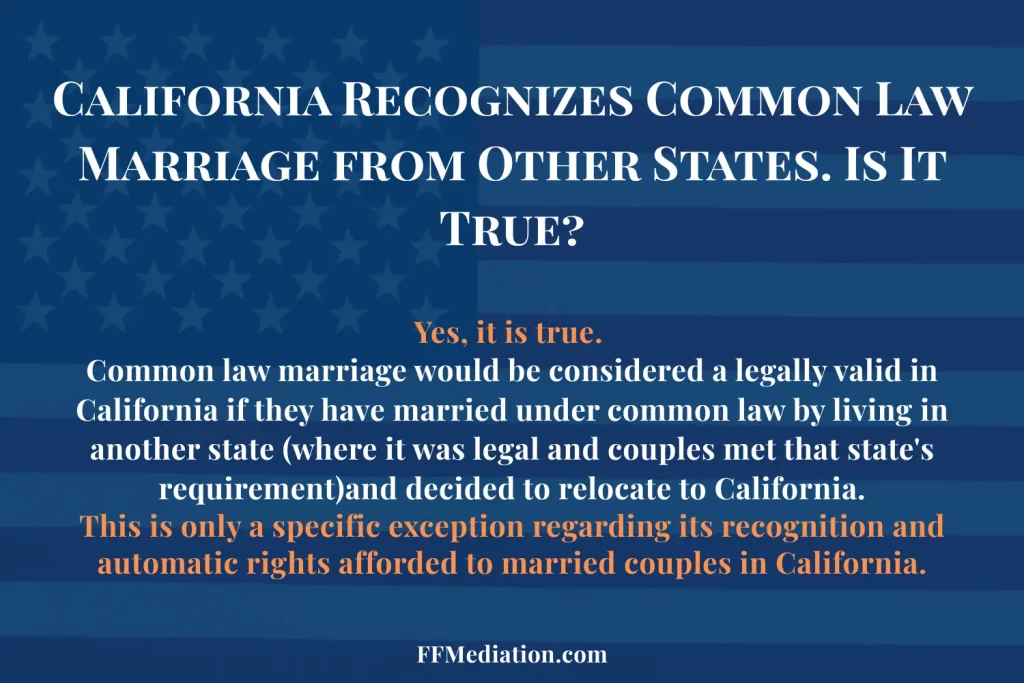
While California does not allow common law marriages to be formed within its borders, it generally recognizes common law marriages that were validly established in another state or country that legally permits them. This principle is based on the Full Faith and Credit Clause of the United States Constitution, which requires states to respect the “public acts, records, and judicial proceedings of every other state.”
-
Full Faith and Credit Clause Implications: If a couple legally entered into a common law marriage in a state like Colorado or Texas and then moves to California, their common law marriage will typically be recognized as a valid marriage by California courts. This means that for all legal purposes, including divorce, property division, and inheritance, California will treat them as married individuals. This is a significant consideration for anyone contemplating relocation to California from a common law state, as it directly impacts their legal and financial lifestyle.
-
Proof Requirements: The challenge for couples whose common law marriage was formed out-of-state often lies in providing sufficient proof to California authorities or courts. Documentation that demonstrates intent, cohabitation, and public presentation as a married couple from their previous state of residence will be crucial. This can include joint tax returns, insurance policies, property deeds, bank accounts, and sworn affidavits from friends or family. It highlights the importance of maintaining clear records, especially for couples whose lifestyle involves interstate moves.
Common Misconceptions and California Lifestyle Realities
The enduring myths surrounding common law marriage often lead to confusion and can have serious legal and financial repercussions for unsuspecting couples in California. Addressing these misconceptions is vital for couples to make informed decisions about their lifestyle and legal status.
The “Seven-Year Myth” and Other Urban Legends
One of the most pervasive myths is the “seven-year rule,” which falsely claims that after living together for a specific number of years (often seven), a couple automatically becomes common law married. This is a complete fabrication in California and most other states. No such automatic conversion exists anywhere in the United States. In states that do recognize common law marriage, the duration of cohabitation is typically not the sole or primary factor, but rather the intent and “holding out” as married. Relying on such myths can lead to devastating consequences when a relationship ends or a partner passes away, leaving an unprotected individual.
Distinguishing Marriage from Committed Relationships
California law recognizes and respects committed relationships, but it draws a sharp distinction between a committed partnership and a legally recognized marriage. While couples may share bank accounts, raise children, refer to each other as “spouses,” and fully integrate their lives, these actions, in and of themselves, do not confer marital rights under California law. The lifestyle of an unmarried, committed couple may outwardly appear identical to that of a married couple, but their legal standing is fundamentally different. This distinction is paramount for understanding property rights, inheritance, and potential support obligations upon separation.

Impact on Travel and Relocation Planning
For couples who travel extensively or plan to relocate to California from a state where common law marriage is recognized, understanding the nuances of how California treats out-of-state common law marriages is critical. A couple legally common law married in Montana, for example, will generally be considered married in California. However, this recognition often comes with the burden of proving the validity of their original common law marriage if challenged. This can create complexities in everything from filing taxes to obtaining medical benefits or dealing with property issues. Therefore, any couple considering such a move, and thus a change in their lifestyle context, should seek legal counsel to ensure their marital status and rights are clearly established and documented.
In summary, for individuals and couples embracing the vibrant lifestyle California offers, understanding the state’s definitive stance on common law marriage is not merely a legal detail but a fundamental aspect of responsible life and relationship planning. While the romantic notion of common law marriage persists, the pragmatic reality in California demands formal action—either through traditional marriage, registered domestic partnership, or comprehensive cohabitation agreements and estate planning—to secure a couple’s future and lifestyle. Ignoring these legal realities can lead to unintended complications and significant financial and emotional distress should a relationship dissolve or a partner pass away. Therefore, informed decision-making and proactive legal planning are the cornerstones of a secure and well-protected lifestyle for all committed couples in the Golden State.
LifeOutOfTheBox is a participant in the Amazon Services LLC Associates Program, an affiliate advertising program designed to provide a means for sites to earn advertising fees by advertising and linking to Amazon.com. Amazon, the Amazon logo, AmazonSupply, and the AmazonSupply logo are trademarks of Amazon.com, Inc. or its affiliates. As an Amazon Associate we earn affiliate commissions from qualifying purchases.