
The Fundamental Orders of Connecticut stand as a pivotal historical landmark, not in the physical sense of a building or monument, but as an foundational document that profoundly shaped the course of American democracy. Adopted in 1639 by the nascent river towns of Hartford, Windsor, and Wethersfield, these orders represent one of the earliest written constitutions in Western history, predating even the Constitution of the United States by nearly a century and a half. Its significance lies in its revolutionary assertion of government by the consent of the governed, establishing a framework for representative self-government that was remarkably progressive for its era. Far from being a mere colonial decree, the Fundamental Orders laid down principles that would echo through the formation of American republicanism, earning Connecticut the enduring moniker, “The Constitution State.” Exploring this document is to delve into the very roots of American political thought, understanding the audacious vision of early settlers who sought to build a society founded on law, liberty, and the collective will of its citizens.
The Genesis of a Groundbreaking Document
The mid-17th century was a period of fervent migration and experimentation in the New World. English Puritans, seeking religious freedom and economic opportunity, established various colonies along the North American coastline. Among these were the settlements that would eventually coalesce into the Colony of Connecticut. The journey toward the Fundamental Orders was not born out of abstract philosophical debate but from the very practical necessities of establishing order and legitimacy in a new and untamed land.
Puritan Migration and the River Towns
The story begins with a group of English Puritan dissenters, led by the influential Reverend Thomas Hooker. Discontent with the strict religious and political hierarchy of the Massachusetts Bay Colony, Hooker and his followers embarked on an arduous journey through the wilderness in 1636, settling in the fertile Connecticut River Valley. They established the towns of Hartford, Windsor, and Wethersfield, attracted by the rich agricultural land and navigable waterways. These communities, while sharing common Puritan ideals, initially lacked a unified, formal governmental structure beyond local agreements. Their unique geographical separation from Boston and their distinct vision for a more inclusive body politic spurred the need for a self-conceived system of governance.
The Influence of Thomas Hooker’s Sermon
While many factors contributed to the creation of the Fundamental Orders, the philosophical groundwork was significantly laid by Thomas Hooker’s famous sermon delivered on May 31, 1638. Preaching to the General Court of Connecticut in Hartford, Hooker articulated radical principles for his time: “The foundation of authority is laid in the free consent of the people.” He argued that the choice of public magistrates belonged to the people, and that those who have the power to appoint also have the power to set the bounds and limitations of the power and place unto which they call them. This sermon was a direct challenge to the prevailing notion of divine right or inherited authority, asserting instead the sovereignty of the community. Hooker’s democratic vision provided the ideological fuel for the creation of a written constitution that would embody these revolutionary ideas.
Defining Principles and Lasting Impact
The Fundamental Orders of Connecticut were not merely a set of rules; they were a profound statement of political philosophy, carving out a path toward self-governance that prioritized the welfare of the commonwealth over individual or sectarian interests. Its provisions demonstrated a remarkable foresight into what would become cornerstones of democratic states.
Key Provisions and Democratic Innovations
Adopted on January 14, 1639, the Fundamental Orders established a framework for a representative government. Unlike other colonial charters or agreements, it did not reference the King of England or any higher earthly authority as the source of its power. Instead, it declared that the people of the three towns “do therefore associate and conjoin ourselves to be as one Public State or Commonwealth” for the purpose of maintaining “the peace and union of such a people for Publick good.”
Key innovations included:
- Elected Governor and Magistrates: The Orders provided for the annual election of a Governor and six magistrates by all “freemen” (male landowners who took an oath of allegiance to the colony). This was a significant departure from systems where leaders were appointed or inherited their positions.
- General Court as Legislative Body: A General Court, comprising deputies chosen by each town, was established as the supreme legislative body, with the power to make laws, levy taxes, and declare war. This ensured local representation in the larger colonial government.
- Secret Ballot: Though not explicitly detailed, the Orders implied a system of voting that was more private than public acclamation, helping to foster more genuine expression of choice.
- Checks on Power: While the Governor had a prominent role, the General Court held ultimate legislative authority, preventing an accumulation of excessive power in a single executive. The Governor was also limited to serving only one term in any two-year period, a direct effort to prevent any individual from becoming too entrenched.
These provisions collectively represented an unprecedented commitment to popular sovereignty and a structured government accountable to its citizens.
A Government for the “Publick Good”
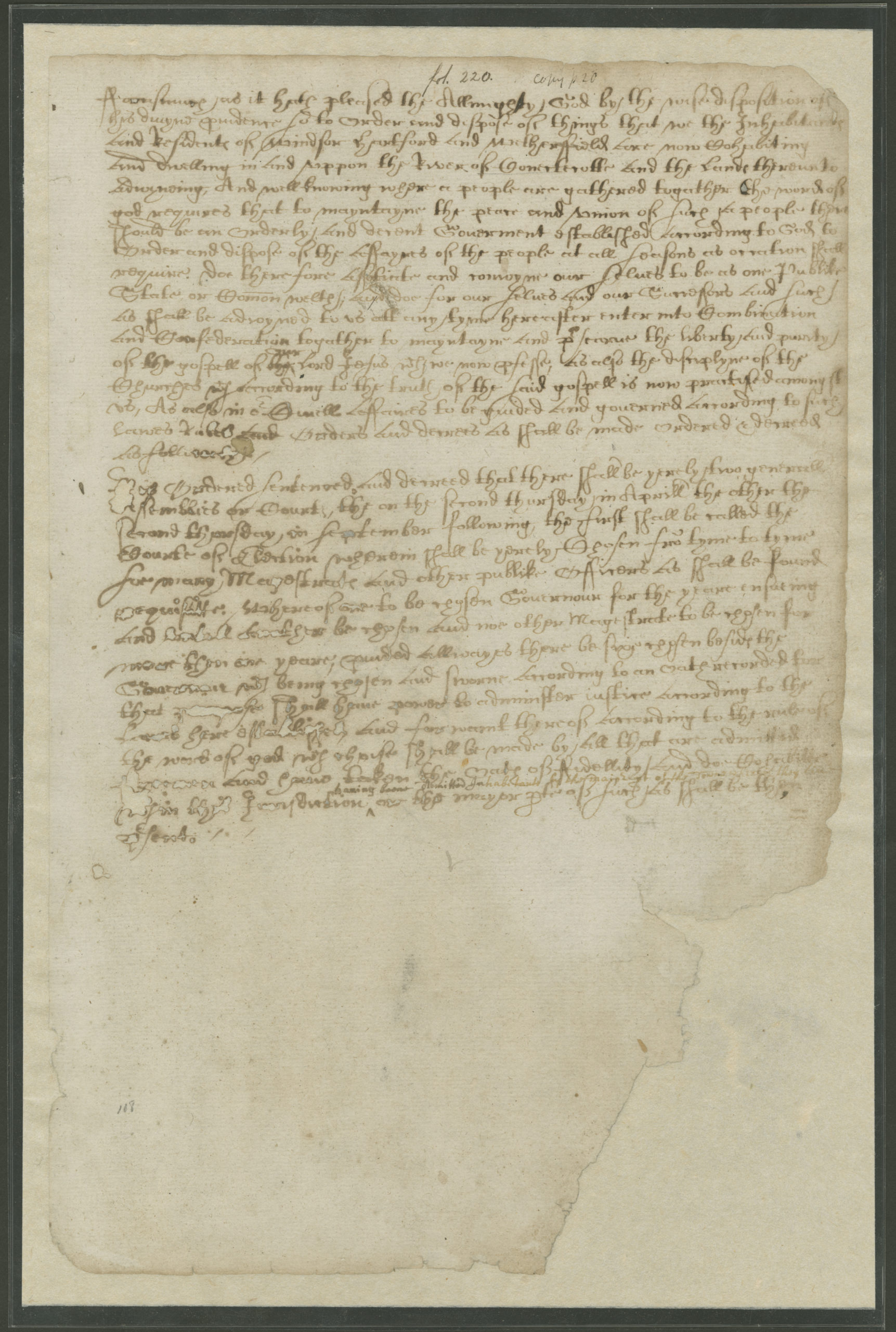
The explicit purpose stated in the Fundamental Orders was “to maintain and preserve the liberty and purity of the Gospel of our Lord Jesus which we now profess, as also the said discipline of the Churches, which according to the truth of the said Gospel is now practiced amongst us; as also in our Civil Affairs to order and dispose ourselves in the best manner and way as we may grow and be guided as from time to time shall be for the greatest comfort of us, our successors and for the Publick good.” This statement, while rooted in Puritan religious belief, crucially expanded the scope of government to include the “Publick good” in civil affairs, not solely religious purity. This broad definition of governmental responsibility for the welfare of all citizens established a precedent for inclusive governance, moving beyond mere theological dictates to encompass the practical needs and prosperity of the community.
A Precursor to Modern Democracy
The historical significance of the Fundamental Orders of Connecticut cannot be overstated. It stands as a critical evolutionary step in the development of constitutional government, influencing not only the future of Connecticut but also the broader trajectory of the United States. Its principles resonate deeply with documents that would define the American experiment.
Echoes in the U.S. Constitution
While the Fundamental Orders predate the U.S. Constitution by almost 150 years, the parallels are striking. Both documents derived their authority from the consent of the people, established a representative government with distinct branches (though less formally separated in the Orders), and aimed to promote the common welfare. The idea of a written constitution as the supreme law of the land, detailing the structure and limits of government power, found one of its earliest and most robust expressions in Connecticut. The Fundamental Orders pioneered concepts like the election of a chief executive, the establishment of a legislative body with elected representatives from towns, and the notion that government power flowed from the governed. These were not mere coincidences but rather foundational ideas that were iteratively refined and expanded upon in later constitutional conventions.
The “Constitution State” Legacy
Connecticut’s official nickname, “The Constitution State,” is a direct tribute to the Fundamental Orders. It recognizes the groundbreaking nature of this document in establishing a government based on a written constitution defining its powers and deriving its authority from the people. This legacy is a source of immense pride and a constant reminder of the state’s pioneering role in shaping democratic principles. The spirit of the Fundamental Orders continued to guide Connecticut’s political development, influencing its colonial charter of 1662 (which was so liberal it essentially incorporated the Orders) and even its post-American Revolution state constitution. The state’s commitment to ordered liberty and popular sovereignty remained a defining characteristic, passed down through generations.
Preservation and Enduring Relevance
Today, the original manuscript of the Fundamental Orders of Connecticut is a treasured artifact, carefully preserved and publicly accessible, allowing visitors to connect directly with this crucial piece of American heritage. Its principles continue to inspire and inform discussions about governance and rights.
A Prized Historical Artifact
The original manuscript of the Fundamental Orders is held at the Connecticut State Library in Hartford. This invaluable document, penned on parchment, serves as a tangible link to the profound intellectual and political daring of the early colonists. Its preservation allows scholars, students, and citizens alike to study the very words that laid the groundwork for self-governance in the United States. Viewing it offers a profound sense of continuity, connecting the earliest aspirations for democratic rule to the complex realities of modern governance. It is a historical landmark in the truest sense, a foundational text that symbolizes an enduring commitment to ordered liberty.

Its Place in American Identity
The Fundamental Orders of Connecticut remains a vital part of the American narrative. It represents the innovative spirit of early settlers who sought not just to escape oppression but to build a better system of governance. It predates more famous documents like the Mayflower Compact in establishing a more comprehensive governmental structure. While less known to the general public than the Declaration of Independence or the U.S. Constitution, its contribution to the evolution of constitutional democracy is undeniable. It showcases how, even in the nascent stages of colonization, ambitious ideas about popular sovereignty and limited government were taking root, eventually blossoming into the democratic republic we know today. The Orders serve as a powerful reminder that the principles of American democracy were forged not in a single moment, but through a long and continuous process of experimentation, debate, and the courageous assertion of human rights and self-determination.
LifeOutOfTheBox is a participant in the Amazon Services LLC Associates Program, an affiliate advertising program designed to provide a means for sites to earn advertising fees by advertising and linking to Amazon.com. Amazon, the Amazon logo, AmazonSupply, and the AmazonSupply logo are trademarks of Amazon.com, Inc. or its affiliates. As an Amazon Associate we earn affiliate commissions from qualifying purchases.