
Chicago, a vibrant metropolis in the heart of the United States, is renowned for its stunning architecture, rich history, and dynamic urban lifestyle. From the towering skyscrapers of the Loop to the artistic flair of River North and the trendy vibe of the West Loop, the city offers a diverse array of neighborhoods, each with its own unique charm and appeal. For residents and visitors alike, navigating the urban landscape often brings a common concern: parking. This is especially true for those considering an apartment stay, whether it’s a long-term relocation or a temporary accommodation for an extended trip. Understanding the parking requirements for apartments in Chicago is not just a matter of urban planning jargon; it’s a crucial factor that impacts daily life, travel logistics, and even the overall cost of living or visiting this magnificent city.
Chicago’s approach to parking has undergone significant transformations over the years, reflecting a broader shift in urban development philosophies across North America. Historically, cities often imposed strict parking minimums, requiring a certain number of parking spaces per residential unit, ostensibly to alleviate street congestion. While well-intentioned, these policies often led to an oversupply of parking, contributing to urban sprawl, increased development costs, and a greater reliance on personal vehicles. As Chicago continues to evolve into a more walkable, transit-friendly city, its zoning ordinances have adapted to promote sustainable development and enhance the quality of urban life. This article will delve into the intricacies of Chicago’s apartment parking requirements, offering insights for prospective residents, developers, and travelers seeking accommodation in the city.
Understanding Chicago’s Evolving Parking Regulations
The regulatory landscape for parking in Chicago is dynamic, shaped by decades of urban planning decisions and a growing emphasis on smart growth. For anyone considering an apartment in the city, deciphering these regulations is key to understanding the practicalities of vehicle ownership and usage. The foundational document governing these rules is the Chicago Zoning Ordinance, which dictates everything from building heights to land use, including off-street parking requirements.
The Historical Context of Parking Minimums
For many years, like most major cities, Chicago operated under a system of mandatory parking minimums. These rules prescribed a specific ratio of parking spaces to residential units, often varying based on the number of bedrooms or the size of the unit. The rationale was simple: to ensure that new developments generated enough parking to accommodate their residents and their guests, thereby preventing spillover onto public streets. For instance, a typical requirement might have been one parking space per studio or one-bedroom apartment, and 1.5 or 2 spaces for larger units. While seemingly logical, this approach had several unintended consequences.
Firstly, it significantly increased the cost of construction. Building structured parking garages is expensive, and these costs were inevitably passed on to residents through higher rents or purchase prices. Secondly, it often led to an abundance of unused parking spaces, particularly in areas well-served by public transit. These vacant spaces represented wasted land that could have been used for more productive purposes, such as additional housing, retail, or green spaces. Thirdly, by making it easier to own and park a car, these policies implicitly encouraged driving, contributing to traffic congestion and environmental pollution, directly contradicting the city’s goals for sustainable urban living.
Modern Reforms and the Shift Away from Rigid Minimums
Recognizing these drawbacks, Chicago has progressively moved away from rigid parking minimums, particularly in denser, transit-rich areas. This shift is part of a broader trend in urban planning that views parking not just as a necessity but as a commodity whose supply should be determined by market forces and strategic urban goals, rather than blanket mandates. The city’s current zoning ordinance allows for greater flexibility, especially in designated Transit-Oriented Development (TOD) areas, which will be explored in detail.
The reform efforts aim to strike a balance: ensuring adequate parking where truly needed, while simultaneously reducing the burden of excessive parking in areas where alternative transportation options are plentiful. This modern approach considers the unique characteristics of different neighborhoods, the availability of public transit, and the overall vision for Chicago’s future as a pedestrian and transit-friendly city. It reflects a growing understanding that parking policy is a powerful tool for shaping urban form and promoting desired behaviors, such as increased public transit ridership and reduced car dependence. For travelers staying in apartments or long-term accommodation, this translates to a more complex but potentially more sustainable approach to navigating the city.

The Impact of Transit-Oriented Development (TOD) on Parking
One of the most significant evolutions in Chicago’s parking requirements is directly tied to its Transit-Oriented Development (TOD) policy. This strategic urban planning approach prioritizes dense, mixed-use developments within easy walking distance of major public transportation hubs, aiming to foster vibrant, walkable communities while reducing reliance on personal vehicles.
Defining Transit-Oriented Development in Chicago
Chicago’s TOD ordinance, first adopted in 2013 and expanded since, specifically targets areas around CTA ( Chicago Transit Authority) and Metra stations. The core idea is to encourage housing and commercial activity where people can readily access buses and trains, thereby minimizing the need for private cars. For residential developments within these designated TOD zones, the parking requirements are significantly reduced, and in many cases, entirely eliminated.
Generally, a property qualifies as being within a TOD zone if it is located within a certain radius of a CTA or Metra station entrance. These radii can vary, but commonly include areas within 1/4 mile (1,320 feet) or sometimes 1/2 mile (2,640 feet) of a station. The exact distance often depends on the type of development, the zoning district, and the specific station’s importance or ridership levels. The intent is clear: if residents have excellent access to public transit, the requirement for private vehicle parking becomes less critical.
Reduced and Eliminated Parking Requirements in TOD Zones
Under the TOD ordinance, residential developments in eligible areas can significantly reduce the number of required parking spaces. For example, a development within a 1/4-mile radius of a CTA or Metra station might see parking minimums reduced by 50% or more. In some cases, particularly for smaller residential buildings (e.g., 20 units or fewer) or those within very close proximity to a high-capacity transit station, parking requirements can be entirely waived. This “zero parking” provision is a game-changer for urban developers and directly impacts the availability and pricing of apartments.
The benefits of these reduced parking requirements are manifold. Developers face lower construction costs, as building fewer parking spaces translates to less expensive projects. These savings can then be passed on to residents in the form of more affordable housing, which is a critical need in a city like Chicago. Furthermore, eliminating or reducing parking allows for more efficient land use, enabling the construction of more residential units, retail spaces, or community amenities. This contributes to a denser, more vibrant urban fabric, which aligns with the overall goals of creating dynamic and sustainable neighborhoods.
The Impact on Residents and Neighborhoods
For residents choosing an apartment in a TOD zone, the implications are profound. While car ownership is not prohibited, the design of these areas encourages a car-lite or car-free lifestyle. This can lead to significant cost savings by avoiding car payments, insurance, fuel, and daily parking fees. It also fosters a greater sense of community, as more people are walking, biking, and utilizing public spaces. Neighborhoods like parts of the West Loop, Logan Square, and Uptown have seen a boom in TOD-compliant apartment buildings, offering convenient access to the Blue Line or Red Line and transforming their local economies.
However, it’s also important to acknowledge potential challenges. While reducing parking minimums benefits the city as a whole, it can sometimes shift parking demand onto adjacent streets, particularly in established neighborhoods not fully equipped for the increased pedestrian traffic. For travelers or those new to Chicago seeking accommodation, understanding if their chosen apartment is within a TOD zone is critical for planning transportation and managing expectations regarding vehicle access.
Practicalities and Challenges of Apartment Parking in Chicago
Even with evolving regulations, the reality of parking in a dense urban environment like Chicago presents practical challenges for residents and visitors alike. Understanding these nuances is crucial for anyone considering an apartment stay, whether for a short vacation or a long-term relocation.
High Demand and Limited Supply
Despite the efforts to reduce reliance on personal vehicles, a significant portion of Chicago’s population still owns cars. This leads to a persistent imbalance between demand and supply for parking spaces, particularly in popular residential areas and business districts such as the Gold Coast, Lincoln Park, and the Magnificent Mile. Many older apartment buildings, constructed before modern zoning reforms or in areas not designated as TOD, often lack sufficient on-site parking. This forces residents to seek alternatives, which can be both costly and inconvenient.
When an apartment does not come with a dedicated parking space, residents often have to explore options like street parking (which might require a residential permit), renting a space in a private garage, or utilizing commercial parking lots. The scarcity is exacerbated by the sheer number of daily commuters and tourists visiting attractions like Millennium Park, the Art Institute of Chicago, or Navy Pier, all of whom contribute to the city’s overall parking congestion.
The Cost of Parking
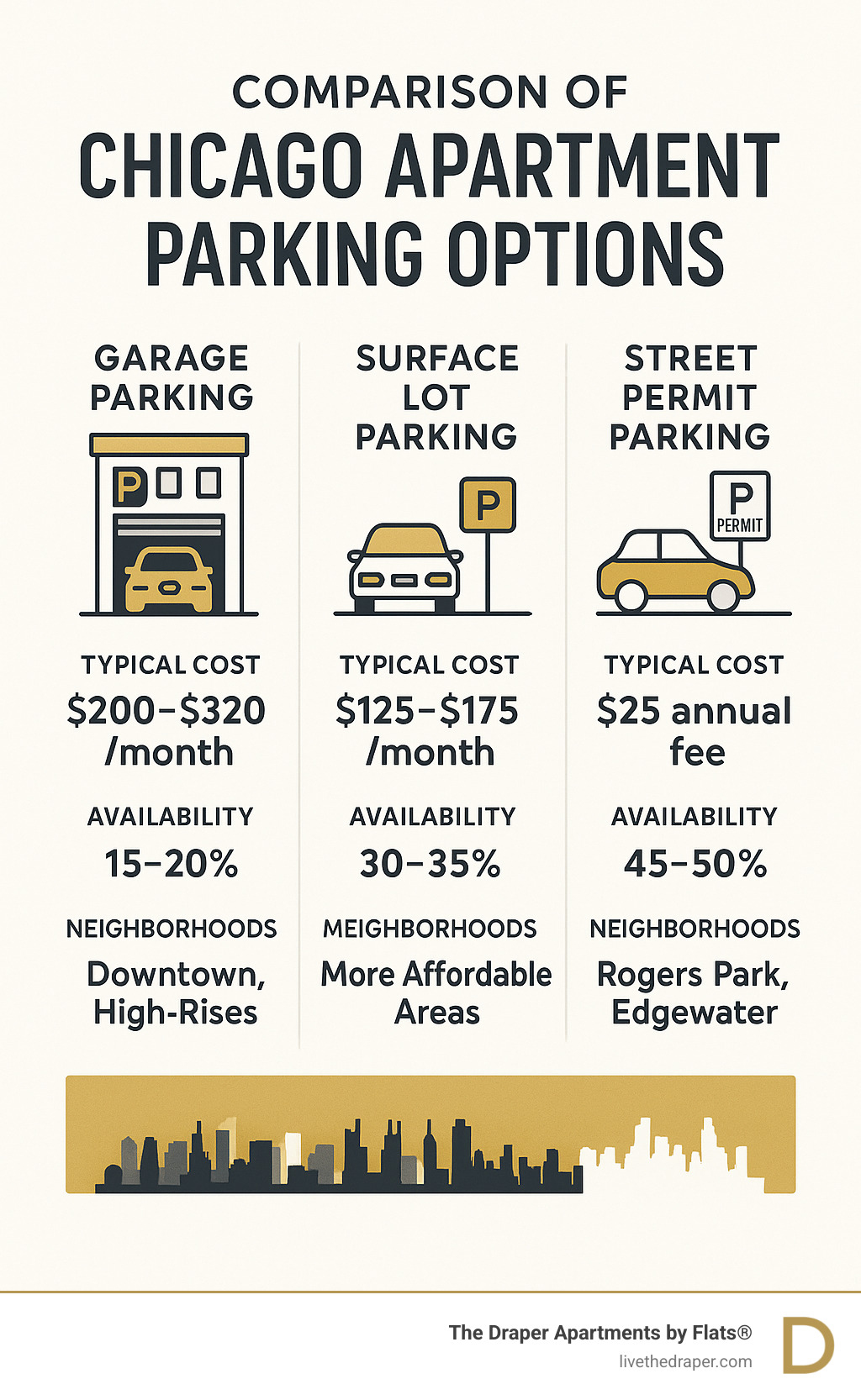
The financial implications of parking in Chicago can be substantial. For apartment dwellers without included parking, monthly rental rates for a dedicated spot in a garage can range from $150 to $400 or more, depending on the neighborhood and the type of facility. In prime downtown locations or popular tourist areas, these costs can be even higher. This represents a significant additional expense on top of monthly rent, impacting the overall affordability of living in certain areas.
Beyond monthly rentals, daily and hourly parking rates at commercial garages and lots can quickly add up for visitors or those with occasional needs. Street parking, while sometimes cheaper (or free in some residential zones with permits), is often subject to strict time limits, parking meters, and street cleaning schedules, making it a less reliable long-term solution. Parking tickets in Chicago are not uncommon and can be quite costly, adding another layer of financial risk for drivers.
Alternative Transportation and Visitor Parking
Given the challenges and costs associated with parking, many Chicago residents embrace the city’s robust public transportation system. The CTA ‘L’ trains and extensive bus network provide excellent connectivity across the city and to both O’Hare International Airport and Midway International Airport. Ride-sharing services, bike-sharing programs like Divvy, and a growing network of bike lanes also offer viable alternatives to car ownership. For apartment residents, prioritizing access to these options can significantly reduce the stress and expense of parking.
Visitor parking is another common concern, especially for those staying in apartments as tourists or during family visits. Many apartment buildings, particularly newer ones designed under TOD guidelines, offer limited or no visitor parking. Guests often have to rely on metered street parking, nearby commercial garages, or finding elusive free street parking in permitted residential zones. For travelers booking apartment-style accommodations, it is highly recommended to inquire about parking options before arrival, particularly if they plan to bring a car. Websites and apps dedicated to parking often provide useful information on available spots and pricing, helping to plan ahead for a smoother experience.
Future Outlook and Strategic Considerations for Chicago Parking
As Chicago continues to evolve, so too will its approach to urban planning and parking management. The trends indicate a sustained movement towards more sustainable, efficient, and equitable solutions, reflecting global best practices in urban development.
Continuing the Trend Towards Sustainable Urbanism
The trajectory of Chicago’s parking policy is firmly set on promoting sustainable urbanism. This means further reductions in parking minimums, especially in dense, transit-rich corridors, and potentially the exploration of parking maximums in certain areas to actively discourage car use. The city is likely to continue investing heavily in its public transit infrastructure, making the CTA and Metra even more attractive options for daily commutes and recreational travel. This focus aligns with broader environmental goals, aiming to reduce carbon emissions and improve air quality within the urban core.
Furthermore, expect to see continued integration of multi-modal transportation options. Bike lanes, pedestrian-friendly street designs, and micro-mobility solutions (like electric scooters) will likely become even more prevalent. For apartment residents, this means a greater variety of convenient and eco-friendly ways to get around, potentially lessening the perceived necessity of car ownership. Developers will be incentivized to incorporate bike storage, charging stations for electric vehicles, and direct access to public transit as key amenities in new apartment complexes.
The Role of Technology and Smart Parking Solutions
Technology is poised to play an increasingly important role in managing Chicago’s parking challenges. Smart parking systems, which use sensors and real-time data to guide drivers to available spaces, could help reduce cruising for parking, thereby alleviating congestion. Mobile apps for finding, reserving, and paying for parking are already popular and will likely become even more sophisticated, offering dynamic pricing based on demand and location. This could benefit both residents and tourists, making the process of finding a spot less frustrating and more predictable.
The long-term future might also see the impact of autonomous vehicles. While still in nascent stages, widespread adoption of self-driving cars could dramatically alter urban parking needs. Fleets of shared autonomous vehicles might reduce the need for personal car ownership and static parking spaces, potentially freeing up valuable urban land currently dedicated to parking lots and garages. This futuristic vision could eventually lead to a significant rethinking of how cities like Chicago allocate space, potentially transforming existing parking structures into new residential units, parks, or commercial spaces.
Strategic Advice for Apartment Seekers and Travelers
For anyone looking to secure an apartment in Chicago, whether for a permanent move or an extended stay, parking should be a key consideration from the outset.
-
For Long-Term Residents:
- Prioritize Location: If car ownership is essential, look for apartments that explicitly include a parking space in the rent or offer dedicated parking for an additional fee.
- Evaluate TOD Areas: If you’re willing to go car-lite or car-free, apartments in TOD zones offer excellent transit access and often more affordable rent due to reduced parking costs for developers.
- Research Neighborhoods: Understand the street parking rules and permit requirements for your desired neighborhood. Some areas have restricted parking zones that require a city-issued residential permit.
- Budget for Parking: Factor in the potential cost of parking (monthly garage rental, daily rates, or potential tickets) into your overall housing budget.
-
For Travelers and Short-Term Stays:
- Inquire Before Booking: Always confirm parking availability and cost when booking apartment-style accommodations. Many vacation rentals or serviced apartments, especially in prime areas, may not include parking.
- Consider Alternatives: Given Chicago’s excellent public transit system, consider foregoing a rental car, especially if your itinerary focuses on downtown attractions like the Willis Tower, Field Museum, Shedd Aquarium, or Adler Planetarium.
- Utilize Parking Apps: Download apps like SpotHero or ParkWhiz to pre-book parking spaces, often at a discount, for specific periods or locations. This can save time and money.
In conclusion, the parking requirements for apartments in Chicago are a complex but essential aspect of urban living and travel in the city. While the city’s move towards Transit-Oriented Development aims to reduce car dependence and promote sustainable growth, the realities of parking availability and cost remain significant. By understanding these regulations and planning strategically, both residents and visitors can navigate Chicago’s dynamic urban landscape more effectively and enjoy all that this incredible destination has to offer.
LifeOutOfTheBox is a participant in the Amazon Services LLC Associates Program, an affiliate advertising program designed to provide a means for sites to earn advertising fees by advertising and linking to Amazon.com. Amazon, the Amazon logo, AmazonSupply, and the AmazonSupply logo are trademarks of Amazon.com, Inc. or its affiliates. As an Amazon Associate we earn affiliate commissions from qualifying purchases.