
The journey of Florida into the United States of America as a sovereign state is a fascinating tapestry woven with threads of exploration, colonial struggles, geopolitical shifts, and the relentless march of American expansionism. From its initial discovery by Europeans to its pivotal role in the Civil War and its subsequent transformation into a modern-day powerhouse, Florida’s history is deeply intertwined with the development of the nation. The simple question, “When did Florida join the Union?” opens a portal to understanding centuries of conflict, aspiration, and the very fabric of American identity. This article delves into the intricate historical narrative that led to Florida’s statehood, exploring the key events, treaties, and political machinations that shaped its destiny and ultimately brought it into the fold as the 27th state.
Early History and Colonial Rule
Before its integration into the United States, Florida’s landscape was a contested prize among European powers, each vying for control over its strategic coastline and fertile lands. This period of colonial rule laid the groundwork for the eventual transfer of sovereignty to the Americans.
Spanish Exploration and First Claims
The European discovery of Florida dates back to 1513 when Juan Ponce de León, a Spanish explorer, landed near what is now St. Augustine and claimed the territory for Spain, naming it “La Florida” in honor of Pascua Florida (Festival of Flowers). Decades later, in 1565, Pedro Menéndez de Avilés established St. Augustine, making it the oldest continuously inhabited European-established settlement in the continental United States. For over two centuries, Spanish Florida served primarily as a military outpost guarding the Spanish trade routes, with its influence extending only modestly beyond its fortifications. Its vast interior remained largely untamed, inhabited by various indigenous tribes.
British Interlude
The geopolitical landscape shifted dramatically in 1763 with the conclusion of the Seven Years’ War (known in North America as the French and Indian War). Under the terms of the Treaty of Paris (1763), Spain ceded Florida to Great Britain in exchange for Havana, Cuba, which the British had captured. The British divided Florida into two colonies: East Florida, with its capital at St. Augustine, and West Florida, with its capital at Pensacola. During this brief but impactful period, the British encouraged settlement and economic development, leading to some growth in agriculture and trade. However, British rule over Florida was short-lived, as the American Revolution soon erupted, pitting the thirteen American colonies against the British Crown. While Florida remained loyal to Britain, the outcome of the war would once again redefine its sovereignty.
Return to Spanish Rule
Following the American victory in the Revolutionary War, another Treaty of Paris was signed in 1783. In a complex diplomatic move, Great Britain returned Florida to Spain as part of the peace settlement. This second period of Spanish control was marked by persistent challenges. The newly independent United States, now bordering Florida to the north, exerted increasing pressure. Spanish authority was weak, struggling to control the vast territory, prevent incursions from American settlers, and manage conflicts with Native American tribes, particularly the Seminoles. This instability, coupled with Spain’s declining global power, made Florida a ripe target for American expansionist ambitions.
The Path to American Acquisition
The early 19th century was a period of aggressive territorial expansion for the United States. Driven by economic interests, strategic concerns, and the prevailing ideology of Manifest Destiny, the young nation cast its eyes southward, viewing Spanish Florida as a natural and necessary addition.
Growing American Interest
As the United States expanded its western frontiers, the presence of foreign-controlled Florida became increasingly problematic. Florida served as a refuge for runaway slaves and a base for Native American raids against American settlements in Georgia and Alabama. It also offered a smuggling haven and impeded American navigation rights on the Mississippi River and access to the Gulf of Mexico. American political leaders, including President Thomas Jefferson and Secretary of State James Monroe, saw the acquisition of Florida as crucial for national security and economic growth. Border disputes, often inflamed by American incursions and Spanish inability to maintain order, fueled the calls for annexation.
The Adams-Onís Treaty
The culmination of these pressures was the Adams-Onís Treaty of 1819, a landmark agreement between the United States and Spain. Negotiations were led by U.S. Secretary of State John Quincy Adams and Spanish Minister Don Luis de Onís. The backdrop to this treaty included incursions into Florida by American General Andrew Jackson during the First Seminole War (1817-1818), demonstrating Spain’s inability to defend its territory. Under the terms of the treaty, Spain ceded all of Florida to the United States and clarified the western boundary of the Louisiana Purchase extending to the Pacific Ocean. In return, the United States agreed to assume up to $5 million in claims by American citizens against Spain. The treaty was ratified in 1821, officially transferring control of Florida to the United States.
Territorial Period
Upon its acquisition, Florida was organized as the Florida Territory in 1822, with William P. Duval appointed as its first governor. Tallahassee was chosen as the territorial capital in 1824, strategically located between the two major population centers of St. Augustine and Pensacola. The territorial period witnessed significant population growth, driven by settlers from the southern United States attracted by cheap land and the promise of agricultural prosperity, particularly in cotton and sugar cane. However, this expansion often came at the expense of indigenous populations. The Second Seminole War (1835-1842), a brutal and costly conflict, aimed to remove the Seminoles and other Native American groups from Florida, making way for further white settlement. The war, the longest and most expensive Indian war in American history, significantly shaped the territory’s development and its path to statehood.
The Road to Statehood

The territorial period, despite its challenges, laid the administrative and demographic foundations for Florida to seek admission into the Union. However, the process was far from straightforward, entangled in the complex national debate over slavery.
Debates Over Slavery
By the 1830s and early 1840s, the issue of slavery dominated American politics. As new territories sought statehood, there was a delicate balance maintained in Congress between free states and slave states. Admitting one without the other could upset this equilibrium and ignite sectional tensions. Florida, with its plantation economy heavily reliant on enslaved labor, was destined to become a slave state. This fact created a political dilemma in Washington. Consequently, Florida’s admission was delayed until a suitable “pair” — a free state — could be admitted simultaneously. This pairing eventually materialized with Iowa, which was preparing for statehood as a free state.
Economic Drivers for Statehood
Beyond the political considerations of slavery, strong economic motivations pushed Florida toward statehood. The burgeoning agricultural sector, particularly cotton and sugar, required more stable legal and political frameworks to support its growth. Land speculation was rampant, and statehood promised improved infrastructure, better access to capital, and more effective governance to protect property rights and facilitate trade. The territory also aspired to develop its ports and transportation networks, seeing statehood as a pathway to federal funding and recognition that would boost its economic prospects. A stable, self-governing state was seen as essential for attracting further investment and ensuring long-term prosperity.
Political Maneuvering
Throughout the 1830s and early 1840s, Florida’s territorial legislature and its delegates to Congress actively lobbied for statehood. Constitutional conventions were held, and the territory drafted a state constitution in 1838, which was ratified by its citizens in 1839. This constitution explicitly protected slavery and established the framework for a state government. Repeated petitions were sent to Washington, emphasizing the territory’s growing population, economic viability, and readiness for self-governance. The delay was primarily due to the aforementioned congressional deadlock over the free-state/slave-state balance, requiring careful political maneuvering to find a solution acceptable to both northern and southern factions.
Statehood Achieved: March 3, 1845
After years of territorial status, internal debates, and national political wrangling, the moment finally arrived for Florida to shed its territorial designation and embrace full statehood.
The Official Date
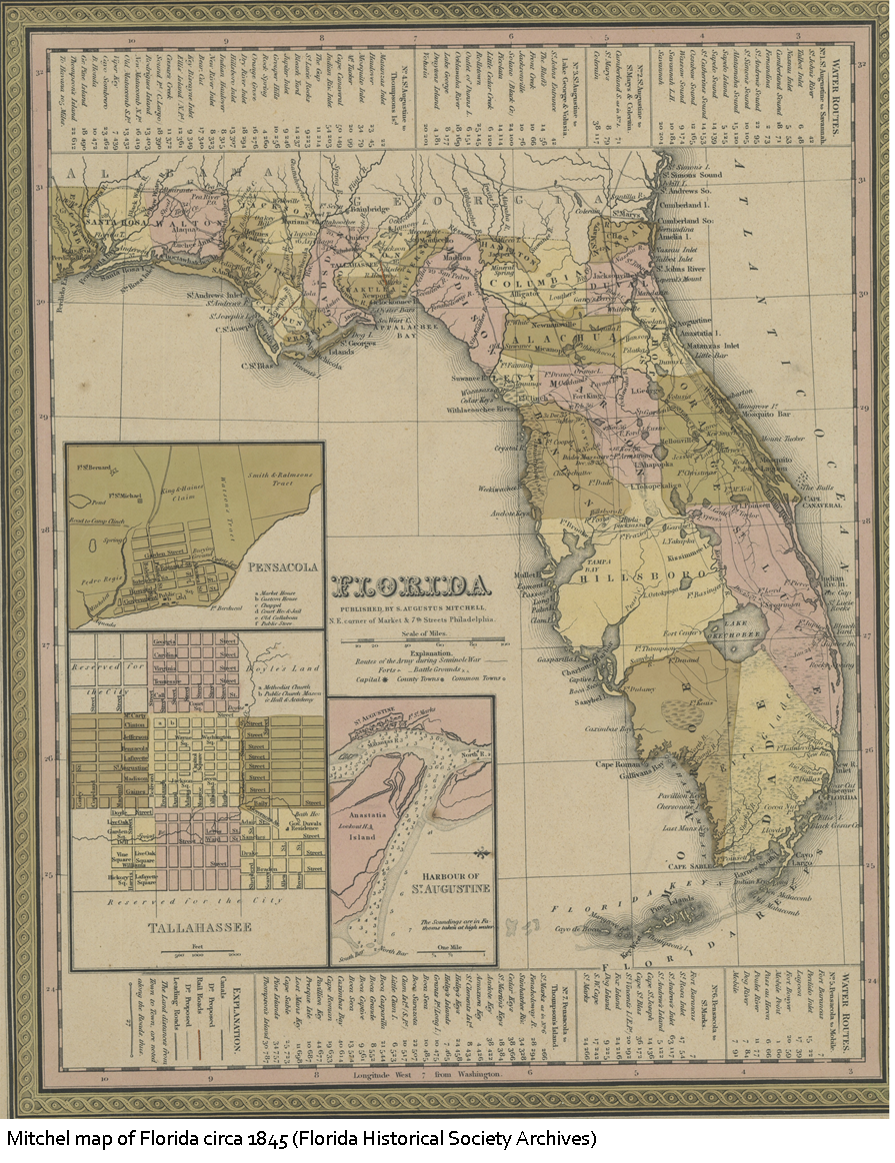
On March 3, 1845, President John Tyler signed the bill that simultaneously admitted Florida as a slave state and Iowa as a free state into the Union. This carefully orchestrated legislative act maintained the delicate balance of power in the United States Senate, a critical consideration in the decades leading up to the Civil War. With this signature, Florida officially became the 27th state of the United States of America. The capital remained at Tallahassee, and the new state government quickly transitioned from its territorial structure.
Immediate Impact and Challenges
Upon achieving statehood, Florida immediately began to integrate more fully into the national political and economic landscape. Its representatives took their seats in Congress, contributing to the growing debates that would ultimately lead to the Civil War. Economically, statehood provided a boost to internal development and external trade, although the reliance on a plantation economy tied its fate closely to the institution of slavery. The challenges were significant: establishing a robust state infrastructure, managing ongoing relations with remaining Native American populations, and navigating the increasingly volatile national political climate. Within 16 years of joining the Union, Florida would, in fact, secede and join the Confederacy, a testament to the profound sectional divisions that characterized the era of its statehood.
Florida’s Legacy in the Union
Florida’s journey within the Union has been one of dramatic change, resilience, and remarkable growth, shaping both the state itself and the nation as a whole.
Post-Civil War and Reconstruction
Following its secession in 1861 and its participation in the Civil War, Florida endured the hardships of war and the subsequent period of Reconstruction. It was readmitted to the Union in 1868 after adopting a new state constitution that abolished slavery and granted civil rights to African Americans, although these rights would be systematically undermined in the decades that followed. The post-war era saw the state slowly begin to rebuild its economy, shifting from a near-total reliance on plantation agriculture to developing new industries, including timber, phosphate mining, and, crucially, tourism. The arrival of railroads in the late 19th century, spearheaded by visionaries like Henry Flagler, transformed the state’s coastal areas and laid the foundation for its future as a premier travel destination.

Modern Florida
Today, Florida stands as a vibrant and diverse state, a far cry from its colonial and territorial past. It is the third-most populous state in the United States, boasting a dynamic economy driven by tourism, agriculture, international trade, aerospace, and high technology. Iconic cities like Miami, with its multicultural flair, and Orlando, home to world-famous theme parks, attract millions of visitors annually. Its unique geography, from the pristine beaches of the Gulf Coast to the ecological wonders of the Everglades, continues to define its identity. Florida’s rich history, from its Spanish colonial roots to its struggle for statehood and its post-Civil War resurgence, remains an integral part of its character, reminding us of the long and intricate path it took to become the “Sunshine State” we know today.
In conclusion, Florida’s journey to join the Union on March 3, 1845, was a complex saga shaped by centuries of European colonial ambitions, American expansionist desires, and the contentious issue of slavery. Its story is not just a chronological account of dates and treaties, but a testament to the enduring forces that forged the United States into the nation it is today, a nation built on a foundation of diverse histories and continuous transformation.
LifeOutOfTheBox is a participant in the Amazon Services LLC Associates Program, an affiliate advertising program designed to provide a means for sites to earn advertising fees by advertising and linking to Amazon.com. Amazon, the Amazon logo, AmazonSupply, and the AmazonSupply logo are trademarks of Amazon.com, Inc. or its affiliates. As an Amazon Associate we earn affiliate commissions from qualifying purchases.