
The Fontainebleau Miami Beach stands as a monumental icon of mid-century modern architecture and high-society luxury. Located on a sprawling oceanfront plot in Miami Beach, Florida, this hotel has long been a playground for celebrities, presidents, and international travelers. However, the story of its ownership is as dramatic and sprawling as its curved facade. To understand who owned the Fontainebleau Miami Beach, one must trace a timeline through visionary builders, financial collapses, and billion-dollar corporate maneuvers.
The Visionary Era: Ben Novack and Morris Lapidus
The inception of the Fontainebleau Miami Beach is inseparable from the ambition of Ben Novack, a hotelier who sought to create the most opulent resort in the United States. In the early 1950s, Ben Novack purchased the Firestone Estate, a massive piece of land formerly owned by the Harvey Firestone family.

The Architectural Genius of Morris Lapidus
To bring his vision to life, Ben Novack hired the avant-garde architect Morris Lapidus. At the time, Morris Lapidus was criticized by his peers for his “excessive” and “flamboyant” style, which he famously called “too much is never enough.” When the hotel opened in 1954, it redefined luxury with its signature bow-tie floors, the “Stairway to Nowhere,” and circular “cheese wall” patterns. Under the ownership of Ben Novack, the hotel became the premier destination in Miami, hosting legends like Frank Sinatra, Dean Martin, and Elvis Presley.
The Great Rivalry and the Spite Wall
One of the most infamous periods of the Ben Novack ownership involved the construction of the Eden Roc Miami Beach next door. When Harry Mufson, a former partner of Ben Novack, built the Eden Roc Miami Beach, the competition became personal. In an act of legendary pettiness, Ben Novack built a massive addition to the Fontainebleau Miami Beach specifically designed to cast a shadow over the Eden Roc Miami Beach pool for most of the day. This “spite wall” defined the cutthroat nature of Miami Beach hospitality ownership during the mid-20th century.
Changing Hands: The Stephen Muss and Hilton Era
By the late 1970s, the glamour of the Fontainebleau Miami Beach had begun to fade. Changing travel patterns and the aging of the property led Ben Novack into significant financial distress. In 1977, the resort filed for bankruptcy, marking the end of the founding family’s control.
Rescuing an Icon: Stephen Muss
In 1978, Stephen Muss, a prominent real estate developer in Florida, acquired the struggling property. Stephen Muss is credited with saving the hotel from irrelevance. He understood that to survive in a modernizing market, the Fontainebleau Miami Beach needed professional management and a massive capital infusion. He invested millions into renovations, modernizing the rooms and the convention spaces to attract a broader business clientele alongside the traditional luxury traveler.
The Partnership with Hilton Hotels
Under the ownership of Stephen Muss, the property entered a long-term management agreement with Hilton Hotels. For many years, the resort was officially known as the Fontainebleau Hilton Resort. This era brought stability and a standardized level of service that helped the brand maintain its status as a top-tier hotel in North America. Hilton Hotels brought global marketing reach, ensuring that the hotel remained a frequent backdrop for Hollywood films such as Scarface and The Bodyguard.
The Soffer Family and the Renaissance of Fontainebleau
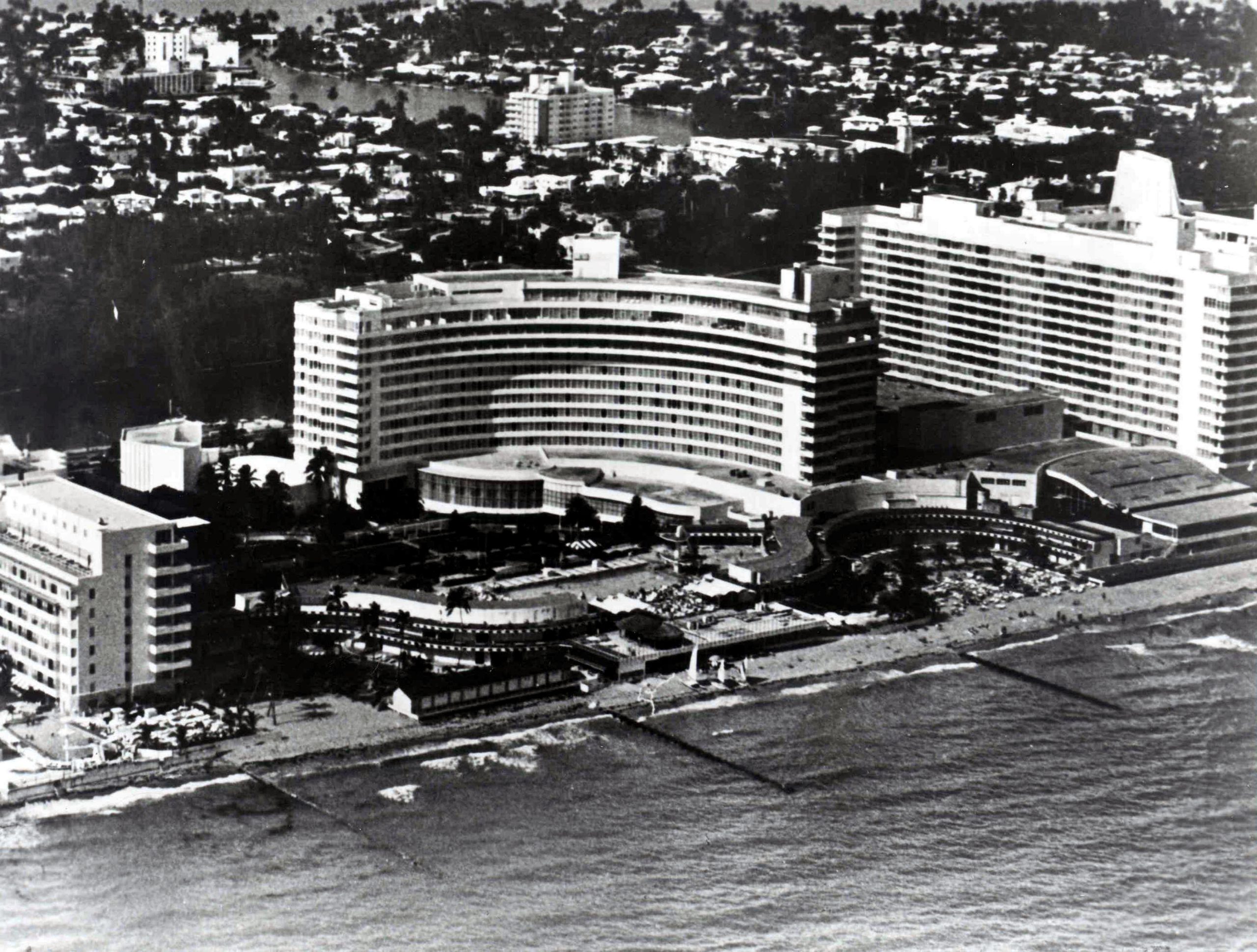
The modern identity of the Fontainebleau Miami Beach is synonymous with the Soffer family. In 2005, Turnberry Associates, a real estate development firm led by Donald Soffer and later his son Jeffrey Soffer, purchased the property from Stephen Muss.
A Billion-Dollar Transformation
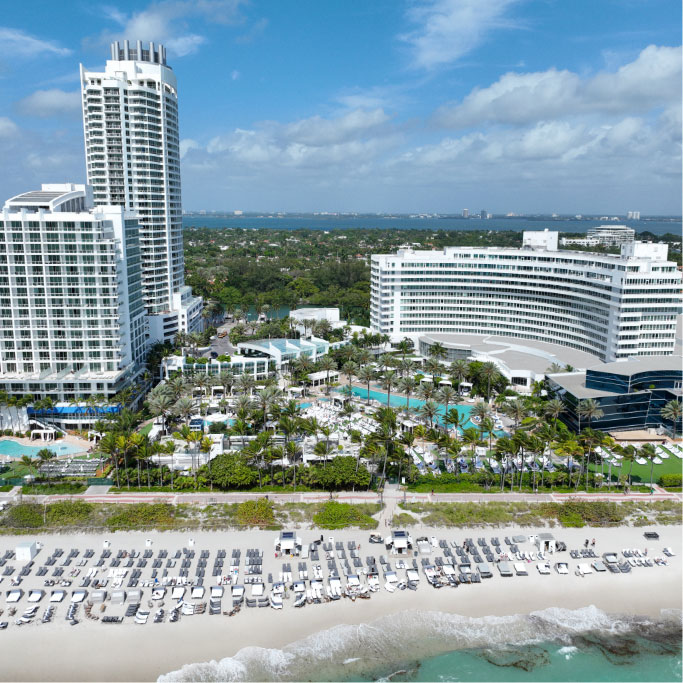
The Soffer family had a vision to return the hotel to the pinnacle of global luxury. They closed the hotel in 2006 for a two-year, $1 billion renovation project. This massive undertaking saw the expansion of the resort to include new all-suite towers, such as the Tresor Tower and the Versailles Tower. When the hotel reopened in 2008, it featured a star-studded gala with performances by Mariah Carey and Robin Thicke.
Strategic Refinement and Fontainebleau Development
Following internal restructuring within Turnberry Associates, ownership of the hotel was eventually consolidated under Jeffrey Soffer and his new entity, Fontainebleau Development. This move allowed for a more focused approach to branding. Jeffrey Soffer sought to evolve the name into a global luxury lifestyle brand, integrating high-end nightlife through venues like LIV Nightclub and gourmet dining experiences like Hakkasan.
The Las Vegas Frontier: Ownership and Turbulence
While the Miami property flourished, the history of the brand’s ownership in Nevada was fraught with difficulty. The attempt to bring the Fontainebleau name to the Las Vegas Strip resulted in one of the most complex ownership sagas in hospitality history.
The Bankruptcy and Carl Icahn
Construction on the Fontainebleau Las Vegas began in 2007 under Jeffrey Soffer. However, the global financial crisis of 2008 led to the project’s bankruptcy. In 2010, the billionaire investor Carl Icahn purchased the unfinished skyscraper for approximately $150 million. Carl Icahn never finished the building, instead holding onto the asset for seven years before selling it for a significant profit.
The Return of Soffer and Koch Real Estate Investments
In 2017, the property was sold to the Witkoff Group and New Valley LLC, who renamed it The Drew Las Vegas. However, the project stalled again. In a surprising turn of events in 2021, Jeffrey Soffer through Fontainebleau Development, in partnership with Koch Real Estate Investments, reacquired the property. This marked a full circle for the ownership, as the original visionary regained control of the Las Vegas project, finally opening it in late 2023.
What Defines the Fontainebleau Brand Today?
Today, ownership by Fontainebleau Development means a commitment to a specific type of hospitality that blends historic reverence with ultra-modern amenities. The brand is no longer just a single hotel but a collection of luxury residences, marinas, and resorts.
World-Class Amenities and Suites
The Fontainebleau Miami Beach currently offers over 1,500 guest rooms and suites. The ownership has invested heavily in the Lapis Spa, which is frequently cited as one of the most beautiful wellness facilities in the United States. From the BleauBar in the lobby to the private cabanas overlooking the Atlantic Ocean, the focus remains on providing an all-encompassing resort experience.
A Legacy of Luxury
The ownership of the Fontainebleau Miami Beach has transitioned from the personal ambition of Ben Novack to the corporate management of Hilton Hotels, and finally to the visionary multi-generational leadership of the Soffer family. Each owner has left an indelible mark on the property. Ben Novack gave it a soul and a shape; Stephen Muss gave it a lifeline; and Jeffrey Soffer gave it a future on a global scale.
As the brand expands into new markets and continues to dominate the Florida luxury landscape, the history of its ownership serves as a testament to the enduring power of great architecture and the relentless pursuit of glamour. Whether you are walking through the lobby in Miami Beach or looking up at the towering glass in Las Vegas, the Fontainebleau remains a beacon of high-end hotel culture, steered by owners who understood that this particular name carries a weight unlike any other in the world of travel.
LifeOutOfTheBox is a participant in the Amazon Services LLC Associates Program, an affiliate advertising program designed to provide a means for sites to earn advertising fees by advertising and linking to Amazon.com. Amazon, the Amazon logo, AmazonSupply, and the AmazonSupply logo are trademarks of Amazon.com, Inc. or its affiliates. As an Amazon Associate we earn affiliate commissions from qualifying purchases.