
The journey from Los Angeles to New York City represents the ultimate traverse of the United States. Spanning nearly the entire width of the North American continent, this route connects the shimmering Pacific Ocean with the historic Atlantic Ocean. Whether you are planning a rapid business trip or a leisurely cross-country exploration, understanding the distance and the logistical nuances of this trek is essential for any modern traveler. The distance between these two iconic metropolises is approximately 2,450 miles (3,940 kilometers) in a straight line, but the actual travel distance varies significantly depending on your chosen mode of transport and specific itinerary.
Bridging the Coast-to-Coast Gap: Distance and Transportation Methods
When calculating the distance between California and New York, the method of travel dictates not just the time spent, but the very nature of the experience. The vastness of the Great Plains, the ruggedness of the Rocky Mountains, and the industrial heart of the Midwest all lie between these two coastal giants.
Flying Across the Continent
For the majority of travelers, the most efficient way to bridge the gap is by air. A non-stop flight from Los Angeles International Airport to John F. Kennedy International Airport typically takes between five and six hours. However, the return trip from the East Coast to the West Coast often takes slightly longer—closer to six and a half hours—due to the prevailing jet stream winds that blow from west to east.
Major carriers often utilize Newark Liberty International Airport or LaGuardia Airport as alternatives for those heading into the Manhattan area. From the air, passengers are treated to a spectacular geographical tapestry, watching the urban sprawl of Los Angeles give way to the Mojave Desert, followed by the snow-capped peaks of the Colorado wilderness, before descending over the dense suburban grids of Pennsylvania and New Jersey.
The Ultimate American Road Trip
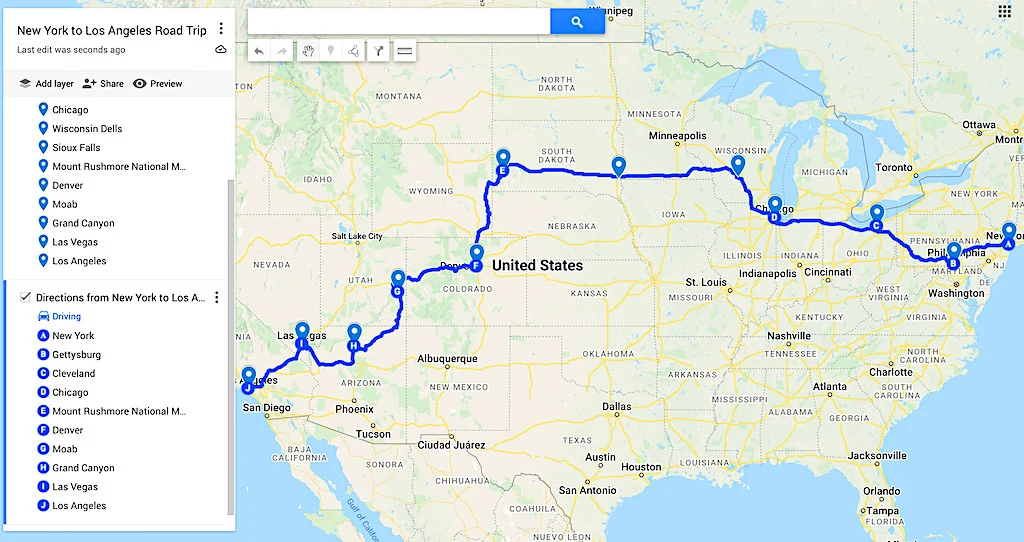
For those who believe that the journey is as important as the destination, driving from Los Angeles to New York City is a bucket-list experience. By road, the distance increases to roughly 2,800 miles, depending on the highways chosen. The fastest route typically involves taking Interstate 40 or Interstate 80, a drive that requires approximately 40 to 45 hours of actual steering time.
A popular southern route allows travelers to follow portions of the legendary Route 66, passing through Arizona, New Mexico, Texas, and Oklahoma. Alternatively, a northern route via Chicago offers a look at the Great Lakes region. Regardless of the path, a road trip of this magnitude typically spans five to ten days, allowing for rest stops in vibrant cities like St. Louis or Denver.
Alternative Routes: Rail and Long-Distance Bus
For a more nostalgic and scenic perspective, Amtrak offers several rail options that connect the two coasts. While there is no direct “Coast-to-Coast” single train, travelers often take the Southwest Chief from Los Angeles to Chicago, and then transfer to the Lake Shore Limited or the Cardinal to reach New York City. This journey takes approximately three days and provides a unique vantage point of the American landscape that is inaccessible by car or plane.
Similarly, long-distance bus services like Greyhound provide a budget-friendly, albeit time-consuming, alternative. This mode of travel is ideal for those who wish to see the smaller towns of Ohio, Indiana, and Kansas up close, offering a deep dive into the rural heart of the United States.
A Comparative Journey: Culture and Atmosphere from East to West
While the physical distance is vast, the cultural shift between Los Angeles and New York City is equally significant. Each city serves as a beacon of its respective coast, offering distinct lifestyles, aesthetics, and historical backgrounds.
The Urban Intensity of the East Coast
New York City is often defined by its verticality and its relentless pace. As you arrive in Manhattan, the density of landmarks like Times Square and the Empire State Building creates an immediate sense of being at the center of the world. The city’s history is etched into the stone of Wall Street and the brownstones of Brooklyn.
Travelers in the “Big Apple” often focus on the rich tapestry of the arts found at the Metropolitan Museum of Art or the theatrical brilliance of Broadway. The experience here is tactile and pedestrian-heavy; one navigates the city via the subway or on foot, finding hidden gems in Greenwich Village or enjoying the expansive greenery of Central Park.

The Laid-Back Sophistication of the West Coast
In contrast, Los Angeles is a city of horizontality and light. It is a sprawling collection of unique neighborhoods, from the cinematic history of Hollywood to the luxury of Beverly Hills. Here, the car culture dominates, and the lifestyle is inherently tied to the outdoors. The “City of Angels” offers a Mediterranean climate that encourages year-round exploration of places like the Santa Monica Pier and the Venice Beach Boardwalk.
While New York City feels like a historical fortress of industry and finance, Los Angeles feels like a modern laboratory of creativity and wellness. Visitors might spend a morning hiking near the Hollywood Sign and an afternoon exploring the contemporary exhibits at the Getty Center. The atmosphere is more relaxed, emphasizing a “sun-drenched” aesthetic that contrasts sharply with the “neon-lit” intensity of the East Coast.
Iconic Landmarks to Explore Between the Two Metropolises
Traveling the 2,450-plus miles between Los Angeles and New York City offers the opportunity to visit some of the most famous landmarks in the world. If you choose to drive or take the train, the middle of the country reveals treasures that air travelers often overlook.
Natural Wonders of the Heartland and Southwest
Leaving Los Angeles and heading east, one of the first major detours is often Grand Canyon National Park in Arizona. This geological marvel provides a stark contrast to the urban environments on either coast. Further north, the Rocky Mountains offer world-class travel experiences in Utah and Colorado, including the red rocks of Arches National Park.
As you move into the central United States, the landscape flattens into the expansive prairies of Kansas and Missouri. This region, often called the “Heartland,” is home to landmarks such as the Gateway Arch in St. Louis, which symbolizes the westward expansion of the United States.
Urban Gems of the American Interior
A cross-country trip is not complete without exploring the major cities that sit between the two coasts. Las Vegas, Nevada, is a common first stop for those leaving California, offering an oasis of entertainment in the Mojave Desert. Further east, Chicago, Illinois, serves as a massive cultural hub, known for its stunning architecture like the Willis Tower and the world-class Art Institute of Chicago.
In Pennsylvania, travelers can visit Philadelphia to see the Liberty Bell and Independence Hall, providing a historical bridge before finally arriving in New York City. These stops enrich the travel experience, turning a simple distance calculation into a comprehensive tour of American heritage.
Travel Tips for the Transcontinental Traveler
To successfully navigate the distance between Los Angeles and New York City, a traveler must account for more than just miles. Logistics, timing, and environmental changes play a crucial role in the comfort and success of the trip.
Planning for Time Zones and Climate Shifts
One of the most immediate impacts of traveling from Los Angeles to New York City is the three-hour time difference. When traveling east, you “lose” three hours, which can lead to significant jet lag. Conversely, traveling west allows you to “gain” time, often making the arrival day feel exceptionally long.
Climate is another major factor. While Los Angeles typically enjoys mild temperatures throughout the year, New York City experiences four distinct seasons. A traveler leaving the sunny shores of Malibu in January must be prepared for the freezing temperatures and potential snow of Manhattan. Packing in layers is the most professional approach to handling the transition from the arid West to the humid, and sometimes frigid, Northeast.

Essential Stops for First-Time Cross-Country Adventurers
For those embarking on this journey for the first time, it is recommended to prioritize a few key experiences to truly appreciate the distance. If flying, try to book a window seat to witness the transition from the Sierra Nevada mountains to the Mississippi River. If driving, ensure your vehicle is prepared for the high altitudes of the Rocky Mountains and the long, desolate stretches of the Southwest.
Finally, always leave room for spontaneity. Whether it is a detour to see the Statue of Liberty upon your arrival in the East or a stop at the Griffith Observatory for a final look at the Los Angeles skyline, the journey between these two cities is a testament to the diversity and scale of the American travel experience. The 2,450 miles may seem daunting, but they contain some of the most vibrant cultures and breathtaking sights found anywhere on the globe.
LifeOutOfTheBox is a participant in the Amazon Services LLC Associates Program, an affiliate advertising program designed to provide a means for sites to earn advertising fees by advertising and linking to Amazon.com. Amazon, the Amazon logo, AmazonSupply, and the AmazonSupply logo are trademarks of Amazon.com, Inc. or its affiliates. As an Amazon Associate we earn affiliate commissions from qualifying purchases.