
The journey to becoming a licensed real estate broker in Texas is a pursuit for ambitious professionals looking to elevate their career, gain greater autonomy, and unlock significant earning potential. Moving beyond the role of a real estate agent, a broker assumes leadership, overseeing operations, managing agents, and often engaging in more complex transactions. This professional evolution offers not just a title change, but a profound shift in lifestyle, enabling a level of financial freedom and flexibility that can support extensive travel, unique experiences, and a deeper engagement with the vibrant communities that make Texas such a desirable destination.
Texas, with its booming economy, diverse landscapes, and burgeoning population, presents an ideal environment for real estate professionals. From the bustling urban centers like Dallas, Houston, Austin, and San Antonio to the serene Hill Country and the captivating Gulf Coast, the demand for expert real estate guidance is consistently high. A broker in Texas isn’t just selling properties; they’re facilitating dreams, shaping communities, and often playing a pivotal role in the tourism and accommodation sectors by handling transactions for hotels, resorts, vacation rentals, and long-term stay properties. This comprehensive guide will walk you through every essential step, highlighting how this career path can open doors to an enriched lifestyle, replete with opportunities for exploration and personal growth within the Lone Star State and beyond.
Charting Your Course: The Path to Brokerage in Texas
Becoming a real estate broker in Texas is a demanding yet incredibly rewarding endeavor. It requires a significant investment of time, effort, and resources, but the payoff in terms of professional independence, increased income, and the ability to shape your own business destiny is substantial. For those who view their career as a pathway to a richer lifestyle – one that includes the freedom to travel, explore new destinations, and enjoy diverse cultural experiences – becoming a broker offers a robust foundation. Imagine the flexibility to manage your business while planning a trip to a secluded villa or a stay at a luxury resort, knowing that your enterprise is robust enough to accommodate your passions.
The journey involves several distinct phases, each designed to ensure that Texas brokers are highly qualified, ethical, and knowledgeable leaders in the real estate industry. These phases include meeting stringent eligibility requirements, accumulating significant practical experience as a sales agent, completing advanced educational coursework, navigating the application process with the Texas Real Estate Commission (TREC), passing a rigorous state examination, and ultimately establishing your own brokerage or leading a team. Each step builds upon the last, progressively equipping you with the expertise needed to excel in this competitive yet highly lucrative field.
Laying the Foundation: Eligibility and Experience
Before even considering the educational or examination phases, aspiring brokers in Texas must meet fundamental eligibility criteria and accumulate substantial practical experience. This foundational stage is critical, as it ensures that only individuals with a proven track record and a solid understanding of the real estate market can advance to a brokerage license.
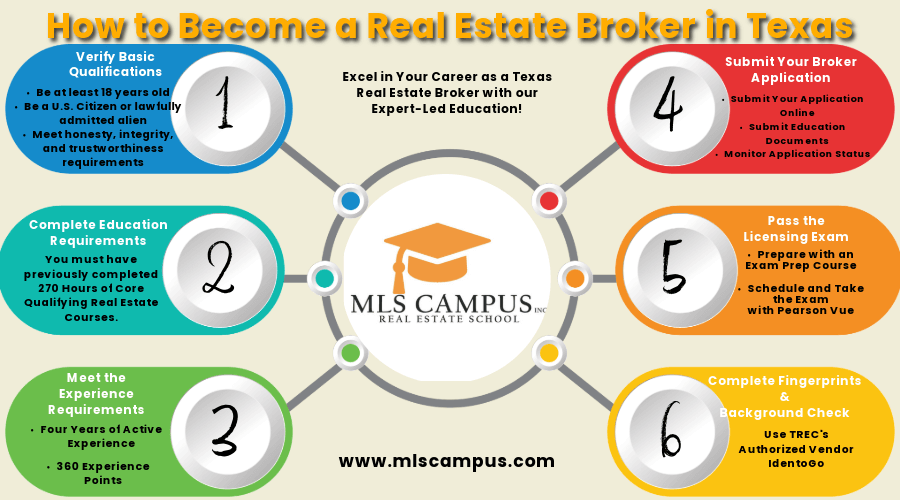
Firstly, candidates must be at least 18 years of age, a U.S. citizen or a lawfully admitted alien, and a resident of Texas. These basic requirements are standard across many professional licenses, ensuring applicants are legally capable of entering into contracts and operating within the state’s jurisdiction. Additionally, a thorough background check is mandatory. Applicants must be able to satisfy TREC as to their honesty, trustworthiness, and integrity. Any past criminal convictions or disciplinary actions can impact eligibility, emphasizing the importance of a clean professional and personal record. This commitment to integrity underpins the public trust placed in real estate professionals, especially those holding a broker’s license.
The cornerstone of the eligibility requirements for a Texas broker’s license is experience. Applicants must have at least four years of active experience as a licensed real estate sales agent in Texas or another state during the five-year period immediately preceding the date the application is filed. This isn’t merely about holding a license; it’s about demonstrating active engagement in the market. TREC defines “active experience” as performing duties of a sales agent for at least 10 hours per week. This ensures that brokers possess a deep, practical understanding of real estate transactions, client management, market analysis, and the diverse property types available across Texas. From residential homes that serve as primary accommodations to commercial properties that house local businesses or even boutique hotels that cater to tourists, this breadth of experience is invaluable. It equips a broker to advise on everything from investment opportunities in a bustling city like Houston to vacation properties near destinations such as South Padre Island or Galveston.
The Educational Journey: Mastering Real Estate Principles
Once the eligibility and experience benchmarks are met, the next significant phase involves advanced education. While a sales agent license requires a certain number of qualifying hours, a broker’s license demands a substantially higher level of academic rigor and specialized knowledge. This extensive educational component ensures that Texas brokers are not just practitioners but also knowledgeable experts capable of handling complex legal, financial, and managerial aspects of real estate.
TREC requires a total of 900 hours of related qualifying courses, which include the 270 hours required for a sales agent license. This breaks down into several key components:
- 180 hours of core real estate courses: These cover foundational topics such as Principles of Real Estate I & II, Law of Agency, Law of Contracts, Promulgated Contracts Forms, and Real Estate Finance. These courses are typically completed during the sales agent licensing process.
- 600 hours of related qualifying courses: These can be in real estate or related fields acceptable to TREC, such as business, marketing, accounting, land use, or real estate inspection. This broad requirement allows individuals to tailor their education to areas of interest or specialization, such as commercial real estate, property management, or even real estate development that might involve building new hotels or accommodation facilities.
- 30 hours of Real Estate Brokerage: This is a specific course dedicated to the unique responsibilities, legal obligations, and operational aspects of running a brokerage firm. It delves into topics like broker responsibility, trust accounts, advertising, and managing sales agents, equipping aspiring brokers with the essential managerial and ethical framework.

In addition to these course hours, applicants must also demonstrate proof of completing at least 4 years of active experience as a licensed real estate sales agent during the 5-year period immediately preceding the application filing date. Furthermore, a broker applicant must satisfy the college degree requirement by holding a bachelor’s degree or higher from an accredited college or university. This degree, in any field, replaces 180 of the 600 hours of related qualifying courses, effectively streamlining the educational path for those with higher academic achievements. For example, a degree from Texas A&M University or the University of Texas at Austin would satisfy this requirement, demonstrating a foundational intellectual capacity for higher-level professional work.
This comprehensive educational background is crucial. It prepares brokers to navigate the intricacies of diverse real estate transactions, whether it’s facilitating the sale of a luxury apartment in the Dallas Arts District, managing property portfolios for investors interested in short-term rentals near Sixth Street in Austin, or advising on commercial land deals that could pave the way for new tourist attractions or hospitality developments. The depth of knowledge gained through these courses ensures that Texas brokers are not only compliant with regulations but are also strategic thinkers, capable of identifying market trends and capitalizing on opportunities, which often intersect with travel and tourism sectors.
Navigating the Licensing Process with TREC
With eligibility met and extensive education completed, the next phase involves the formal application and examination process governed by the Texas Real Estate Commission (TREC). TREC is the regulatory body responsible for licensing and regulating real estate brokers and sales agents in Texas, ensuring public protection and promoting professional standards. Navigating their requirements meticulously is paramount to a successful outcome.
The application process begins with submitting a comprehensive application form to TREC, accompanied by all required documentation, including proof of education and experience. This is not merely a formality; TREC scrutinizes each application to ensure that all prerequisites have been fully satisfied. Any discrepancies or missing information can lead to significant delays. As part of the application, applicants must also undergo fingerprinting for a criminal background check. This is a standard procedure to verify the applicant’s honesty, trustworthiness, and integrity, a fundamental expectation for anyone holding a broker’s license that involves significant financial transactions and public trust.
Conquering the Texas Real Estate Broker Exam
Once the application is approved, the most immediate hurdle for many aspiring brokers is the Texas Real Estate Broker Exam. This is a comprehensive, challenging examination designed to test a candidate’s mastery of real estate principles, laws, and practices specific to Texas, as well as general real estate knowledge. The exam is divided into national and Texas-specific sections, covering a vast array of topics from property ownership, contracts, agency law, and finance to appraisal, real estate calculations, and broker responsibilities.
Successful preparation typically involves rigorous study, often utilizing official study guides, practice exams, and sometimes enrolling in exam prep courses. The importance of understanding Texas state laws cannot be overstated, as this section of the exam often proves to be the most challenging for candidates. Passing this exam is the final academic and theoretical validation of a candidate’s readiness to operate as a broker. It signifies that the individual possesses the critical knowledge to advise clients on property investments near iconic landmarks like The Alamo in San Antonio, understand zoning regulations for commercial developments in Fort Worth, or even facilitate transactions for properties bordering natural wonders like Big Bend National Park or Padre Island National Seashore. The depth of knowledge required for the exam directly translates to the versatility a broker needs to succeed in Texas’s diverse real estate market.
Stepping Into Brokerage: Sponsorship or Independence
Upon successfully passing the broker exam, the final step in the licensing process is to choose how to operate as a broker. This decision significantly impacts a broker’s professional trajectory and lifestyle. A licensed broker has two primary options:
-
Sponsor a sales agent: This involves setting up your own brokerage firm, whether as a sole proprietorship, partnership, or corporation, and then sponsoring one or more real estate sales agents. This path offers the highest degree of independence and entrepreneurial freedom. It means taking on the full responsibilities of managing a business, including compliance with TREC regulations, financial management, marketing, and agent training and supervision. For those seeking a truly independent lifestyle, with the ability to build their own brand and potentially create a business that allows for significant travel and flexible work arrangements, this is the ultimate goal. Imagine running a successful brokerage firm from your laptop while exploring destinations, knowing your team is expertly handling operations back in Texas.
-
Work for another broker: A newly licensed broker can also choose to work under the supervision of another established broker. This is a common path for those who want to transition into brokerage responsibilities gradually, learn from an experienced mentor, or prefer to focus on sales without the full administrative burden of running a firm. While offering less independence, it still provides the status and earning potential of a broker, often with the benefit of an established infrastructure and client base.
Regardless of the chosen path, becoming a broker signifies a major upgrade in professional standing. Brokers are typically involved in more complex transactions, commercial deals, and often act as consultants for larger investment projects, including those related to hotels, resorts, or specialized accommodation services. Their expertise is highly sought after, offering opportunities to engage with a broader spectrum of the Texas economy, including its thriving tourism and hospitality industries.
Beyond Licensure: Sustaining a Successful Brokerage Career
Obtaining a Texas real estate broker’s license is a significant achievement, but it’s merely the beginning of a fulfilling and dynamic career. Sustaining success in brokerage requires continuous learning, strategic networking, and a commitment to professional development. The ever-evolving real estate market, coupled with changes in consumer preferences and technological advancements, demands that brokers remain agile and informed.
One of the cornerstones of maintaining a broker’s license is adhering to Continuing Education (CE) requirements. TREC mandates that all active brokers complete 18 hours of CE every two years. These hours must include specific courses on Legal Update I and Legal Update II, as well as an advanced elective course. This ensures that brokers stay current with changes in real estate law, contract forms, and ethical practices, protecting both their clients and their license. Beyond mandatory CE, successful brokers often pursue additional specialized training in areas such as commercial real estate, luxury home sales, investment properties, or property management, which can directly involve dealings with various forms of accommodation and tourism-related properties.
Professional development and networking are equally vital. Engaging with professional organizations like the Texas Association of Realtors or local real estate boards provides opportunities for mentorship, collaboration, and staying abreast of local market trends. Attending industry conferences, workshops, and seminars, whether in Dallas, Houston, or even El Paso, broadens one’s perspective and expands their professional network. These connections can lead to lucrative partnerships, referral opportunities, and insights into emerging markets or niche sectors, such as the growing demand for unique vacation rentals or eco-tourism lodges in less explored parts of Texas.
Embracing the Broker Lifestyle: Freedom and Opportunity
The most compelling aspect of becoming a real estate broker in Texas for many is the unparalleled freedom and lifestyle it affords. Unlike a salaried position, a broker’s income is directly tied to their effort, skill, and market acumen, offering the potential for substantial financial independence. This financial freedom, combined with the inherent flexibility of managing one’s own business, creates opportunities for a life rich in experiences, including extensive travel.
Imagine the ability to take extended trips to exotic destinations or spend quality time exploring the diverse attractions within Texas itself – from the vibrant Riverwalk in San Antonio to the innovative green spaces like Klyde Warren Park in Dallas, or the fascinating Museum District and Space Center Houston in Houston. A broker’s lifestyle often allows for strategic business trips that blend with leisure, exploring international real estate markets or attending luxury property showcases in destinations around the globe. This entrepreneurial spirit often leads to engaging with high-value properties, including those in the hospitality sector, such as boutique hotels or luxury resorts, further intertwining their professional life with the world of travel and premium accommodation.
Furthermore, brokers contribute significantly to local economies and communities. By facilitating property sales, managing developments, and advising on land use, they play a direct role in shaping the physical and economic landscape of Texas. This involvement can extend to impacting local tourism by helping establish new visitor accommodations, restaurants, or entertainment venues. The decision to pursue a broker’s license is not just a career move; it is an investment in a lifestyle characterized by autonomy, intellectual stimulation, and the freedom to pursue a broad range of personal interests and travel ambitions.
In conclusion, becoming a real estate broker in Texas is a demanding yet highly rewarding endeavor that promises more than just a professional title. It’s a pathway to an enriched lifestyle, offering significant financial independence, unparalleled flexibility, and the opportunity to engage with the dynamic real estate landscape of one of America’s most vibrant states. From the initial eligibility requirements and extensive education to navigating TREC’s licensing process and passing the rigorous state exam, each step builds toward creating a highly competent and ethical leader. Beyond licensure, a commitment to continuing education and professional development ensures ongoing success. Ultimately, the broker lifestyle allows for the freedom to travel, explore diverse destinations, and make a tangible impact on the communities and economies of Texas, fostering a career that truly enables a life “out of the box.”
LifeOutOfTheBox is a participant in the Amazon Services LLC Associates Program, an affiliate advertising program designed to provide a means for sites to earn advertising fees by advertising and linking to Amazon.com. Amazon, the Amazon logo, AmazonSupply, and the AmazonSupply logo are trademarks of Amazon.com, Inc. or its affiliates. As an Amazon Associate we earn affiliate commissions from qualifying purchases.