
The acquisition of Texas by the United States is a pivotal chapter in North American history, a narrative woven with threads of exploration, revolution, expansionist ambition, and diplomatic maneuvering. Far from a simple transaction, this territorial expansion was a complex process, reflecting the evolving geopolitical landscape of the 19th century and the burgeoning ideology of Manifest Destiny that would propel the young nation westward. To understand how Texas became a state, we must delve into its origins as part of New Spain, its struggle for independence, and the subsequent debates and decisions that led to its annexation.
The Genesis of Texas: From New Spain to Mexican Territory
The story of Texas begins long before its association with the United States. The vast expanse of land, initially inhabited by indigenous peoples for millennia, came under the purview of European powers during the Age of Exploration. Following the voyages of Christopher Columbus and the establishment of New Spain, Spanish explorers and missionaries began to venture into the region. Figures like Alonso Álvarez de Pineda mapped the coastline in the early 16th century, and later expeditions, such as that of Álvar Núñez Cabeza de Vaca, provided early accounts of the interior.
Despite early claims, effective Spanish control over Texas remained limited for centuries. The vast distances, harsh terrain, and resistance from native tribes made extensive settlement difficult. The primary Spanish interest lay in establishing a buffer zone against potential French incursions from Louisiana and in converting indigenous populations to Christianity. Missions were established, such as the famous Mission San Antonio de Valero (later known as the Alamo), but these efforts yielded modest demographic results.
The turning point in Texas’s colonial status came with the Mexican War of Independence. After centuries of Spanish rule, Mexico declared its independence in 1821. As part of the newly formed Mexican republic, Texas was initially administered as part of the state of Coahuila y Tejas. The Mexican government, eager to populate and develop its northern territories, began to encourage immigration.
The Empresario System and American Settlement
Recognizing the challenges of populating such a vast territory, the Mexican government adopted the empresario system. This policy granted land to individuals who agreed to recruit and settle a specific number of families, primarily from the United States. Moses Austin was one of the first to receive such a grant, but it was his son, Stephen F. Austin, who successfully fulfilled the terms and became known as the “Father of Texas.”
Stephen F. Austin brought hundreds of Anglo-American families into Texas, establishing colonies and laying the groundwork for a burgeoning society. These settlers were attracted by the promise of fertile land, economic opportunity, and a more familiar legal and cultural environment. However, as the number of American settlers grew, so too did tensions with the Mexican government. Differences in language, religion, and legal traditions began to surface, exacerbated by the Mexican government’s attempts to assert greater control and restrict further American immigration.
Growing Discontent and the Road to Revolution
By the late 1820s and early 1830s, discontent among the Texas settlers, many of whom were now American citizens or their descendants, reached a boiling point. Key grievances included:
- Centralization of Power: The Mexican government, particularly under the presidency of Antonio López de Santa Anna, moved towards a more centralized form of government, which was met with resistance by Texans who favored greater autonomy.
- Enforcement of Laws: Policies such as the abolition of slavery (which Texas relied upon economically) and attempts to disarm the population were particularly unpopular.
- Lack of Representation: Texans felt they lacked adequate representation in the Mexican government and that their concerns were being ignored.
These simmering tensions finally erupted into open conflict in 1835, culminating in the Texas Revolution. The early stages of the revolution saw skirmishes and battles, with key events like the Battle of Gonzales marking the beginning of armed resistance. The decisive moment came at the Battle of the Alamo in March 1836, where a small band of Texans made a valiant but ultimately doomed stand against Santa Anna’s army. Although a tactical defeat for the Texans, the Alamo became a powerful symbol of resistance and sacrifice.
Independence and the Republic of Texas

Following the fall of the Alamo, Texan forces, under the command of Sam Houston, rallied. A short time later, on March 2, 1836, delegates at Washington-on-the-Brazos signed the Texas Declaration of Independence, formally severing ties with Mexico. The subsequent Battle of San Jacinto on April 21, 1836, proved to be the turning point of the revolution. Sam Houston’s army achieved a decisive victory, capturing Santa Anna himself and effectively securing Texas’s independence.
On October 22, 1836, Sam Houston was inaugurated as the first elected president of the Republic of Texas. The new nation faced immense challenges. Its economy was fragile, its borders were disputed with Mexico, and it struggled to gain international recognition. Mexico never formally recognized the independence of the Republic of Texas, and skirmishes along the border were common. Despite these difficulties, Texas functioned as an independent nation for nearly a decade.
During this period, Texas actively sought annexation by the United States. Presidents Houston and his successor, Mirabeau B. Lamar, explored various diplomatic avenues, but the issue of annexation was highly contentious in the United States.
The Path to Annexation: Political Debate and Manifest Destiny
The prospect of annexing Texas ignited a fierce debate within the United States. The primary obstacles were rooted in the issue of slavery and the balance of power between free and slave states in Congress. Texas, as a slave-holding republic, would tip this delicate balance significantly, raising concerns among abolitionists and those who feared the growing influence of the “Slave Power.”
However, the growing ideology of Manifest Destiny also played a crucial role. This belief, prevalent in the 1840s, posited that the United States was divinely ordained to expand its dominion and spread democracy across the North American continent. Proponents of Manifest Destiny saw Texas as a vital piece of this continental expansion, a land rich in resources and strategically important for national security and economic growth.
Despite earlier rejections, pro-annexation sentiment gained momentum. The election of James K. Polk in 1844, a strong advocate for expansion and Manifest Destiny, signaled a shift in U.S. policy. Polk’s victory was interpreted as a mandate for acquiring Texas.
The Joint Resolution of Annexation
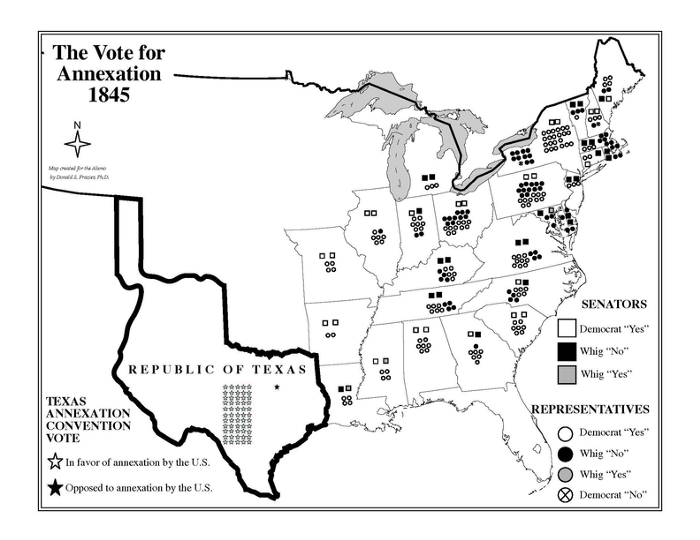
In the final days of President John Tyler’s administration, and with Polk’s impending inauguration, Congress moved to annex Texas. Unlike a treaty, which required a two-thirds Senate majority and was difficult to achieve due to the slavery issue, annexation was pursued through a joint resolution. This required only a simple majority in both the House of Representatives and the Senate.
On February 28, 1845, the United States House of Representatives passed the joint resolution to annex Texas. The Senate followed suit on March 1, 1845. President Tyler signed the resolution on March 1, 1845, just days before leaving office. The terms of the resolution offered Texas the option to be admitted as a state or as a territory, with the power to form a new state constitution. It also stipulated that the republic could retain its public lands, a crucial provision for the financially strapped republic, which would then use the revenue from land sales to pay off its debts.

Texas Ratifies and Becomes the 28th State
The Republic of Texas formally accepted the annexation terms. A convention of Texan delegates met and drafted a new state constitution that protected slavery, reflecting the will of the majority of its citizens. On October 13, 1845, Texans overwhelmingly ratified the constitution and the annexation resolution.
Finally, on December 29, 1845, President James K. Polk signed the congressional act admitting Texas into the United States as the 28th state. While the formal transfer of power was completed in February 1846, the date of December 29, 1845, is officially recognized as the date of admission.
The annexation of Texas, however, was not without its consequences. It immediately intensified disputes with Mexico, which still considered Texas a rebellious province. These disputes, coupled with lingering border disagreements, directly led to the outbreak of the Mexican-American War in April 1846, a conflict that further expanded United States territory. The acquisition of Texas marked a significant step in the westward expansion of the United States, fundamentally reshaping the nation’s geography and its political landscape, while also sowing the seeds for future sectional conflict over the expansion of slavery.
LifeOutOfTheBox is a participant in the Amazon Services LLC Associates Program, an affiliate advertising program designed to provide a means for sites to earn advertising fees by advertising and linking to Amazon.com. Amazon, the Amazon logo, AmazonSupply, and the AmazonSupply logo are trademarks of Amazon.com, Inc. or its affiliates. As an Amazon Associate we earn affiliate commissions from qualifying purchases.