
Navigating the roads of Texas as a young driver comes with a specific set of regulations designed to promote safety and responsible driving. For 16-year-olds, this period is a crucial step towards full driving independence, marked by the acquisition of a provisional driver’s license. This license, while granting newfound freedom, is accompanied by restrictions that are vital for new drivers and their families to understand. These rules are not merely bureaucratic hurdles; they are foundational elements in building a lifetime of safe driving habits, ensuring that novice drivers gain experience in a controlled and supervised manner before facing the full complexities of Texas roadways.
Understanding the Provisional Driver’s License
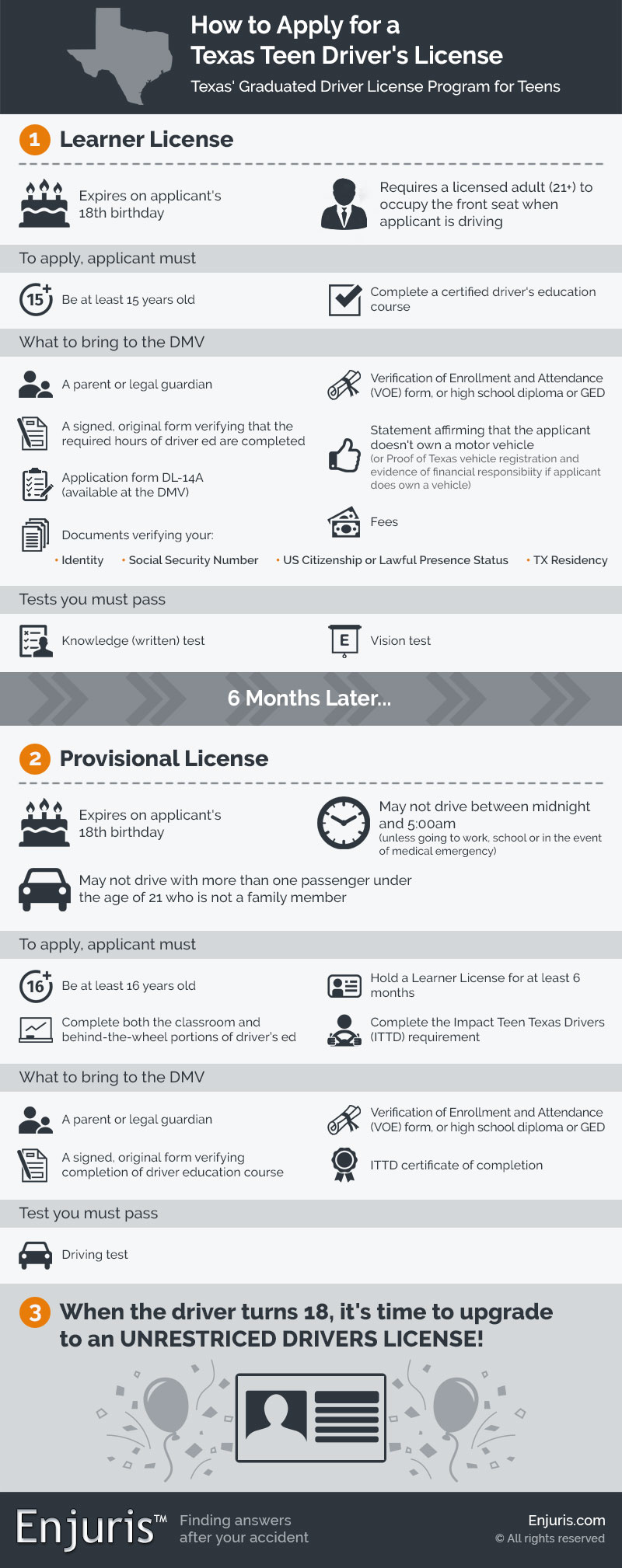
In Texas, the journey to a standard driver’s license for individuals under 18 years old is a phased process. The first significant milestone after obtaining an Instruction Permit is the Provisional Driver’s License. This license is specifically designed for drivers aged 16 and 17 and comes with a distinct set of privileges and limitations. It is issued by the Texas Department of Public Safety (DPS) and requires applicants to have held their Instruction Permit for at least six months, completed a driver education program, and passed a driving test. The provisional license signifies a greater level of trust and responsibility, but it also carries provisions aimed at minimizing risks inherent to new drivers.
Eligibility Requirements
To be eligible for a Provisional Driver’s License in Texas, a 16-year-old must meet several key criteria. Firstly, they must be at least 16 years old. Secondly, they must have possessed a valid Texas Instruction Permit for a minimum of six months. This holding period is intended to allow the new driver to gain practical experience under supervision. Thirdly, a driver education course approved by the Texas Education Agency must be successfully completed. This typically includes 32 hours of classroom instruction and 44 hours of behind-the-wheel training, with at least 10 of those hours occurring at night. Finally, the applicant must pass the driving test administered by the DPS. This test evaluates the applicant’s ability to safely operate a vehicle in various traffic situations.
Key Restrictions of the Provisional License
The Provisional Driver’s License in Texas is characterized by several important restrictions designed to enhance safety for young drivers. These limitations are in effect until the driver turns 18 years old.
- Passenger Restrictions: Perhaps the most significant restriction relates to passengers. For the first six months after obtaining the provisional license, a 16-year-old driver cannot transport more than one passenger under the age of 21 who is not a family member. Once this six-month period has passed, the driver may transport up to three passengers under the age of 21 who are not family members. Family members are defined as the driver’s children, siblings, or step-siblings. This rule is implemented to reduce distractions for novice drivers, as having too many young passengers can be a significant source of inattention.
- Curfew: Another critical restriction is the nighttime driving curfew. From midnight to 5:00 AM, a 16-year-old with a provisional license cannot drive a vehicle unless an adult 21 years of age or older is in the front passenger seat, or the driving is necessary for employment, school-related activities, or a medical emergency. This curfew is in place because statistics show that nighttime driving, especially with inexperienced drivers, carries a higher risk of accidents.
- Mobile Device Use: Similar to all drivers in Texas, provisional license holders are prohibited from using a wireless communication device (including cell phones) while driving, except in emergencies. This prohibition extends to texting, emailing, or using social media while operating a vehicle. This is a crucial rule for all drivers, but particularly for new drivers who may be more susceptible to distractions.
- Vehicle Capacity: The provisional license holder is restricted from operating a vehicle with more passengers than its designed capacity. This means they cannot attempt to squeeze extra people into a car or transport passengers in areas not designed for seating.
The Driving Education Imperative
The emphasis on formal driver education in Texas is a cornerstone of its licensing process for young drivers. It’s not just about passing a test; it’s about building a strong foundation of knowledge and practical skills. The required driver education program ensures that 16-year-olds receive structured instruction that covers a wide range of topics essential for safe driving.
Components of an Approved Driver Education Program

An approved driver education program in Texas typically comprises two main components: classroom instruction and behind-the-wheel training.
- Classroom Instruction: This portion of the program focuses on theoretical knowledge. Topics covered include traffic laws and ordinances, safe driving techniques, defensive driving strategies, the effects of alcohol and drugs on driving ability, and the importance of seat belt use. It also delves into vehicle operation, maintenance, and the responsibilities of being a licensed driver.
- Behind-the-Wheel Training: This hands-on component is crucial for developing practical driving skills. It involves supervised driving practice in various conditions, including different times of day and in varying traffic densities. The requirement for at least 10 hours of night driving is particularly important, as it prepares the new driver for the increased risks associated with driving after dark. The supervised practice helps the young driver gain confidence and refine their ability to react to different road scenarios.
The Importance of Parent Involvement
While formal driver education provides a structured learning environment, the role of parents and guardians in the driving education of their 16-year-old is invaluable. Texas law recognizes this by requiring a certain number of supervised driving hours as part of the overall process. However, beyond the legal minimums, parents can significantly enhance their child’s safety and competence.
- Supervised Driving Practice: Parents should actively engage in supervised driving practice beyond the required hours. This provides opportunities for the learner to practice in familiar environments and situations, building confidence. It’s also a chance for parents to reinforce lessons learned in driver education and to address any specific concerns they may have about their child’s driving.
- Modeling Good Behavior: Parents are role models. Demonstrating safe driving habits – such as always wearing a seatbelt, obeying speed limits, avoiding distractions, and maintaining a calm demeanor behind the wheel – sets a positive example for their teenage driver.
- Open Communication: Fostering open communication about driving is essential. Discussing potential risks, near misses, and challenging driving situations can help the young driver develop critical thinking skills and a greater awareness of the responsibilities that come with driving.
Transitioning to Full Driving Privileges
The Provisional Driver’s License is a stepping stone. Once a 16-year-old has successfully navigated the restrictions and demonstrated a commitment to safe driving for a year, they can move towards full driving privileges. This transition signifies a higher level of trust and responsibility, allowing for greater freedom on the road.
The Road Test
The driving test, or road test, is a critical hurdle for all aspiring drivers in Texas. For a 16-year-old applying for a provisional license, passing this test is mandatory. The test is designed to assess the applicant’s ability to safely operate a vehicle and adhere to traffic laws. Examiners evaluate various skills, including:
- Vehicle Control: Steering, acceleration, braking, and gear shifting (if applicable).
- Traffic Law Adherence: Observing speed limits, obeying traffic signals and signs, yielding to pedestrians and other vehicles.
- Maneuvering Skills: Performing maneuvers such as three-point turns, parallel parking, and changing lanes safely.
- Situational Awareness: Checking mirrors, blind spots, and general observation of the driving environment.
The vehicle used for the test must be in good working order, with current registration and insurance. It’s advisable for the young driver to practice these specific maneuvers repeatedly to build proficiency and confidence.
Moving Beyond the Provisional License
Upon reaching the age of 18, and provided the provisional license has been held without any major violations, the restrictions associated with the provisional license are automatically lifted. The driver then transitions to a standard unrestricted driver’s license. This is a significant milestone, representing full legal driving privileges in Texas. However, the lessons learned during the provisional license period – the importance of defensive driving, awareness of distractions, and responsible decision-making – should continue to guide their driving habits throughout their lives. The state’s graduated licensing system, with its phased approach, aims to ensure that young drivers develop the necessary skills and maturity to become safe and responsible members of the motoring public.
LifeOutOfTheBox is a participant in the Amazon Services LLC Associates Program, an affiliate advertising program designed to provide a means for sites to earn advertising fees by advertising and linking to Amazon.com. Amazon, the Amazon logo, AmazonSupply, and the AmazonSupply logo are trademarks of Amazon.com, Inc. or its affiliates. As an Amazon Associate we earn affiliate commissions from qualifying purchases.