
The Crimson Tide’s Storied Legacy
The question of how many national championships Alabama Football has won is a common one, sparking debates and fueling the passionate fandom surrounding one of the most historically dominant programs in American college football. The University of Alabama Crimson Tide boasts a trophy case that is overflowing with accolades, a testament to decades of exceptional coaching, elite talent, and unwavering program commitment. Understanding the exact number often depends on the recognized authority, but the consensus points to a remarkable and ever-growing figure that places them among the very elite.

Defining “National Championship” in College Football
In the realm of college football, the concept of a “national championship” has evolved significantly over time. Unlike professional leagues with a unified playoff system, college football has historically relied on various polls and selectors to crown its champion. This has led to differing interpretations and claims over the years.
Early Poll Era and Retroactive Selections
In the early to mid-20th century, the primary method for determining a national champion was through polls conducted by organizations like the Associated Press (AP) and the United Press International (UPI). Coaches and sports writers would vote on their top teams, and the team ranked No. 1 at the end of the season was often declared the champion.
However, the landscape became more complex with the advent of retroactive selections. Various organizations and statisticians have, over time, reviewed past seasons and awarded championships to teams that may not have been recognized at the time. These retrospective claims can sometimes inflate the perceived number of championships for a program.
The Bowl Championship Series (BCS) and College Football Playoff (CFP) Eras
The Bowl Championship Series (BCS), established in 1998, aimed to create a more definitive national championship game by pitting the top two ranked teams against each other. This era brought a clearer conclusion to the season for many years. More recently, the College Football Playoff (CFP), introduced in 2014, expanded the postseason to include four teams, further solidifying the championship game as the ultimate decider.
For the purposes of this discussion, and as commonly understood by fans and acknowledged by major statistical bodies, we will focus on championships recognized by the NCAA and generally accepted by the broader college football community, including those awarded via major polls and the modern playoff system.
Alabama’s Championship Count: A Deep Dive
The Alabama Crimson Tide officially holds a significant number of national championships, a figure that has been a source of immense pride for its supporters and a point of contention for rivals. The exact number can vary slightly depending on the source, but the NCAA officially recognizes Alabama with 18 national championships. This count encompasses titles won across different eras, from the pre-modern playoff days to the current CFP era.
Championship Eras and Key Figures
The journey to 18 national titles for Alabama Football is a narrative woven through the contributions of legendary coaches and generations of immensely talented players.
Bear Bryant’s Dynasty
Perhaps the most impactful period in Alabama’s championship history came under the legendary coach Bear Bryant. During his tenure from 1958 to 1982, Bryant transformed the Crimson Tide into a perennial powerhouse, instilling a culture of discipline, toughness, and winning. He is credited with leading Alabama to six national championships:
- 1961: This season marked the first of Bryant’s national titles, showcasing a dominant defense and a powerful running game.
- 1964: Another dominant season that solidified Alabama’s national reputation.
- 1965: A repeat championship, demonstrating the sustained excellence of Bryant’s teams.
- 1973: A hard-fought championship that highlighted Alabama’s resilience.
- 1978: A thrilling season capped by a thrilling victory.
- 1979: Bryant’s final national championship, a fitting end to his illustrious career.
These championships under Bryant established the foundation for Alabama’s enduring legacy of success and cemented his place as one of the greatest coaches in sports history. The passionate fanbase that flocked to games at Bryant–Denny Stadium during this era was instrumental in creating the electric atmosphere that has become synonymous with Tuscaloosa football.
The Gene Stallings Era
After a brief period without a national title, Gene Stallings took the helm and quickly restored Alabama to championship glory. Stallings, a former player under Bear Bryant, led the Crimson Tide to a national championship in 1992. This title was particularly memorable, as it was won during the final year of the Bowl Coalition era, a precursor to the BCS. The team’s dominant performance, particularly on defense, was a hallmark of Stallings’ coaching philosophy.
Nick Saban’s Modern Dynasty
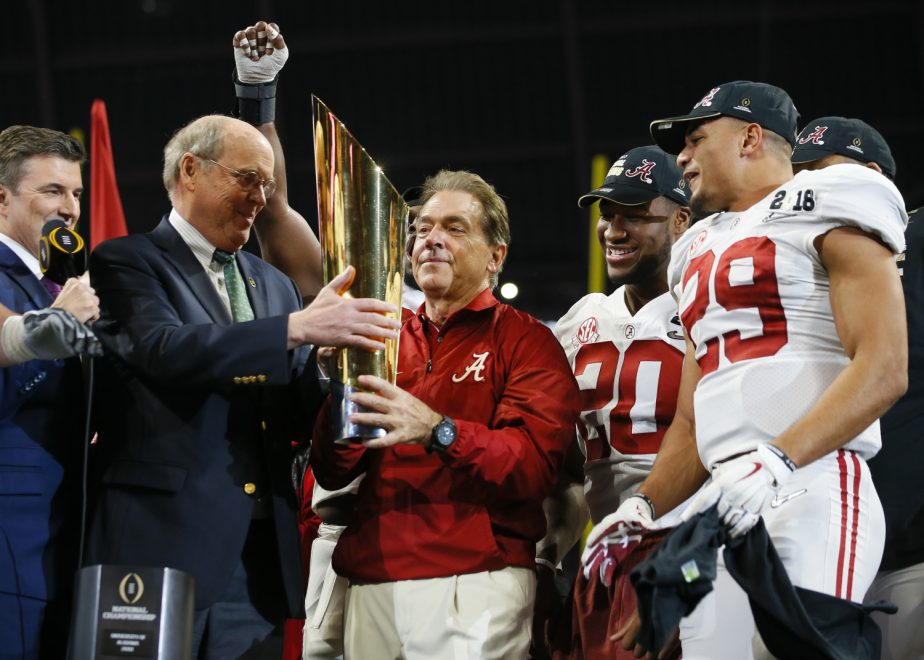
The most recent and arguably most dominant chapter in Alabama’s championship history has been written under the leadership of Nick Saban. Since his arrival in 2007, Saban has presided over an unprecedented era of success, transforming the Crimson Tide into a modern-day dynasty. Under his guidance, Alabama has captured seven national championships:
- 2009: Saban’s first national title with Alabama, breaking a long drought and signaling the dawn of a new era.
- 2011: A dominant season that saw the Crimson Tide reclaim the top spot.
- 2012: A repeat championship, showcasing the program’s incredible depth and talent.
- 2015: A thrilling victory in the first-ever College Football Playoff championship game.
- 2017: A dramatic comeback victory in overtime of the CFP National Championship.
- 2020: A record-setting offensive performance led to another dominant championship.
Saban’s tenure is characterized by exceptional recruiting, innovative coaching strategies, and an unwavering commitment to player development. His teams have consistently been at the forefront of college football, adapting to rule changes and evolving offensive and defensive schemes. The consistent presence of Alabama Football in the College Football Playoff has become a regular occurrence, with their trips to venues like the Mercedes-Benz Stadium in Atlanta and the Hard Rock Stadium in Miami Gardens becoming almost expected.
Comparing Alabama’s Championship Count
When comparing Alabama Football’s championship total to other storied programs in college football, the numbers become even more impressive. While programs like Notre Dame and the University of Michigan also boast significant championship counts, Alabama’s 18 recognized titles place them at the pinnacle.
Historical Context and Future Prospects
The longevity of Alabama’s success is a key factor in their championship count. They have achieved national titles across multiple decades, under different coaching regimes, and through various iterations of the college football championship structure. This sustained excellence is a rare feat in the highly competitive world of college athletics.
Looking ahead, the Alabama Crimson Tide remain a formidable force in college football. With the ongoing commitment to recruiting top talent and the continued presence of elite coaching staff, the possibility of adding to their impressive championship collection in the future remains very real. The program’s dedication to excellence ensures that the discussion of Alabama’s national championships will continue to be a prominent one for years to come. The passionate fanbase, often found in the vibrant city of Tuscaloosa, eagerly anticipates each new season, hoping to witness history being made once again at Bryant–Denny Stadium.
LifeOutOfTheBox is a participant in the Amazon Services LLC Associates Program, an affiliate advertising program designed to provide a means for sites to earn advertising fees by advertising and linking to Amazon.com. Amazon, the Amazon logo, AmazonSupply, and the AmazonSupply logo are trademarks of Amazon.com, Inc. or its affiliates. As an Amazon Associate we earn affiliate commissions from qualifying purchases.