
Forming an S Corporation (S Corp) in California is a strategic move for many entrepreneurs and small business owners seeking to optimize their tax situation and enhance their financial lifestyle. While often misunderstood as a separate business entity, an S Corp is, in fact, a tax election made with the IRS for an existing corporation or Limited Liability Company (LLC). This election allows a business to pass its income, losses, deductions, and credits through to its shareholders, avoiding the double taxation often associated with traditional C Corporations. For those living an entrepreneurial lifestyle, particularly in a high-tax state like California, understanding this structure is pivotal for financial efficiency and long-term success.
Understanding the S Corp Advantage for California Businesses
The primary allure of the S Corp election lies in its ability to potentially reduce the self-employment tax burden on owner-employees. In a traditional sole proprietorship or partnership, all business profits are subject to self-employment taxes (Social Security and Medicare), totaling 15.3% on net earnings up to a certain threshold. With an S Corp, an owner who actively works for the business must be paid a “reasonable salary,” which is subject to these payroll taxes. However, any remaining profits can be distributed to the owner as dividends, which are not subject to self-employment taxes, though they remain subject to federal and state income taxes. This distinction can lead to substantial savings, making the S Corp a powerful tool for financial planning within the entrepreneurial lifestyle.
For California businesses, the S Corp provides a distinct advantage, albeit with a unique state-level consideration. While the federal S Corp status can lead to significant tax efficiencies, California S Corps are subject to a 1.5% state income tax on their net income, in addition to the annual minimum franchise tax ($800) that applies to all corporations and LLCs in the state. Despite this state-specific tax, the overall federal self-employment tax savings often outweigh this additional California burden, particularly for profitable businesses. This structure is especially beneficial for consultants, service providers, and other small businesses with significant profits, allowing them to retain more capital for reinvestment, personal financial goals, or simply to enjoy the fruits of their labor within the vibrant California economy.
Eligibility and Initial Steps
Before electing S Corp status, it’s essential to ensure your business meets both federal and state requirements. The process generally begins by forming the underlying business entity, typically an LLC or a C Corporation, and then making the S Corp election.
IRS S Corp Requirements
To qualify for S Corp status with the IRS, a business must satisfy several criteria:
- It must be a domestic corporation (incorporated in the U.S.) or an eligible LLC.
- It cannot have more than 100 shareholders.
- Shareholders must be individuals, certain trusts, or estates. Partnerships, corporations, and non-resident aliens are generally not permitted as shareholders.
- The corporation can only have one class of stock.
- It cannot be an ineligible corporation, such as certain financial institutions, insurance companies, or domestic international sales corporations.
Meeting these federal requirements is the first hurdle in leveraging the S Corp structure for your entrepreneurial journey.
Forming the Underlying Entity
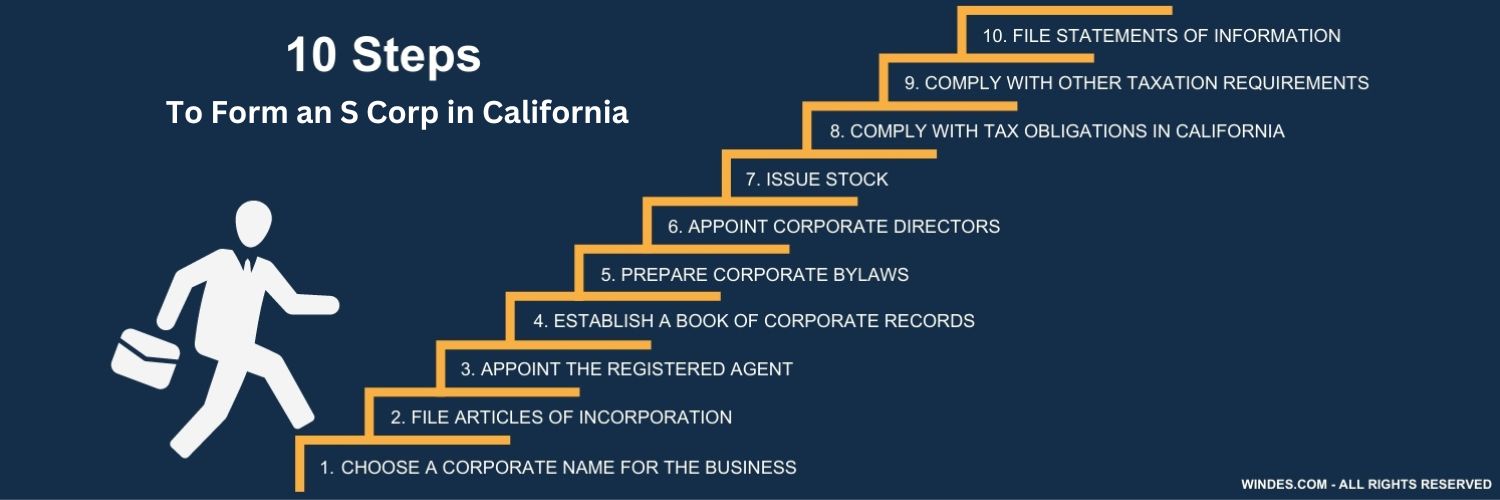
In California, an S Corp is not a standalone business entity type but rather a tax classification. Therefore, the first step is to establish a legal entity that can then elect S Corp status. Most commonly, entrepreneurs choose to form an LLC or a C Corporation.
- Choose a Business Name: Select a unique name for your business and verify its availability with the California Secretary of State.
- File Formation Documents:
- For Corporations: File Articles of Incorporation with the California Secretary of State.
- For LLCs: File Articles of Organization with the California Secretary of State.
- Appoint a Registered Agent: Your business must designate a registered agent in California who can receive legal and tax documents on its behalf. This agent must have a physical street address in California and be available during regular business hours.
- Obtain an Employer Identification Number (EIN): Regardless of whether you choose an LLC or a C Corp, you will need an Employer Identification Number (EIN) from the IRS for tax purposes. This nine-digit number acts as a Social Security number for your business and is required for filing taxes, opening bank accounts, and hiring employees.
Once these foundational steps are complete, your business is legally established and ready to proceed with the S Corp election.
The S Corp Election Process in California
The process of electing S Corp status involves filing specific forms with the IRS. While California generally recognizes the federal election, there are state-specific considerations to keep in mind.
Federal S Corp Election (Form 2553)
To elect S Corp status, you must file IRS Form 2553, “Election by a Small Business Corporation,” with the IRS. This form officially informs the IRS of your intention to be taxed as an S Corp.
- Timing is Crucial: For the election to take effect for the current tax year, IRS Form 2553 must typically be filed either:
- During the tax year immediately preceding the tax year for which the election is to take effect, or
- No later than two months and 15 days after the beginning of the tax year for which the election is to take effect.
- Late Election Relief: If you miss the deadline, the IRS does offer late election relief under certain circumstances, usually requiring a reasonable cause for the delay. This often involves attaching a statement explaining why the election was not timely filed.
It’s imperative to ensure accurate and timely submission of IRS Form 2553 to secure your S Corp status and begin enjoying its tax benefits.
California State S Corp Recognition

Unlike some other states that require a separate state-level S Corp election, California generally conforms to the federal S Corp election. This means that if you’ve successfully elected S Corp status with the IRS, California will automatically recognize your business as an S Corp for state tax purposes.
However, as previously noted, California does impose a 1.5% income tax on the net taxable income of S Corporations, in addition to the $800 annual minimum franchise tax. This makes California unique compared to many other states where S Corps are not subject to a separate state-level income tax. Business owners must factor this into their financial planning to fully understand the state tax implications of operating an S Corp in California. Despite this, the federal tax savings often make the S Corp election a worthwhile strategy for California entrepreneurs.
Ongoing Compliance and Best Practices for California S Corps
Maintaining S Corp status and ensuring compliance in California requires diligent attention to legal and tax responsibilities. Neglecting these could result in loss of S Corp status or significant penalties.
Maintaining Corporate Formalities
For corporations electing S Corp status, it’s vital to maintain traditional corporate formalities to preserve the limited liability protection and S Corp election. This includes:
- Holding annual shareholder and director meetings.
- Recording minutes of all meetings.
- Keeping accurate corporate records, including bylaws and stock certificates.
- Following the operating agreement for LLCs.
Failing to adhere to these formalities can lead to “piercing the corporate veil,” where the owner’s personal assets could be exposed to business liabilities.
Payroll and Reasonable Salary
A cornerstone of the S Corp tax strategy is the “reasonable salary” requirement. Owners who actively work for the S Corp must receive a salary commensurate with what a non-owner in a similar role and industry would earn. This salary is subject to all applicable payroll taxes (Social Security, Medicare, federal, and California income taxes). Any remaining profits can then be distributed as tax-advantaged dividends. The IRS and the California Franchise Tax Board closely scrutinize this, and misclassifying salary as distributions to avoid payroll taxes can lead to audits, penalties, and reclassification of distributions as wages. Establishing a robust payroll system and regularly reviewing salary against industry benchmarks is a critical best practice.
Tax Filings and Deadlines
S Corporations have specific federal and state tax filing obligations:
- Federal: File Form 1120-S, U.S. Income Tax Return for an S Corporation, and issue Schedule K-1s to each shareholder, detailing their share of income, losses, and deductions.
- California: File Form 100S, California S Corporation Franchise or Income Tax Return, with the California Franchise Tax Board.
- Annual Statement of Information: S Corps must also file an Annual Statement of Information with the California Secretary of State to update contact and officer information.
Staying abreast of these deadlines and requirements is vital for smooth operation and compliance within the California business landscape.
Professional Guidance
Navigating the complexities of S Corp formation and compliance, particularly in a state with unique tax laws like California, underscores the importance of professional advice. Consulting with a qualified tax professional, Certified Public Accountant (CPA), or business attorney who specializes in California and federal S Corp regulations can provide invaluable insights. These experts can help determine if an S Corp is the right fit for your business, assist with the formation and election process, advise on reasonable salary, and ensure ongoing compliance, allowing you to focus on your core business activities and entrepreneurial lifestyle.
The Lifestyle and Entrepreneurial Advantage of an S Corp in California
For many, the choice to form an S Corp in California extends beyond mere tax savings; it’s an integral part of shaping a desirable entrepreneurial lifestyle. California, with its innovative spirit and diverse markets, attracts a global community of entrepreneurs, from tech innovators in Silicon Valley to creative industries in Los Angeles. An S Corp structure can significantly impact how these individuals manage their finances, grow their businesses, and enjoy their personal freedom.
Financial Freedom and Tax Efficiency
The tax efficiencies offered by an S Corp, primarily through reduced self-employment taxes, directly translate into greater financial freedom for the business owner. By optimizing their tax burden, entrepreneurs can free up capital that can be reinvested into their business, used for personal savings, or channeled into experiences that enrich their lifestyle, such as travel, further education, or pursuing other passions. This enhanced cash flow management contributes to a more sustainable and rewarding entrepreneurial journey, allowing founders to maintain a healthier work-life balance and enjoy the dynamic California lifestyle with fewer financial constraints.
Business Credibility and Growth
Beyond tax advantages, operating as an S Corp (an elected status for a corporation or LLC) lends an air of professionalism and credibility to a business. This structured approach can be crucial for attracting potential investors, securing larger client contracts, or establishing partnerships, particularly in competitive markets. The formal legal framework associated with corporations and LLCs, combined with the transparent tax reporting of an S Corp, demonstrates a commitment to sound business practices. This foundation supports scalability and growth, allowing businesses to thrive and expand their reach, whether locally within California’s diverse regions or across national and international borders.

Operating in California’s Dynamic Economy
California offers an unparalleled environment for entrepreneurship, characterized by a large consumer base, access to venture capital, and a culture of innovation. However, it also comes with a unique set of regulatory and tax challenges. For digital nomads or location-independent entrepreneurs who choose California as their business’s home base, understanding and strategically utilizing an S Corp can be a game-changer. It allows them to tap into the state’s economic advantages while intelligently navigating its specific tax structures. By taking the time to properly form and manage an S Corp, entrepreneurs in California can ensure their business is not only compliant but also positioned for maximum financial efficiency and personal lifestyle enhancement. This strategic business decision becomes a foundational element of their journey to success in one of the world’s most vibrant economies.
LifeOutOfTheBox is a participant in the Amazon Services LLC Associates Program, an affiliate advertising program designed to provide a means for sites to earn advertising fees by advertising and linking to Amazon.com. Amazon, the Amazon logo, AmazonSupply, and the AmazonSupply logo are trademarks of Amazon.com, Inc. or its affiliates. As an Amazon Associate we earn affiliate commissions from qualifying purchases.