
The process of obtaining a death certificate in California is a critical administrative task that touches upon numerous aspects of an individual’s life, from legal compliance to the practicalities of managing an estate and personal affairs after a loss. While often overshadowed by immediate grief, understanding this process is essential for families, executors, and anyone involved in the post-life arrangements. This document is far more than a mere formality; it is the legal cornerstone for resolving many issues that arise following a death, directly influencing the lifestyle adjustments of surviving family members.
The Indispensable Role of a Death Certificate in California Life
A death certificate is an official record serving as legal proof of death. In California, this document details the deceased’s identity, the time and place of death, and the cause of death. Its importance permeates various aspects of daily life and legal systems, impacting families in profound ways. From settling estates and claiming life insurance benefits to facilitating funeral arrangements and addressing potential international legal requirements for those with global connections, the death certificate is a foundational document.

Without a certified copy, families can encounter significant delays and complications in managing the deceased’s affairs. Financial institutions, government agencies, and legal entities all mandate this document to process claims, transfer property, and officially recognize changes in legal status. For individuals whose lifestyle includes managing complex estates, international assets, or intricate family structures, securing this certificate promptly and accurately is paramount for maintaining order and ensuring the deceased’s wishes are honored. It underpins many critical post-life processes, enabling surviving family members to navigate new routines and make necessary lifestyle adjustments during a challenging period.
Navigating the Process: Key Steps to Obtaining a California Death Certificate
Obtaining a death certificate in California follows a structured procedure, typically initiated by the funeral director or the person responsible for the disposition, and subsequently by authorized individuals requesting certified copies. A clear understanding of these steps can significantly streamline this potentially overwhelming task.
Initial Registration of Death
The process commences immediately after a death occurs. In California, the attending physician, coroner, or medical examiner is responsible for completing the medical certification portion of the death certificate, which includes the cause of death. This must generally be finalized within 15 days of the death. Concurrently, the funeral director, or an individual acting in that capacity (e.g., a family member handling arrangements), collects demographic information about the deceased from the informant, usually a close family member. Once all sections are complete, the funeral director electronically submits the certificate to the California Department of Public Health – Vital Records (CDPH-VR) for official registration. Upon registration, the death is formally recorded, and certified copies become available for request.
Requesting Certified Copies
Once the death is registered, certified copies can be ordered. These copies are invariably required for legal and financial purposes. The most common method for obtaining copies is through the local county vital records office where the death occurred, or directly through the California Department of Public Health (CDPH-VR). Both entities process requests, but local county offices often offer faster service for deaths registered within their specific jurisdiction.
Through the Local County Vital Records Office
This option often proves to be the quickest. Most county offices, such as the Los Angeles County Registrar-Recorder/County Clerk or the San Diego County Assessor/Recorder/County Clerk, facilitate requests in person, by mail, or occasionally online. In-person requests frequently result in same-day service, provided all necessary documentation is in order. Mail requests typically incur a waiting period of several weeks.
Through the California Department of Public Health (CDPH-VR)
The CDPH-VR processes requests for deaths that transpired anywhere within California. This approach is beneficial if you are uncertain about the specific county of registration or prefer a centralized request method. Requests can be submitted by mail or, for expedited service, often through third-party services officially authorized by the CDPH-VR.
Eligibility and Necessary Documentation for Requestors
Access to certified copies of death certificates in California is restricted to authorized individuals due to privacy concerns and to mitigate identity theft or fraud. This safeguard ensures that sensitive personal information remains protected, aligning with broader lifestyle considerations of personal security and privacy in contemporary society.
Who is an Authorized Person?
An authorized person typically includes:
- A parent or legal guardian of the deceased.
- A child, grandparent, grandchild, or sibling of the deceased.
- The spouse or registered domestic partner of the deceased.
- An attorney representing the deceased’s estate or a person explicitly named in the will.
- A law enforcement or governmental agency official conducting official business.
- A party legally entitled to receive the record by court order.
- A funeral director or an agent formally appointed by the family to order copies on their behalf.
- A power of attorney or executor of the deceased’s estate.
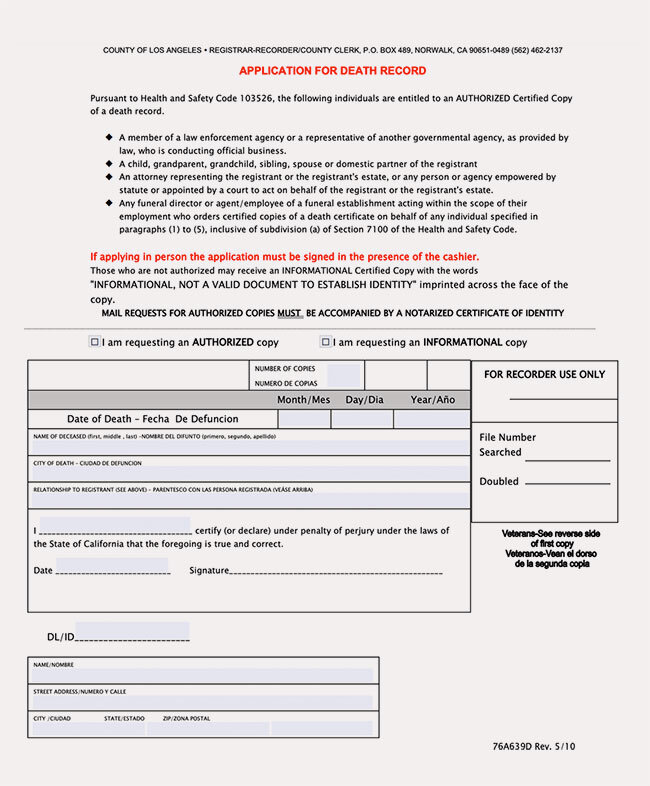
Individuals who do not meet these specific criteria may still obtain an “informational copy” of the death certificate. This copy contains identical information but is explicitly marked “INFORMATIONAL, NOT A VALID DOCUMENT TO ESTABLISH IDENTITY.” While it cannot be utilized for legal purposes, it satisfies personal record-keeping needs.
Required Information for the Application

When submitting a request, specific details are required to ensure the correct record is identified. This generally includes:
- The full legal name of the deceased.
- The date of death.
- The place of death (city/county).
- The date of birth of the deceased.
- The full names of parents (including the mother’s maiden name).
- Your relationship to the deceased.
- Your mailing address and a daytime phone number.
- The precise reason for your request.
Sworn Statement and Identification
For certified copies, authorized individuals must complete a sworn statement, affirming under penalty of perjury that they are indeed an authorized person. This statement typically requires notarization. Additionally, a valid form of identification, such as a driver’s license, state-issued ID card, or passport, is usually mandatory. Some county offices may accept copies of ID along with a notarized sworn statement for mail-in requests, whereas in-person requests necessitate the presentation of the original ID. This stringent process is a crucial element of California’s legal framework, underscoring the importance of security and legitimacy in life’s most significant administrative matters.
Fees, Processing Times, and Special Considerations
Understanding the financial and temporal aspects of obtaining a death certificate helps in planning and managing expectations, an integral component of personal and financial lifestyle management.
Associated Fees
There is a fee for each certified copy of a death certificate. This fee is established by the state and may exhibit minor variations by county. As per recent updates, the typical fee per certified copy ranges from $21-$24. Acceptable payment methods generally include check, money order, or credit card (for online or in-person requests). It is always prudent to consult the specific county’s or CDPH-VR’s website for the most current fee schedule, as these are subject to change.
Processing Times
Processing times can vary considerably based on the method of request and the current volume of applications.
- In-person requests at county offices: Often the quickest, sometimes offering same-day service.
- Mail requests to county offices: Typically require 2-4 weeks for processing, in addition to mailing time.
- Mail requests to CDPH-VR: Can take 4-6 weeks or even longer during peak periods.
- Online requests via third-party services: These services frequently expedite the process for an additional fee, potentially reducing mail-in wait times significantly. It is crucial to verify the legitimacy of any third-party service before use.
Amending a Death Certificate
Errors on a death certificate can have substantial legal repercussions, impacting inheritance, insurance, and personal identification. If an error is discovered after the certificate has been filed, it is possible to amend it. The amendment process typically involves submitting an “Application to Amend a Death Record” (form VS 24) along with supporting documentation that verifies the correct information. For medical details, the attending physician or coroner must initiate the change. For demographic information, the informant generally provides the correction. This process demands meticulous attention to detail and can be time-consuming, highlighting the importance of accuracy during the initial data collection by the funeral director.
Streamlining the Process: Tips for Families and Professionals
For families navigating the profound grief of a loss, bureaucratic procedures can be particularly taxing. Professionals, including attorneys, estate planners, and funeral directors, play an indispensable role in guiding individuals through this complex process. These practical tips aim to offer guidance for a smoother experience, contributing to a more manageable lifestyle during such difficult times.
Work Closely with Your Funeral Director
The funeral director is frequently the primary point of contact for the initial death registration. They possess expert knowledge of the process and can provide invaluable assistance in completing the necessary forms, submitting the death certificate for registration, and ordering initial certified copies on your behalf. Providing them with accurate and complete information promptly can prevent delays and errors. This collaborative partnership is invaluable in ensuring a respectful and efficient transition.
Gather Information Proactively
Having essential information readily available can significantly accelerate the process. This includes the deceased’s full legal name, date and place of birth, Social Security number, parents’ full names (including the mother’s maiden name), and spouse’s name (if applicable). For families considering long-term planning, maintaining a comprehensive file of such vital statistics for all members can prove immensely beneficial.
Determine the Number of Copies Needed
Carefully consider all the entities that will require a certified copy: banks, various insurance companies (life, health, auto), investment firms, credit card companies, utility providers, government agencies (Social Security Administration, Department of Veterans Affairs, IRS), employers, and legal counsel for probate or estate settlement. It is almost universally advisable to order a few extra copies than to discover later that more are needed and have to re-initiate the request process. A common recommendation is to obtain at least 10-15 copies, depending on the complexity of the deceased’s affairs.
Understand the Difference Between Certified and Informational Copies
Clearly differentiating between certified and informational copies is paramount. Certified copies are mandatory for all legal and financial transactions. Informational copies, while containing all the same data, cannot be used for these purposes due to the explicit “informational only” stamp. Ensuring you request the correct type for your specific needs will prevent rework and frustration, helping to maintain clarity in your administrative responsibilities.
By approaching the task of obtaining a death certificate in California with a clear understanding of the steps, requirements, and available resources, individuals can navigate this necessary administrative process with greater ease and efficiency. This empowerment allows them to focus on personal healing and the broader lifestyle adjustments that accompany such significant life events.
LifeOutOfTheBox is a participant in the Amazon Services LLC Associates Program, an affiliate advertising program designed to provide a means for sites to earn advertising fees by advertising and linking to Amazon.com. Amazon, the Amazon logo, AmazonSupply, and the AmazonSupply logo are trademarks of Amazon.com, Inc. or its affiliates. As an Amazon Associate we earn affiliate commissions from qualifying purchases.