
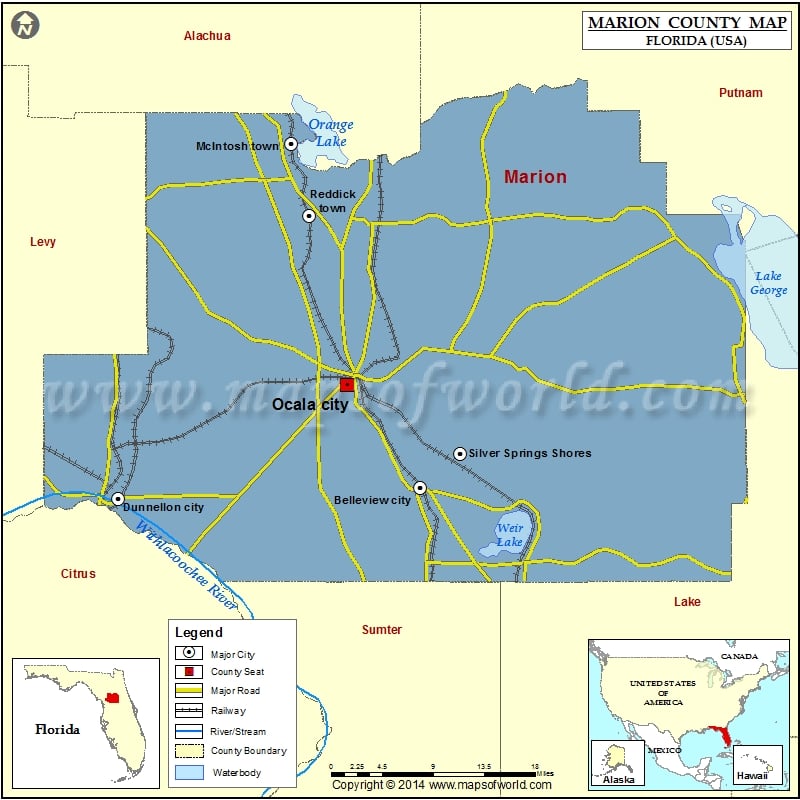
Marion County is situated in the heart of the Sunshine State, serving as a central hub that bridges the gap between the coastal reaches of the Atlantic Ocean and the Gulf of Mexico. Geographically, it is located in North-Central Florida, positioned approximately midway between the Georgia border and the Everglades. As one of the largest counties in the state by land area, it encompasses a diverse landscape that transitions from the rolling hills of the inland ridge to the sprawling pine scrub of the Ocala National Forest.
The county seat and largest city is Ocala, a community widely recognized as a significant landmark in its own right due to its historical and cultural importance to the United States equestrian industry. Understanding the location of Marion County requires looking at its surrounding neighbors: it is bordered by Alachua County and Putnam County to the north, Lake County to the east and southeast, Sumter County and Citrus County to the south, and Levy County to the west. This strategic location makes it a vital corridor for transportation and a sanctuary for some of the most significant natural landmarks in the Southeastern United States.

The Geographic and Natural Landmarks of Marion County
One cannot discuss the location of Marion County without highlighting the geological features that define its boundaries. The county sits atop the Floridan Aquifer, a massive underground reservoir that fuels several of the world’s largest and most famous freshwater springs. These springs are the primary natural landmarks of the region, drawing visitors and researchers alike for centuries.
Silver Springs State Park: A Geological Wonder
Perhaps the most iconic landmark in Marion County is Silver Springs State Park. Located just east of Ocala, this park is home to what is often cited as Florida’s first tourist attraction. The springs themselves are a natural marvel, producing millions of gallons of crystal-clear water daily. Historically, the site gained international fame through the introduction of Glass Bottom Boats, an innovation that allowed people to view the underwater limestone formations and diverse aquatic life without getting wet.
The architecture of the park’s main entrance and the historical preservation of its mid-century aesthetic serve as a bridge between Florida’s colonial past and its modern identity. The Silver River, which originates at the springs, flows through untouched wetlands, providing a glimpse into the prehistoric landscape of the North American continent.
Ocala National Forest: The Southernmost Sand Pine Scrub
On the eastern side of Marion County lies the Ocala National Forest, the oldest national forest in the United States east of the Mississippi River. This massive expanse of wilderness covers over 600 square miles and is a major geographic landmark. Within its borders are several “jewel” springs, including Alexander Springs, Juniper Springs, Salt Springs, and Silver Glen Springs.
Each of these springs represents a unique geological ecosystem. For instance, Salt Springs is noted for its high mineral content, which stems from deep underground vents that release ancient seawater minerals into the fresh water. The forest also encompasses Lake George, the second-largest lake in Florida, which marks the eastern boundary of the county. The forest serves as a vital landmark for biodiversity, housing the Florida Black Bear and the endangered Florida Scrub-Jay.
Rainbow Springs State Park
Located in the western part of the county near Dunnellon, Rainbow Springs State Park is another critical natural landmark. This spring is the headstock of the Rainbow River and is famous for its man-made waterfalls and ornamental gardens, which were developed during the early 20th century. The site reflects the historical trend of turning natural springs into elaborate botanical landmarks, a practice that defines much of Florida’s early 20th-century tourism architecture.
Historical and Architectural Landmarks
The history of Marion County is etched into its buildings and historical sites. Established in 1844, the county was named after Francis Marion, the “Swamp Fox” of the American Revolutionary War. The architectural heritage of the region ranges from military outposts to Victorian-era mansions.
Fort King National Historic Landmark
Fort King National Historic Landmark is perhaps the most significant historical site in Ocala. It served as a vital military outpost during the Seminole Wars in the 1830s. The site was the location of a pivotal agency that managed relations between the United States Government and the Seminole Tribe. Today, the reconstructed fort serves as a landmark for historians, representing the complex and often turbulent history of Florida’s frontier days. The architecture of the fort, with its heavy timber stockades and blockhouses, provides an educational look at 19th-century military engineering.
Ocala Historic Districts
The Ocala Downtown Square and the surrounding Ocala Historic District contain some of the most beautiful residential architecture in the state. After a devastating fire in 1883, much of the downtown area was rebuilt with brick, earning Ocala the nickname “The Brick City.” Landmark buildings like the Marion Theatre, a 1941 Art Deco masterpiece, continue to stand as cultural beacons.
Walking through the East Fort King Heritage District, one can find examples of Queen Anne, Colonial Revival, and Mediterranean Revival architecture. These homes are landmarks of the citrus and cattle wealth that flowed into the region during the late 19th and early 20th centuries. Tuscawilla Park, located near the heart of the city, acts as a landscape landmark that integrates public art, historical monuments, and modern recreational facilities.
The Cultural Landscape: Horse Capital of the World
A defining characteristic of Marion County is its designation as the “Horse Capital of the World,” a title it shares with Lexington, Kentucky. This is not just a marketing slogan but a reflection of the county’s landscape and land use. The limestone-rich soil and year-round moderate climate make it ideal for raising thoroughbreds.
The World Equestrian Center
The World Equestrian Center in Ocala is the largest equestrian complex in the United States. This modern architectural marvel is a landmark of luxury and sportsmanship. Featuring climate-controlled arenas, high-end retail spaces, and a five-star hotel, it has transformed the western part of the county into a global destination for equestrian events. Its massive scale and opulent design have set a new standard for sports landmarks in the Southern United States.
Thoroughbred Farms and Greenways
The sprawling horse farms that dot the landscape of Marion County are themselves iconic landmarks. Places like Gypsy Gold Horse Farm, which introduced the Vanner breed to North America, offer a look at the specialized agriculture that defines the region. The Cross Florida Greenway, a massive park system that traverses the county, occupies the land once intended for the Cross Florida Barge Canal. The canal was never completed, and the remaining infrastructure, such as the Santos Trailhead, has become a landmark for outdoor enthusiasts and mountain bikers from around the globe.
Museums and Scientific Landmarks
Beyond nature and horses, Marion County is home to several institutional landmarks that preserve the culture and technological history of the region.
Appleton Museum of Art
The Appleton Museum of Art, affiliated with the College of Central Florida, is a premier cultural landmark. The building itself is an architectural standout, featuring a classical design with Italian travertine marble. The museum houses a diverse collection, including European, American, Asian, African, and pre-Columbian artifacts. It serves as a central point for the arts in Florida, offering a sophisticated contrast to the county’s rugged natural beauty.
Don Garlits Museum of Drag Racing
Located in Belleview, just south of Ocala, the Don Garlits Museum of Drag Racing is a landmark for automotive history. Founded by “Big Daddy” Don Garlits, a pioneer in the sport, the museum preserves the evolution of the dragster and chronicles the history of the National Hot Rod Association. It is a site of pilgrimage for racing fans and serves as a testament to the county’s diverse interests.

Conclusion: A Centrally Located Tapestry
In summary, Marion County is located in the inland heart of Florida, but its identity is far from isolated. It is a region defined by its prominent landmarks, from the crystal-clear depths of Silver Springs State Park to the high-tech arenas of the World Equestrian Center. Its position allows it to serve as a gateway to both the wilderness of the Ocala National Forest and the sophisticated historical corridors of Ocala.
Whether one is looking for the architectural beauty of a Victorian home in the Ocala Historic District, the military history preserved at Fort King National Historic Landmark, or the natural splendor of the Rainbow River, Marion County stands as a monumental landmark in the geography of the United States. Its central location is not just a point on a map, but a destination where the history, nature, and culture of Florida converge.
LifeOutOfTheBox is a participant in the Amazon Services LLC Associates Program, an affiliate advertising program designed to provide a means for sites to earn advertising fees by advertising and linking to Amazon.com. Amazon, the Amazon logo, AmazonSupply, and the AmazonSupply logo are trademarks of Amazon.com, Inc. or its affiliates. As an Amazon Associate we earn affiliate commissions from qualifying purchases.