
The journey to Hawaii is often viewed as more than just a flight; it is a pilgrimage across the vast expanse of the Pacific Ocean to a land that feels entirely separate from the rest of the United States. This archipelago is the most isolated population center on Earth, situated thousands of miles from any continental landmass. For travelers planning a getaway to these tropical shores, understanding the physical and temporal distance is crucial for setting expectations, managing travel fatigue, and appreciating the unique ecological and cultural landscape that such isolation has fostered.
The Geographic Isolation of the Hawaiian Archipelago
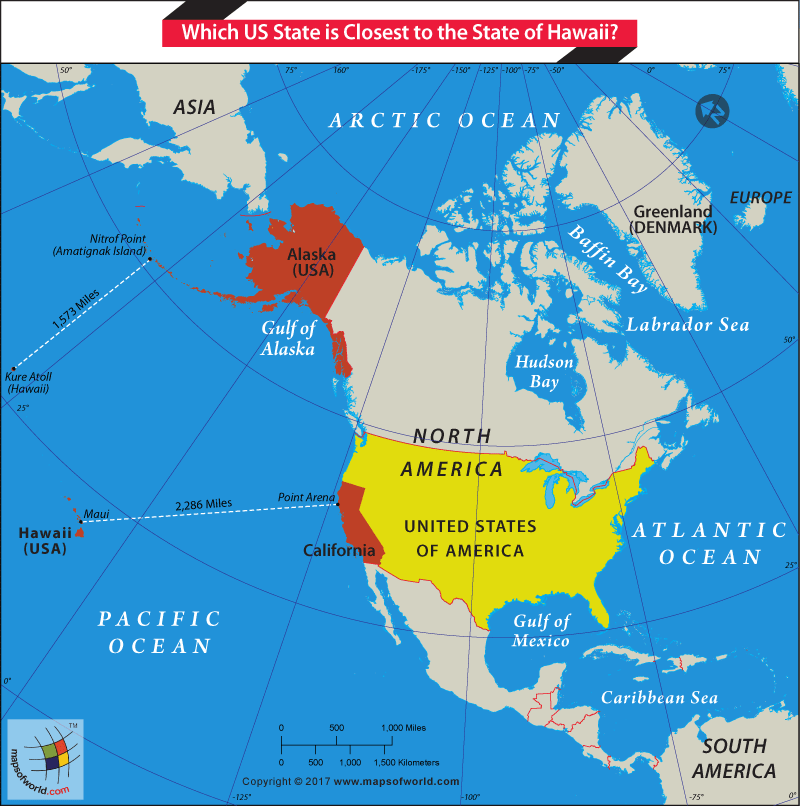
The sheer scale of the distance between Hawaii and the North America mainland is often difficult to grasp until one is mid-flight, looking out over an endless horizon of blue. Geographically, the islands are located in the central Pacific Ocean, far to the southwest of the contiguous United States.
Defining the Distance in Miles and Kilometers
When measuring the distance from the US Mainland, the numbers vary depending on your starting point. On average, Hawaii is approximately 2,400 to 2,500 miles (about 3,800 to 4,000 kilometers) from the West Coast. To put this in perspective, a flight from Los Angeles to Honolulu covers a greater distance than a flight from New York City to Los Angeles.
The closest point on the mainland to the islands is actually Point Arena in California, which sits approximately 2,045 nautical miles from the coast of Oahu. While this remains the shortest physical gap, most travelers will find themselves departing from major aviation hubs which add slightly more mileage to the trip.
The Impact of Oceanic Isolation
The distance is not merely a matter of travel time; it is the reason why Hawaii possesses such a high rate of endemic species. Because the islands are so far from the mainland, only a limited number of plants and animals were able to reach the shores via wind, water, or wings before human arrival. This isolation is what makes visiting landmarks like Haleakala National Park or the Na Pali Coast so distinct; you are witnessing an evolutionary story that unfolded in near-total solitude for millions of years.
Flight Dynamics: Crossing the Pacific
For the modern traveler, the distance is best measured in hours. Aviation has made this remote paradise accessible, but the flight remains one of the longest domestic routes available in the United States. Depending on your departure city and the prevailing winds—specifically the jet stream—the time spent in the air can fluctuate significantly.
West Coast Gateways
The West Coast serves as the primary springboard for Hawaiian travel. From cities like San Francisco, Seattle, and San Diego, the flight typically takes between five and six hours.
- Los Angeles to Honolulu: Approximately 5 hours and 30 minutes.
- Seattle to Kahului: Approximately 6 hours.
- Portland to Lihue: Approximately 6 hours.
Returning to the mainland is usually faster due to the tailwinds provided by the jet stream, often shaving 30 to 45 minutes off the travel time. Airlines such as Hawaiian Airlines, Alaska Airlines, and Southwest Airlines frequently service these routes, making the distance feel more manageable through regular daily departures.
East Coast and Midwest Challenges
For travelers starting in the Midwest or on the East Coast, the distance is formidable. A direct flight from New York City or Newark to Honolulu is one of the longest scheduled flights in the world, often clocking in at 10 to 11 hours.
- Chicago to Honolulu: Roughly 9 hours.
- Dallas to Kona: Roughly 8.5 hours.
- Atlanta to Honolulu: Approximately 9.5 to 10 hours.
These long-haul domestic flights require a different level of preparation, emphasizing the need for comfort and entertainment to bridge the gap between the continental United States and the Polynesian triangle.
Navigating the Time Zones and Travel Logistics

Distance in the Pacific Ocean is inextricably linked to time. Hawaii operates on its own schedule, which can result in significant jet lag for those arriving from the East Coast.
Understanding Hawaii-Aleutian Standard Time
Hawaii follows Hawaii-Aleutian Standard Time (HST). One of the most important things for travelers to remember is that the state does not observe Daylight Saving Time. This means the time difference between the mainland and the islands changes twice a year.
During the summer months, Hawaii is three hours behind Pacific Daylight Time and six hours behind Eastern Daylight Time. In the winter, when the mainland shifts back to standard time, that gap narrows to two hours for the West Coast and five hours for the East Coast. Understanding this “time distance” is vital for booking tours at Pearl Harbor or making dinner reservations in Waikiki.
Managing the Transition
The physical distance often results in a “lost day” of travel when heading west, and a “red-eye” experience when returning east. Most travelers find that the first 48 hours in Hawaii are best spent acclimating to the environment. Taking a gentle stroll through Foster Botanical Garden or watching the sunset over Diamond Head can help reset the internal clock before embarking on more strenuous activities like hiking Koko Head.
Exploring the Main Islands: Proximity and Connectivity
Once you have crossed the vast distance from the mainland, the proximity between the islands themselves becomes the next logistical consideration. While they may look close on a map, the Hawaiian Islands are spread out over several hundred miles.
Oahu: The Central Hub
Most international and mainland flights arrive at Daniel K. Inouye International Airport in Honolulu. As the most populous island, Oahu serves as the gateway to the rest of the chain. From here, the distance to the “neighbor islands” is short but requires further air travel, as there are no passenger ferries connecting the major islands (with the exception of a small ferry between Maui and Lanai).
Neighbor Island Distances
Travelers often choose to “island hop” to experience the diversity of the archipelago.
- Honolulu to Kahului (Maui): A 100-mile flight taking approximately 35 minutes.
- Honolulu to Lihue (Kauai): A 102-mile flight taking about 40 minutes.
- Honolulu to Kona (Island of Hawaii): A 170-mile flight taking roughly 45 to 50 minutes.
The Island of Hawaii, often called the Big Island, is the furthest south and the largest, home to the massive Mauna Kea and the active landscapes of Hawaii Volcanoes National Park. Despite the short flight times, the distance is enough to create distinct microclimates; you can move from the urban bustle of Honolulu to the rainforests of Hilo in less than an hour.
The Allure of the Remote Destination
Why do millions of people traverse such immense distances every year? The answer lies in what that distance provides: a complete departure from the familiar. When you are 2,400 miles away from the nearest continent, the air smells different, the light hits the volcanic peaks of Waimea Canyon with a unique clarity, and the pace of life naturally slows down.
The distance acts as a buffer, preserving the Native Hawaiian culture and the “Aloha Spirit” from being entirely absorbed by mainland trends. Whether you are surfing the legendary waves of the North Shore or exploring the quiet history of Molokai, the realization of how far you have traveled adds a layer of magic to the experience.

Planning for the Long Haul
To make the most of the distance, seasoned travelers recommend a minimum stay of seven to ten days, especially if coming from the Central United States or East Coast. This allows for the recovery of travel time and ensures that the hours spent over the Pacific Ocean result in a deeply restorative experience.
Preparation should include booking with reliable carriers like United Airlines or Delta Air Lines, ensuring you have the necessary documentation for the Safe Travels Hawaii programs (if applicable), and packing for a variety of activities—from the humid beaches of Hanauma Bay to the chilly summits of Haleakala.
In conclusion, while the distance from the US Mainland to Hawaii is significant, it is this very remoteness that defines the islands’ identity. Crossing the 2,400-mile threshold is not just a logistical necessity; it is an essential part of the adventure, marking the transition into a world where the horizon is endless and the spirit of the Pacific is everywhere.
LifeOutOfTheBox is a participant in the Amazon Services LLC Associates Program, an affiliate advertising program designed to provide a means for sites to earn advertising fees by advertising and linking to Amazon.com. Amazon, the Amazon logo, AmazonSupply, and the AmazonSupply logo are trademarks of Amazon.com, Inc. or its affiliates. As an Amazon Associate we earn affiliate commissions from qualifying purchases.