
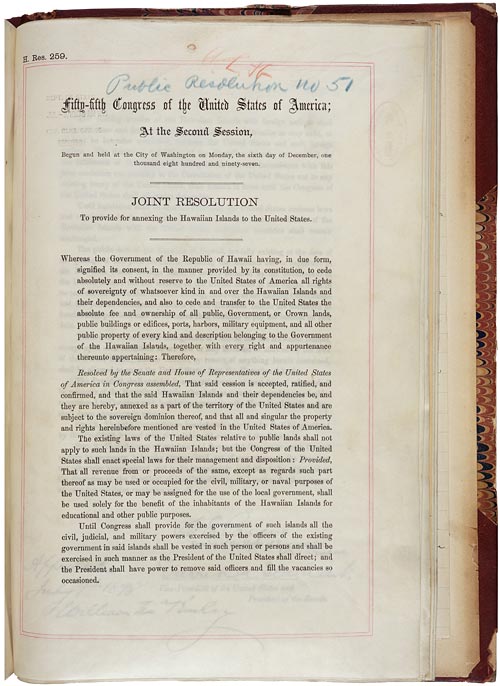
The history of the United States and its relationship with the Pacific Ocean is defined by several pivotal moments, but perhaps none are as geographically and politically significant as the annexation of Hawaii. To understand when the United States officially annexed the islands, one must look back to the year 1898. On July 7, 1898, President William McKinley signed the Newlands Resolution, which effectively transferred the sovereignty of the islands to the United States. However, the journey toward this landmark event was a complex tapestry of political maneuvering, commercial interest, and cultural upheaval that is still etched into the physical landmarks of Honolulu today.

The annexation was not a singular event but the culmination of a decade-long struggle between the indigenous monarchy and a group of American-backed sugar planters and businessmen. While the formal ceremony took place on August 12, 1898, at the Iolani Palace, the roots of this transition extend back to the early 19th century when the islands first became a vital stop for whaling ships and merchant vessels traveling between North America and Asia.
The Historical Timeline of the Annexation of Hawaii
The timeline leading to the 1898 annexation is a essential study for anyone interested in the landmarks of the central Pacific. For much of the 19th century, Hawaii was a recognized independent kingdom with its own diplomatic ties to Great Britain and France. However, the growing influence of the American sugar industry began to shift the political landscape of the islands.
The Overthrow of the Hawaiian Monarchy (1893)
A critical precursor to the annexation occurred in January 1893. Queen Liliuokalani, the last reigning monarch of the Kingdom of Hawaii, attempted to implement a new constitution that would restore power to the monarchy and voting rights to the native people. In response, a group known as the Committee of Safety, composed largely of American residents and led by Sanford B. Dole, organized a coup. With the support of U.S. Minister John L. Stevens and the landing of U.S. Marines from the USS Boston, the monarchy was overthrown.
Following the coup, a provisional government was established, and later, the Republic of Hawaii was proclaimed. During this period, the provisional leaders sought immediate annexation by the United States, but they were initially met with resistance from President Grover Cleveland, who believed the overthrow was an illegal act of war.
The Newlands Resolution of 1898
The tide shifted with the onset of the Spanish-American War. The strategic value of Hawaii as a mid-Pacific refueling station for the U.S. Navy became undeniable. As American troops were dispatched to the Philippines and Guam, the necessity of a permanent base in the Pacific prompted Congress to bypass the traditional treaty process, which required a two-thirds majority in the Senate. Instead, they passed the Newlands Resolution, which required only a simple majority.
On August 12, 1898, the Hawaiian Flag was lowered at the Iolani Palace, and the Stars and Stripes were raised in its place, marking the official transformation of the islands into a U.S. territory.
Landmark Sites of the Annexation Era
For those exploring the history of the islands, the landmarks associated with this period offer a profound look into the architectural and cultural shifts of the late 19th century. These sites are not merely tourist attractions; they are the physical manifestations of a nation’s transition.
Iolani Palace: A Monument to Sovereignty
Located in the heart of downtown Honolulu, the Iolani Palace stands as the most significant landmark of the annexation era. Completed in 1882 by King Kalakaua, it is the only royal palace on American soil. Its “American Florentine” architectural style, featuring grand staircases and intricate woodwork, was intended to project the kingdom’s modernity and sophistication to the rest of the world.
The palace was the site of the 1893 overthrow and the subsequent 1898 annexation ceremony. Perhaps more poignantly, it was also the place where Queen Liliuokalani was imprisoned for several months following a failed 1895 counter-revolution. Visitors today can view the room where she was held, which remains a powerful symbol of the loss of Hawaiian sovereignty.
Washington Place: The Queen’s Final Residence
A short walk from the palace is Washington Place, a grand mansion that served as the private home of Queen Liliuokalani. Built in the mid-19th century, this landmark reflects the blend of Western architecture and island lifestyle common among the Hawaiian elite. After the annexation, the mansion became the official residence of the Governor of Hawaii. It serves as a reminder of the personal life of the monarch who navigated the difficult years of transition and remained a revered figure among the Hawaiian people until her death in 1917.
The Hawaii State Capitol and the Archives
While the Hawaii State Capitol is a mid-20th-century structure, its location in the Capitol District of Honolulu is essential to the historical narrative. Adjacent to it are the Hawaii State Archives, which house the original documents of the Kingdom of Hawaii, including the petitions signed by thousands of native Hawaiians protesting the annexation. These landmarks provide the academic and political context necessary to understand the gravity of the events that occurred in 1898.
The Strategic Importance of Pearl Harbor
One cannot discuss the annexation of Hawaii without addressing the strategic importance of Pearl Harbor. Long before the United States formally annexed the islands, the deep-water harbor on the island of Oahu was viewed as the “key to the Pacific.”
The 1887 Reciprocity Treaty and the Rise of Sugar
The roots of the military interest in Pearl Harbor can be traced back to the Reciprocity Treaty of 1875. This agreement allowed Hawaiian sugar to enter the United States duty-free, leading to a boom in the island’s economy and an influx of American capital. When the treaty was renewed in 1887, the United States secured the exclusive right to use Pearl Harbor as a coaling and repair station for its ships.
This economic and military entanglement made the eventual annexation almost inevitable in the eyes of American expansionists. The harbor became a primary landmark of American naval power, a role it continues to play today as the headquarters of the United States Pacific Fleet.
Naval Expansion in the Pacific
By the time of the Spanish-American War in 1898, Pearl Harbor was no longer just a commercial interest; it was a national security priority. The annexation provided the legal framework for the United States to develop the harbor into a massive naval complex. Today, the Pearl Harbor National Memorial is one of the most visited landmarks in Hawaii, serving as a place of reflection on both the events of World War II and the earlier strategic moves that brought the islands into the American orbit.
Preserving History at the Bernice Pauahi Bishop Museum
To grasp the full scope of the culture that existed before and during the annexation, the Bernice Pauahi Bishop Museum is an indispensable landmark. Founded in 1889 in honor of Princess Bernice Pauahi Bishop, the last descendant of the Kamehameha Dynasty, the museum houses the world’s largest collection of Hawaiian and Pacific artifacts.
The museum’s Hawaiian Hall is a landmark of Victorian-era architecture, and its exhibits detail the rise of the monarchy, the arrival of missionaries, and the eventual political shifts of the late 1800s. It provides a cultural counter-narrative to the political history of annexation, highlighting the resilience of Hawaiian traditions and the identity of the people whose nation was transformed.
Reflecting on Hawaii’s Past Through Its Iconic Landscapes
Beyond the buildings and documents, the very landscape of Oahu serves as a landmark of this historical era. Places like the Nuuanu Pali Lookout are central to the story of the kingdom’s formation under King Kamehameha I. The unification of the islands was a prerequisite for the centralized government that would later deal with the United States.
When visitors stand at the Diamond Head State Monument, they are looking out over a coastline that has seen the arrival of Captain James Cook, the growth of the sugar industry, and the arrival of the U.S. Navy. The volcanic crater itself was used as a military lookout point following the annexation, further integrating the natural landmarks of Hawaii into the American military infrastructure.
The annexation of Hawaii in 1898 remains a complex and often debated chapter in American history. It was a moment that redefined the borders of the United States and the future of the Pacific. By visiting the landmarks of Honolulu and Oahu, one can see the physical remnants of this transition—from the gilded halls of Iolani Palace to the fortified waters of Pearl Harbor. These sites serve as enduring witnesses to the year 1898, a year that forever changed the trajectory of the Hawaiian Islands.
LifeOutOfTheBox is a participant in the Amazon Services LLC Associates Program, an affiliate advertising program designed to provide a means for sites to earn advertising fees by advertising and linking to Amazon.com. Amazon, the Amazon logo, AmazonSupply, and the AmazonSupply logo are trademarks of Amazon.com, Inc. or its affiliates. As an Amazon Associate we earn affiliate commissions from qualifying purchases.