
Navigating the complexities of public assistance programs can often feel like deciphering a foreign language. For residents of Oregon seeking to understand their potential Supplemental Nutrition Assistance Program (SNAP) benefits, commonly referred to as food stamps, clarity is paramount. This guide aims to demystify the process, outlining the key factors that influence benefit amounts and providing a framework for estimating your potential allocation. The Oregon Department of Human Services oversees the SNAP program in the state, striving to ensure that eligible individuals and families have access to nutritious food.
Understanding SNAP Eligibility and Benefit Calculation in Oregon
The amount of SNAP benefits an individual or household receives in Oregon is not a static figure. It’s a dynamic calculation influenced by a comprehensive set of criteria designed to assess financial need and household composition. The primary goal of SNAP is to supplement, not replace, a household’s own food budget. Therefore, the benefit amount is determined by the difference between what a household is expected to contribute towards their food costs and the total cost of a basic, nutritious diet for that household.
Household Income: The Cornerstone of Benefit Determination
The most significant factor influencing SNAP benefit amounts is household income. This encompasses all earnings from employment, self-employment, and any other sources of income received by members of the applicant household. The Oregon Department of Human Services utilizes both gross and net income in its calculations.
- Gross Monthly Income: This is the total income a household receives before any deductions. It serves as an initial screening tool.
- Net Monthly Income: This is the gross income minus certain allowable deductions. Deductions are crucial as they reduce the countable income, potentially increasing the SNAP benefit amount. Common deductions include:
- Earned Income Deduction: A standard deduction applied to income from employment.
- Dependent Care Deduction: Expenses for caring for a child or incapacitated adult that are necessary for a household member to work, train, or attend school.
- Medical Expense Deduction: For elderly or disabled household members, medical expenses exceeding a certain threshold (typically $35 per month) after being reimbursed by other sources can be deducted.
- Shelter Deduction: Housing costs, including rent or mortgage payments, property taxes, and utilities, that exceed 50% of the household’s net income. There’s a cap on the shelter deduction unless at least one household member is elderly or disabled.
- Standard Deduction: A fixed amount that varies based on household size, applied to reduce gross income.
The SNAP benefit is calculated by multiplying the net monthly income by 30% (as it’s assumed households will spend 30% of their available income on food) and subtracting this from the maximum benefit amount for a household of that size.
Household Size: A Direct Correlation to Benefit Potential
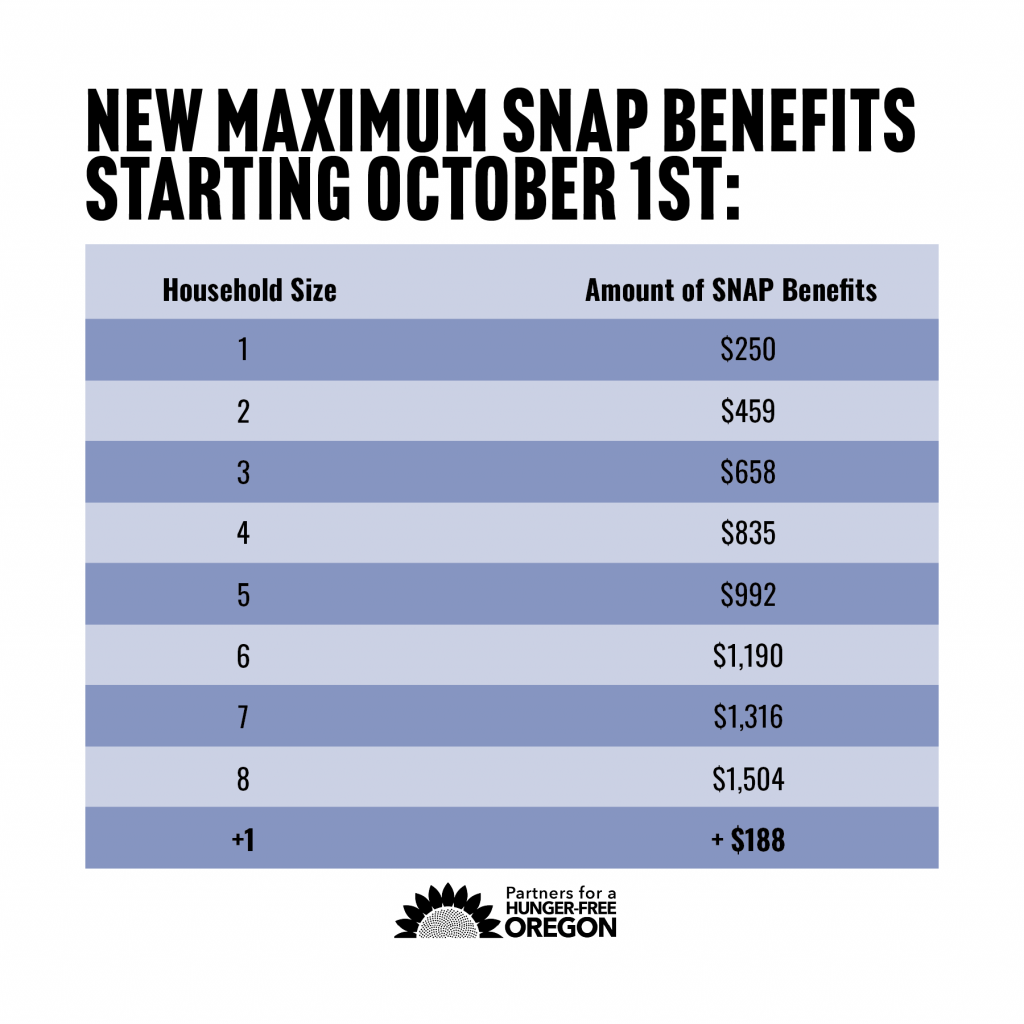
The number of individuals within a household is a fundamental determinant of the maximum possible SNAP benefit. Larger households generally have higher food needs, and consequently, their maximum benefit allotments are higher. This ensures that the program scales appropriately to meet the dietary requirements of families of various sizes.
For instance, a single individual will have a lower maximum benefit than a family of four, even if their income and deductions were identical. The Oregon Department of Human Services publishes maximum monthly benefit tables that are updated periodically to reflect changes in food costs and inflation. These tables serve as the upper limit for what a household of a specific size can receive.
Allowable Expenses and Deductions: Reducing Countable Income
As mentioned previously, certain allowable expenses can be deducted from a household’s income, thereby reducing their “countable income.” This is a critical aspect of the benefit calculation that can significantly impact the final amount. It’s essential for applicants to meticulously track and document all eligible expenses.
- Housing Costs: Rent or mortgage payments, property taxes, insurance, and utility costs (if not included in rent) are significant deductions. The Oregon Department of Human Services has specific rules regarding what qualifies as a utility expense and how it’s calculated, especially in cases where a standard utility allowance is provided.
- Child Care Expenses: Costs incurred for the care of a child or other dependent in order for a household member to work or participate in a Workforce Innovation and Opportunity Act (WIOA) approved training program are deductible.
- Medical Expenses: For households with members who are elderly (age 60 or older) or disabled, certain out-of-pocket medical expenses that exceed $35 per month can be deducted. This includes costs for prescribed medications, doctor visits, and other medically necessary services not covered by other programs.
- Child Support Payments: Legally obligated child support payments made to non-household members are deductible.
It is crucial to understand that there are limits and specific criteria for each deduction. The Oregon Department of Human Services provides detailed guidelines on its website and through application materials to help applicants understand these rules.
Estimating Your Potential Food Stamp Benefit
While a precise benefit amount can only be determined after a formal application and review by the Oregon Department of Human Services, it’s possible to create an educated estimate. This involves gathering all necessary financial information and using the program’s underlying principles.
Step-by-Step Estimation Process
- Determine Your Household Size: Accurately count all individuals who will be included in the SNAP application.
- Calculate Your Gross Monthly Income: Sum all income received by household members from all sources before any deductions.
- Identify and Sum Allowable Deductions: Meticulously list all eligible expenses and calculate their total monthly value. This requires careful review of the Oregon Department of Human Services guidelines for each deduction category.
- Calculate Your Net Monthly Income: Subtract your total allowable deductions from your gross monthly income.
- Calculate Your Expected Food Contribution: Multiply your net monthly income by 0.30 (30%). This represents the portion of your income that the program assumes you will spend on food.
- Find the Maximum Benefit for Your Household Size: Consult the most current maximum SNAP benefit tables for Oregon for your household size. These are typically available on the Oregon Department of Human Services website.
- Estimate Your Benefit Amount: Subtract your expected food contribution (from step 5) from the maximum benefit for your household size (from step 6). If this number is less than $23 (a minimum benefit amount in many states, though subject to change), you may still receive that minimum amount. If the calculation results in zero or a negative number, you likely will not be eligible for SNAP benefits.

Example Scenario:
Let’s consider a household of three in Oregon with a gross monthly income of $2,000. They have allowable deductions for rent and utilities totaling $800 and $150 for dependent care, for a total of $950 in deductions.
- Gross Monthly Income: $2,000
- Allowable Deductions: $950
- Net Monthly Income: $2,000 – $950 = $1,050
- Expected Food Contribution: $1,050 * 0.30 = $315
- Maximum Benefit for a Household of 3 (hypothetical, as of current tables): $600
- Estimated SNAP Benefit: $600 – $315 = $285
In this hypothetical scenario, the household might receive an estimated $285 in monthly SNAP benefits. This estimation process is a valuable tool for understanding potential eligibility and benefit levels before formally applying.
Factors Beyond Income and Household Size
While income and household size are primary drivers of SNAP benefit calculations, several other factors can influence the outcome of an application and the final benefit amount.
Assets and Resource Limits
SNAP has asset limits for most households, though these limits are subject to change and can be higher for households with elderly or disabled members. Generally, countable assets include checking and savings accounts, stocks, bonds, and other liquid resources. Certain assets, such as the primary residence, one vehicle per adult, and retirement accounts, are typically excluded. If a household’s countable assets exceed the limit, they may not be eligible for benefits, regardless of their income.
Work Requirements and ABAWD Rules
For certain adult SNAP recipients who do not have dependent children in their household and are not otherwise exempt (e.g., due to disability), there are work requirements. These individuals may be subject to time limits on receiving benefits, often referred to as the Able-Bodied Adults Without Dependents (ABAWD) rule. To continue receiving benefits beyond these limits, they must meet certain work or work-program participation criteria. Exceptions and waivers can apply in areas with high unemployment.
Special Circumstances and Household Composition
The definition of a “household” for SNAP purposes can be nuanced. It typically includes individuals who live together and customarily purchase and prepare meals together. However, there are specific rules for certain relationships, such as children living with parents or spouses. The Oregon Department of Human Services has detailed guidelines on how to define a SNAP household, which can impact the total income and number of individuals considered in the benefit calculation.
Furthermore, specific situations like student eligibility rules, the inclusion of sponsored non-citizens, and the treatment of certain types of income (e.g., foster care payments, adoption subsidies) can influence eligibility and benefit amounts.
Applying for SNAP in Oregon and Next Steps
The process of applying for SNAP in Oregon is designed to be accessible. Applicants can typically apply online through the Oregon Department of Human Services website, by mail, or in person at local offices.
The Application Process
- Gather Documentation: Before starting your application, it’s advisable to gather essential documents. This includes proof of identity, residency, income (pay stubs, tax returns), and expenses (rent receipts, utility bills, medical bills).
- Complete the Application: Fill out the SNAP application form accurately and completely. Incomplete applications can delay the process.
- Submit the Application: Submit the application through your preferred method.
- Interview: Most applicants will be required to complete an interview with a caseworker, typically by phone, to discuss the application details and eligibility.
- Verification: The Oregon Department of Human Services will verify the information provided.
- Decision: Once the review is complete, you will receive a decision on your eligibility and, if approved, the amount of your monthly benefits. Benefits are typically issued via an Electronic Benefit Transfer (EBT) card, similar to a debit card, which can be used at authorized retailers.

Where to Find More Information
For the most accurate and up-to-date information, including current maximum benefit levels, deduction rules, and asset limits, it is highly recommended to consult the official resources provided by the Oregon Department of Human Services. Their website often features detailed FAQs, application forms, and contact information for local offices where you can speak with a representative directly. Understanding these nuances will empower you to navigate the application process effectively and ensure you receive the maximum benefit you are entitled to, helping to alleviate food insecurity in Oregon.
LifeOutOfTheBox is a participant in the Amazon Services LLC Associates Program, an affiliate advertising program designed to provide a means for sites to earn advertising fees by advertising and linking to Amazon.com. Amazon, the Amazon logo, AmazonSupply, and the AmazonSupply logo are trademarks of Amazon.com, Inc. or its affiliates. As an Amazon Associate we earn affiliate commissions from qualifying purchases.