
Navigating the legal landscape of divorce can be a complex and emotionally taxing process. In Oregon, the dissolution of marriage is governed by specific statutes and procedures designed to ensure fairness and order. Understanding these requirements is crucial for a smoother transition. This guide aims to demystify the divorce process in the Beaver State, covering essential steps, residency requirements, types of divorce, and key considerations to help you navigate this significant life change with clarity and preparedness.
Understanding Oregon Divorce Law
Oregon is a “no-fault” divorce state, meaning neither party needs to prove wrongdoing by the other to obtain a divorce. The sole ground for divorce is that the marital relationship between the parties is irretrievably broken. This simplifies the legal process by removing the need to assign blame, focusing instead on the equitable division of assets and liabilities and the well-being of any children involved.

Residency Requirements
Before filing for divorce in Oregon, at least one of the spouses must meet the state’s residency requirements.
- State Residency: One of the parties must have resided in Oregon for at least six months immediately preceding the filing of the petition for divorce.
- County Residency: Additionally, one of the parties must have resided in the county where the divorce petition is filed for at least 30 days immediately preceding the filing.
If you do not meet these requirements, you will need to wait until you do before you can initiate divorce proceedings in Oregon.
Types of Divorce in Oregon
Oregon offers different pathways to divorce, each suited to varying circumstances:
Uncontested Divorce
An uncontested divorce is generally the most straightforward and cost-effective option. This occurs when both spouses agree on all significant issues, including:
- Division of Property and Debts: How marital assets (like homes, vehicles, savings, investments) and debts (mortgages, loans, credit card balances) will be divided.
- Spousal Support (Alimony): Whether one spouse will pay support to the other, and if so, the amount and duration.
- Child Custody and Visitation: Legal and physical custody arrangements for any minor children, including parenting time schedules.
- Child Support: The amount of financial support one parent will pay to the other for the children’s needs.
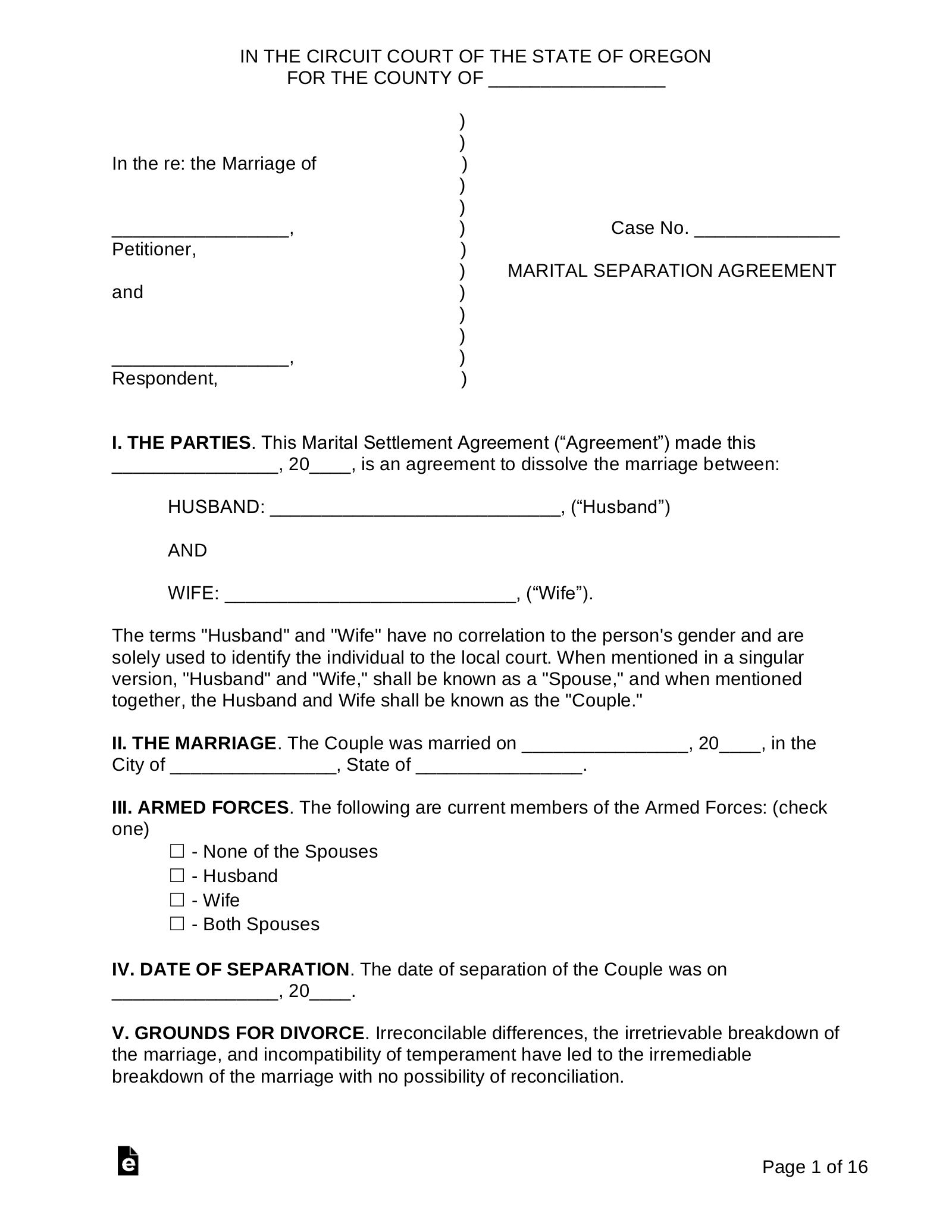
In an uncontested divorce, both parties can typically sign a settlement agreement, which is then submitted to the court for approval. This often involves less court intervention and can be finalized more quickly.
Contested Divorce
A contested divorce arises when spouses cannot agree on one or more of the key issues mentioned above. In such cases, the court will need to make decisions on behalf of the parties after a trial. The process for a contested divorce typically involves:
- Filing the Petition: One spouse files a Petition for Divorce with the court.
- Service of Process: The other spouse (the respondent) is formally notified of the divorce action.
- Response: The respondent files a response to the petition.
- Discovery: Both parties exchange financial information and other relevant documents, which may involve depositions, interrogatories, and requests for production of documents.
- Mediation/Settlement Conferences: Courts often encourage or require parties to attempt mediation to resolve disputes outside of court.
- Trial: If no settlement is reached, a trial will be held where a judge hears evidence and makes final decisions.
Contested divorces are generally more time-consuming, expensive, and emotionally draining due to the involvement of the court system and potential adversarial proceedings.
Simplified Divorce (Summary Dissolution)
Oregon also offers a simplified divorce process for couples who meet very specific criteria. This is typically available for marriages of short duration with no minor children and minimal assets and debts. The exact requirements for a summary dissolution can be found in the Oregon Revised Statutes, but generally include that the marriage lasted a short period, neither party is pregnant, and both parties have limited income and property. This process significantly streamlines the paperwork and court appearances.
The Divorce Process Step-by-Step
Regardless of whether your divorce is contested or uncontested, certain procedural steps are common in Oregon.
1. Filing the Petition for Divorce
The process begins when one spouse, the petitioner, files a Petition for Divorce with the appropriate county court. This document formally initiates the divorce action and outlines basic information about the marriage, the parties, and the relief sought (e.g., division of assets, child custody). The petitioner must also file a Summons.
2. Serving the Other Spouse
After filing, the other spouse, the respondent, must be formally served with the legal documents. This ensures that the respondent is aware of the divorce proceedings and has an opportunity to respond. Service is typically performed by a sheriff’s deputy, a professional process server, or another adult not involved in the case. The respondent then has a specific timeframe, usually 30 days, to file a response.
3. Financial Disclosures
In Oregon, both parties are required to exchange detailed financial information with each other. This disclosure is crucial for the court to make informed decisions about property division, spousal support, and child support. You will need to provide information about income, assets, debts, and expenses. Failing to provide accurate and complete financial disclosures can have serious legal consequences.
4. Negotiation and Settlement
For uncontested divorces, this stage involves open communication and negotiation to reach an agreement on all outstanding issues. If parties are represented by attorneys, their lawyers will handle much of this negotiation. Mediation is often a valuable tool during this phase, providing a neutral third party to help facilitate an agreement.
5. Court Approval and Final Judgment
Once an agreement is reached (in an uncontested case) or decisions are made by the judge (in a contested case), the terms are documented in a Final Judgment of Divorce. This legally binding document dissolves the marriage and outlines all terms related to property, support, and children. The judge reviews and signs the judgment, at which point the divorce is finalized. There is typically a mandatory 90-day waiting period after the petition is filed before a divorce can be finalized in Oregon.
Key Considerations in Divorce
Beyond the legal procedures, several critical aspects require careful consideration during a divorce.
Division of Marital Property and Debt
Oregon is an “equitable distribution” state, meaning marital property and debts acquired during the marriage will be divided fairly, but not necessarily equally, between the spouses. The court will consider various factors, including:
- The duration of the marriage.
- The contribution of each spouse to the acquisition, preservation, or improvement of marital assets.
- The economic circumstances of each spouse.
- The age and health of each spouse.
- The need for a home for any minor children.
Understanding what constitutes marital property versus separate property (owned before the marriage or received as a gift/inheritance) is vital.
Child Custody and Support
When minor children are involved, the court’s primary concern is the best interests of the child. This guides decisions regarding:
- Legal Custody: The right to make decisions about a child’s upbringing (e.g., education, healthcare, religious training).
- Physical Custody: Where the child will primarily reside.
- Parenting Time: The schedule for when each parent will have the child.
Child support is calculated based on statewide guidelines that consider the income of both parents and the number of overnights each child spends with each parent.
Spousal Support (Alimony)
Spousal support is financial assistance paid by one spouse to the other after divorce. It is not automatically awarded in every divorce. The court considers factors such as the length of the marriage, the financial need of one spouse, the ability of the other spouse to pay, the age and health of the parties, and contributions to the marriage.
Legal Representation
While it is possible to represent yourself in a divorce, seeking legal counsel from an experienced Oregon divorce attorney is highly recommended, especially in complex cases or when children are involved. An attorney can guide you through the legal intricacies, protect your rights, help negotiate favorable settlements, and represent you in court if necessary. Some individuals choose to work with attorneys on specific aspects of their case, such as drafting agreements or providing legal advice, while managing other tasks themselves.

Emotional and Practical Support
Divorce is an emotionally challenging time. Seeking support from friends, family, therapists, or support groups can be invaluable. Practically, you will need to consider changes in housing, finances, and daily routines. Planning for these adjustments proactively can ease the transition.
Navigating divorce in Oregon requires a thorough understanding of the legal framework and personal considerations. By preparing for the process, understanding your rights and responsibilities, and seeking appropriate guidance, you can work towards a more stable and positive future.
LifeOutOfTheBox is a participant in the Amazon Services LLC Associates Program, an affiliate advertising program designed to provide a means for sites to earn advertising fees by advertising and linking to Amazon.com. Amazon, the Amazon logo, AmazonSupply, and the AmazonSupply logo are trademarks of Amazon.com, Inc. or its affiliates. As an Amazon Associate we earn affiliate commissions from qualifying purchases.