
Navigating Arizona’s Landscapes with Accessible Parking
Exploring the breathtaking beauty and vibrant cities of Arizona offers an unparalleled experience, from the majestic vistas of the Grand Canyon to the bustling urban centers of Phoenix and Tucson. For individuals with mobility challenges, ensuring seamless access to these incredible destinations often begins with securing a handicap placard. This essential permit unlocks designated parking spaces, significantly enhancing convenience, reducing stress, and ultimately enabling a more enjoyable and accessible travel experience throughout the state. Understanding the process to obtain one is a critical step for both residents and visitors planning extended stays or frequent trips within the Grand Canyon State.

Why a Placard is Essential for Arizona Travel
Arizona’s vast and diverse terrain means that getting around often requires a vehicle. Whether you’re planning a road trip through its scenic byways, exploring the historic districts of its cities, or visiting one of its many national parks and monuments, accessible parking is a key component of stress-free travel. A handicap placard provides the holder with the legal right to park in designated accessible parking spaces, which are typically wider, closer to entrances, and designed for easier access. Without one, navigating crowded parking lots at popular attractions, shopping centers, or medical facilities can become a significant hurdle, diminishing the overall travel experience. For those with limited mobility, a placard isn’t just a convenience; it’s a necessity that empowers independence and ensures equitable access to all that Arizona has to offer. It transforms the potential frustration of parking into an opportunity to focus on the adventure itself, from enjoying the desert botanicals at the Desert Botanical Garden to experiencing the vibrant arts scene in Sedona.
The Legal Framework: Arizona’s Commitment to Accessibility
The foundation for accessible parking privileges in the United States is the Americans with Disabilities Act (ADA), a comprehensive civil rights law that prohibits discrimination against individuals with disabilities. Arizona, like all other states, adheres to the ADA guidelines, implementing its own specific regulations through the Arizona Department of Transportation (ADOT) and its Motor Vehicle Division (MVD). These regulations ensure that individuals with qualifying disabilities are granted the necessary permits to utilize accessible parking facilities. The system is designed not only to provide a legal framework but also to foster an inclusive environment, allowing individuals with disabilities to participate fully in society, including enjoying recreational travel and daily activities without unnecessary barriers. Understanding this commitment to accessibility can provide peace of mind to travelers, knowing that their needs are recognized and accommodated within the state’s infrastructure.
Eligibility for an Arizona Handicap Placard
Obtaining a handicap placard in Arizona is contingent upon meeting specific medical criteria as defined by state law. The primary objective is to ensure that these valuable parking privileges are extended to those who genuinely require them due to a verifiable disability that impairs mobility.
Medical Conditions That Qualify
The Arizona MVD outlines a clear set of medical conditions that qualify an individual for a disability placard. These conditions generally fall into categories that significantly limit a person’s ability to walk or move independently without assistance. Key qualifying conditions include, but are not limited to:
- Inability to walk without assistance: This includes reliance on crutches, canes, braces, prosthetics, wheelchairs, or other mobility aids.
- Severe lung disease: Individuals whose forced expiratory volume for one second (FEV1) is less than one liter, or who are dependent on supplemental oxygen, often qualify.
- Cardiac conditions: Those classified in Class III or IV according to the American Heart Association standards, indicating severe limitations in physical activity.
- Neurological conditions: Conditions such as multiple sclerosis, Parkinson’s disease, or spinal cord injuries that severely impair walking or coordination.
- Arterial or vascular disease: Limiting the ability to walk due to intermittent claudication.
- Loss or significant impairment of a limb: Such as the loss of a leg or the use of both legs.
- Arthritic, neurological, or orthopedic conditions: Any other condition that severely restricts a person’s ability to walk.
It’s important to note that the impact of the condition, rather than the diagnosis alone, is the determining factor. The medical professional’s assessment of how the condition affects mobility is paramount.
Required Medical Certification
A critical step in the application process is obtaining certification from a licensed medical professional. This isn’t merely a formality; it’s a legal requirement to verify the applicant’s disability. The certification must be provided by one of the following licensed practitioners:
- A medical doctor (M.D.)
- A physician assistant (PA)
- A nurse practitioner (NP)
- A chiropractor (for specific musculoskeletal conditions)
- A podiatrist (for foot-related conditions affecting mobility)
- An ophthalmologist (for vision-related impairments affecting mobility, though less common for placards)
The medical professional must complete a specific section of the application form, detailing the nature of the disability, its severity, and its expected duration. For temporary placards, they will indicate the anticipated period for which the placard is needed. Their signature and license number are mandatory for the application to be valid. This ensures that the medical necessity is properly documented, adhering to Arizona state regulations.
The Application Process: Your Roadmap to Accessible Parking
Once you’ve confirmed your eligibility, navigating the application process for an Arizona handicap placard is straightforward, designed to be as accessible as possible. Careful attention to detail will ensure a smooth experience.
Obtaining the Application Form
The first step is to acquire the correct application form. The official “Application for Disability Placard/Plate” is Form 96-0104. You can easily obtain this form through several channels:
- Online: The quickest way is to download it directly from the Arizona Department of Transportation (ADOT) website. Look for the Motor Vehicle Division (MVD) section related to disability services.
- In-person: Visit any local MVD office located throughout Arizona, including major cities like Phoenix and Tucson.
- By Mail: You may also request the form by mail from the ADOT MVD Disability Unit.
Completing the Applicant Section
The applicant section of Form 96-0104 requires your personal information, including your full name, address, date of birth, and Arizona driver’s license or identification card number. You will also need to specify the type of placard you are applying for: permanent, temporary, or disabled veteran plate. Ensure all information is accurate and matches your official identification documents.
The Medical Professional’s Role
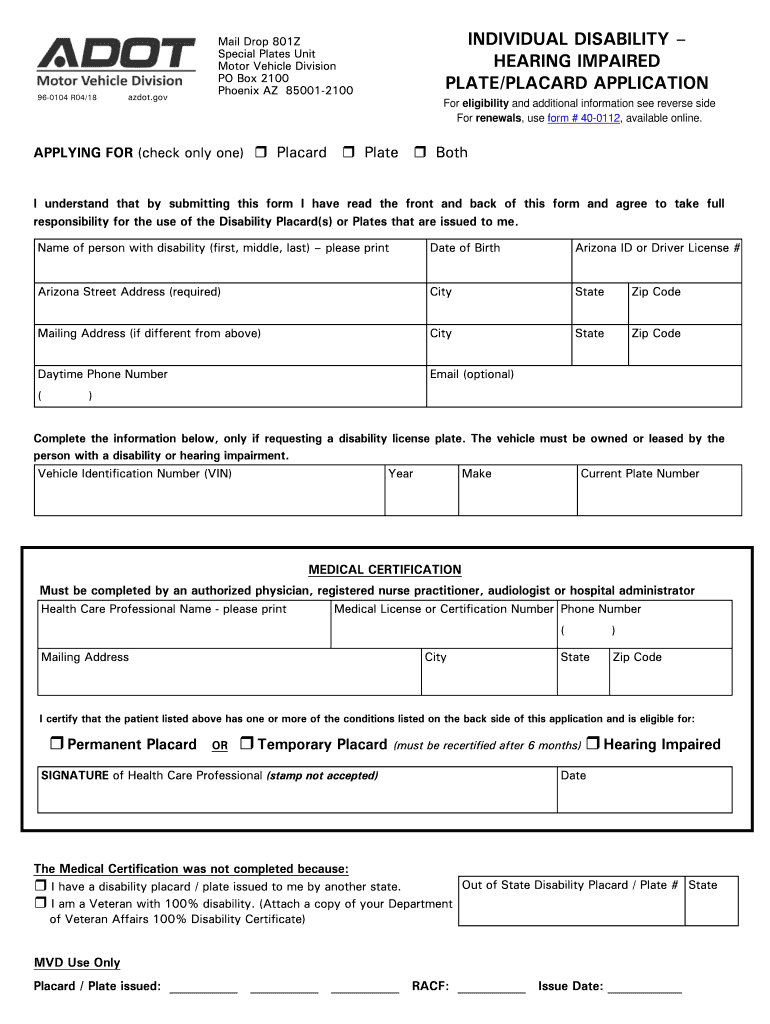
As previously highlighted, the medical certification is paramount. After completing your portion, take the form to your licensed medical professional. They must meticulously fill out their designated section, providing details about your specific disability, how it impacts your mobility, and the duration for which the placard is required (especially crucial for temporary placards). The doctor’s signature, date, and professional license number are non-negotiable requirements. Without a properly completed medical certification, your application will be rejected. It’s advisable to make an appointment specifically for this purpose to ensure your doctor has adequate time to complete the form accurately.
Submission Options
Once both sections of Form 96-0104 are complete, you have a few options for submission:
- In-person: For immediate processing and to receive your placard on the same day (for permanent placards), visit an MVD office. Bring your completed form, a valid Arizona driver’s license or ID card, and any other required documentation. This option is highly recommended for temporary placards as well, to ensure quick receipt.
- By Mail: You can mail the completed application to the ADOT MVD Disability Unit. The mailing address is provided on the application form itself. While convenient, this method will involve a waiting period for processing and mail delivery.
- Fax: Some MVD offices or the Disability Unit may accept faxed applications. Confirm this option directly with the MVD before faxing, as physical signatures are often required for verification.
Fees and Documentation
Generally, initial disability placards issued by the Arizona MVD are free of charge. However, fees may apply for replacement placards due to loss, theft, or damage. When submitting your application, always bring your valid Arizona driver’s license or state identification card as proof of identity. For disabled veteran plates, additional documentation proving veteran status and disability (such as a letter from the Department of Veterans Affairs) will be necessary. Carefully review the application form for a complete list of any other potentially required documents.
Types of Placards and Responsible Usage for Arizona Travel
Understanding the different types of handicap placards available in Arizona and how to use them properly is crucial for maintaining your parking privileges and ensuring a smooth travel experience. Misuse can lead to significant penalties, undermining the very convenience the placard is designed to provide.
Permanent vs. Temporary Placards
Arizona offers two primary types of disability placards, each catering to different mobility needs:
- Permanent Placards: These are issued to individuals with long-term or permanent disabilities that significantly impair their mobility. A permanent placard is typically valid for five years and is renewable without requiring a new medical certification, unless there are changes to the individual’s condition or identification. This type is ideal for Arizona residents or frequent visitors who require continuous accessible parking.
- Temporary Placards: Designed for individuals with short-term mobility impairments, these placards are valid for a period specified by the certifying medical professional, up to a maximum of six months. If the condition persists beyond this period, a new application with a fresh medical certification is required for a six-month extension. Temporary placards are particularly useful for visitors to Arizona who have a temporary injury or medical condition impacting their mobility during their stay.
Disabled Veteran Plates
In addition to placards, Arizona also provides special disabled veteran license plates for eligible service members. These plates grant the same accessible parking privileges as a placard, eliminating the need to display a separate hangtag. Veterans applying for these plates must provide specific documentation from the Department of Veterans Affairs verifying their disability rating and service connection. This option offers a convenient and dignified solution for those who have served our country and face mobility challenges.
Proper Display and Usage
Correct display and responsible usage are paramount to avoid fines and legal complications while using your handicap placard in Arizona.
- Display: The placard must be clearly displayed from the rearview mirror of the vehicle when parked in an accessible space. It should be easily visible from the front and rear of the vehicle. When the vehicle is in motion, the placard must be removed from the rearview mirror to prevent obstruction of the driver’s view.
- Usage: The placard is issued to the individual, not the vehicle. This means the disabled person must be present in the vehicle (either as the driver or a passenger) for the placard to be legally used. It is strictly prohibited for someone without the qualifying disability to use the placard, even if they are running an errand for the placard holder who is not present. Misuse can result in significant fines, confiscation of the placard, and even criminal charges, potentially impacting future travel and privileges. Arizona law is very clear on this, and enforcement is strict to protect the integrity of accessible parking.
- Reciprocity: For out-of-state travelers, Arizona generally honors valid disability placards issued by other U.S. states and often from other countries. This broad reciprocity simplifies travel for individuals with disabilities visiting Arizona, allowing them to enjoy attractions from the Hoover Dam to the Sonoran Desert with confidence. However, it’s always prudent to review local city or county ordinances for any specific rules that might apply.
Ensuring Continued Accessibility: Renewals and Replacements
Maintaining your handicap placard’s validity is essential for uninterrupted accessible travel throughout Arizona. Understanding the renewal process and how to handle lost or damaged placards will help you avoid unnecessary complications.
Renewal Process
The renewal process varies depending on the type of placard you possess:
- Permanent Placards: For permanent placards, the Arizona MVD typically sends a renewal notice approximately 90 days before expiration. These placards usually have a five-year validity period. In most cases, renewal can be completed online or by mail without the need for a new medical certification, provided there have been no changes to your medical condition or identification. This streamlined process ensures that individuals with permanent disabilities continue to have access to accessible parking without repetitive bureaucratic hurdles.
- Temporary Placards: Temporary placards are issued for a maximum of six months. If your temporary condition persists beyond this period and you still require accessible parking, you must apply for an extension. This process is essentially a new application, requiring a fresh medical certification from a licensed professional, confirming the continued need for the placard. It is crucial to reapply well before your current temporary placard expires to prevent any lapse in your parking privileges.
Lost, Stolen, or Damaged Placards
Life happens, and placards can be lost, stolen, or damaged. If this occurs, it’s important to act promptly to obtain a replacement:
- Reporting: If your placard is stolen, it is advisable to report the theft to local law enforcement. While not always mandatory for replacement, a police report can be useful for your records and for preventing potential misuse by others.
- Replacement Application: To obtain a replacement, you will generally need to complete a “Replacement Disability Placard/Plate Application” form. This form is often available online through the ADOT MVD website or at any MVD office.
- Fees: There is typically a nominal fee for replacement placards. This fee helps cover administrative costs and deter fraudulent replacement requests.
- Submission: Replacement applications can usually be submitted online, by mail, or in person at an MVD office. Submitting in person can often expedite receiving your replacement.

Importance of Compliance
Adhering to all regulations regarding your handicap placard is not just a legal obligation; it’s a commitment to ensuring accessible parking remains available for those who genuinely need it. Misuse, such as lending your placard to an unauthorized individual or failing to remove it while driving, can lead to substantial fines, confiscation of the placard, and in some cases, even legal prosecution. By correctly renewing, replacing, and using your placard, you contribute to a system that promotes equity and convenience for individuals with disabilities, allowing everyone to fully enjoy the diverse attractions and daily life that Arizona offers. Compliance ensures that your travels, whether to the saguaro forests near Tucson or the urban cultural hubs of Phoenix, remain stress-free and truly accessible.
LifeOutOfTheBox is a participant in the Amazon Services LLC Associates Program, an affiliate advertising program designed to provide a means for sites to earn advertising fees by advertising and linking to Amazon.com. Amazon, the Amazon logo, AmazonSupply, and the AmazonSupply logo are trademarks of Amazon.com, Inc. or its affiliates. As an Amazon Associate we earn affiliate commissions from qualifying purchases.