
Boston, Massachusetts, stands as one of the United States’ most historic and vibrant cities, yet it also carries a reputation for being one of the most expensive places to live, particularly when it comes to housing. For anyone contemplating a move to this New England hub, understanding the rental market is not just important; it’s essential for financial stability and successful integration. Deciphering how much to budget for rent in Boston involves a multifaceted analysis of neighborhood specifics, property types, economic factors, and individual financial strategies. This guide aims to provide a comprehensive breakdown, offering insights into the true cost of securing a place to live in the city.
Navigating Boston’s High-Demand Rental Landscape
The rental market in Boston is characterized by high demand and limited supply, a combination that inevitably drives up prices. Several foundational elements contribute to this dynamic, making it crucial for prospective renters to understand the underlying forces at play.
Why Boston Rent is Premium
At its core, Boston’s premium rental prices are a direct result of a bustling economy and a concentrated urban environment. The city is a global leader in education, healthcare, biotechnology, and finance, attracting a highly educated workforce. Major institutions like Harvard University, Massachusetts Institute of Technology (MIT), Boston University, Northeastern University, Suffolk University, and Tufts University draw hundreds of thousands of students and faculty annually, all requiring housing. This constant influx of residents, coupled with the city’s geographical constraints (being largely surrounded by water and adjacent towns), means that available housing simply cannot keep pace with demand. The result is a competitive market where properties are quickly snapped up, often at prices that surprise newcomers. Historic preservation efforts also limit new construction in many desirable areas, further constricting supply.
Key Factors Influencing Rental Costs
While the overall market is expensive, individual rental costs are influenced by several specific factors:
- Location: This is paramount. Rent in a prime, transit-accessible neighborhood like Back Bay or Beacon Hill will be significantly higher than in a more distant or developing area.
- Property Type and Size: A studio apartment will naturally cost less than a multi-bedroom unit. Modern, luxury apartments with amenities command higher prices than older, traditional brownstones or walk-ups.
- Amenities: Features such as in-unit laundry, central air conditioning, a gym, parking, or concierge services can add hundreds, if not thousands, to monthly rent.
- Time of Year: The rental market in Boston experiences seasonal fluctuations. Peak season, typically from August through September, coincides with the start of the academic year, leading to increased competition and higher prices. Renters searching during the colder months (November to March) might find slightly better deals or more negotiation room.
Average Rental Costs Across Boston Neighborhoods
To provide a concrete understanding of rent expectations, it’s helpful to break down average costs by neighborhood and unit size. It’s important to remember these are averages, and specific prices can vary widely based on property condition, amenities, and exact location within a neighborhood.
Downtown & Core Urban Areas
These neighborhoods represent the pinnacle of Boston’s rental market, offering unparalleled access to cultural attractions, dining, and employment centers.
- Back Bay / Beacon Hill / South End: These are some of the most prestigious and expensive areas. A studio here can range from $2,500 to $3,500+, a 1-bedroom from $3,000 to $4,500+, and 2-bedrooms upwards of $4,500 to $6,500+. The architecture is often historic, with elegant brownstones and tree-lined streets near the Boston Common and Public Garden.
- Seaport District: A newer, rapidly developing area known for its modern luxury high-rises and waterfront views. Rents here are comparable to, or even exceed, those in Back Bay. Studios can start at $2,800, 1-bedrooms at $3,500-$5,000+, and 2-bedrooms at $5,500-$7,500+.
Popular Student & Young Professional Hubs
These areas blend vibrant social scenes with relatively good public transit access, making them popular among students and recent graduates.
- Fenway-Kenmore: Home to Fenway Park and close to several universities, this area is lively. Studios range from $2,000 to $2,800, 1-bedrooms from $2,500 to $3,500, and 2-bedrooms from $3,500 to $4,500+.
- Allston-Brighton: Known for its diverse community and more affordable options compared to central Boston, particularly for shared housing. Studios are typically $1,800-$2,500, 1-bedrooms $2,200-$3,000, and 2-bedrooms $2,800-$4,000. Larger multi-bedroom units are common and often shared by students.
- Cambridge / Somerville: These independent cities across the Charles River are often considered part of the broader Boston metropolitan area. Cambridge, home to Harvard and MIT, is very competitive. Studios can be $2,300-$3,000+, 1-bedrooms $2,800-$4,000+, and 2-bedrooms $4,000-$6,000+. Somerville offers slightly more varied pricing, with studios from $2,000-$2,800, 1-bedrooms $2,500-$3,500, and 2-bedrooms $3,500-$5,000.
More Affordable Options and Commuter-Friendly Locales
For those seeking to stretch their budget, looking slightly further afield within Boston or into adjacent towns can yield more favorable prices, often requiring a commute.
- Dorchester: Boston’s largest neighborhood, offering a wide range of housing from triple-deckers to new developments. Rent here can be more accessible, with studios from $1,600-$2,200, 1-bedrooms $2,000-$2,800, and 2-bedrooms $2,500-$3,500.
- Jamaica Plain: Known for its green spaces and diverse community, it offers a blend of affordability and urban convenience. Studios might range from $1,800-$2,500, 1-bedrooms $2,200-$3,200, and 2-bedrooms $3,000-$4,000.
- East Boston: With growing popularity due to new developments and easy access to downtown via the MBTA Blue Line and proximity to Logan International Airport, rents are rising but still offer relative value. Studios from $1,800-$2,500, 1-bedrooms $2,200-$3,000, and 2-bedrooms $2,800-$3,800.
- Quincy: A suburban city just south of Boston, offering significantly lower rents, especially for larger units, with excellent MBTA Red Line access. 1-bedrooms can be found from $1,800-$2,500, and 2-bedrooms from $2,200-$3,200.
Beyond the Sticker Price: Additional Rental Expenses
The monthly rent payment is often just one component of the total cost of living in a rental unit. Prospective tenants must also factor in other essential expenses.
Utilities and Services
Most rental agreements in Boston will require tenants to pay for some or all utilities.
- Heat and Hot Water: Especially important in New England’s cold winters. Some landlords include these, but many do not. Gas heat can be cheaper than electric.
- Electricity: For lights, appliances, and often air conditioning (if available).
- Internet and Cable: Essential for most modern households. High-speed internet typically costs $50-$80 per month.

Combined, utilities can add anywhere from $150 to $400+ to your monthly budget, depending on usage, apartment size, and building efficiency.
Broker Fees and Security Deposits
Upfront costs in Boston can be substantial.
- Broker Fees: Many apartments, particularly in competitive areas, are rented through real estate brokers who charge a fee, often equivalent to one month’s rent. This is a one-time, non-refundable cost due at lease signing.
- Security Deposits: Landlords typically require a security deposit, usually equal to one month’s rent, to cover potential damages.
- First and Last Month’s Rent: It is common practice for landlords to ask for the first month’s rent and the last month’s rent upfront.
This means that when signing a lease, you might need to pay 3-4 months’ worth of rent (first, last, security deposit, and broker fee) all at once. For a $3,000/month apartment, this could easily amount to $9,000 to $12,000.
Commuting Costs
Depending on your chosen neighborhood and workplace, transportation costs can significantly impact your overall budget. Boston’s public transit system, the MBTA (colloquially known as “the T”), is extensive but not free. A monthly pass for subway and bus can cost around $90-$100. If you drive, parking in Boston is notoriously expensive and scarce, with monthly garage spots often costing $200-$400+.
Crafting Your Boston Rental Budget
With Boston’s high costs, meticulous financial planning is crucial. Understanding the traditional budgeting rules and adapting them to the local reality is key.
The 30% Rule: A Starting Point
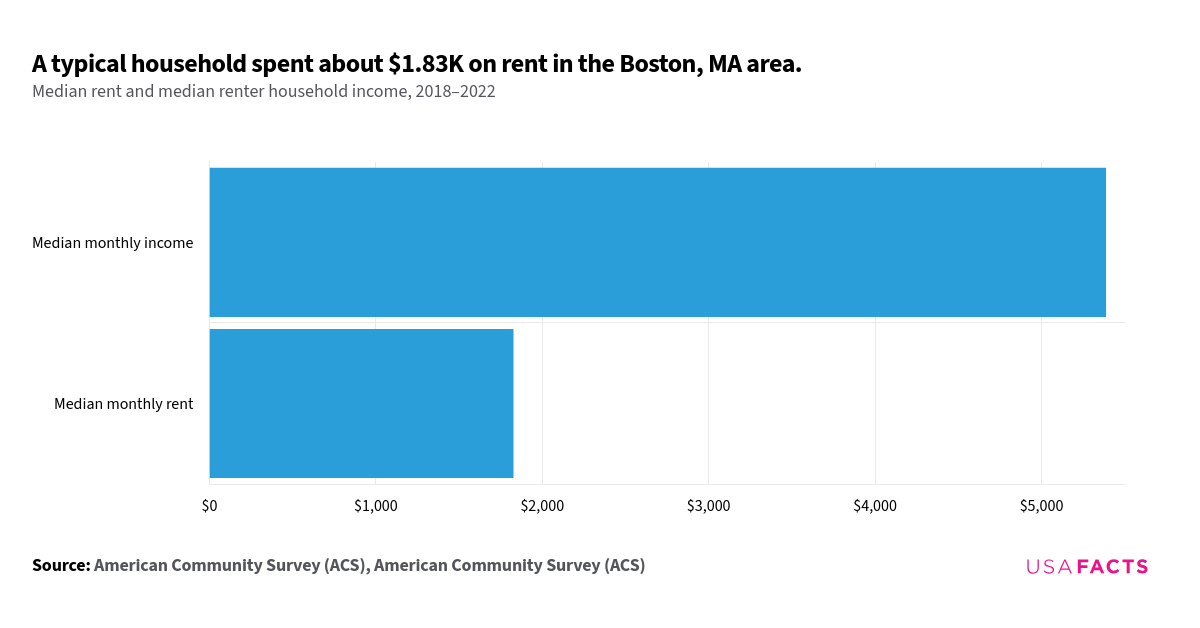
The common financial guideline suggests that housing costs (including rent and utilities) should not exceed 30% of your gross monthly income. In Boston, this rule often proves challenging to adhere to, especially for individuals or those with moderate incomes. For example, to afford a $3,000/month apartment within the 30% rule, you would need a gross annual income of at least $120,000. While a good aspirational target, many residents find themselves spending closer to 35-40% or even more on rent, particularly when living alone in a desirable area. This necessitates making trade-offs in other spending categories.
Income vs. Rent: Practical Considerations
Landlords and rental agencies typically require your gross monthly income to be at least 3 times the monthly rent. Some may require even higher ratios, especially for luxury units. This is a crucial hurdle for many, and it often dictates the need for roommates or exploring more distant neighborhoods. Being transparent about your financial situation and having a strong credit score and reliable references can sometimes offer a slight advantage.
Roommates: A Common Strategy
Sharing an apartment is arguably the most common and effective strategy for making Boston rent affordable. Splitting a 2-bedroom or 3-bedroom unit significantly reduces individual housing costs, making otherwise unattainable neighborhoods accessible. For instance, a $4,000 2-bedroom in Cambridge becomes $2,000 per person, which is a much more manageable figure for many professionals and students. Beyond the financial benefits, roommates can also provide a built-in social network in a new city.
Smart Strategies for Securing Your Boston Rental
Finding the right rental in Boston requires more than just money; it demands strategy and preparedness.
Timing Your Search
As mentioned, the market is highly seasonal. The peak season for rentals is May through September, with a frenzy leading up to September 1st (a common lease start date for students). If your move-in date is flexible, consider searching and signing a lease during the off-peak months (November to March). There might be fewer options, but less competition often translates to slightly lower prices or more leverage for negotiation.
Leveraging Rental Resources
- Online Platforms: Websites like Zillow, Apartments.com, PadMapper, and Facebook Marketplace are primary resources. Be vigilant for scams and always verify listings.
- Real Estate Agents/Brokers: While they charge a fee, an experienced local broker can be invaluable. They have access to exclusive listings, understand neighborhood nuances, and can navigate the competitive market on your behalf, potentially saving you time and stress.
- Direct Landlord Contact: Some smaller landlords list directly, avoiding broker fees. These can be harder to find but are often advertised on local community boards or niche websites.

Being Prepared and Proactive
When you find a desirable apartment, you need to act fast. Landlords expect applicants to be ready with:
- Proof of Income: Pay stubs, offer letters, or bank statements.
- Credit Report and Score: A good credit score (typically 650+) is crucial.
- References: Previous landlords and employer references.
- Identification: Government-issued ID.
- Funds for Deposit/Fees: Be prepared to submit initial payments quickly to secure the unit.
Living in Boston is an enriching experience, offering a unique blend of history, culture, and innovation. While the rental costs can be daunting, a clear understanding of the market, careful budgeting, and strategic planning can make finding your ideal Boston home a reality.
LifeOutOfTheBox is a participant in the Amazon Services LLC Associates Program, an affiliate advertising program designed to provide a means for sites to earn advertising fees by advertising and linking to Amazon.com. Amazon, the Amazon logo, AmazonSupply, and the AmazonSupply logo are trademarks of Amazon.com, Inc. or its affiliates. As an Amazon Associate we earn affiliate commissions from qualifying purchases.