
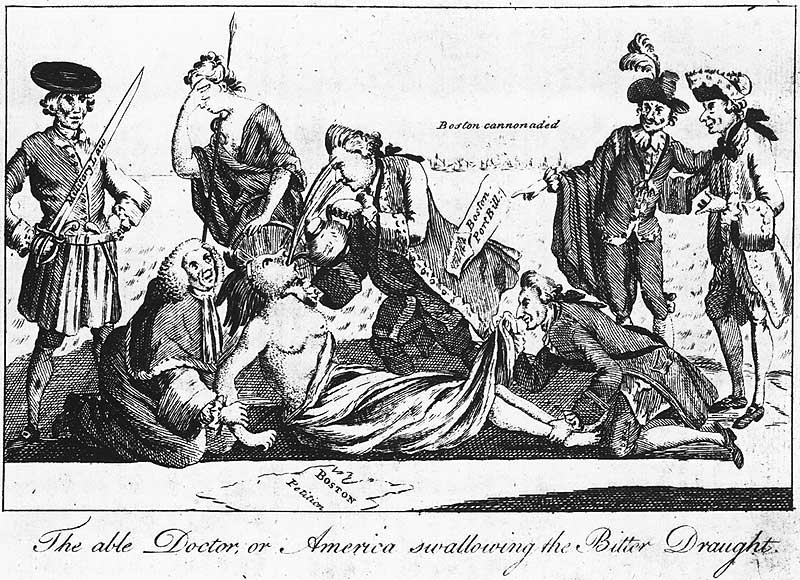
The Boston Port Act, enacted by the British Parliament in March 1774, stands as a pivotal moment in the historical trajectory of Boston and, by extension, the American colonies. Far more than a mere piece of legislation, it was a punitive measure designed to assert imperial authority and crush dissent in the vibrant port city that had become a hotbed of revolutionary sentiment. To understand its profound impact on Boston as a landmark of colonial resistance, one must first grasp the tumultuous context from which it emerged and the domino effect it triggered across North America. This act, one of the five coercive measures collectively known as the Intolerable Acts, not only crippled Boston’s economy but also inadvertently galvanized colonial unity, setting the stage for the American Revolutionary War.
The Spark of Revolution: Context of the Boston Port Act
The year 1773 was a tense one for the relationship between Great Britain and its American colonies. Years of contentious taxation policies, such as the Stamp Act and the Townshend Acts, had fueled a growing sense of injustice and infringement on colonial rights. Boston, with its bustling port and a deeply politicized populace, was often at the forefront of this resistance, embodying a spirit of self-governance that increasingly clashed with British imperial ambitions. The city’s inhabitants saw themselves as free Englishmen, entitled to representation for any taxation, a principle that Parliament largely disregarded.
Rising Tensions with Great Britain
The British desire to raise revenue from the colonies after the costly French and Indian War, coupled with a belief in parliamentary supremacy, led to a series of legislative actions perceived as oppressive by the colonists. Acts like the Sugar Act, Stamp Act, and Townshend Acts provoked widespread boycotts, protests, and intellectual arguments against “taxation without representation.” Boston, a vital maritime trade hub and intellectual center, became a crucible of this discontent. Its citizens, including prominent figures like Samuel Adams and John Hancock, openly challenged British authority, leading to skirmishes like the Boston Massacre in 1770, which further inflamed anti-British sentiment. The city, therefore, was already a symbol of defiance long before the port act was conceived.
The Boston Tea Party as a Catalyst
The immediate impetus for the Boston Port Act was the infamous Boston Tea Party. On December 16, 1773, in response to the Tea Act, which granted the East India Company a monopoly on tea sales in the colonies and imposed a duty, a group of Sons of Liberty disguised as Mohawk Indians boarded three British ships anchored in Boston Harbor. They systematically dumped 342 chests of tea, valued at approximately £10,000 (a colossal sum at the time), into the frigid waters. This audacious act of defiance, orchestrated by radical elements in Boston, was seen by King George III and Parliament not merely as property destruction but as an outright challenge to British sovereignty. The response from London was swift, severe, and designed to make an example of Boston.
The Draconian Measures: Provisions of the Act
The Boston Port Act was the first of what the colonists would call the Intolerable Acts, passed in retaliation for the Boston Tea Party. Its provisions were explicitly punitive, targeting the very economic lifeline of Boston and, by extension, attempting to break the spirit of its inhabitants.
Closure of Boston Harbor
The central provision of the Boston Port Act was the complete closure of Boston Harbor to all incoming and outgoing trade. Effective June 1, 1774, no ship was allowed to load or unload goods in Boston until the colonists paid for the destroyed tea and reimbursed the Crown for customs duties lost. The only exceptions were vessels carrying food or fuel, and even these required special permits and military escorts. This blockade effectively throttled the city’s economy, which was almost entirely dependent on maritime commerce. The act explicitly stated that the port would remain closed indefinitely, “until such time as the value of the tea destroyed, and the duties due to His Majesty thereon, shall be fully paid and satisfied.” This was a declaration of economic war on Boston, a city that flourished precisely because of its access to the sea.
Economic Devastation for the City

The consequences for Boston were immediate and catastrophic. Thousands of livelihoods depended on the bustling activity of the port: merchants, sailors, dockworkers, shipbuilders, draymen, and countless others. With the harbor shut down, businesses shuttered, unemployment skyrocketed, and the city faced widespread poverty and famine. Food prices soared as supplies became scarce and had to be brought in by land, greatly increasing costs. The British authorities moved the seat of government for Massachusetts to Salem to further isolate Boston and diminish its importance. This deliberate economic strangulation was intended to force the people of Boston into submission, compelling them to surrender the individuals responsible for the Boston Tea Party and renounce their defiant political stance. However, the exact opposite effect would eventually be achieved.
A Landmark Under Siege: Boston’s Reaction and Wider Colonial Response
Rather than breaking Boston’s spirit, the Boston Port Act and the subsequent Intolerable Acts solidified its resolve and, crucially, elicited an outpouring of sympathy and support from the other colonies. The act transformed Boston from a rebellious city into a symbol of colonial suffering and British tyranny, further cementing its status as a historical landmark of revolutionary fervor.
Local Resistance and Resilience
Despite the immense hardship, the citizens of Boston largely refused to back down. They found innovative ways to circumvent the blockade, moving goods through alternative ports and relying on overland routes. More importantly, they established committees of correspondence to communicate their plight to other colonies and organize resistance. While many suffered, the shared adversity fostered a stronger sense of community and determination to resist British overreach. The British expectation that loyalists within Boston would rise up against the radicals to restore order proved to be a miscalculation; the hardship galvanized patriotic sentiment across all strata of society.
Uniting the Colonies: The Intolerable Acts
The Boston Port Act was merely the first in a series of punitive measures aimed at Massachusetts. These included the Massachusetts Government Act, which stripped the colony of its self-governance; the Administration of Justice Act, which allowed British officials to be tried in Great Britain rather than in the colonies; and an expanded Quartering Act, forcing colonists to house British soldiers. A fifth act, the Quebec Act, also inflamed colonial anger, though it wasn’t directly aimed at Massachusetts.
These “coercive acts,” as the British called them, were seen by the American colonies as an attack on their collective liberties. The realization dawned that if Parliament could impose such draconian measures on Massachusetts, no colony was safe. This shared fear and indignation spurred unprecedented intercolonial cooperation. From New York to South Carolina, communities sent aid and provisions to beleaguered Boston, demonstrating a nascent sense of American unity. This wave of solidarity culminated in the convening of the First Continental Congress in Philadelphia in September 1774, where representatives from twelve colonies gathered to formulate a unified response to the British actions.
Legacy and Lasting Impact on a Historical Landmark
The historical legacy of the Boston Port Act is undeniable, fundamentally altering the relationship between Great Britain and its American colonies and forever etching Boston’s role into the annals of American history. It ceased to be merely a busy port city and became an enduring symbol of resistance against tyranny, a landmark of foundational American ideals.
Paving the Way for Independence
Far from quelling dissent, the Boston Port Act proved to be a critical miscalculation by the British government. It served as a clear demonstration of British resolve to maintain absolute control, leaving the colonists with little doubt about the potential loss of their freedoms. The closure of Boston Harbor and the ensuing economic hardship, coupled with the other Intolerable Acts, pushed moderate colonists towards radical positions. The crisis in Boston accelerated the movement towards open rebellion. The First Continental Congress, directly spurred by these acts, established a unified front against British policies, laying the groundwork for the future Second Continental Congress which would declare independence. The act thus unintentionally became a crucial stepping stone towards the American Declaration of Independence in 1776 and the subsequent birth of the United States.

Boston’s Enduring Spirit as a Landmark of Freedom
Today, Boston remains a city rich with historical landmarks that tell the story of the revolutionary period. The Freedom Trail guides visitors through sites directly impacted by or associated with the events leading up to the Revolutionary War, including the historic Boston Harbor. The Boston Port Act, though a punitive measure, inadvertently elevated Boston’s status from a regional port to a national emblem of the struggle for liberty. It is a powerful reminder of how adversity can forge unity and how a single legislative act, intended to subjugate, can instead ignite the flames of revolution. The resilience and defiance shown by the people of Boston in the face of economic ruin, and the widespread colonial support they received, underscore the profound significance of this act not just for Boston, but for the very foundation of the American nation.
LifeOutOfTheBox is a participant in the Amazon Services LLC Associates Program, an affiliate advertising program designed to provide a means for sites to earn advertising fees by advertising and linking to Amazon.com. Amazon, the Amazon logo, AmazonSupply, and the AmazonSupply logo are trademarks of Amazon.com, Inc. or its affiliates. As an Amazon Associate we earn affiliate commissions from qualifying purchases.