
The story of how the United States acquired California is a multifaceted narrative woven with exploration, colonial ambition, geopolitical shifts, and a dash of opportunism. Far from a simple transaction, it involved centuries of contested claims, military conflict, and the dramatic influence of a monumental discovery. Understanding this historical arc is crucial to appreciating the unique cultural and political landscape of modern California.
Early Claims and European Exploration
Long before it became a battleground for American expansion, California was a land inhabited by diverse indigenous peoples, each with rich cultures and distinct territories. European contact began in 1542 when Portuguese explorer Juan Rodríguez Cabrillo, sailing under the Spanish flag, mapped portions of the coast. He named the region “Alta California” and claimed it for Spain, though immediate colonization efforts were minimal due to the perceived lack of resources and difficult terrain.

For over a century, California remained largely unexplored by Europeans, viewed primarily as a distant, wild frontier. However, renewed interest emerged in the late 18th century, driven by two primary concerns: the burgeoning presence of Russian fur traders pushing south from Alaska, and the perceived threat of British encroachment. To solidify its claim and prevent foreign powers from establishing a foothold, Spain launched a concerted effort to colonize Alta California.
Spanish Colonial Rule
Beginning in 1769, Spain’s strategy for colonizing Alta California was spearheaded by Franciscan missionary Junípero Serra and military commander Gaspar de Portolá. Their efforts established a chain of 21 missions stretching from San Diego to Sonoma. These missions, along with military presidios (forts) and pueblos (civilian towns), formed the backbone of Spanish colonial society.
The mission system profoundly impacted the indigenous populations, often forcibly converting them to Catholicism and integrating them into a labor-intensive agricultural economy. While designed to civilize and Christianize, the system also led to the decline of native cultures and populations due to disease, forced labor, and loss of traditional lands. By the early 19th century, Spanish Alta California was a sparsely populated, agrarian outpost of the vast Spanish Empire, connected to the rest of New Spain (present-day Mexico) by a precarious land route and occasional sea voyages. Its economy was largely based on ranching, producing hides and tallow, which would later become valuable commodities in international trade.
Mexican Independence and the California Republic
The early 19th century brought radical change to New Spain. A protracted war for independence, fueled by Enlightenment ideals and Creole discontent, culminated in 1821 with the establishment of the First Mexican Empire. Alta California transitioned from Spanish to Mexican rule, becoming a distant and often neglected department of the new nation.
Under Mexican rule, the mission system gradually declined. In the 1830s, the Mexican government enacted secularization laws, dismantling the missions and distributing their lands to private citizens, primarily wealthy Californios (Mexican citizens of California descent). This created vast ranches, further solidifying a hierarchical society centered on cattle and land ownership. During this period, foreign trade increased, especially with American and British merchants who exchanged manufactured goods for hides and tallow. This opened California to external influences and foreshadowed future geopolitical struggles.
Rising Tensions and American Interest
As Mexico grappled with internal political instability and economic challenges, the United States underwent a period of rapid territorial expansion fueled by the ideology of Manifest Destiny—the belief that America was divinely ordained to expand westward across the North American continent. American traders and trappers began venturing into California, followed by a trickle of settlers, some of whom eventually established communities in the Sacramento Valley.
These American settlers, though few in number, increasingly viewed Mexican rule as inefficient and restrictive. Their growing presence, coupled with the strategic importance of California’s Pacific ports for potential trade with Asia, intensified American interest in acquiring the territory. President James K. Polk, a fervent proponent of Manifest Destiny, made no secret of his desire to purchase California from Mexico, though his diplomatic overtures were repeatedly rejected.
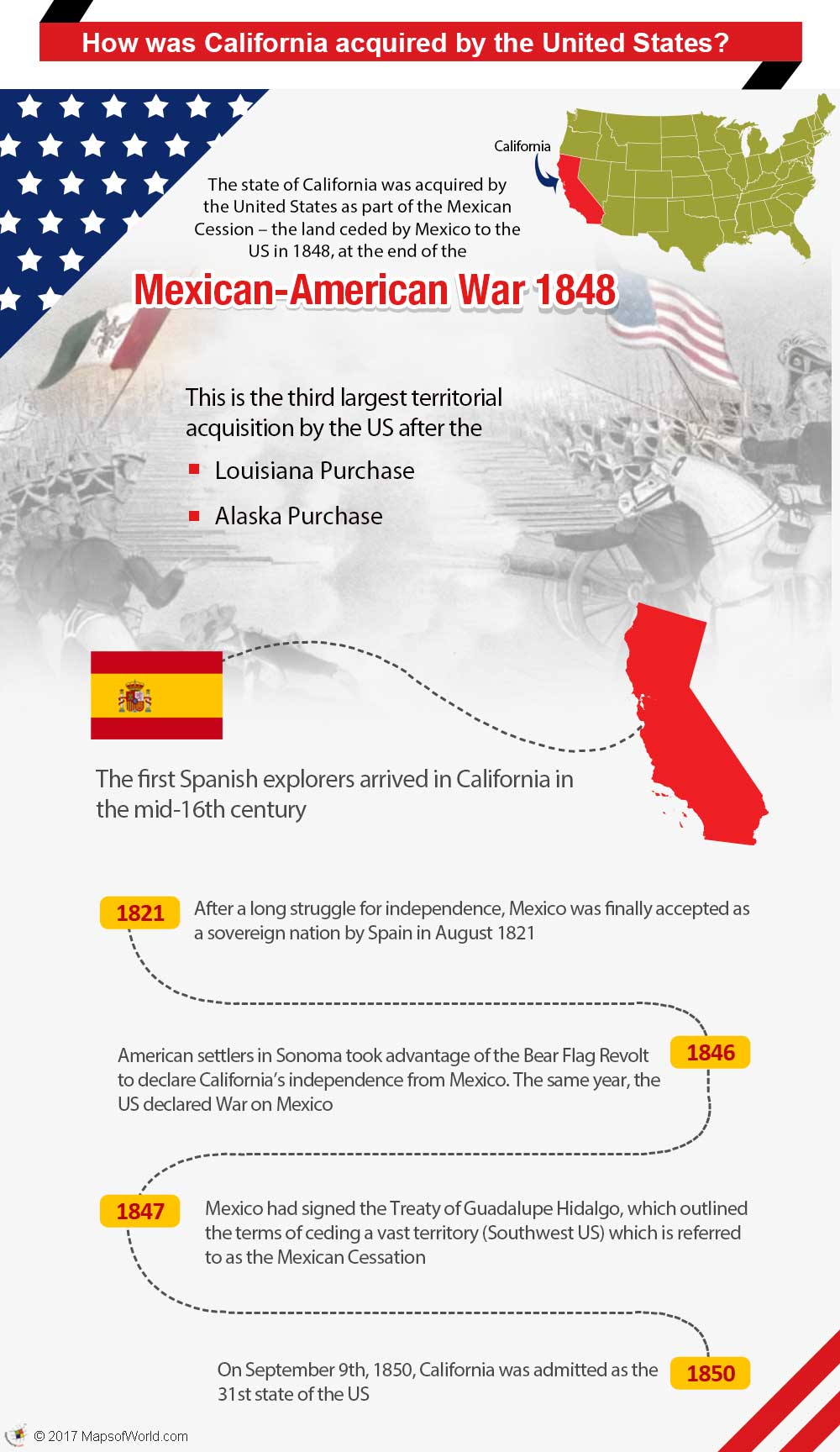
The situation became increasingly volatile. In June 1846, a small group of American settlers, encouraged by the presence of U.S. Army Captain John C. Frémont’s mapping expedition, revolted against Mexican authorities in Sonoma. They declared California an independent nation—the California Republic—and raised a crudely drawn flag featuring a bear and a star, thus earning the moniker “Bear Flag Revolt.” This brief, localized insurrection, while not officially sanctioned by the United States government at its outset, served as a convenient pretext for further American intervention.
The Mexican-American War and Treaty of Guadalupe Hidalgo
The “Bear Flag Revolt” coincided with the outbreak of the Mexican-American War. Tensions between the United States and Mexico had escalated over the disputed boundary of Texas and President Polk’s persistent attempts to acquire more Mexican territory. When Mexican troops crossed the Rio Grande in April 1846, clashing with American forces, Polk seized the opportunity to declare war.
While the primary theater of the war was in Mexico proper, a significant campaign was waged in California. Commodore John D. Sloat of the U.S. Navy landed at Monterey in July 1846, raising the American flag and formally claiming California for the United States. He was soon joined by Captain Frémont’s forces and later by General Stephen W. Kearny’s “Army of the West,” which marched overland from New Mexico.
Though Mexican resistance in California was fierce at times, particularly from the skilled Californio lancers, American military superiority ultimately prevailed. Key battles included the Battle of San Pasqual and the Battle of La Mesa. By January 1847, with the signing of the Treaty of Cahuenga, hostilities in California officially ceased, effectively placing the territory under American control.
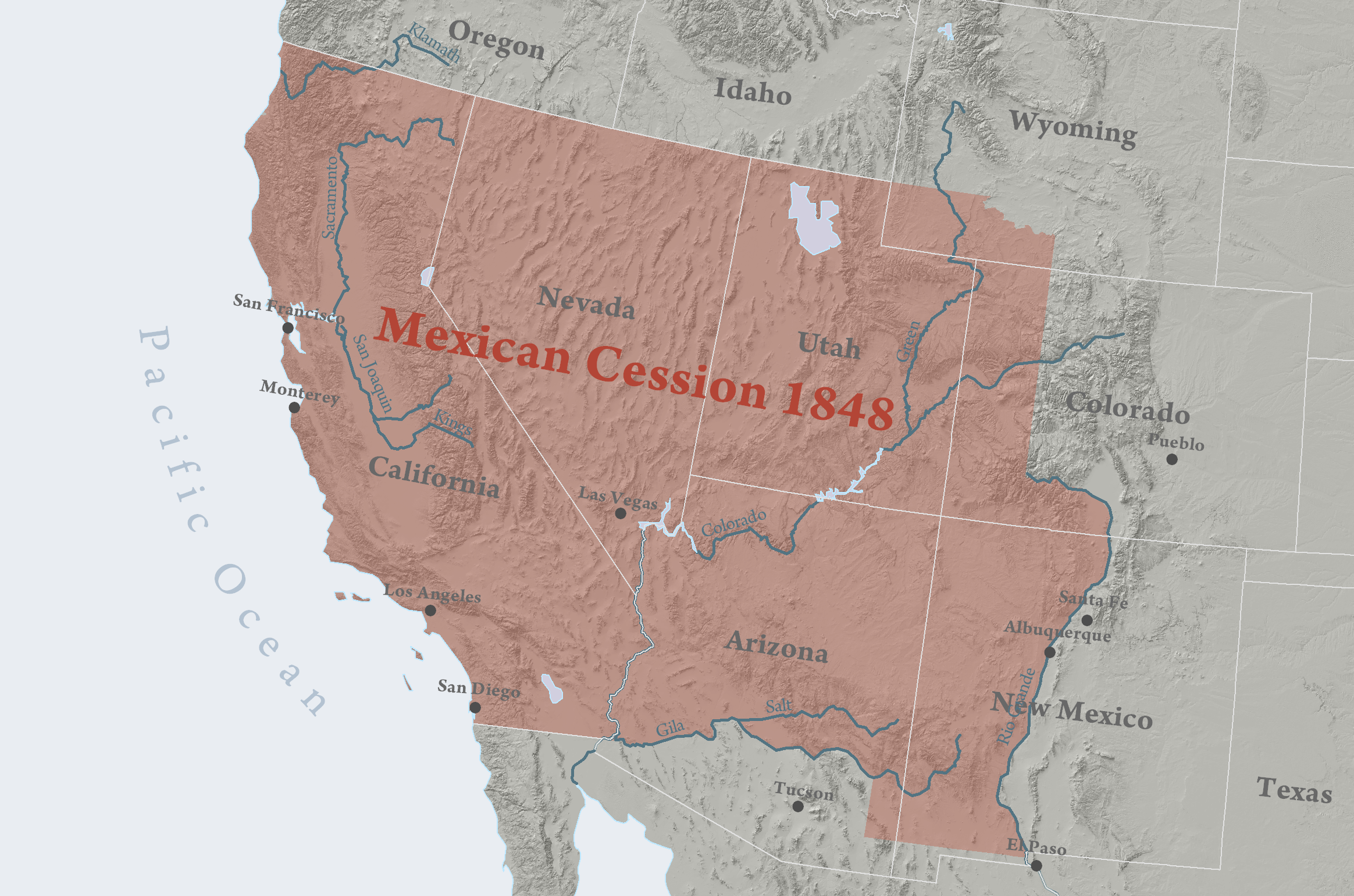
The broader Mexican-American War concluded with the signing of the Treaty of Guadalupe Hidalgo on February 2, 1848. This monumental treaty formally ended the conflict and drastically reshaped the North American map. Under its terms, Mexico ceded vast territories to the United States, including all of Alta California and New Mexico, encompassing parts of present-day Arizona, Nevada, Utah, and portions of Colorado and Wyoming. In return, the United States paid Mexico $15 million and assumed about $3.25 million in claims by American citizens against Mexico.
The Gold Rush and Statehood
Remarkably, just nine days before the Treaty of Guadalupe Hidalgo was signed, a discovery was made that would forever alter the trajectory of California and solidify its rapid integration into the United States. On January 24, 1848, James W. Marshall found flakes of gold at Sutter’s Mill near Coloma. News of the discovery spread slowly at first, but by late 1848, it had ignited the California Gold Rush.
The Gold Rush triggered an unprecedented influx of people from across the United States and around the world. Prospectors, merchants, and adventurers flocked to California by land and sea, transforming a sparsely populated frontier into a burgeoning territory. The population exploded, leading to rapid economic development, the growth of new towns like San Francisco, and an urgent need for established governance.
The sheer volume of new American residents, combined with the immense wealth being extracted, propelled California towards statehood at an accelerated pace. Despite fierce debates in the U.S. Congress over whether it would enter the Union as a free or slave state (a central issue of the era), California was admitted as a free state on September 9, 1850, as part of the Compromise of 1850. This rapid transition from Mexican territory to American state in less than three years underscored the profound impact of the Gold Rush and the fervent American drive for westward expansion.
Enduring Legacy and Modern California
The process by which the United States gained California is a cornerstone of American history, emblematic of the nation’s expansionist ambitions and the complex interplay of military might, economic opportunity, and demographic shifts. The legacy of this period continues to shape California today.
The Spanish and Mexican influences remain visible in California’s architecture, place names (Los Angeles, San Jose, San Francisco), legal systems, and vibrant cultural traditions. The missions, presidios, and adobes stand as tangible landmarks of an earlier era, offering glimpses into a past that predates American annexation. The rancho period bequeathed a tradition of large-scale agriculture and a strong connection to the land that persists, albeit in vastly different forms, in the state’s modern agricultural prowess.
Moreover, the Treaty of Guadalupe Hidalgo included provisions for protecting the property and civil rights of Mexicans who chose to remain in the newly acquired territories. While these protections were often challenged and undermined in practice, particularly regarding land titles, they underscore the complex human stories intertwined with territorial shifts.
The California Gold Rush cemented California’s reputation as a land of opportunity and innovation, a magnet for dreamers and entrepreneurs. This “boomtown” mentality, born of the gold fields, laid the foundation for the state’s future economic powerhouses, from agriculture to technology. The journey from indigenous lands to Spanish colony, Mexican department, and finally to a pivotal American state, illustrates a remarkable transformation, securing California’s place as a dynamic and influential region within the United States.
LifeOutOfTheBox is a participant in the Amazon Services LLC Associates Program, an affiliate advertising program designed to provide a means for sites to earn advertising fees by advertising and linking to Amazon.com. Amazon, the Amazon logo, AmazonSupply, and the AmazonSupply logo are trademarks of Amazon.com, Inc. or its affiliates. As an Amazon Associate we earn affiliate commissions from qualifying purchases.