
Navigating the legal landscape of employment agreements can be complex, particularly when considering restrictive covenants like non-compete clauses. For individuals and businesses operating within Texas, understanding the enforceability of these clauses is crucial. This article delves into the specific legal framework governing non-compete agreements in the Lone Star State, exploring the conditions under which they are considered valid and what employers and employees need to know.
The Texas Framework for Non-Compete Agreements
Texas law has a distinct approach to non-compete clauses, influenced by its strong historical emphasis on freedom of contract. However, this freedom is balanced by a public policy concern for the ability of individuals to earn a livelihood and for businesses to operate competitively. The Texas Covenants Not to Compete Act, codified in the Texas Business & Commerce Code, provides the primary statutory guidance.

Statutory Requirements for Enforceability
For a non-compete clause to be enforceable in Texas, it must satisfy several key requirements outlined in the statute. These conditions ensure that the restriction placed upon an employee is reasonable and necessary to protect the employer’s legitimate business interests.
Legitimate Business Interest
The fundamental premise for a non-compete clause in Texas is that it must be designed to protect a legitimate business interest of the employer. This is not a blanket right for employers to prevent former employees from working in their field. Courts have recognized several categories of legitimate business interests, including:
- Confidential Information: This encompasses trade secrets, proprietary formulas, customer lists developed with significant effort and expense, and other sensitive business information that provides a competitive advantage. The information must be truly confidential and not readily available to the public or competitors.
- Goodwill: Employers can protect the goodwill they have built with their customers. This is particularly relevant in industries where personal relationships and trust are paramount, such as professional services, sales, or customer-facing roles. The non-compete must be reasonably tailored to prevent the former employee from unfairly leveraging established customer relationships to their new employer’s benefit.
- Specific Training: In some cases, if an employer has invested substantial resources in providing specialized training to an employee, which creates a unique skill set that could be used to directly compete, this can be considered a legitimate business interest. However, this is a less common justification than confidential information or goodwill.
It is important to note that simply preventing ordinary competition or retaining employees is generally not considered a legitimate business interest. The employer must demonstrate a specific, tangible interest that warrants the restriction.
Reasonable Restrictions
Beyond identifying a legitimate business interest, the scope of the non-compete clause itself must be reasonable. Texas courts scrutinize three key aspects of reasonableness:
- Scope of Activity: The clause must specify the particular business activities the former employee is prohibited from engaging in. A clause that broadly prohibits an employee from working in “any capacity” within an entire industry is likely to be deemed unreasonable. Instead, it should relate to the specific duties and responsibilities the employee held and the competitive activities they could realistically undertake. For example, a non-compete for a software engineer at a tech company might restrict them from developing similar software for a direct competitor, but not necessarily from working on entirely different types of technology.
- Geographic Scope: The geographic area covered by the non-compete must also be reasonable. This typically means the area where the employer actually conducts business and where the former employee had significant client contact or access to confidential information. A nationwide or statewide restriction is often deemed unreasonable unless the employer’s business operations and client base are truly that extensive. For a local restaurant in Austin, a restriction covering the entire state would be highly unlikely to be enforced.
- Duration of Restriction: The time period for which the non-compete is effective must be limited. While there is no hard-and-fast rule, durations of six months to two years are more commonly upheld. Longer periods are subject to stricter scrutiny and may be found unreasonable unless justified by very specific circumstances.
Consideration
Like any contract, a non-compete agreement requires valid consideration to be binding. This means that something of value must be exchanged between the employer and the employee.
- Initial Employment: For new employees, the offer of employment itself typically serves as sufficient consideration for signing a non-compete agreement.
- Continued Employment: For existing employees asked to sign a non-compete, Texas law generally requires new consideration beyond continued at-will employment. This could include a promotion, a raise, a bonus, or other tangible benefits. Without such additional consideration, a non-compete signed by a current employee may be unenforceable.
Reformation of Unreasonable Clauses
A significant aspect of Texas law regarding non-competes is the concept of “reformation.” If a court finds a non-compete clause to be unreasonable in its scope, geography, or duration, it is not automatically invalidated. Instead, the court has the discretion to “reform” or modify the clause to make it reasonable and then enforce it as reformed. This means a court can rewrite the terms to fit within the bounds of what is considered legally permissible.
This power of reformation provides employers with a degree of protection, as an overly broad clause might not be thrown out entirely but rather adjusted to a enforceable scope. However, it also underscores the importance of drafting these clauses carefully to avoid unnecessary litigation.
Key Considerations for Employers
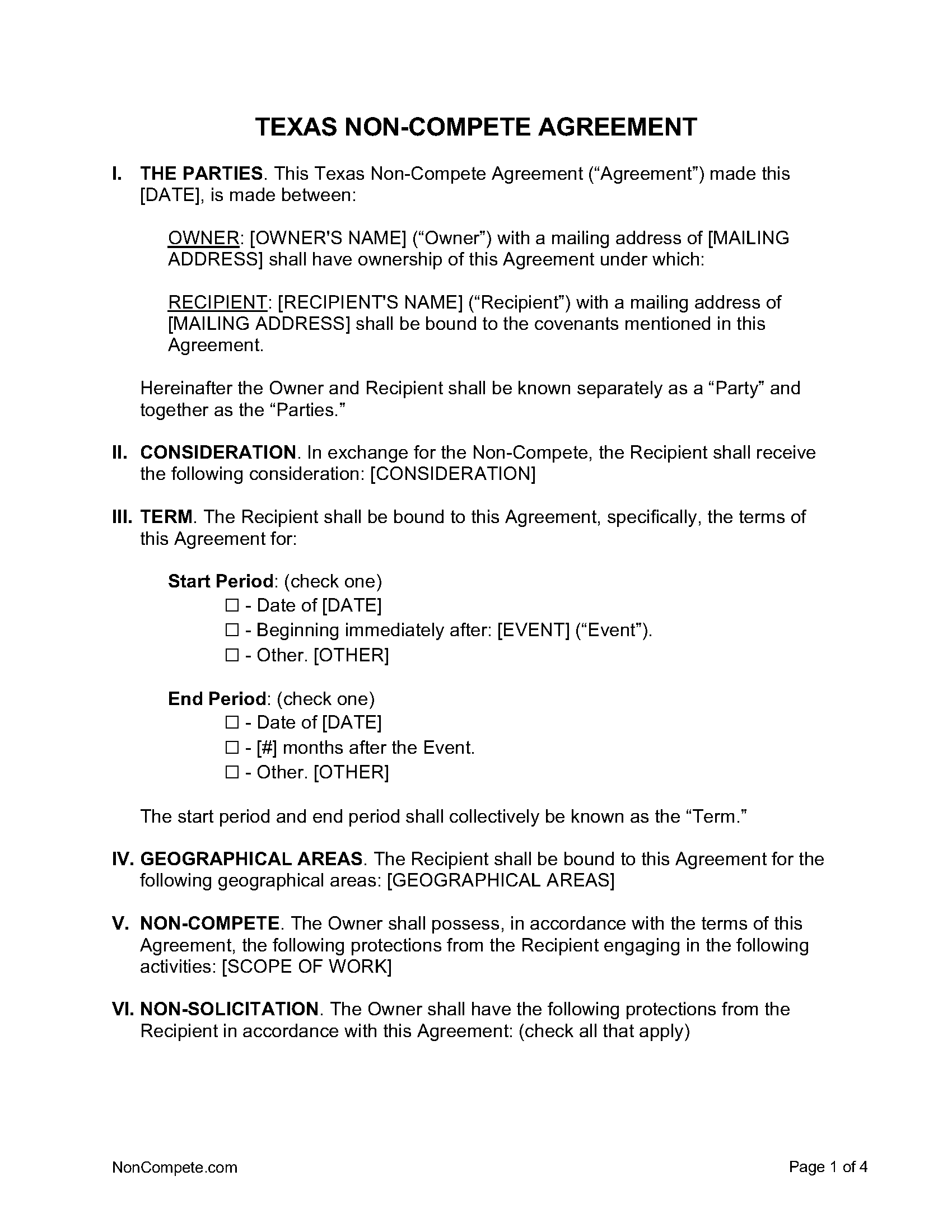
For businesses in Texas seeking to utilize non-compete clauses, careful drafting and strategic implementation are paramount.
Drafting Best Practices
- Specificity is Key: Clearly define the legitimate business interest being protected and the specific activities, geographic areas, and durations that are reasonably necessary to protect that interest. Avoid vague or overly broad language.
- Tailor to the Role: The restrictions should be tailored to the specific role and responsibilities of the employee. A non-compete for a senior executive with access to extensive confidential information will likely be different from one for a junior sales associate.
- Ensure Adequate Consideration: For existing employees, ensure that new and independent consideration is provided for signing a non-compete.
- Review and Update: Periodically review and update non-compete agreements to ensure they align with current business practices and legal interpretations.
Enforcement Strategies
- Documentation: Maintain thorough documentation of the legitimate business interest being protected, the employee’s role, and the rationale for the restrictions imposed.
- Consistent Application: Apply non-compete policies consistently across similar employee roles.
- Seek Legal Counsel: It is highly advisable for employers to consult with experienced employment law attorneys in Texas when drafting or seeking to enforce non-compete agreements. Attorneys can help ensure compliance with current laws and best practices.
Key Considerations for Employees
For individuals entering into employment agreements or considering a change in their career path in Texas, understanding non-compete clauses is equally important.
Before Signing
- Read Carefully: Thoroughly read and understand all terms of the employment agreement, paying close attention to any non-compete provisions.
- Seek Clarification: If any part of the non-compete clause is unclear, do not hesitate to ask the employer for clarification.
- Consult an Attorney: It is strongly recommended that employees consult with an employment attorney before signing an agreement containing a non-compete clause. An attorney can explain the implications of the clause, assess its potential enforceability, and advise on negotiation possibilities.
After Departure
- Review Your Agreement: If you have signed a non-compete, review it carefully to understand your obligations and the restrictions you face.
- Assess Enforceability: Evaluate whether the non-compete clause meets the legal requirements for enforceability in Texas. Factors like the employer’s legitimate business interest, the reasonableness of the restrictions, and the consideration provided are critical.
- Seek Legal Advice: If you are considering a new role that may violate a non-compete agreement, or if your former employer threatens legal action, consult with an employment attorney. They can help you understand your rights and options, and potentially negotiate a resolution or challenge the enforceability of the clause.
Common Scenarios and Challenges
The enforceability of non-compete clauses in Texas can become a point of contention in various employment scenarios.
High-Tech Industries
In rapidly evolving sectors like technology, non-compete clauses can be particularly contentious. Employers invest heavily in research and development, and the departure of key engineers or scientists can pose significant risks. However, courts are often cautious about overly broad restrictions that could stifle innovation or prevent individuals from utilizing their highly specialized skills. The definition of “confidential information” and the “scope of activity” become critical in these contexts. For example, a non-compete for a developer at a startup in Austin might be scrutinized differently than one for a long-tenured executive at an established manufacturing firm.
Sales and Client-Facing Roles
Employees in sales or client-facing positions often develop strong relationships with customers. Non-compete clauses in these roles are typically aimed at preventing the former employee from soliciting these clients for a new employer. The reasonableness of the geographic scope and the duration of the restriction are crucial here, as is the employer’s ability to demonstrate that the client relationships were built through the employer’s efforts and investment, rather than solely through the individual employee’s personal network.
Non-Compete Clauses in Divorce Settlements
It is worth noting that non-compete clauses can also appear in other contexts, such as in agreements related to business sales or, in rare instances, within divorce decrees. However, the legal standards and considerations for enforceability can differ significantly outside the employer-employee relationship.

Conclusion
In Texas, non-compete clauses are a viable tool for employers to protect legitimate business interests, but their enforceability is subject to strict legal scrutiny. The key lies in drafting clauses that are narrowly tailored, reasonable in scope, geographic reach, and duration, and supported by adequate consideration. Both employers and employees are well-advised to seek experienced legal counsel to navigate the complexities of these agreements, ensuring that their rights and obligations are understood and protected. The legal landscape is dynamic, and staying informed about current interpretations and statutes is essential for all parties involved in employment contracts in the Lone Star State.
LifeOutOfTheBox is a participant in the Amazon Services LLC Associates Program, an affiliate advertising program designed to provide a means for sites to earn advertising fees by advertising and linking to Amazon.com. Amazon, the Amazon logo, AmazonSupply, and the AmazonSupply logo are trademarks of Amazon.com, Inc. or its affiliates. As an Amazon Associate we earn affiliate commissions from qualifying purchases.