
A high-quality sleeping bag is perhaps the most critical component of your overnight outdoor gear. It’s not just about staying warm; it’s about ensuring restful sleep, which directly impacts your safety, endurance, and enjoyment of the trip. Whether you’re backpacking through mild summer trails, tackling shoulder-season alpine treks, or braving freezing winter conditions, having the right bag is non-negotiable.
Choosing a sleeping bag can be overwhelming, given the multitude of temperature ratings, fill materials, shapes, and weights available. This comprehensive guide breaks down the essential factors and highlights the best sleeping bags tailored for every season and adventure type, ensuring you wake up refreshed, regardless of what the weather throws at you.
Understanding Sleeping Bag Temperature Ratings
The single most important factor when choosing a sleeping bag is its temperature rating. However, understanding what those numbers mean requires knowing the standardized testing system. Most reputable brands adhere to the ISO (or EN) rating system.
Comfort, Limit, and Extreme
The ISO rating typically provides three key temperatures:
- Comfort Rating: This is the most important number for general buyers. It represents the lowest temperature at which a standard woman (who sleeps colder than men) can expect to sleep comfortably for eight hours. Always buy a bag based on its Comfort Rating.
- Limit Rating: This is the lowest temperature at which a standard man can sleep for eight hours, curled up, without feeling too cold.
- Extreme Rating: This is a survival rating, indicating the temperature at which a person can remain for six hours without dying from hypothermia, but frostbite and extreme discomfort are likely. Never rely on the Extreme Rating for comfort or safety.
Seasonal Categories
To simplify selection, sleeping bags are categorized by their intended use:
| Season/Condition | Ideal Comfort Rating Range | Best Fill Type |
|---|---|---|
| Summer (Mild/Warm) | $40^{\circ}\text{F}$ and up ($5^{\circ}\text{C}$+) | Synthetic or very light Down |
| Three-Season (Spring, Fall, Mild Winter) | $15^{\circ}\text{F}$ to $40^{\circ}\text{F}$ ($-10^{\circ}\text{C}$ to $5^{\circ}\text{C}$) | Versatile Down (650-750 Fill Power) |
| Winter (Cold/Freezing) | $0^{\circ}\text{F}$ to $15^{\circ}\text{F}$ ($-18^{\circ}\text{C}$ to $-10^{\circ}\text{C}$) | High-Quality Down (800+ Fill Power) |
| Expedition (Extreme Cold) | Below $0^{\circ}\text{F}$ (Below $-18^{\circ}\text{C}$) | Top-Tier Down with high loft |
Down vs. Synthetic Fill: The Great Debate
The insulation material inside your bag determines its weight, compressibility, and performance in wet conditions.
Down Insulation (Feather Fill)
Down (usually goose or duck feathers) is the gold standard for weight-to-warmth ratio.
- Pros: Incredibly light, highly compressible (packs down small), and extremely durable if maintained correctly. Measured by Fill Power (FP)—a higher number (e.g., 850 FP) means higher quality and loft for the same weight.
- Cons: Expensive and loses almost all insulating properties when wet.
- Modern Solution: Look for Hydrophobic Down, which is treated with a water-resistant polymer to mitigate its weakness against moisture, making it much more reliable in damp conditions.
Synthetic Insulation
Synthetic fibers (typically polyester) are an affordable, practical alternative.
- Pros: Performs well even when wet, dries faster than down, and is significantly cheaper.
- Cons: Heavier and much bulkier than down for the same warmth level. Its lifespan is also shorter, as the fibers break down over time, reducing loft.
General Rule: For backpacking where minimal weight and bulk are essential, Down (preferably Hydrophobic) is the superior choice. For car camping or wet environments, Synthetic is a cost-effective, dependable option. If you are looking to create a lightweight backpacking gear list, Down is non-negotiable.
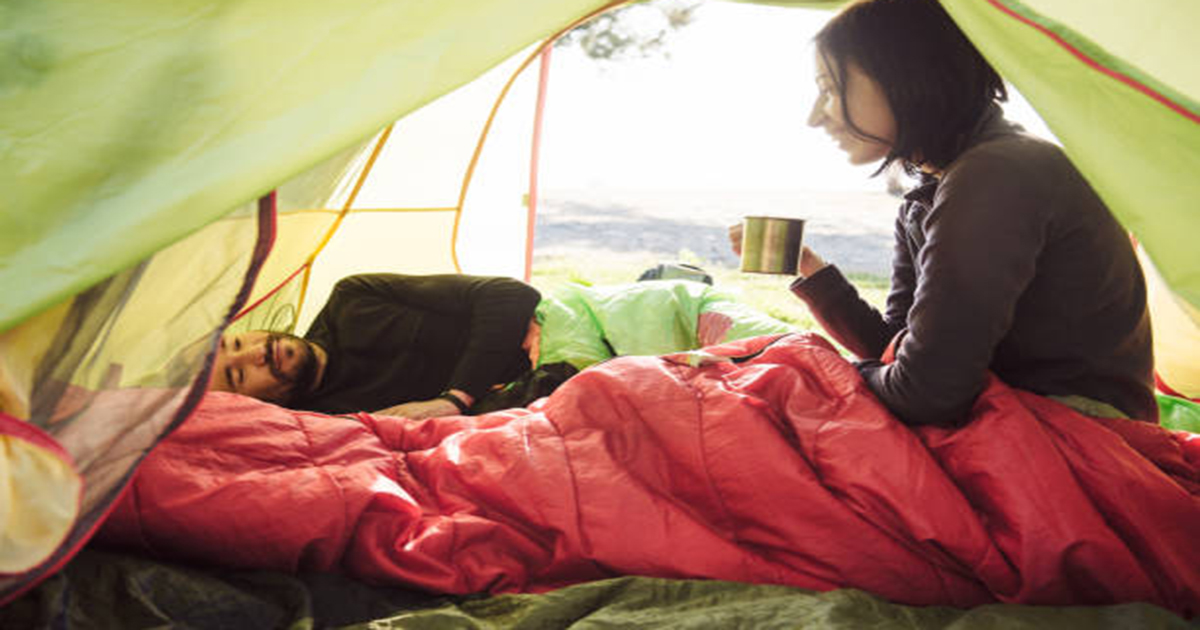
Sleeping Bag Shape: Mummy vs. Rectangular
The shape of your bag profoundly affects warmth retention and comfort.
Mummy Shape
- Design: Tapers significantly toward the feet and features a snug hood around the head.
- Best For: Backpacking and cold weather.
- Benefit: The reduced internal air space means your body expends less energy heating the air inside the bag, maximizing thermal efficiency. The hood also prevents crucial heat loss from the head.
Rectangular Shape
- Design: Maintains a consistent width from the shoulders to the feet, offering maximum space to sprawl out.
- Best For: Car camping and warm weather where thermal efficiency is not the top concern.
- Benefit: Unparalleled comfort and roominess. Many rectangular bags can be fully unzipped and used as a large blanket.
Semi-Rectangular (or Relaxed Mummy)
A good compromise for travelers who sleep restlessly but still need some thermal efficiency. It offers more shoulder and hip room than a traditional mummy bag.
Top Picks for Every Season
1. The Best Three-Season Workhorse
For the average camper or backpacker, a highly versatile bag rated for three seasons provides the best value.
- The Model Profile: Look for a 20-30$^{\circ}\text{F}$ (Comfort Limit) Hydrophobic Down bag (650-750 Fill Power) in a semi-rectangular shape. This range is suitable for most conditions encountered from spring to late fall.
- Key Features: Must have a draft collar (a tube of insulation around the neck) and a full-length zipper baffle to prevent heat loss through the zipper.
2. The Best Lightweight Summer Bag
When warmth isn’t the priority, the goal is minimal weight and bulk.
- The Model Profile: A $45^{\circ}\text{F}$+ Synthetic or ultra-light Down quilt or bag liner.
- Quilt Advantage: Quilts ditch the back insulation and hood, relying on your sleeping pad for warmth underneath. This drastically cuts weight and bulk, making them ideal for minimalist packing. They are perfect for combining with other gear on an extended trip, complementing your essential gear for mountain trekking.
3. The Best for Extreme Winter Conditions
Survival in sub-freezing temperatures requires specialized gear with maximum insulation.
- The Model Profile: A $0^{\circ}\text{F}$ or below bag with high-loft 800+ Fill Power Down, featuring a highly-cinchable hood, insulated foot-box, and a full perimeter draft collar.
- Crucial Detail: Winter bags often use a Pertex Shield or similar shell fabric that is highly water-resistant and durable against frost accumulation inside the tent.
Important Accessories for Maximizing Warmth
No matter how high-rated your sleeping bag is, its performance will be undermined if you neglect the crucial accessories that complete your sleep system.
The Sleeping Pad
Your sleeping bag only provides insulation on the top and sides; the insulation beneath you is compressed by your body weight, rendering it useless. Your sleeping pad provides the crucial insulation from the cold ground.
- R-Value: This is the measure of a pad’s insulating ability.
- Summer: R-Value 2.0 or less.
- Three-Season: R-Value 2.5 to 4.0.
- Winter/Snow: R-Value 4.5 and up.
A high R-value pad is the most effective way to upgrade the warmth of a three-season bag for colder nights.
Liner Bags
A sleeping bag liner (typically silk, fleece, or thin cotton) serves multiple purposes:
- Hygiene: It keeps the inside of your expensive sleeping bag clean, reducing the need for washing (which degrades insulation over time).
- Warmth Boost: A fleece or Thermolite liner can add $5^{\circ}\text{F}$ to $15^{\circ}\text{F}$ of extra warmth, turning a light three-season bag into a capable winter bag.
Maintenance and Longevity
A high-quality sleeping bag is a significant investment. Proper care ensures it lasts for decades.
Storage
Never store a sleeping bag compressed. Storing it compressed for long periods destroys the loft (the air pockets that trap heat) of the insulation. Always keep it loosely packed in a large, breathable mesh or cotton storage sack.
Washing
- Down Bags: Must be washed sparingly with a specialized down cleaner (like Nikwax Down Wash). Use a front-loading commercial washer and dry on low heat with several clean tennis balls to break up the down clumps and restore loft.
- Synthetic Bags: Can be washed slightly more frequently but require the same front-loading machine and low heat drying process.
Regular cleaning of your best travel backpacks and sleeping bags ensures your gear remains in top condition for years of adventures.
Final Thoughts
The pursuit of the “Best Sleeping Bag” is less about finding a universally perfect model and more about matching the bag’s specifications to your intended use. For maximum versatility, invest in a high-quality three-season Down bag (around $20^{\circ}\text{F}$ Comfort) paired with an appropriately rated sleeping pad. This core system will serve you reliably in almost all conditions. For extreme cold, layering your clothing and utilizing a liner will extend the bag’s limits, proving that the system—pad, bag, and liner—is always more effective than the bag alone. Choose wisely, sleep soundly, and explore often.
LifeOutOfTheBox is a participant in the Amazon Services LLC Associates Program, an affiliate advertising program designed to provide a means for sites to earn advertising fees by advertising and linking to Amazon.com. Amazon, the Amazon logo, AmazonSupply, and the AmazonSupply logo are trademarks of Amazon.com, Inc. or its affiliates. As an Amazon Associate we earn affiliate commissions from qualifying purchases.