
The question of whether Puerto Rico can become a state of the United States is a complex and deeply rooted issue, intertwined with history, economics, and the very identity of the island’s residents. For over a century, Puerto Rico has held the status of a U.S. territory, a unique political relationship that has shaped its development and continues to fuel debate about its future. Understanding this relationship requires delving into the historical context, the current political landscape, and the potential implications of statehood for both Puerto Rico and the United States.
Historical Roots of the Relationship
The current political status of Puerto Rico traces back to the Spanish-American War in 1898. Following the U.S. victory, Spain ceded several territories, including Puerto Rico, to the United States under the Treaty of Paris. Initially, Puerto Rico was governed by the U.S. military, but in 1900, the U.S. Congress passed the Foraker Act, establishing a civilian government and defining its territorial status. This act declared Puerto Ricans as citizens of Puerto Rico but not U.S. citizens, a distinction that would later be rectified.
In 1917, the Jones-Shafroth Act granted statutory U.S. citizenship to all residents of Puerto Rico. This was a significant development, theoretically aligning the island’s inhabitants more closely with the mainland. However, the act also maintained the island’s territorial status, meaning Puerto Ricans could serve in the U.S. military and travel freely to the mainland, but they could not vote in U.S. presidential elections and had no voting representation in the U.S. Congress. This “taxation without representation” aspect, while not literal in terms of federal income tax (residents do not pay federal income tax on income earned in Puerto Rico), became a recurring point of contention.
The mid-20th century saw further evolution in Puerto Rico’s governance with the passage of Public Law 600 in 1950, which allowed Puerto Rico to draft its own constitution. This led to the establishment of the Commonwealth of Puerto Rico in 1952, a status that granted a degree of local autonomy while still remaining under U.S. sovereignty. This “commonwealth” status, however, has been a source of ongoing debate, with proponents of statehood arguing that it is neither fully sovereign nor fully integrated into the United States.
Key Legislative Milestones
- 1898: Treaty of Paris cedes Puerto Rico to the U.S.
- 1900: Foraker Act establishes a civilian government and territorial status.
- 1917: Jones-Shafroth Act grants statutory U.S. citizenship to Puerto Ricans.
- 1950: Public Law 600 allows for a local constitution.
- 1952: Commonwealth of Puerto Rico established.
The Statehood Debate: Arguments and Aspirations
The aspiration for statehood in Puerto Rico is not new, but it has gained significant momentum in recent decades. Proponents of statehood argue that it is the ultimate resolution to the island’s political and economic challenges, offering full U.S. citizenship rights and a more stable political future.
Advantages of Statehood for Puerto Rico
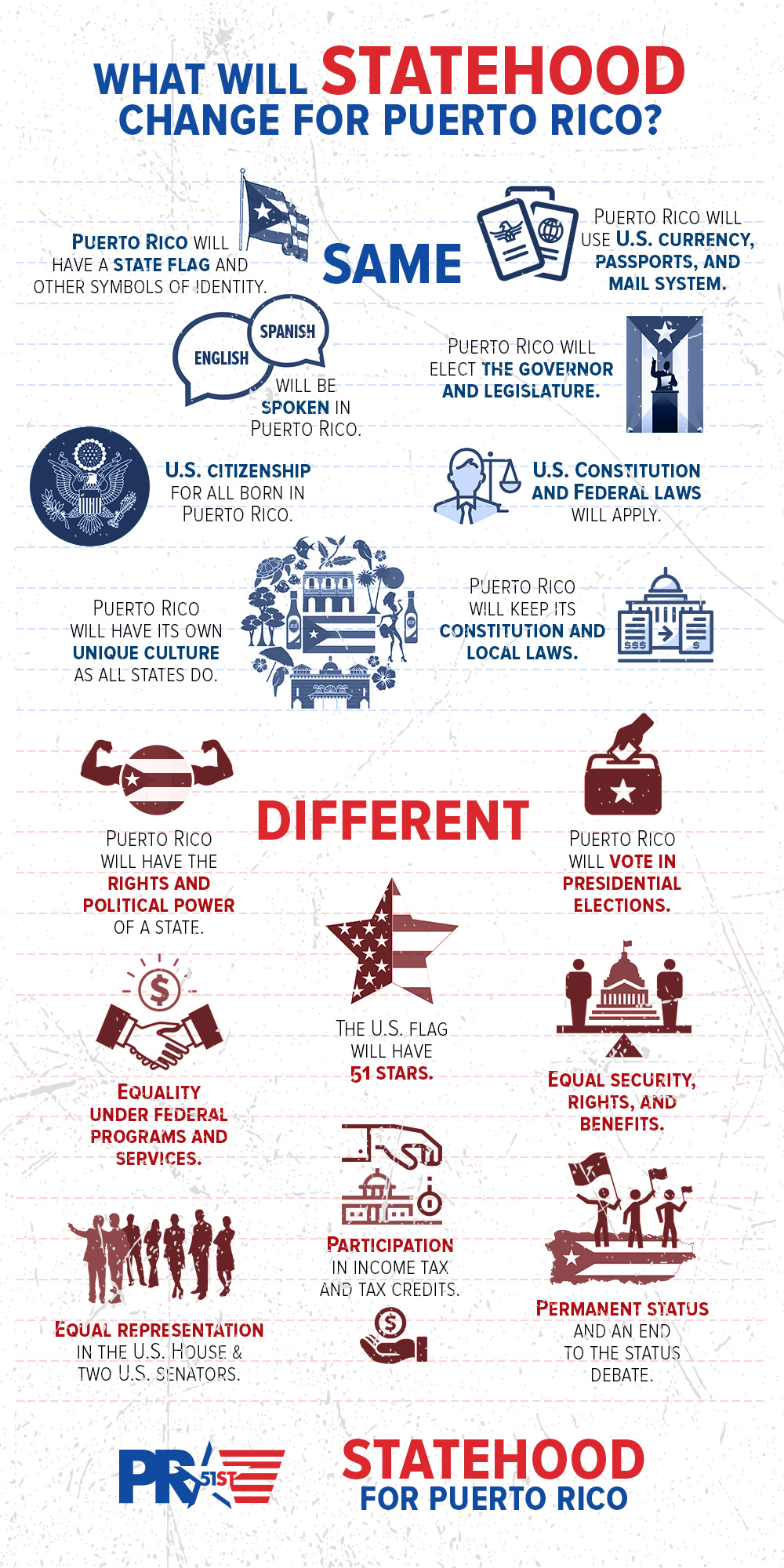
One of the most significant arguments for statehood revolves around political equality. As a state, Puerto Rico would gain two senators and a commensurate number of representatives in the U.S. House of Representatives, as well as full voting rights in presidential elections. This would empower Puerto Ricans to have a direct say in the laws and policies that govern them, ending the current situation of being subject to federal laws without full representation.
Economically, statehood is expected to bring substantial benefits. Residents would receive full eligibility for federal programs, including Medicare and Medicaid, which currently provide lower funding levels to Puerto Rico compared to states. This could lead to significant improvements in healthcare access and quality. Furthermore, statehood would likely lead to increased federal investment in infrastructure, education, and economic development. Proponents believe that the certainty of statehood would attract more businesses and investment, fostering job creation and economic growth.
The argument is also made that statehood would solidify the cultural and political identity of Puerto Ricans within the United States. It would resolve the ambiguity of their current status, allowing for a clearer understanding of their rights and responsibilities as American citizens. Many see statehood as the natural evolution of the relationship, a recognition of the island’s contributions to the nation and its people’s aspirations.
The Economic Case for Statehood
- Full access to federal programs: Increased funding for Medicare, Medicaid, and other social safety nets.
- Economic stimulus: Potential for greater federal investment in infrastructure, education, and job creation.
- Business confidence: Enhanced stability and predictability to attract domestic and international investment.
- Taxation parity: While residents would likely begin paying federal income taxes, proponents argue that this would be offset by increased federal benefits and economic growth.
Alternatives and Counterarguments
While statehood garners significant support, it is not the only option on the table, nor is it universally desired. The debate includes strong arguments for maintaining the current commonwealth status, or even for pursuing independence.
The Case for Enhanced Commonwealth Status
Some advocate for an enhanced commonwealth status, which would grant Puerto Rico greater autonomy while maintaining its ties to the United States. This could involve greater control over local affairs, exclusive rights to negotiate international trade agreements, or even the ability to retain a portion of the federal taxes collected on the island. Proponents of this option believe it offers a unique model that respects Puerto Rico’s distinct cultural identity and allows for self-determination without severing ties with the U.S.
Independence: A Separate Path
A segment of the Puerto Rican population supports full independence, envisioning Puerto Rico as a sovereign nation. This perspective emphasizes national identity and self-governance, arguing that true freedom can only be achieved through complete separation from the United States. However, the economic implications of independence are significant, raising questions about trade relations, currency, and access to international markets.
Challenges and Concerns Regarding Statehood
Opponents of statehood raise several concerns. One of the most significant is the potential economic impact on the U.S. mainland. Questions arise about the cost of integrating Puerto Rico into the federal system, particularly regarding the immediate increase in federal spending on social programs. There are also concerns about the potential for increased federal taxes on Puerto Rican residents and businesses, which could impact the island’s economy in ways that are not fully understood.
Another point of contention is the cultural and linguistic identity of Puerto Rico. While Spanish is the dominant language, English is widely spoken, and proponents of statehood believe that Puerto Rico can maintain its vibrant culture as a state. However, some worry that statehood could lead to the erosion of Puerto Rican identity and traditions.
The Path Forward: Referendums and Political Will
The question of Puerto Rico’s political status has been addressed through numerous referendums over the years, with varying results and interpretations. These votes reflect the deeply divided opinions on the island regarding its future.
History of Status Referendums
Puerto Rico has held several plebiscites on its political status. In 1967, a plebiscite favored the continuation of the commonwealth status. In 1993, another vote on status options also saw the commonwealth option win, though statehood and independence received significant backing. More recently, in 2012, a majority voted for statehood, though the validity and interpretation of this vote were contested due to low turnout and alleged boycotts by parties supporting other options. In 2017, a referendum overwhelmingly favored statehood, but turnout was extremely low, with boycotts from opponents of statehood, casting further doubt on its definitive mandate.

The Role of the U.S. Congress
Ultimately, the decision on whether Puerto Rico can become a state rests with the U.S. Congress. While referendums on the island can express the will of the people, federal legislation is required to initiate and approve any change in status, including statehood. This means that even if a clear majority on the island favors statehood, political will and consensus-building within the U.S. Congress are crucial for its realization.
The ongoing debate highlights the complexities of self-determination and the intricate relationship between territories and the federal government. As Puerto Rico continues to navigate its unique political landscape, the question of its future status remains a central and compelling issue, one that will undoubtedly shape the island and its people for years to come. The island’s journey toward a definitive political resolution is a testament to its resilience and the enduring spirit of its people.
LifeOutOfTheBox is a participant in the Amazon Services LLC Associates Program, an affiliate advertising program designed to provide a means for sites to earn advertising fees by advertising and linking to Amazon.com. Amazon, the Amazon logo, AmazonSupply, and the AmazonSupply logo are trademarks of Amazon.com, Inc. or its affiliates. As an Amazon Associate we earn affiliate commissions from qualifying purchases.