
The question of whether Mexico “sold” California to the United States is a fascinating entry point into a pivotal moment in North American history. It encapsulates a complex narrative of territorial ambition, military conflict, and the reshaping of national identities. Far from a simple commercial transaction, the transfer of California and vast other territories from Mexico to the United States was a direct consequence of the Mexican-American War (1846-1848), formalized by the Treaty of Guadalupe Hidalgo. While monetary compensation was part of the agreement, it was paid under duress, making the term “sale” misleading. This historic event not only redrew maps but also profoundly influenced the cultural tapestry, economic development, and tourism landscape of what would become the American Southwest, offering travelers today a rich blend of history, culture, and breathtaking natural beauty.

A Land of Promise: California Before the United States
To understand the context of this transfer, one must first appreciate California’s status before the mid-19th century. For centuries, this expansive and resource-rich land was largely beyond the grasp of what would become the modern United States. Its history was shaped by indigenous cultures, followed by colonial powers.
Spanish Colonial Roots and Mexican Independence
From the late 18th century, California was part of New Spain, a vast colonial territory administered by Spain. The Spanish presence in Alta California (Upper California, distinct from Baja California in what is now Mexico) was characterized by a chain of missions, presidios (forts), and pueblos (towns) stretching from San Diego to Sonoma. These institutions aimed to convert indigenous populations, establish agricultural outposts, and secure Spain’s claim against potential Russian or British encroachment. Iconic landmarks such as Mission San Juan Capistrano or Mission San Gabriel Arcángel stand today as poignant reminders of this era, offering visitors a glimpse into the architectural and cultural heritage that predates American annexation.
In 1821, after a decade-long war for independence, Mexico achieved sovereignty from Spain. Alta California, along with other northern territories like New Mexico and Texas, became part of the newly formed Mexican Republic. The Mexican period (1821-1846) saw the secularization of the missions, with their vast lands often redistributed as ranchos to prominent Mexican citizens. This created a distinctive ranchero lifestyle, characterized by cattle ranching and a vibrant equestrian culture, which still echoes in parts of California’s cultural identity. Today, travelers interested in local culture can explore these historical haciendas, many of which are preserved as museums or even boutique accommodations, blending historical authenticity with modern luxury travel.
Early Encounters and Westward Expansion
During Mexico’s rule, Alta California remained sparsely populated by non-indigenous settlers, especially compared to the rapidly expanding United States to the east. American fur trappers, traders, and explorers began to venture westward, increasingly seeing California’s fertile lands and access to the Pacific Ocean as a natural extension of their nation’s destiny. The idea of Manifest Destiny – the belief that the United States was divinely ordained to expand across the North American continent – gained significant traction, fueling ambitions for territorial acquisition, including California.
These early American arrivals, often referred to as “Anglos,” began to settle in regions like Sacramento and Sonoma, often clashing with Mexican authorities over land rights and governance. The demographic shift, though slow, contributed to a growing tension between the two nations, setting the stage for future conflict. For those tracing the footsteps of pioneers, historical routes and museums across the state offer a fascinating look into these early migrations and the adventurous lifestyle of those who sought new opportunities in the West.
The Seeds of Conflict: The Mexican-American War
The notion of a “sale” of California is fundamentally challenged by the fact that its transfer was a direct outcome of a full-scale military conflict. The Mexican-American War was a decisive and often brutal affair that reshaped the geopolitical landscape of North America.
Border Disputes and Manifest Destiny
The primary catalyst for the war was the annexation of Texas by the United States in 1845. Mexico had never formally recognized Texas’ independence, viewing its annexation as an act of war. A critical point of contention was the border between Texas and Mexico: the United States claimed the Rio Grande as the boundary, while Mexico insisted on the Nueces River, further north.
President James K. Polk, a fervent proponent of Manifest Destiny, also desired to acquire California and New Mexico. He attempted to purchase these territories from Mexico, but his overtures were rejected. When Mexican forces crossed the Rio Grande into the disputed territory in April 1846, clashing with American troops, Polk seized the opportunity to declare war, framing it as a defense against Mexican aggression. This controversial declaration ignited a conflict that would forever alter the map of the continent.
Major Battles and Shifting Tides
The Mexican-American War unfolded on multiple fronts. American forces, often outnumbered, demonstrated superior artillery and leadership. General Zachary Taylor led campaigns in northern Mexico, securing victories at Palo Alto and Monterrey. Meanwhile, General Stephen W. Kearny marched west to seize Santa Fe, New Mexico, before pushing on towards California.
In California itself, American settlers, with the encouragement of explorer and military officer John C. Frémont, initiated the Bear Flag Revolt in June 1846, declaring the short-lived Republic of California. Naval forces under Commodore John D. Sloat simultaneously seized Monterey and San Francisco bays. By early 1847, after a series of skirmishes, including the Battle of Los Angeles, American forces had largely secured control of Alta California.
The decisive blow came with General Winfield Scott’s amphibious landing at Veracruz and his subsequent march inland to capture Mexico City in September 1847. The occupation of the Mexican capital forced Mexico to the negotiating table, demonstrating that the acquisition of territory, including California, was achieved through military conquest rather than a consensual “sale.” Traveling through these historical battlegrounds and cities today offers a profound perspective on the sacrifices and strategies of this era, providing a unique historical tourism experience.
The Treaty of Guadalupe Hidalgo: A New Era for the Southwest
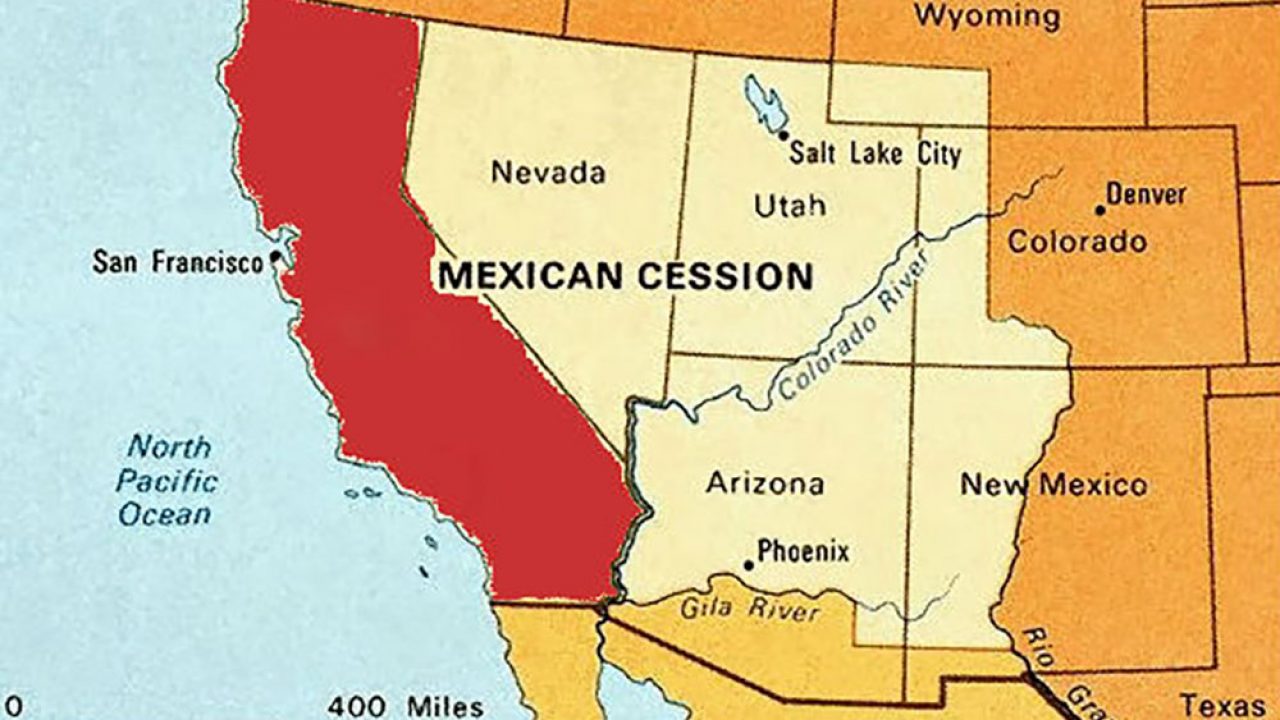
With its capital occupied and its military largely defeated, Mexico had little choice but to cede a vast portion of its territory. The negotiations that followed led to the signing of the Treaty of Guadalupe Hidalgo in a small village outside Mexico City.
The Terms of Cession and Compensation
Signed on February 2, 1848, the Treaty of Guadalupe Hidalgo officially ended the Mexican-American War. Under its terms, Mexico agreed to cede over 525,000 square miles of territory to the United States. This immense land grab, often referred to as the Mexican Cession, included all of present-day California, Nevada, and Utah, most of Arizona and New Mexico, and parts of Colorado, Wyoming, Kansas, and Oklahoma. The Rio Grande was also formally recognized as the border with Texas.
In exchange for this vast territory, the United States agreed to pay Mexico $15 million. Additionally, the United States assumed approximately $3.25 million in claims that American citizens had against the Mexican government. While this monetary sum might lead some to describe it as a “sale,” it’s crucial to understand that it was compensation for conquered territory, not a voluntary transaction. Mexico was in no position to refuse, and the payment served more to legitimize the territorial transfer under international law than to represent a fair market value for the land.
The treaty also included provisions for the protection of property rights and citizenship for Mexican citizens living in the ceded territories. These individuals were given the option to retain Mexican citizenship or become American citizens, a decision that carried profound implications for their identity and future. The legacy of these provisions, and often their failure to be fully realized, continues to be a subject of historical study and cultural importance, reflected in the vibrant Mexican-American culture thriving across the Southwest today.
From Mexican Territory to American States
The signing of the treaty marked the official end of Mexican sovereignty over California. Almost immediately, the region underwent rapid transformation. Just days before the treaty was signed, gold was discovered at Sutter’s Mill in Coloma, California. This discovery triggered the California Gold Rush, an event that dramatically accelerated American settlement and statehood.
The influx of “forty-niners” from around the world brought unprecedented population growth and economic development, far surpassing anything seen during the Spanish or Mexican eras. The demand for accommodation, supplies, and services transformed sleepy towns into bustling cities like San Francisco and Sacramento. Within two years of the treaty, California had enough population to qualify for statehood and was admitted to the Union in 1850. The story of the Gold Rush is a classic tale of ambition and adventure, and today, visitors can explore ghost towns, historical mining sites, and museums that chronicle this wild chapter of American history.
Legacy and Transformation: California’s Enduring Appeal
The events of the mid-19th century profoundly shaped California’s destiny, transforming it from a remote frontier into one of the most dynamic and influential states in the United States. Its complex origins are woven into its fabric, creating a unique appeal for residents and travelers alike.
The Gold Rush and Rapid Growth
The Gold Rush was a turning point, not just for California but for global migration and economic development. It attracted a diverse population, including Chinese, European, and Latin American immigrants, contributing to California’s multicultural identity. This era laid the groundwork for the state’s future economic power, diversifying beyond mining to agriculture, manufacturing, and eventually, technology and entertainment.
The rapid growth led to the establishment of modern infrastructure, educational institutions, and sophisticated urban centers. The demand for everything from basic necessities to luxury goods fueled innovation and entrepreneurial spirit, hallmarks of the Californian lifestyle even today. For history buffs and adventure seekers, exploring the legacy of the Gold Rush offers a tangible connection to this transformative period. Destinations like Columbia State Historic Park provide an immersive experience, complete with preserved buildings and reenactments, while museums throughout Sacramento and San Francisco delve deeper into the stories of those who chased the golden dream.
Cultural Intersections and Modern California Life
Today, California is a vibrant mosaic of cultures, a direct legacy of its diverse historical roots. The Mexican and Spanish heritage is deeply embedded in the state’s architecture, cuisine, place names, and traditions. Cities like Los Angeles and San Diego boast historic districts like Olvera Street and Old Town, where visitors can experience the sights, sounds, and tastes of Mexican culture that has thrived for centuries.
The blend of cultures creates a rich lifestyle, from authentic Mexican eateries to world-renowned wineries in Napa Valley, and from the historical charm of Monterey to the cutting-edge innovation of Silicon Valley. This cultural richness contributes significantly to California’s appeal as a top travel destination, offering everything from luxurious resort stays to budget-friendly cultural explorations. The state truly embodies a global crossroads, where historical narratives meet contemporary trends.

Exploring Historical Landmarks and Vibrant Cities Today
For travelers today, California offers an unparalleled array of experiences shaped by its unique history. Beyond the Hollywood glamour and tech innovation, there’s a profound sense of history waiting to be discovered.
- Historical Missions and Presidios: Tour the historic California Missions, like Mission San Juan Capistrano or Mission San Luis Obispo, to connect with the Spanish colonial era. Many offer museum exhibits, beautiful gardens, and insights into early Californian life.
- Old Town San Diego: Old Town San Diego State Historic Park transports visitors back to the Mexican period, showcasing restored adobe buildings, period shops, and cultural performances. It’s a fantastic spot for families and those interested in local culture and food.
- Monterey and the Bear Flag Revolt Sites: Explore Monterey, California’s original capital, with its historic Custom House and Old Town buildings that witnessed the transition from Mexican to American rule. Nearby Sonoma features the Sonoma Barracks, a key site of the Bear Flag Revolt.
- San Francisco’s Presidio and Beyond: The Presidio of San Francisco, once a Spanish fort, now offers stunning views, hiking trails, and cultural events. Other iconic landmarks like the Golden Gate Bridge and Alcatraz Island are testaments to subsequent eras of growth and development.
- Natural Wonders and Cultural Experiences: Beyond the cities, California’s natural landmarks like Yosemite National Park and the dramatic coastline of Big Sur offer breathtaking experiences, complementing the historical narrative. These natural attractions often served as backdrops for the historical events, providing a sense of scale to the human struggles and triumphs.
In conclusion, while the question “Did Mexico sell California to the United States?” has a simple “no” as its direct answer, the full story is far more nuanced. California was ceded through the spoils of war, with compensation offered as part of a peace treaty. This pivotal moment dramatically altered the course of both nations, leaving an indelible mark on the landscape, culture, and identity of California. For travelers, this rich history provides countless opportunities to explore fascinating landmarks, immerse themselves in diverse cultures, and appreciate the complex journey that shaped one of the world’s most dynamic regions. Whether seeking luxury accommodations in a historic city or a rustic experience exploring gold rush towns, California’s past is an open book, inviting exploration and discovery.
LifeOutOfTheBox is a participant in the Amazon Services LLC Associates Program, an affiliate advertising program designed to provide a means for sites to earn advertising fees by advertising and linking to Amazon.com. Amazon, the Amazon logo, AmazonSupply, and the AmazonSupply logo are trademarks of Amazon.com, Inc. or its affiliates. As an Amazon Associate we earn affiliate commissions from qualifying purchases.