
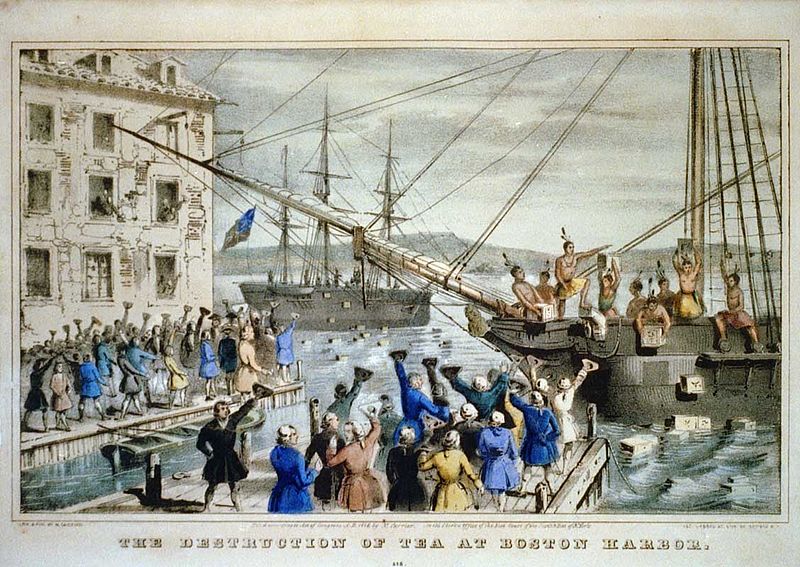
The Boston Tea Party of December 16, 1773, was a pivotal event in the lead-up to the American Revolution. It was not merely a spontaneous act of defiance but a calculated protest against the Tea Act of 1773, a piece of legislation that the American colonists viewed as taxation without representation. The colonists, disguised as Native Americans, boarded three ships – the Dartmouth, the Eleanor, and the Beaver – docked in Boston Harbor and dumped 342 chests of tea into the water. This act of destruction, while celebrated by many colonists as a victory for liberty, was perceived by the British government as an act of treason and a direct challenge to its authority over the colonies. The response from Britain was swift, severe, and ultimately, counterproductive, fundamentally altering the relationship between the Crown and its American subjects.

The Immediate Outrage and Parliamentary Debate
News of the Boston Tea Party reached London with considerable speed, igniting a firestorm of indignation within Parliament and among the British public. The destruction of private property, particularly valuable East India Company tea, was seen as an unforgivable affront. King George III himself was reportedly furious, viewing the act as a deliberate attempt to undermine British sovereignty.
The East India Company’s Financial Predicament
Central to the British government’s motivation was the precarious financial state of the East India Company. The company, a quasi-governmental entity that held vast economic and political power in India, was on the brink of bankruptcy. The Tea Act was, in part, designed to help the company by allowing it to sell tea directly to the colonies without paying the usual duties in Britain, thus undercutting smuggled Dutch tea and generating much-needed revenue for the company, and by extension, for the British treasury. The destruction of this tea meant not only a financial loss for the company but also a perceived blow to British commercial interests and imperial prestige.
Calls for Retribution
In Parliament, the debate was heated. Many members, particularly those aligned with the government of Lord North, saw the actions in Boston as a clear case of rebellion that required a firm and decisive response. Arguments were made that leniency would only embolden further defiance. While some voices, like that of Edmund Burke, cautioned against an overly punitive approach, urging conciliation, the prevailing sentiment favored strong measures to assert parliamentary authority. The opposition to the Tea Act was interpreted not as a legitimate grievance but as a challenge to the fundamental right of Parliament to legislate for the entire empire.
The Coercive Acts: Punishment for Massachusetts
The British government, under the leadership of Lord North, decided to punish Massachusetts specifically, as it was the colony where the protest had occurred. The punitive measures enacted were a series of laws known collectively in the colonies as the “Intolerable Acts” (though the British government referred to them as the “Coercive Acts”). These acts were designed to bring the colony to heel and serve as a stark warning to any other colonial territory contemplating similar acts of defiance. The Coercive Acts were fourfold:
The Boston Port Act
The most immediate and perhaps most impactful of the Coercive Acts was the Boston Port Act, passed on March 31, 1774. This act ordered the closure of the port of Boston to all trade until the colonists paid for the destroyed tea and demonstrated a willingness to submit to parliamentary authority. This measure was intended to cripple the economy of Boston, thereby pressuring its citizens and the colonial government to comply. The closure of the port was a severe blow, as Boston was a major commercial hub, and its livelihood depended heavily on maritime trade. Ships were diverted to other ports like Salem and Marblehead, which were granted permission to continue their trade, a move intended to sow division among the colonies.
The Massachusetts Government Act
Enacted on May 20, 1774, the Massachusetts Government Act fundamentally altered the colony’s charter. It effectively nullified many of the democratic principles that had been established. The act restricted town meetings, requiring royal approval for any gathering, and significantly increased the power of the royal governor, who was appointed by the Crown. The governor gained the authority to appoint judges, sheriffs, and other officials, replacing the colonial legislature’s role in these appointments. This was a direct assault on the self-governance that the colonists had come to expect and cherish. The intent was to centralize power in the hands of the royal governor and weaken the influence of colonial assemblies.
The Administration of Justice Act
Also passed on May 20, 1774, the Administration of Justice Act was designed to protect British officials and soldiers accused of capital crimes in the colonies. Under this act, if a colonial official or soldier was accused of murder or any other capital offense while performing their duties in Massachusetts, they could be sent to another colony or even to Great Britain for trial. The rationale was that a colonial jury would be biased against British officials and unlikely to deliver a fair verdict. Colonists, however, viewed this as the “Murder Act,” arguing that it would allow British officials to act with impunity, knowing they would likely escape justice for any wrongdoing committed against colonists.
The Quartering Act of 1774
While not solely aimed at Massachusetts, the Quartering Act of 1774 was expanded to apply more broadly and was part of the punitive package. This act allowed British governors to house soldiers in any unoccupied buildings, such as private homes, if suitable barracks were not available. This infringed upon the privacy and property rights of colonists and was deeply resented, reminiscent of earlier grievances related to the quartering of troops.
The Colonial Reaction and Unintended Consequences
The British response, intended to isolate and subdue Massachusetts, had precisely the opposite effect. Instead of alienating the other colonies, the Coercive Acts served as a unifying force, demonstrating the perceived threat to colonial liberties posed by the British government.
Solidarity with Massachusetts
News of the Boston Port Act and the subsequent measures spread rapidly throughout the thirteen colonies. Rather than siding with Britain, most colonies expressed deep sympathy for Massachusetts. They recognized that if Parliament could arbitrarily close the port of one city and dismantle the government of one colony, it could do the same to any of them. This shared sense of vulnerability fostered a spirit of intercolonial cooperation that had previously been lacking.
The First Continental Congress
In direct response to the Coercive Acts, delegates from twelve of the thirteen colonies (Georgia did not send representatives) convened the First Continental Congress in Philadelphia in September 1774. This landmark assembly was not intended to declare independence but rather to coordinate a unified colonial response to British policy. The delegates debated their grievances, drafted a Declaration of Rights and Grievances, and called for a boycott of British goods. The formation of the Continental Congress marked a significant step towards organized colonial resistance and a unified political identity.

Escalation of Tensions
The Coercive Acts, designed to quell dissent, instead fanned the flames of rebellion. The punitive nature of the British response convinced many colonists that reconciliation was impossible and that armed resistance might be their only recourse. The colonists began to organize militias, stockpile weapons, and prepare for a potential conflict. The actions of the British government, therefore, inadvertently accelerated the movement towards revolution, transforming a protest over tea into a full-blown imperial crisis. The Boston Tea Party, intended to assert British authority, ultimately became a catalyst for the very independence that Britain sought to prevent. The British response, characterized by a lack of understanding of colonial sentiment and an overreliance on punitive measures, proved to be a critical miscalculation in the unfolding drama of American history.
LifeOutOfTheBox is a participant in the Amazon Services LLC Associates Program, an affiliate advertising program designed to provide a means for sites to earn advertising fees by advertising and linking to Amazon.com. Amazon, the Amazon logo, AmazonSupply, and the AmazonSupply logo are trademarks of Amazon.com, Inc. or its affiliates. As an Amazon Associate we earn affiliate commissions from qualifying purchases.