
The story of how Texas became a part of the United States is a captivating narrative woven with threads of rebellion, independence, and ultimately, annexation. It’s a tale that resonates with the spirit of adventure and self-determination, a journey from a vast, untamed territory to a state that embodies a unique blend of American and Texan identity. Understanding this historical transition offers a deeper appreciation for the Lone Star State and its enduring appeal as a destination for travelers, history enthusiasts, and those seeking a distinctive lifestyle experience.
The origins of Texas‘s unique position are deeply rooted in its colonial past. For centuries, the land that would become Texas was claimed by various European powers, with Spain being the most influential for an extended period. Under Spanish rule, the region was known as Tejas, a vast territory with a sparse population and limited development. Spanish missions and presidios were established, laying the groundwork for future settlements, but the true influx of non-Spanish settlers began with Mexico‘s independence from Spain in 1821.
The Mexican Era and the Seeds of Revolution
Following Mexico‘s hard-won independence, the new nation sought to populate its northern territories and bolster its defenses against potential incursions from the United States. To achieve this, the Mexican government encouraged immigration, offering land grants to empresarios who would bring settlers to Texas. Among the most prominent of these empresarios was Stephen F. Austin, often hailed as the “Father of Texas.” Austin successfully recruited hundreds of families, primarily from the southern United States, who were enticed by the promise of fertile land and economic opportunity.
These new settlers, while agreeing to abide by Mexican laws, brought with them their own customs, language, and, crucially, their slavery practices. This cultural and legal divergence soon led to friction with the Mexican government. Mexico, having abolished slavery as part of its independence, began to view the growing number of American settlers and their insistence on maintaining slavery with increasing suspicion and concern. The Mexican government also sought to centralize power, which clashed with the desire for greater autonomy among the Texan settlers.
Furthermore, Mexico‘s political landscape was far from stable in the decades following its independence. Frequent changes in government and the rise of strongman rule created an environment of uncertainty. As Mexico experimented with different forms of governance, including a shift towards a more centralized republic under President Santa Anna, the settlers in Texas felt their rights were being undermined. The imposition of new taxes, restrictions on immigration, and the attempted dismantling of states’ rights further fueled discontent.
The breaking point arrived in the early 1830s. President Santa Anna dissolved the Mexican Congress and began to consolidate power, a move that many Texans viewed as a direct threat to their freedoms. In response to these perceived injustices, a growing sentiment for independence began to take root.
The Texas Revolution: A Fight for Independence
The simmering tensions erupted into open conflict in 1835. The Texian militia clashed with Mexican forces in several skirmishes, most notably at the Battle of Gonzales, where the famous “Come and Take It” flag became a symbol of Texan defiance. This marked the beginning of the Texas Revolution.
The revolution was a fierce and often brutal struggle. Early victories for the Texians were hard-won, but the tide seemed to turn against them with devastating losses, most famously at the Battle of the Alamo in March 1836. This iconic siege, where a small band of Texians defended a former Spanish mission against a vastly larger Mexican army, became a legendary symbol of Texan courage and sacrifice. Though the Alamo defenders were ultimately overwhelmed, their bravery galvanized the Texian cause and provided a rallying cry for the troops led by General Sam Houston.
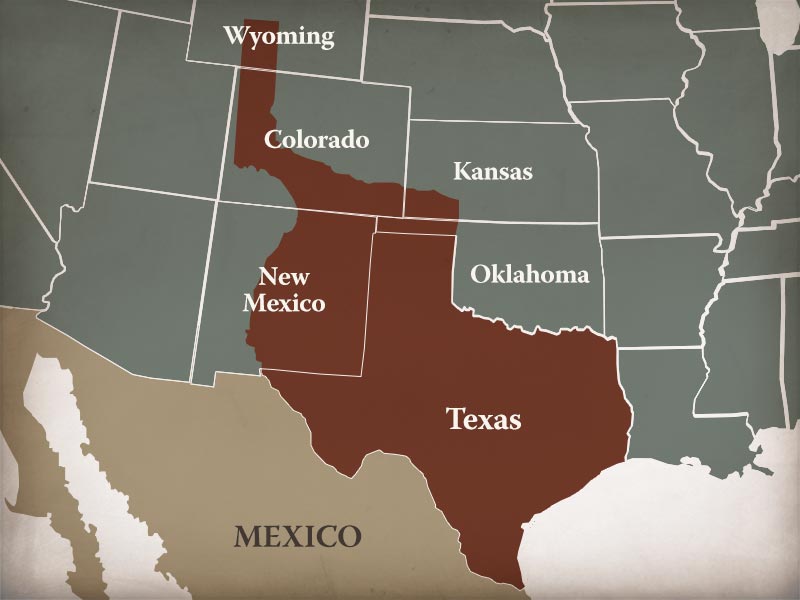
Just weeks after the fall of the Alamo, on March 2, 1836, delegates gathered at Washington-on-the-Brazos and formally declared Texas‘s independence from Mexico, creating the Republic of Texas. This declaration was a bold and audacious act, asserting the right of the Texians to govern themselves.
The decisive moment of the revolution came on April 21, 1836, at the Battle of San Jacinto. Under the command of General Sam Houston, the Texian army launched a surprise attack on President Santa Anna‘s forces, achieving a swift and decisive victory. Santa Anna himself was captured, and his army was routed. This victory effectively secured Texas‘s independence from Mexico.
The Republic of Texas: A Brief but Defining Era
For nearly a decade, Texas existed as an independent nation, the Republic of Texas. During this period, the new republic faced significant challenges. Economically, it struggled with debt incurred during the revolution and the need to establish a stable economy. Politically, it navigated complex relationships with both Mexico, which refused to recognize its independence, and the United States, which was increasingly interested in its vast territory.
The republic also grappled with internal divisions and the ongoing threat of renewed conflict with Mexico. Despite these challenges, the Republic of Texas established its own government, drafted a constitution, and began to develop its infrastructure. It was a period of frontier spirit, where settlers worked to build a new society in a land rich in natural resources. The dream of a thriving, independent Texas was alive, but the vastness of the continent and the growing influence of the United States presented a compelling alternative for many.
Annexation: The Path to Statehood
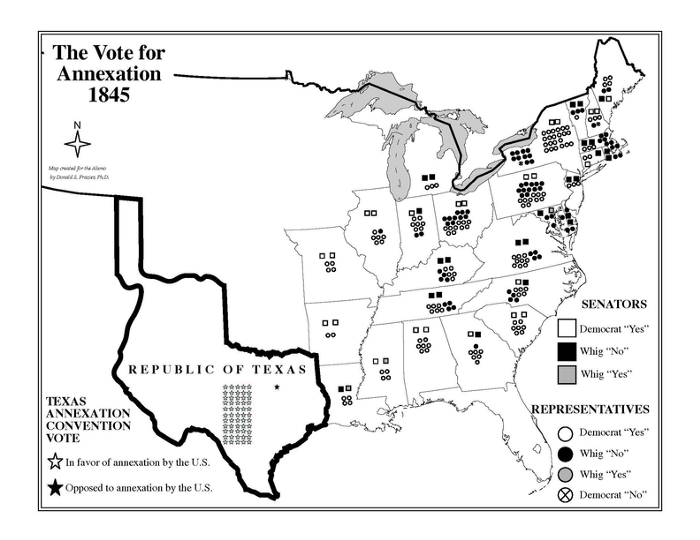
The question of annexation by the United States was a dominant issue throughout the Republic of Texas‘s existence. Many Texians, especially those who had emigrated from the United States, desired to rejoin the Union. They saw annexation as a path to greater economic stability, security, and shared cultural identity. However, the issue was contentious in both Texas and the United States.
In the United States, annexation was complicated by the issue of slavery. Texas was a slave-holding state, and its admission to the Union threatened to upset the delicate balance of power between free and slave states in the U.S. Congress. Anti-slavery factions in the United States strongly opposed the admission of another large slave state.
Despite these obstacles, proponents of annexation continued to push the agenda. Diplomatic efforts were made, and public opinion in Texas generally favored joining the United States. Finally, after years of debate and negotiation, the United States passed the Texas Annexation Act in 1845. On December 29, 1845, Texas officially became the 28th state of the United States.
The annexation of Texas was not without its consequences. Mexico, still considering Texas a rebellious province, viewed the annexation as an act of aggression. This dispute over the southern border of Texas ultimately led to the Mexican-American War (1846-1848), a conflict that further expanded the territory of the United States.

The Legacy of Becoming Part of the United States
The journey of Texas from a Spanish territory to an independent republic and finally to a state within the United States is a pivotal chapter in American history. It shaped the geopolitical landscape of North America and contributed to the westward expansion of the United States.
For visitors, understanding this history enriches any exploration of Texas. From the historic Alamo in San Antonio to the vibrant cities like Austin and Houston, the echoes of this past are palpable. Texas‘s unique cultural heritage, a blend of American, Mexican, and frontier influences, is a direct result of its complex origins.
Exploring Texas today offers a diverse range of experiences. Travelers can delve into the history at numerous landmarks and museums, experience the rich local culture through its music and festivals, and savor its renowned cuisine, from authentic Tex-Mex to hearty barbecue. Whether seeking luxury resorts or budget-friendly accommodations, Texas offers a wide array of options, making it a compelling destination for every kind of traveler, embodying a lifestyle that is as diverse and expansive as its history. The story of how Texas became part of the United States is not just a historical footnote; it’s the foundation of a state that continues to captivate and inspire.
LifeOutOfTheBox is a participant in the Amazon Services LLC Associates Program, an affiliate advertising program designed to provide a means for sites to earn advertising fees by advertising and linking to Amazon.com. Amazon, the Amazon logo, AmazonSupply, and the AmazonSupply logo are trademarks of Amazon.com, Inc. or its affiliates. As an Amazon Associate we earn affiliate commissions from qualifying purchases.