
The cobblestone streets of Boston, now a vibrant hub of history, culture, and innovation, once bore witness to events that irrevocably shaped the future of a nation. Among these pivotal moments, the Boston Massacre, a harrowing clash on March 5, 1770, stands out as a critical turning point. Far from being an isolated incident, this tragic encounter between British soldiers and American colonists was a crescendo of escalating tensions, a propaganda coup, and ultimately, a powerful catalyst that propelled the thirteen colonies towards the American Revolution. To understand its profound impact is to trace the very roots of American independence, delving into the political, economic, and social landscape of colonial Boston in the late 18th century, and recognizing how these historical landmarks and stories continue to shape our travel experiences today.
The Seeds of Discontent: Pre-Massacre Tensions in Colonial Boston
By the late 1760s, the relationship between Great Britain and its American colonies, particularly Massachusetts, was stretched to a breaking point. Following the costly Seven Years’ War (known in America as the French and Indian War), the British Parliament sought to recoup its expenses by imposing a series of taxes and regulations on the colonies. These measures, enacted without colonial representation in Parliament, ignited a fervent cry of “no taxation without representation,” laying the groundwork for widespread dissent.
A City Under Siege: British Occupation and Economic Strain
Boston, a thriving port city and a hotbed of revolutionary sentiment, became a focal point of British efforts to assert authority. The notorious Stamp Act of 1765 and the subsequent Townshend Acts of 1767 levied duties on imported goods like glass, lead, paints, paper, and tea. These acts were not merely economic burdens; they were perceived as direct infringements on colonial liberties. In response, colonists organized boycotts of British goods, impacting trade and revenue for the Crown.
To enforce these unpopular laws and suppress growing unrest, British troops were deployed to Boston in force starting in October 1768. The arrival of roughly 2,000 soldiers in a city of only 16,000 residents immediately transformed the urban landscape. Redcoats patrolled the streets, their presence a constant reminder of British authority. While some soldiers were housed in public buildings, many were quartered in private homes, a practice deeply resented by the colonists under the terms of the Quartering Act.
The economic ramifications were also significant. British soldiers, often poorly paid, sought additional income by competing with colonial laborers for jobs during their off-duty hours. This created direct economic competition and animosity, particularly among working-class Bostonians. Sailors, dockworkers, and tradesmen found themselves vying for scarce employment with armed soldiers, further stoking the flames of resentment. The sight of British warships docked in Boston Harbor and troops parading on Boston Common, a place now cherished by visitors exploring the city’s rich history, symbolized a loss of local autonomy and an oppressive military occupation. The friction was palpable, with daily skirmishes and insults becoming commonplace between the “Lobsterbacks” and the “Yankees.”
Voices of Resistance: Early Patriot Leaders
Amidst this atmosphere of simmering rebellion, influential figures emerged to articulate the colonial grievances and mobilize public opinion. Men like Samuel Adams, a master propagandist and shrewd political organizer, tirelessly campaigned against British policies. He utilized local newspapers, pamphlets, and public speeches to rally support for the Patriot cause, highlighting every instance of British overreach as a step towards tyranny. His ability to connect with the common people and articulate their frustrations made him a formidable force in pre-revolutionary Boston.
John Hancock, one of the wealthiest merchants in the colonies, lent not only his considerable fortune but also his prestige to the Patriot movement. His defiance of British trade regulations, particularly regarding smuggling to avoid duties, made him a constant target of British authorities and a hero to the colonists. The seizure of his sloop, the Liberty, in 1768 on charges of smuggling, sparked riots that further demonstrated the colonists’ unwillingness to tolerate British customs enforcement.
These leaders, alongside others, skillfully leveraged every incident to frame British rule as increasingly oppressive and unjust. Their narratives painted the British soldiers not as protectors, but as an occupying force, setting the stage for a dramatic confrontation that would forever alter the course of history. Travelers today can walk the path of these early patriots on the Freedom Trail, visiting sites like Faneuil Hall, where many of these fiery speeches were delivered, and feeling the palpable weight of history that permeates these venerable landmarks.
The Night of March 5, 1770: A Spark Ignites
The cold, dark evening of March 5, 1770, began like many others in occupied Boston, with taunts and minor confrontations. However, this night would escalate into a bloody tragedy that reverberated through the colonies, becoming a powerful symbol of British tyranny and a rallying cry for American liberty. The event occurred near the Old State House, a building that housed the colonial government and overlooked the bustling King Street (now State Street), a site today that draws countless visitors keen to immerse themselves in America’s foundational narrative.
From Confrontation to Carnage: The Events Unfold
The initial spark came when a young wigmaker’s apprentice, Edward Garrick, allegedly insulted a British officer, Captain-Lieutenant John Goldfinch, over an unpaid bill outside the Custom House. A British sentry, Private Hugh White, intervened, striking Garrick with his musket. This scuffle quickly attracted a crowd of angry Bostonians, who began to gather, hurling insults, snowballs, ice, and even oyster shells at Private White.
Alarmed by the growing mob, Private White called for reinforcements. A contingent of seven soldiers from the 29th Regiment, led by Captain Thomas Preston, arrived to support him. The soldiers, bayonets fixed, formed a semicircle around the Custom House, attempting to disperse the increasingly agitated crowd, which had swelled to several hundred people. The air was thick with tension, noise, and the pervasive fear of what might happen next.
The crowd pressed closer, daring the soldiers to fire. Amidst the chaos, various accounts suggest cries of “Fire!” were heard, though it remains unclear if these commands came from Preston, the crowd, or were simply misinterpreted. What is certain is that a soldier, Private Hugh Montgomery, was struck by a projectile, lost his footing, and discharged his musket. This single shot was followed by a volley from other soldiers, who, whether by order or panic, opened fire into the unarmed crowd.
When the smoke cleared, five men lay dead or dying. The first to fall was Crispus Attucks, a former slave and a sailor of mixed African and Native American descent, often regarded as the first casualty of the American Revolution. Other victims included Patrick Carr, a leather worker; James Caldwell, a sailor; Samuel Gray, a rope maker; and Samuel Maverick, a seventeen-year-old apprentice. Six more were wounded. The scene was one of shock and horror, instantly transforming a street brawl into a massacre.
The Aftermath: Propaganda, Public Outcry, and the Trial
The immediate aftermath of the Boston Massacre saw a swift and powerful reaction from colonial leaders. Samuel Adams and other Patriots seized upon the incident as undeniable proof of British brutality and tyranny. They quickly dubbed the event a “massacre,” an intentional act of aggression by the British military against innocent civilians. This narrative, carefully crafted and widely disseminated, became a crucial piece of propaganda in the burgeoning revolutionary movement.
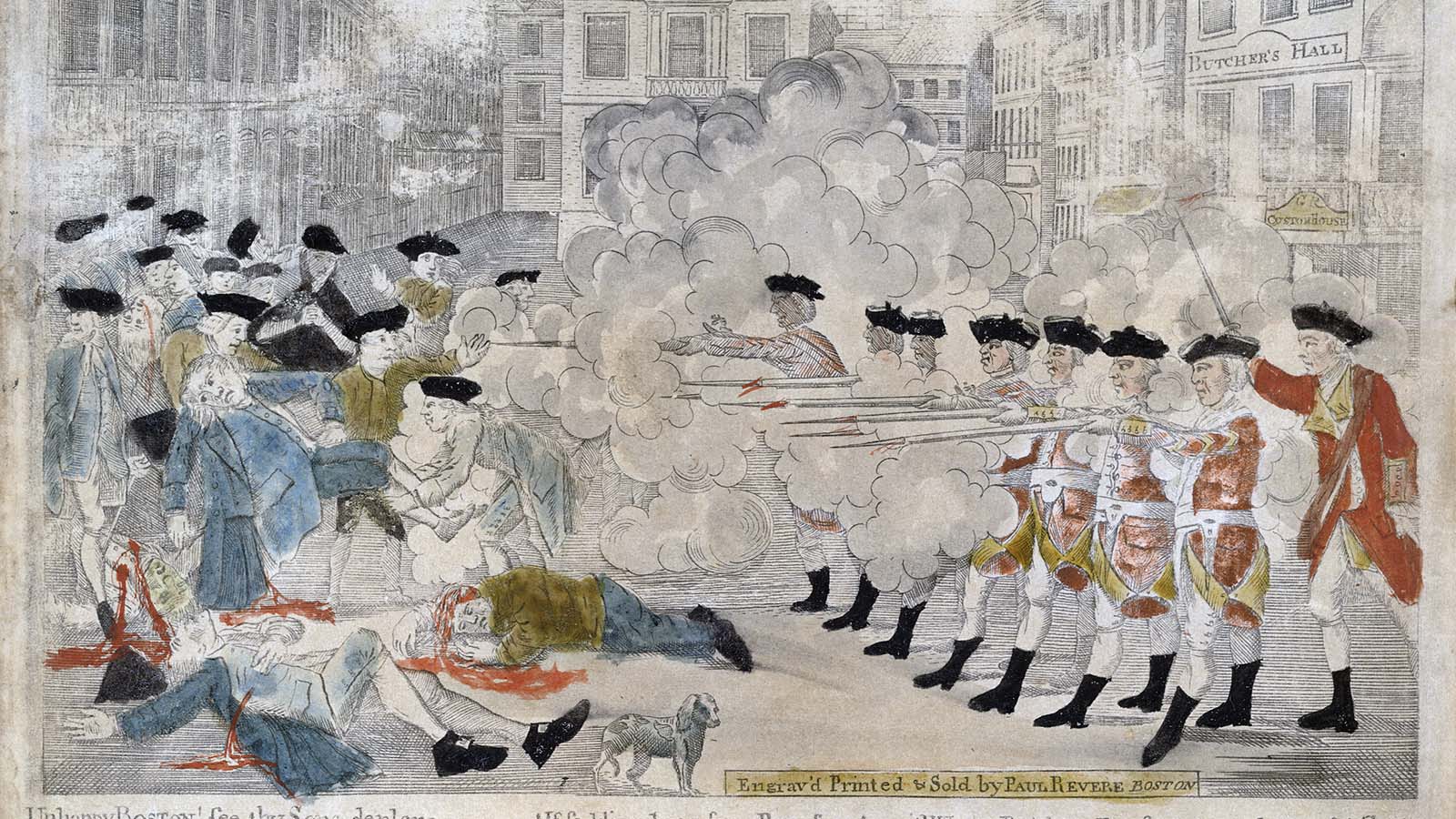
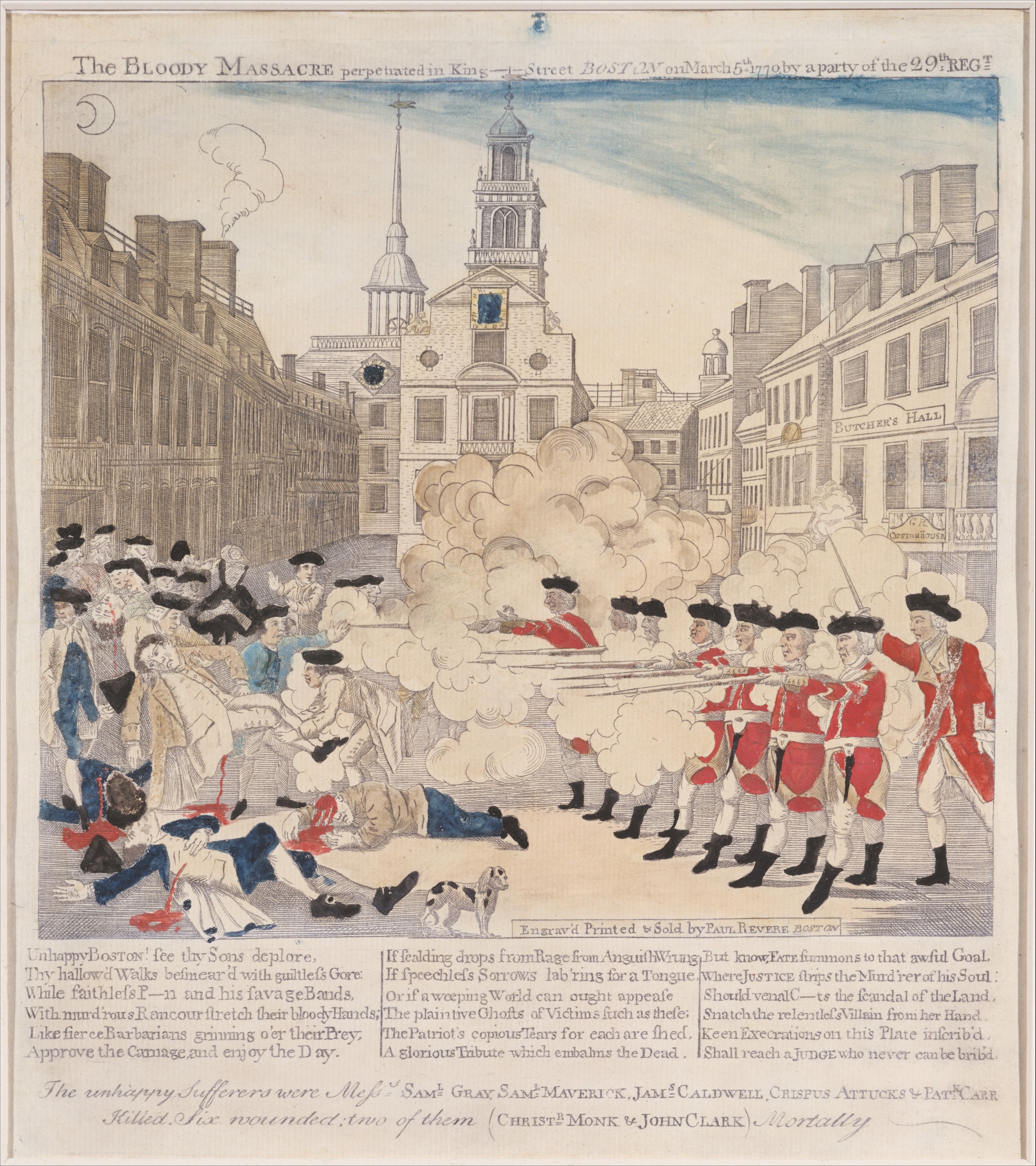
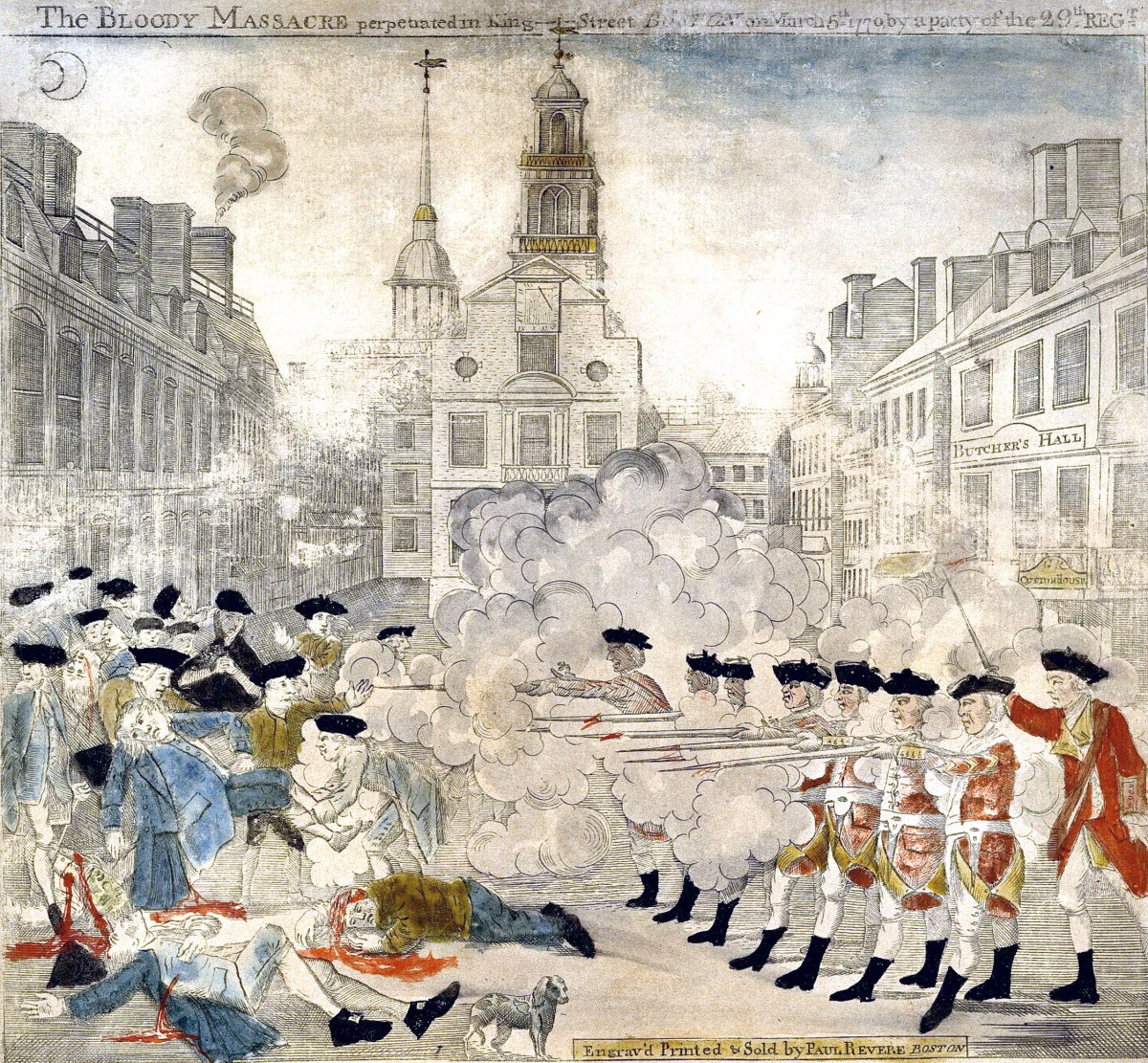
One of the most enduring and impactful pieces of propaganda was an engraving by Paul Revere, titled “The Bloody Massacre in King-Street.” Revere, a silversmith and Patriot, depicted the British soldiers in a disciplined line, firing deliberately into a defenseless crowd, while Captain Preston stood behind them, seemingly ordering the attack. The image was highly sensationalized and inaccurate – the sky was made brighter, a dog was included, and the Custom House was relabeled “Butcher’s Hall” – but its emotional power was undeniable. It circulated widely throughout the colonies, fanning the flames of anti-British sentiment and galvanizing support for the Patriot cause. Copies of this iconic image are displayed in museums today, a stark reminder of the power of visual media in shaping historical narratives.
The funerals of the victims were transformed into massive public demonstrations. Thousands of Bostonians marched in procession, underscoring the collective grief and outrage. Joseph Warren, a prominent Patriot physician and leader, delivered powerful orations commemorating the slain, further cementing their status as martyrs for liberty. The bodies of the victims were interred in the Granary Burying Ground, a site that can still be visited on the Freedom Trail today, where their shared gravestone stands as a silent testament to the beginning of the end of British rule.
In an effort to restore order and demonstrate British justice, Captain Preston and eight of his soldiers were arrested and charged with murder. What followed was a remarkable trial, where the accused were defended by none other than John Adams, a future president of the United States and a leading Patriot. Adams took on the case, despite the immense public pressure and the potential damage to his own reputation, believing that every person deserved a fair trial. His defense centered on the argument that the soldiers had fired in self-defense against a riotous mob. In the end, Captain Preston and six of the soldiers were acquitted, while two soldiers were found guilty of manslaughter and branded on their thumbs. While the verdict was not what many Patriots had hoped for, Adams’s courageous defense underscored a commitment to the rule of law, even in the midst of revolutionary fervor.
Echoes of Revolution: The Massacre’s Lasting Impact
The immediate aftermath of the Boston Massacre saw a temporary easing of tensions. British troops were withdrawn from Boston to Castle William in the harbor, and Parliament repealed most of the Townshend Acts, leaving only the tax on tea. This period of relative calm, however, was merely a deceptive lull before the storm. The events of March 5, 1770, had fundamentally altered the colonial mindset and irrevocably set the stage for outright rebellion.
Unifying a Nation: A Catalyst for Colonial Solidarity
The Boston Massacre served as a powerful rallying cry that transcended local grievances and fostered a sense of shared identity and purpose among the colonies. Prior to 1770, inter-colonial cooperation was sporadic, driven primarily by economic concerns. The Massacre, however, presented a common enemy and a shared narrative of oppression. It became a vivid example of how British authority, backed by military force, threatened the fundamental liberties of all colonists.
Samuel Adams, leveraging the outrage ignited by the Massacre, played a crucial role in establishing the Committees of Correspondence in 1772. These committees were networks of communication that allowed Patriots in different colonies to share information, coordinate resistance efforts, and foster a sense of collective action. The ability to quickly disseminate news and interpret events, much like Revere’s engraving of the Massacre, meant that incidents in one colony could immediately galvanize support and sympathy in others. The Massacre had demonstrated the urgent need for a unified front against perceived British tyranny, laying the organizational groundwork for what would become the Continental Congress.
The memory of the victims became enshrined in the emerging American narrative of martyrdom for liberty. Orations commemorating the Massacre were delivered annually, keeping the flames of revolutionary sentiment alive. These speeches, given on the anniversary of the event, served to remind colonists of the price of freedom and the dangers of unchecked power. They reinforced the idea that British policies were leading to the enslavement of Americans and that decisive action was necessary.
The Massacre’s significance goes beyond the immediate bloodshed; it fundamentally eroded trust in British rule. It transformed abstract political arguments about taxation and representation into a visceral image of armed soldiers firing upon innocent citizens. This concrete act of violence crystallized the argument that Britain viewed the colonists not as equal subjects, but as rebellious subordinates to be controlled by force. It solidified the belief among many colonists that reconciliation was becoming increasingly impossible, and that a more radical path might be the only way to secure their rights.
This growing disillusionment directly contributed to subsequent acts of defiance, such as the Boston Tea Party in 1773, where colonists, disguised as Mohawk Indians, dumped British tea into Boston Harbor in protest of the Tea Act. The British response to the Tea Party, the punitive Intolerable Acts of 1774, only further inflamed tensions, leading directly to the convening of the First Continental Congress and the eventual outbreak of the Revolutionary War at Lexington and Concord in April 1775. The seeds of revolution, sown by years of grievance and watered by the blood spilled on King Street, had finally blossomed into open warfare. The Declaration of Independence, adopted in 1776, would articulate the very principles of self-governance and individual rights for which the Massacre’s victims had unwittingly died.
Experiencing History Today: Following the Footsteps in Boston
For those planning a trip to Boston today, the echoes of the Boston Massacre and the American Revolution are palpable, offering a profound journey through the birth of a nation. The city itself is a living museum, making it an unparalleled destination for history buffs and casual tourists alike.
The most iconic way to immerse oneself in this history is by walking the Freedom Trail, a 2.5-mile red-lined path that connects 16 historically significant sites. Among these, the very spot of the Boston Massacre is marked by a cobblestone circle in front of the Old State House. Standing there, one can envision the chaotic scene of over two centuries ago, the tension, the shouts, and the fatal shots fired into the crowd. The Old State House itself, now a museum, offers exhibits detailing the events of the Massacre, including a replica of Revere’s famous engraving, providing vital context to the pivotal moments that unfolded outside its doors.
Further along the Freedom Trail, visitors can explore other sites intrinsically linked to the Massacre’s legacy. Faneuil Hall, known as the “Cradle of Liberty,” was where Samuel Adams and other Patriots frequently delivered impassioned speeches, rallying support against British rule. The Granary Burying Ground holds the graves of the Massacre victims, as well as those of Samuel Adams, John Hancock, and Paul Revere, offering a somber space for reflection on the lives sacrificed for American independence.
Beyond the specific sites of the Massacre, Boston offers a broader tapestry of revolutionary history. A visit to the Paul Revere House provides insight into the life of one of the Revolution’s most famous figures, while the Bunker Hill Monument commemorates one of the earliest battles of the Revolutionary War. Exploring these landmarks offers not just a history lesson, but an immersive experience into the local culture and the spirit of the people who shaped a nation.
For travelers, staying in Boston provides the perfect base to delve into this profound historical narrative. Whether opting for a luxury hotel in the heart of the city, a charming boutique accommodation in a historic neighborhood, or a budget-friendly option, the city caters to all lifestyles. Many hotels are within walking distance of the Freedom Trail, allowing visitors to seamlessly blend historical exploration with modern urban comforts. Engaging with local guides, trying traditional New England cuisine, and simply soaking in the atmosphere of America’s historic capital enriches the journey, connecting past and present in a truly unforgettable travel experience. The Boston Massacre, therefore, is not just a chapter in history; it is a vital part of the city’s enduring identity and a beacon for understanding the profound costs and triumphs of liberty.
LifeOutOfTheBox is a participant in the Amazon Services LLC Associates Program, an affiliate advertising program designed to provide a means for sites to earn advertising fees by advertising and linking to Amazon.com. Amazon, the Amazon logo, AmazonSupply, and the AmazonSupply logo are trademarks of Amazon.com, Inc. or its affiliates. As an Amazon Associate we earn affiliate commissions from qualifying purchases.