
The acquisition of Florida by the United States is a fascinating chapter in North American history, deeply intertwined with geopolitical ambitions, frontier conflicts, and strategic diplomacy. For today’s traveler, understanding this complex past enriches any visit to the Sunshine State, transforming picturesque beaches and vibrant cities into living museums of imperial struggles and burgeoning nationhood. From the ancient cobblestones of St. Augustine to the strategic waterways of Pensacola, the echoes of Spanish conquistadors, British colonists, and American pioneers still resonate.
A Crossroads of Empires: Early Colonial Florida
Long before it became a premier global travel destination, Florida was a contested territory, a strategic pawn in the grand chess game of European colonial powers. Its unique geographical position, straddling the Gulf of Mexico and the Atlantic Ocean, made it invaluable for controlling trade routes, defending existing colonies, and projecting power into the Caribbean and the fledgling American states.
Spanish Dreams and Strategic Importance
The Spanish arrived in Florida in the early 16th century, establishing St. Augustine in 1565 – the oldest continuously inhabited European-established settlement in the United States. This was not merely an outpost; it was a bulwark, intended to protect Spain’s lucrative treasure fleets sailing from Mexico and South America along the Florida coast. For centuries, Spanish Florida remained sparsely populated but strategically vital. The iconic Castillo de San Marcos in St. Augustine, a massive masonry fort that still stands today as a testament to Spanish engineering and resilience, exemplifies this commitment. Visitors today can explore its formidable walls, imagining the soldiers who once guarded this distant frontier. Further west, Pensacola served as another critical Spanish port, guarding the western approach to the Gulf.
Life in Spanish Florida was a blend of military discipline, missionary zeal, and often tense interactions with various Native American tribes, including the Timucua, Apalachee, and later the Seminole. The architecture in St. Augustine’s historic district, the narrow streets, and the enduring Spanish names bear witness to this foundational period, offering a unique cultural immersion for travelers seeking to step back in time.
British Interlude and Shifting Sands
The geopolitical landscape of North America shifted dramatically following the French and Indian War (known in Europe as the Seven Years’ War). In 1763, the Treaty of Paris saw Spain cede Florida to Great Britain in exchange for Havana, Cuba, which the British had captured. This marked a significant, albeit temporary, change in Florida’s colonial identity.
The British divided Florida into two colonies: East Florida, with its capital at St. Augustine, and West Florida, governed from Pensacola. They actively encouraged settlement, offering land grants, and saw a period of economic growth, particularly in timber and agriculture. However, British rule was short-lived. During the American Revolution, while most of the colonies revolted, the Floridas remained loyal to the British Crown. In a twist of fate, Spain, allied with France against Great Britain, seized the opportunity to recapture parts of West Florida and launched successful campaigns against British garrisons. The subsequent Treaty of Paris, which recognized the independence of the United States, also stipulated the return of both East and West Florida to Spanish control. Thus, by 1783, Florida was back in Spanish hands, but a new, formidable neighbor had emerged to its north: the fledgling United States.
The United States’ Growing Ambition and Border Tensions
The return of Florida to Spain after the American Revolution set the stage for increasing friction with the rapidly expanding United States. The young American republic, fueled by ideals of westward expansion and national security, viewed Spanish Florida as both an opportunity and a persistent problem.
The Lure of Expansion and Frontier Instability
From the American perspective, Spanish Florida presented several significant challenges. Firstly, its borders were porous and ill-defined, leading to constant disputes with settlers in Georgia and Alabama. This instability was exacerbated by the presence of various Native American groups, particularly the Seminole and Creek peoples, who frequently crossed the border to raid American settlements and provide refuge for runaway slaves. These groups, often incited by Spanish agents or British adventurers, added a dangerous layer of complexity to the frontier. For travelers interested in indigenous cultures and the complex history of their interactions with European powers, the legacy of these conflicts can be explored in several historical markers and museums across Florida that shed light on the Seminole people’s enduring resilience.
Secondly, Spanish control over the mouth of the Mississippi River and access to the Gulf of Mexico was a constant source of anxiety for American trade and expansion, although this concern was largely mitigated by Pinckney’s Treaty in 1795 and the subsequent Louisiana Purchase in 1803. However, the fear of a hostile foreign power controlling strategic waterways remained. American land hunger was insatiable, and the fertile lands of Florida seemed ripe for the taking, especially as Spain’s grip on its vast colonial empire began to weaken significantly following the Napoleonic Wars.
The First Seminole War and Jackson’s Campaign
The simmering tensions finally erupted into open conflict in what became known as the First Seminole War (1817-1818). This period is crucial for understanding the immediate catalyst for Florida’s acquisition. The war primarily involved American forces clashing with Seminole and Creek warriors, as well as escaped slaves who had found sanctuary in Florida.
Major General Andrew Jackson, a formidable military leader who would later become president, was tasked with securing the Georgia border. However, Jackson exceeded his orders, leading his troops deep into Spanish territory. He systematically destroyed Seminole villages, captured Spanish strongholds like Fort Barrancas in Pensacola, and even executed two British subjects accused of inciting Native American resistance. This audacious campaign, carried out without direct authorization, caused an international uproar. Spain was outraged by the blatant violation of its sovereignty, and Great Britain protested the execution of its citizens.
Despite the controversy, Jackson’s actions demonstrated Spain’s inability to control its own territory and defend its borders effectively. The United States government, particularly Secretary of State John Quincy Adams, shrewdly capitalized on this weakness. Rather than condemning Jackson outright, Adams used the incident as leverage, presenting Spain with a stark choice: either adequately police Florida or cede it to the United States.

The Diplomacy of Acquisition: The Adams-Onís Treaty
The period following Jackson’s unauthorized invasion of Florida was a tense but ultimately fruitful diplomatic dance, largely orchestrated by the brilliant American Secretary of State, John Quincy Adams. Recognizing Spain’s declining power and its inability to manage its North American territories effectively, Adams pressed for a resolution that would firmly establish America’s southern and western boundaries.
Negotiating a New Frontier
The primary negotiator for Spain was Don Luis de Onís, the Spanish Minister to the United States. The negotiations were protracted and complex, extending over several years. While Florida was a central point of contention, the talks also encompassed broader territorial claims, particularly concerning the vast, ill-defined western reaches of the continent, including the Oregon Country and the border with Spanish Mexico (which included present-day California, New Mexico, and Texas).
Adams skillfully played his hand. He acknowledged the American incursions into Florida but framed them as a necessary response to Spain’s inability to maintain order, which threatened American security. He made it clear that Spain’s continued ownership of Florida was a liability, not an asset, and that a sale or cession was the most practical solution for both nations. From the Spanish perspective, clinging to a distant, ungovernable territory while struggling with rebellions across its Latin American empire seemed increasingly untenable. Giving up Florida in exchange for a clear western boundary and American recognition of Spanish claims elsewhere was a pragmatic choice.
The Terms and Impact of the Treaty
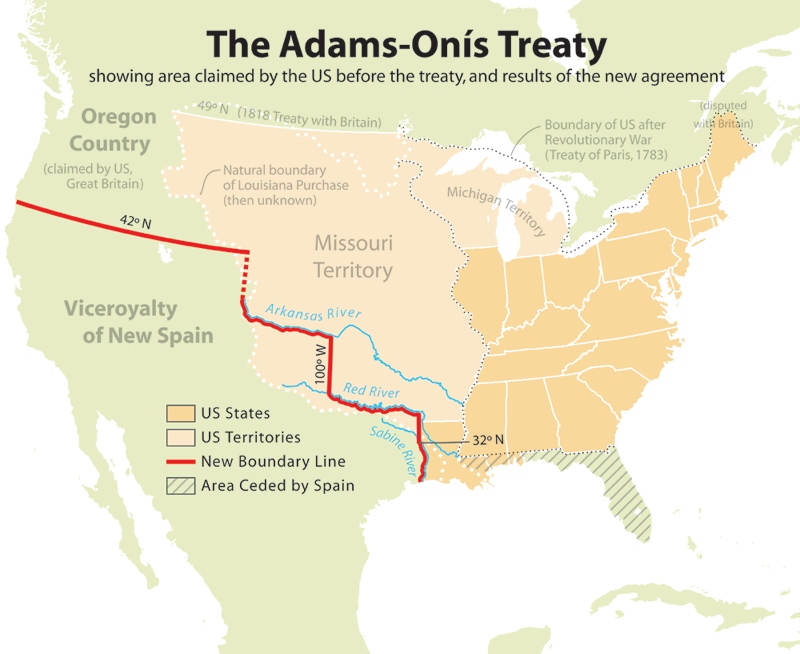
On February 22, 1819, the Adams-Onís Treaty was signed in Washington D.C.. Also known as the Transcontinental Treaty or the Florida Purchase Treaty, this landmark agreement formalized the transfer of Florida from Spain to the United States.
The key provisions of the treaty were:
- Cession of Florida: Spain ceded all of East Florida and its remaining claims to West Florida to the United States. In return, the United States agreed to assume up to $5 million in claims by American citizens against Spain. This was not a direct payment to Spain but rather a settlement of outstanding debts.
- Boundary Delimitation: The treaty also defined the western boundary of the Louisiana Purchase. It established a clear border between the United States and Spanish Mexico stretching from the Gulf of Mexico to the Pacific Ocean (specifically, to the 42nd parallel north, which would become the northern boundary of California). Spain relinquished its claims to the Oregon Country, while the United States recognized Spanish sovereignty over Texas.
The ratification process was delayed by two years due to Spain’s internal political turmoil and initial reluctance, but it was finally confirmed in 1821. This treaty was a diplomatic triumph for the United States, securing its southeastern flank and clarifying its western territorial ambitions. It was a foundational step in the nation’s continental expansion and established a blueprint for future territorial acquisitions.
Florida Under the American Flag: A New Era
With the ratification of the Adams-Onís Treaty in 1821, Florida officially became a territory of the United States. This marked the end of over 300 years of European colonial rule and the beginning of a new chapter that would profoundly reshape the peninsula.
Transition and Territorial Development
The transition was not without its challenges. The new American government had to integrate a territory with a long-standing Spanish culture, different legal traditions, and a diverse population of Spanish, Native American, and African descent. Andrew Jackson himself served briefly as Florida’s first military governor, establishing the framework for American governance. In 1824, Tallahassee was chosen as the territorial capital, a central location between the historic strongholds of St. Augustine and Pensacola.
American settlers, particularly from Georgia and the Carolinas, rapidly flowed into Florida, eager to cultivate its fertile lands, especially for cotton and sugar. This influx intensified conflicts with the Seminole and other Native American groups, leading to the brutal Second Seminole War (1835-1842) and the forced removal of most of the indigenous population to Indian Territory (present-day Oklahoma). Only a small group of Seminole remained, retreating deep into the Everglades, where their descendants continue to live today.
Despite these struggles, Florida steadily developed, eventually achieving statehood in 1845. Key cities like Jacksonville grew as trading hubs, while Key West became a bustling port for salvage and commerce in the Caribbean. The remnants of this early American period can be explored in historic districts throughout the state, often standing in fascinating contrast to the older Spanish colonial architecture.
Legacy: From Wilderness to World-Class Destination
The acquisition of Florida was more than just a territorial grab; it laid the foundation for the vibrant, diverse state we know today. The strategic significance that once attracted empires now draws millions of tourists annually, making tourism and travel central to its identity.
- Historic Destinations: For history buffs, St. Augustine offers a journey through centuries of colonial life, complete with horse-drawn carriage tours, authentic Spanish eateries, and boutique hotels housed in historic buildings. Pensacola’s historic village and maritime museum provide insights into its five-flag heritage.
- Natural Wonders: The vast, untouched wilderness that once provided refuge for Native Americans now defines iconic attractions like Everglades National Park, where visitors can experience unique ecosystems and wildlife through airboat tours or guided safaris.
- Modern Attractions: The stability and infrastructure provided by American ownership eventually allowed for the development of incredible tourism amenities. Cities like Orlando became synonymous with world-class theme parks such as Walt Disney World and Universal Studios, transforming a former agricultural region into a global entertainment hub. Miami, once a small settlement, exploded into an international cultural and financial center, renowned for its art deco architecture, vibrant nightlife, and luxurious resorts along the Atlantic Coast.
- Lifestyle & Accommodation: Today, Florida caters to every lifestyle, from luxury beachfront resorts in Palm Beach and Naples to budget-friendly family accommodations near its many attractions. The state’s diverse geography, from the serene Gulf Coast beaches of Sarasota and St. Petersburg to the bustling urban centers of Tampa and Jacksonville, ensures a variety of travel experiences, each with its own unique blend of history, culture, and modern amenities. Even space exploration finds its home here, with the Kennedy Space Center drawing millions to witness humanity’s push beyond Earth.
The story of how the United States acquired Florida is a journey from colonial battleground to modern-day paradise. It’s a testament to shifting global powers, shrewd diplomacy, and the relentless drive of a young nation to define its borders and fulfill its destiny. For the curious traveler, this rich history adds depth and meaning to every sun-drenched beach, historic fort, and vibrant city across the Florida peninsula.
LifeOutOfTheBox is a participant in the Amazon Services LLC Associates Program, an affiliate advertising program designed to provide a means for sites to earn advertising fees by advertising and linking to Amazon.com. Amazon, the Amazon logo, AmazonSupply, and the AmazonSupply logo are trademarks of Amazon.com, Inc. or its affiliates. As an Amazon Associate we earn affiliate commissions from qualifying purchases.